Sunday, August 14, 2016
Parents of Olympic medalist Adam Peaty fly to Rio after washing machine breaks down
Headline of the Day has an Olympic theme. Congratulations to ITV News.

Scott Walker: The Girls from the Streets
Scott Walker made the songs of Jacques Brel much better known in Britain. This, taken from Scott 2, was an attempt by Walker to write a Brel song himself.
I think it is safe to say I like it more than Then Play Long does:
The deliberately leaden procession of the verses, combined with words like "Snap! The waiters animate, luxuriate like planets whirling ‘round the sun," suggest a predication of Gary Numan, but the transition into the choruses sounds a little forced and its hideous Light Programme backing singers and accordion are more in keeping with Benny Hill avec comedy beret; it tries to be greater, more ambitious, than Brel, but Walker hasn’t yet worked out how to pull it off.
Saturday, August 13, 2016
Six of the Best 618

"It’s been accused of evading reporting guidelines on suicide, of reckless journalism, and of acting as a left-wing clickbait factory." Marie Le Conte on the success of The Canary.
Wayne Arnold looks at New Zealand's experience of abolishing farming subsidies.
Sarah Barns examines the legacy of Jane Jacobs, who changed our understanding of cities.
Will Alsop discusses Leighton House, and what its architecture says about the artist Frederick Leighton who commissioned it.
"One of the most imaginative children’s movies we’ve ever seen was made in 1981 by the king of the bizarre, the grand maester of visual storytelling, the American odd man out in the Monty Python British lineup—the one and only, Terry Gilliam." Cinephilia & Beyond champions the everlasting importance of Time Bandits.
Darley Dale: The village ground where Hampshire won the John Player League

I spent today visiting Peak Rail, a preserved line that runs north from Matlock to Rowsley South. No doubt I shall show you some photos of it soon.
But when I was planning this trip it was the name of the intermediate station that interested me: Darley Dale.
That name stirred faint memories of a televised Sunday League match in the 1970s with the cameras feasting on the green hills that ringed the ground and (was it?) Barry Richards scoring runs.
I found the cricket ground at Darley Dale near the station - in Station Road, in fact.
Chatting to a couple of the older spectators, I learnt that my memory was correct. A Sunday League match had been held here and televised, and Hampshire had been Derbyshire's opponents.
Richards and Gordon Greenidge had hit the ball over the trees and into a field across the road, I was told, and Alan Ward had been playing for Derbyshire.
At home this evening I checked the score on Cricket Archive and found that all those players featured. There is also a mention of the game on the Darley Dale Cricket Club site:
On 7 September 1975 over 6000 people packed the ground to witness perhaps the biggest event in the Club’s history – a televised John Player League match between Derbyshire and Hampshire.There is more: it was at Darley Dale that Hampshire clinched the John Player title.
A Hampshire Cricket Society newsletter remembers the day:
The final match was at the little village ground at Darley Dale in Derbyshire. The match posed a problem for the BBC. Great improvisation was required by the engineers to get a strong enough electrical signal out of the valley and then along the top of the Dales for twenty odd miles to the nearest booster mast. There was even talk of asking Derbyshire to change the venue to Chesterfield, but they rightly kept faith with the local village club who had spent all season preparing for this match.
Hampshire stormed to the title in style. Richards (52) and Greenidge (55) gave Hampshire an initial advantage which they never relinquished. Tom Motram (5 – 21) and John Rice (4 – 14) ensured the landmark victory by 70 runs.


Friday, August 12, 2016
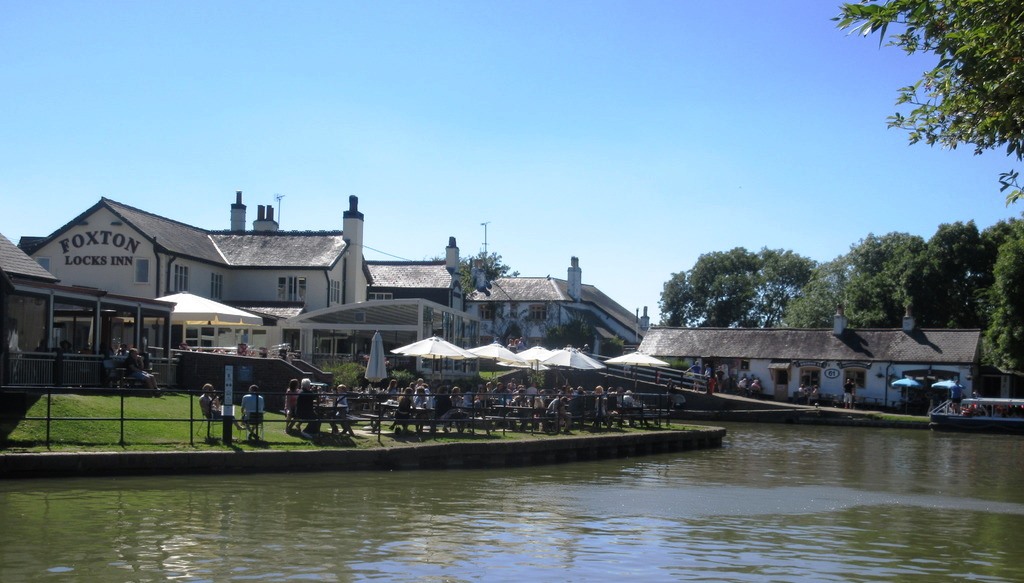
Foxton locks - where the 1985 Liberal Assembly was organised

Back in the 1980s I spent a summer working for the Liberal party conference office. This being the old Liberal party, it was naturally housed in two semi-converted narrow boats moored deep in the Leicestershire countryside.
It was one of those crazy periods when the Liberal/SDP Alliance had just won a startling byelection and everyone thought it was going to form the next government. The phones were hot with companies ringing up to ask if exhibition space was still available. We kept increasing the price, and they kept agreeing to pay it.So I wrote for the Guardian website in 2007.
I was back at Foxton locks today, so I have another chance to show you where the 1985 Liberal Party Assembly in Dundee was organised. That summer we won back the Ashes and David Gower was always batting,
Those two semi-converted narrow boats lived on the arm that used to take boats to the bottom of the inclined plane that took boats up the hill in Edwardian days..
The arm is still given over to private moorings today, but I decided I had the right to revisit it.
What in 1985 was the vehicle access to the bottom of the locks is now a quiet footpath, and there are now two pubs down there: Bridge 61 and the Foxton Locks Inn.


Hunter S Thompson's widow returns antlers he stole from Ernest Hemingway home after 52 years
The judges were somewhere around Barstow on the edge of the desert when the drugs began to take hold and they gave the International Business Times our Headline of the Day Award.
Thursday, August 11, 2016
The leaves of Southwell revisited

Years ago I blogged about a visit to Southwell and quoted Nikolaus Pevsner book The Leaves of Southwell, which is about the carvings in the Minster's chapter house:
Could these leaves of the English countryside, with all their freshness, move us so deeply if they were not carved in that spirit which filled the saints and poets and thinkers of the thirteenth century, the spirit of religious respect for the loveliness of created nature?
The inexhaustible delight in live form that can be touched with worshipping fingers and felt with all senses is ennobled ... by the conviction that so much beauty can exist only because God is an every man and beast, in every herb and stone. The Renaissance in the South two hundred years later was perhaps once again capable of such worship of beauty, but no firm faith was left to strengthen it.
Seen in this light, the leaves of Southwell assume a significance as one of the purest symbols surviving in Britain of Western thought, our thought, in its loftiest mood.The leaves are indeed lovely, but there are green men in the chapter house too.

Vince Cable is interviewed on Reflections with Peter Hennessy
Vince Cable was Peter Henneddy's interviewee in the latest edition of Reflections.
As the BBC's blurb says:
He talks movingly of his early years, and although his own views have remained consistently on the centre-left of British politics, he emerges as something of a political nomad, having belonged to the Labour Party and the SDP before joining the Liberal Democrats. After finally being elected to Parliament in his fifties, he first captured public attention with his warnings about the financial crash in 2008 and won widespread respect as a sage voice in the ensuing economic storm.
Although Vince Cable would have preferred to serve in a centre-left government, he worked with Conservative ministers in the Department for Business, Innovation and Skills and tried to make a success of the coalition by focussing on the practical work of government. However, his department was responsible for higher education and he was involved in the controversial decision to abandon his party's 'pledge' to phase out university tuition fees.
Vince Cable won a place in people's hearts by demonstrating his skill as a ballroom dancer on 'Strictly Come Dancing'. He retains his passion for ballroom dancing and is also trying his hand as a writer.You can listen to the programme on the BBC iPlayer.
Wednesday, August 10, 2016
The village of Somerby in Leicestershire

Somerby is about a mile's walk from the Iron Age hill fort of Burrough Hill.
It turned out to have a good pub and an eccentric school building on an almost urban main street.
I did not make it to the church, but Chapel Lane looked promising.


Tuesday, August 09, 2016
A lost line: Staines and West Drayton
Another video from the people at Londonist. This one finds some appealing fragments of the southern half of the line and that the northern half - from West Drayton to Colnbrook - is still open for freight traffic.
You can read more about this line on the Disused Stations page for Staines West.
Holy Trinity, Teigh: Village church or Georgian country house?

Holy Trinity in the village of Teigh has an interior that feels as much like a Georgian country house as a village church.
Leicestershire & Rutland Churches speaks of its "unique feature":
the fantastic triple pulpit built into the west wall, the ‘Strawberry Hill Gothic’ pulpit, prayer desk and Lectern are all built over and around the entrance to the nave. The rector and readers would have been in the different position and heights during the service. You would only see their heads and tops of their bodies a most unusual feature. We see why the pews are facing each other so they could see up to the rector at the pulpit and then turn to view the altar.Enjoy it now, but there is much else - light and dark - to tell about this little Rutland village.


The Archers: Rob Titchener and Neville Heath

My defence of true crime books, and this is a very good one, is that they depict the details of everyday life - clothes, food, furnishings - in a way that no other books do.
Handsome Brute, for instance, paints a picture of genteel Bournemouth in Word War II that changes your view of the town. Piers dismantled; beach mined; the hotels filled with civil servants from evacuated ministries and recuperating servicemen before it became a centre of preparations for D-Day; severely bombed by the Germans.
Handsome Brute is written by Sean O'Connor, and if the name sounds familiar it may be because he has edited The Archers for the past three years.
And listeners to that radio soap will be familiar with another handsome brute: Rob Titchener. I wonder if by any chance he and Neville Heath are related?
Monday, August 08, 2016
Death in Little Venice

I was down in London today and decided to visit Little Venice. Coming from a family that had canal holidays back in the 1960s, when they were far less common, I have always known the name but have never been there.
It is a pleasant area with interesting moored boats, and the expanse of water where the Paddington arm of the Grand Union joins the Regents Canal is impressive.
But there are no small bridges, no backwaters, no gondolas and no Dirk Bogarde in pancake make up.
At the risk of sounding provincial, most provincial cities have more interesting waterscapes.
I do fancy a trip along the Regents Canal to Camden some time though.


Six of the Best 617

Paddy French looks at how Owen Smith's family connections in the Welsh political and media elite have helped his career,
"The barely veiled implication, whichever version you consider, is that the people undergoing these travails deserve relatively little sympathy." Alec MacGillis and ProPublica on the demonisation of poor white Americans.
Neil MacFarquhar looks at new evidence about the fate of Raoul Wallenberg.
Fake news stories from Kremlin propagandists regularly become social media trends, say Andrew Weisburd and Clint Watts.
Ales Cox looks back 30 years to the making of his film Sid and Nancy.
Scientist attacks JK Rowling over response to female orgasm research
The Press from York wins our Headline of the Day Award.
Sunday, August 07, 2016
Market Harborough to Melton Mowbray by bus

My most recent Six of the Best included an article by John Disney that says our rural bus services are in meltdown.
Judging from Market Harborough he is right. In the last couple of years we have lost a bus that served Northamptonshire villages on the way to Clipton and our service to Wilbarston, Corby and Gretton. Even the mighty 44 has been reduced in frequency.
Given that background, I have long been intrigued by the 303, which claims to run from Rothwell via Market Harborough to Melton Mowbray on the first Tuesday of every month.
Finding myself at a loose end last Tuesday - the first Tuesday in August - I had a mind to catch it.
So unlikely did the service sound that I rang Hamiltons & Buckbys Coaches the day before to make sure it was running.
They assured me it was. Where it stopped in Harborough was a slight mystery, but my mother said she had caught a bus to Melton years ago and her memory of where she had got on it coincided with my theory.
So I presented myself at the bus stop on Northampton Road shortly before 9.30. By the time the bus was due I had been joined by half a dozen old ladies and when it arrived it proved to be the mighty beast you see in the photo above.
We followed the B road through High Leicestershire from Market Harborough to Melton, taking in little-visited settlements like Three Gates and New Inn. It would have been an education to those who tell me the Midlands are flat and uninteresting - as would my ultimate destination Burrough Hill.
The 303 appears to be a purely commercial venture to take the active pensioners of Rothwell to Melton Mowbray market. I wish it well.
Mari Wilson and the Wilsations: Just What I Always Wanted
This 1982 hit looked back in musical style and hairstyle to the great female singers of the 1960s. In fact Mari Wilson was later to play Dusty Springfield in a musical.
She is still active, as you can see from her website Mari Wilson Pop Deluxe.
Michelle Collins - Cindy Beale from EastEnders - was one of the Wilsations.
Clan of cake-eating pine martens steal the show at Scotland’s hidden power station
Today's winning headline comes from The Herald.
Saturday, August 06, 2016
Leicestershire vs Derbyshire, Grace Road, 5 August 2016

When I first went to see a match at Grace Road the advertising around the ground was dominated by the Leicester dairy Kirby & West, but it was never called the Kirby & West County Ground.
I spent Friday at the cricket there and found that it is now officially the Fischer County Ground, Grace Road.
It has also acquired floodlights since I was last there. The fox weather vane on the score box that J.W. Logan donated is still missing though.
Friday was the second day of the match and Leicestershire had scored 300-7 on the first, with Ned Eckersley 73 not out. He played watchfully the next morning and managed to reach his century before he ran out of support at the second end.
Leicestershire made early progress in the field, with the first three Derbyshire batsmen clean bowled before they reached 50. But Wayne Madsen then played well - I left just after he was out with the score on 174-6 when it still looked as though Leicestershrie (who made 380) would manage a substantial first innings lead.
However, this morning the Derbyshire tail wagged and they almost caught Leicestershire up by making 362. By the close tonight they had reduced Leicestershire to 109-5 in their second innings and may even be favourites to win tomorrow.
As to favourite players, for Leicestershire I liked Charlie Shrek. Aged 38 now, he began playing in leagues in Cornwall and did not make his first class debut until he was 25, yet he made it as far as the England Lions team. If not the fastest bowler on show yesterday, he was certainly the most aggressive. He was the only one who bothered bowling bouncers, and one of them accounted for Madsen when he seemed well set.
Better still was the comfortably upholstered figure of Mark Cosgrove, Leicestershire's captain. A one-day international for Australia, he now reminds me of the county championship of earlier days when players did not numbers and the ball was not thrown back aggressively to the keeper every time it was fielded. He once fell (I almost wrote "had a fall") fielding and went off for a while to recover.
None of this is meant to be disrespectful - Cosgrove's captaincy has been vital to Leicestershire's return from the dead in the last couple of seasons.
For Derbyshire I appreciated Tom Milnes, a pocket version of a fast bowler with a lovely action, and the debutant Callum Parkinson. He is a left-arm spinner who took four wickets in Leicestershire's first innings and an undefeated 48 at no. 11. His twin brother Mark has already had an impact for bowling leg spin for Lancashire this season.
But I fear that Leicestershire's approach - hulking great seamers and no spinners - is more calculated to help a side prosper in the second division.
I worked out that my first visit to Grace Road was also to see Leicestershire play Derbyshire and in 1973 - an incredible (to me) 43 years ago. I remember nothing of the play, but I do remember that the ground floor of the Meet (the barrel-roofed stand the club brought with it from Aylestone Road) doubled as a groundsman's shed and a servery for refreshments.
I have a much clearer memory of my second visit that season when M.J. Smith scored a hundred before lunch for Middlesex.
What really dates that visit is that Fred Trueman had played some Sunday league games for Derbyshire the year before and the friend I went with and I speculated that he might turn out for them at Grace Road.
If you like This Sort of Thing, Backwatersman does it much better.


Richmond House, G.K. Chesterton and the President of the MCC's buttocks

I have not read his The Flying Inn, but I can cut and paste from Wikipedia with the best of them:
The Flying Inn is a novel first published in 1914 by G. K. Chesterton. It is set in a future England where the Temperance movement has allowed a bizarre form of "Progressive" Islam to dominate the political and social life of the country. Because of this, alcohol sales to the poor are effectively prohibited, while the rich can get alcoholic drinks "under a medical certificate".
The plot centres on the adventures of Humphrey Pump and Captain Patrick Dalroy, who roam the country in their cart with a barrel of rum in an attempt to evade Prohibition, exploiting loopholes in the law to temporarily prevent the police taking action against them.Far-fetched, you will say, but have you read this report in the Guardian?
MPs considered nationalising a Whitehall pub to avoid a drinking ban while they are relocated to the Department of Health’s offices for the duration of refurbishment works at the Palace of Westminster.
Richmond House, which hosts the department, is one of three government buildings owned by Middle East financiers who have bought into an Islamic bond issued by the government. One of its stipulations is that no alcohol will be sold on the premises.
To get around the restriction, some MPs proposed taking the Red Lion pub, located between parliament and Richmond house, into public ownership and banning entry to the general public.Important buildings in Whitehall sold to foreign owners? That sale took place under the Coalition so, if it worries you, we Liberal Democrats cannot escape our share of the blame.
But let it serve as a reminder that, for all there willingness to wrap themselves in the flag, the Conservatives will do anything for money.
I am reminded of a House Points column I wrote back in 2005:
People think the cricket authorities are stuffy, but really they are the most shamelessly commercial administrators of all. There are now logos on the players' clothing and painted on the field of play. For the right price you could probably get your company's slogan tattooed on the President of the MCC's buttocks.
Subscribe to:
Posts (Atom)