Showing posts with label Tynemouth. Show all posts
Showing posts with label Tynemouth. Show all posts
Friday, April 03, 2020

Saturday, April 21, 2018

Sunday, May 29, 2016
Six of the Best 600

Alexandra Lange contrasts the reactions to Garden Bridge and Pier 55 - "Two cities, one designer and one strategy – to build a privately funded park above a river."
"Thanks to my older brother, I was an Observer reader as a schoolboy. On most Sundays in the year or two either side of 1960 he would take the bus six miles to our nearest town and return with a paper that augmented the Sunday Post – delivered to the door that morning by the village newsagent – and its claustrophobic worldview formed fifty years before in Presbyterian Dundee." Ian Jack reviews a new life of the paper's editor David Astor.
"[Jack] Cardiff achieved many of the visual effects in camera by drawing inspiration from the use of light and colour by such artists as Caravaggio, Rembrandt, Vermeer and Van Gogh." David Parkinson looks back at Powell and Pressburger's Black Narcissus.
"One of the reasons I can’t stand United is the air of sanctimony that hovers over the club. If Mourinho takes them back to the summit it ought to puncture that – it’ll show they’re no better than anyone else, just another plaything for the great man’s ego." David Runciman is right about Jose's re-emergence at Old Trafford.
The Beauty of Transport celebrates Tynemouth Station.
Friday, September 18, 2015
Passengers left stunned by crabs on the metro
ITV News wins Headline of the Day.
It also tells us that the crabs have been taken to the Blue Reef Aquarium in Tynemouth.
It also tells us that the crabs have been taken to the Blue Reef Aquarium in Tynemouth.
Friday, July 12, 2013
Labour's foolish opposition to private schools entering the state sector
Last summer I spent a few days in Tynemouth and shortly afterwards blogged about the plans of The King's School, Tynemouth, to enter the state sector:
The kindest thing you can say about people like Councillor Grayson is that they display a typical Labour weakness: they are interested in a the overall system but far less interested in individual schools.
I shall leave you with the wise words of George Walden in his 1996 book We Should Know Better:
Such moves ... are to be welcomed, but the left is always deeply suspicious of them.
Sure enough, the area's Labour MP is quoted on the Evening Chronicle website expressing concerns about the move.Sebastian Payne has more about this story in this week's Spectator and about the Labour council's opposition to the school's plan:
The Labour-run North Tyneside council is a bastion of resistance to the Baker/Blair/Gove reforms, and seems to be primarily interested in protecting its own territory. Allowing the King’s School to open to state pupils would, they say, upset the ‘feeder’ system that shepherds pupils in primaries into designated secondaries. Giving parents a choice upsets this careful plan.
The opposition is being led by Ian Grayson, a National Union of Teachers official who doubles as the North Tyneside council member responsible for education. He believes that removing the Priory school from council control could ‘destabilise’ the entire education system in the borough. Giving parents choice, he told me, could ‘see a significant drop in numbers elsewhere in the borough and we have to plan for that’. A third of pupils might choose schools other than the ones the council has designated for them. To Mr Grayson, this is not something to celebrate, but a problem.
Councillor Grayson has been trying to thwart King’s School by demanding a formal investigation into the effect the new academy would have on the borough. This is how school wars are fought in England: the opponents demand a bureaucratic assessment, hoping that a judicial review will delay the process long enough to stop the new school opening — in this case in September.
Even taken at face value, Grayson’s arguments make no sense. North Tyneside council is building three new secondary schools and one new primary, so his ‘balance’ will be upset anyway. It appears Grayson and his comrades loathe the idea of not being in control. The real issue is that the unreformed left don’t want any new schools while places in old, inadequate schools remain unfilled.Payne goes on to sat that the pro-reform left - people like Andrew Adonis - are almost as angry as the Tories about this, while Stephen Twigg, Labour's shadow education secretary, is on the fence but leaning towards the anti-reform side.
The kindest thing you can say about people like Councillor Grayson is that they display a typical Labour weakness: they are interested in a the overall system but far less interested in individual schools.
I shall leave you with the wise words of George Walden in his 1996 book We Should Know Better:
In no other European country do the moneyed and professional classes - lawyers, surgeons, businessmen, accountants, diplomats, newspaper and TV editors, judges, directors, archbishops, air chief marshalls, senior academics, Tory ministers, artists, authors, top civil servants - in addition to the statistically insignificant but eye-catching cohort of aristocracy and royalty - reject the system of education used by the overwhelming majority pretty well out of hand, as an inferior product.
In no modern democracy except Britain is tribalism in education so entrenched that the two main political parties send their children to different schools.That is why we should welcome private schools entering the state system.
Thursday, December 06, 2012
Richmond and Richmond Castle, North Yorkshire

Richmond ... was like no other town they had ever seen. When they reached the top of the hill they were in one corner of an enormous cobbled square. In the centre was the squat building of a church, in the sides of which were really built some shops. At the top of the huge market square beyond some parked buses, was a great stone pillar crowned with a ball, round which were some steps on which dalespeople were sitting. Shops and inns were round the four sides of the square and between them, the children noticed, were the narrow entrances to many little courts and alleys.
The Secret of Buzzard Scar (1955) Malcolm Saville
The whole castle wall has long since fallen, all along the edge of the rock overlooking the river. Now the mown grass comes to the edge, and there is a fence, not to keep out any strangers, but to keep in the visitors. But the rest of the walls round the great court are there still, hiding the town from the castle and the castle from the town; but there is enough to show clearly what the castle was likeMy favourite children's writers had given me a clear enough picture of Richmond, yet somehow I had got it wrong. I had imagined a castle high above the town - something like the set up at Montgomery.
Earthfasts (1966) William Mayne.
In reality, the castle is more intimately connected with the town than any I know. The castle old bailey is the town's market square.
My guidebook says that the ruins of Richmond Castle represent "one of the most important surviving examples of early medieval domestic architecture in the country".
They are right, but that it is not what strikes you most about the castle ruins. Its setting - perched high above the River Swale - is hugely impressive, and its modern history is important too.
Richmond Castle was used to house conscientious objectors in World War I - the Richmond Sixteen. There drawings and writings still exist in the castle gatehouse, though they are too fragile to put on display to the public.
The military authorities' plan, apparently, was to ship them to France, where they could be shot for refusing orders in the face of the enemy. This plan was thwarted, but many of the Sixteen found themselves social outcasts after the war - but they were in the right, were they not?
The castle yard was also the site of barracks of the North Yorkshire Militia from 1855, and those buildings were the home of Robert Baden-Powell for two years until 1910 - just the period when his Scouting movement was taking shape.
The barracks building were demolished in 1931. Had they survived until the present day, they would surely have been preserved as an important part of the site's history. I met the same change in attitudes at Tynemouth Priory this summer.
Sunday, November 11, 2012

Monday, October 22, 2012
Six of the Best 287

If you watched Trumped on BBC last night you will be interested in a post on Love and Garbage about Alex Salmond's attempt to win Donald Trump's support for the release of Abdelbasset Al Megrahi.
The truth has finally caught up with Lance Armstrong, writes Paul Kimmage in the Irish Independent.
Northumberlandia celebrates Admiral Cuthbert Collingwood - "A pious, just and exemplary man".
While Anita Harris and her marvellous juicy melons are celebrated by The Downstairs Lounge.
Song of the Paddle takes a canoe trip down the Welland from Market Harborough to Ashley.
Wednesday, September 05, 2012
The King's School, Tynemouth, to enter state sector
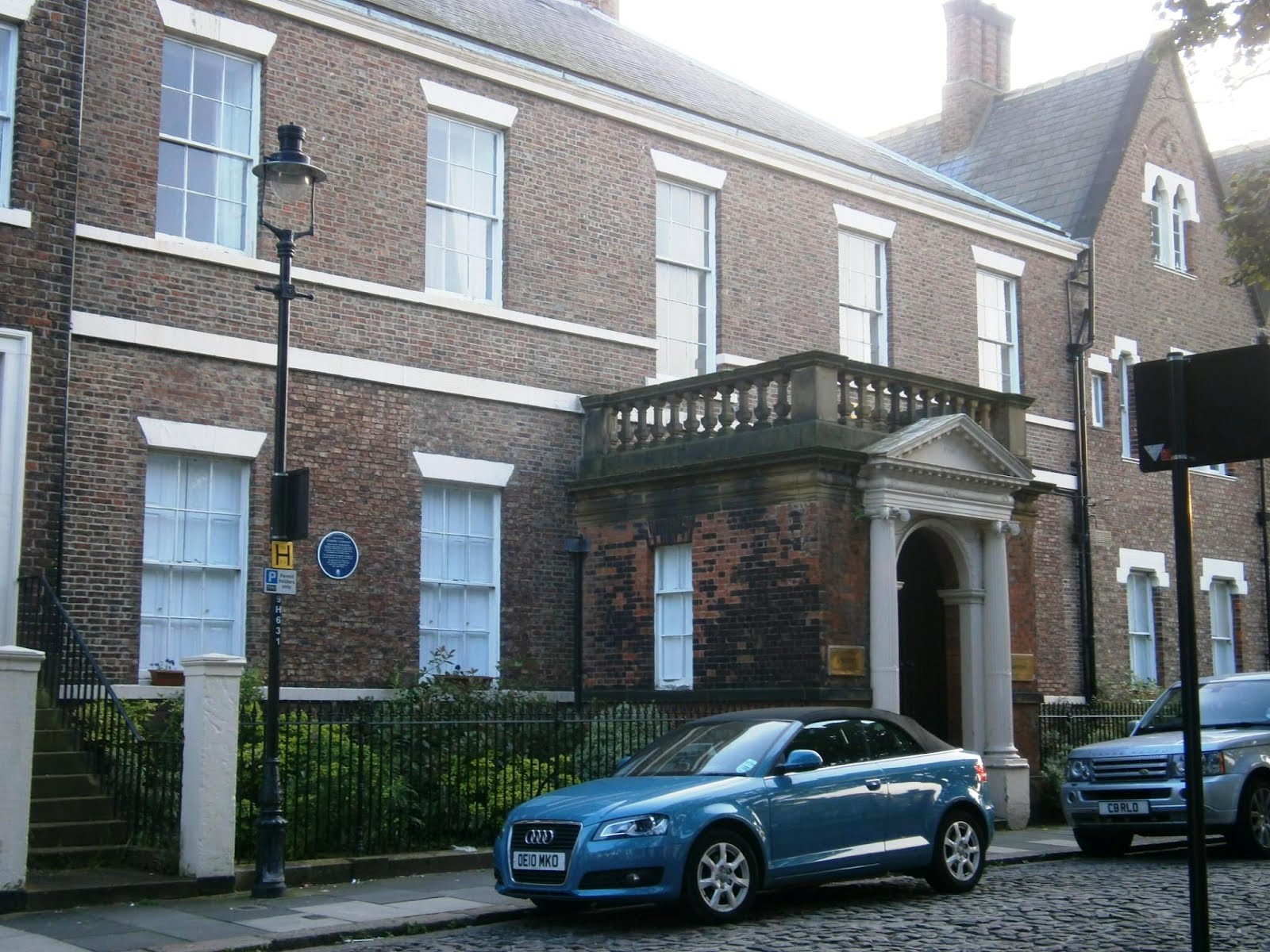
This house now forms part of The King's School, Tynemouth - former pupils include Stan Laurel and Toby Flood. The blue plaque on its wall records that Garibaldi stayed here in 1854 "while visiting Tynemouth to brief local political and industrial leaders on his plans for a unified Italy".
The King's School is in the news this week. As The Journal reports:
One of the North East’s leading private schools will become free to parents next year after the Government approved plans for it to convert to academy status.
The King’s School in Tynemouth will merge with nearby Priory Primary School to become an all-age, state-funded independent academy.
The new school, called Kings Priory, is due to open in September 2013 and will be sponsored and operated by the Woodard Academies Trust.As I blogged last year, such moves - bringing good schools into the state sector - are to be welcomed, but the left is always deeply suspicious of them.
Sure enough, the area's Labour MP is quoted on the Evening Chronicle website expressing concerns about the move.
Friday, August 31, 2012
Tynemouth station

It is a monument to the age of steam, a gateway to the breathtaking beaches of the North East and an architectural achievement that has stood firm for 130 years.wrote Helen Nugent in the Guardian in April.
Now the long-neglected railway station at Tynemouth is receiving the loving touch that it deserves.
A multi-million pound renovation project promises to return the Victorian station to its former glory. Close to completion, the transformation of Tynemouth station is, according to the council and planners, a "true tale of a heritage phoenix rising from the ashes".She's right you know. And another good thing about the station is that it still has one of the North Eastern Railway's tile maps showing the extent of its lines in the region.
These used to be quite common in the stations of Yorkshire and the North East. I could not find the one at York station when I was there earlier this summer, though there was one in the National Rail Museum.

Even better, those maps were made at Jackfield in Shropshire.

Tuesday, August 28, 2012
The burial of Alexander Rollo at Tynemouth Priory

Not a drum was heard, not a funeral note,
As his corse to the rampart we hurried;
Not a soldier discharged his farewell shot
O'er the grave where our hero we buried.
We buried him darkly at dead of night,
The sods with our bayonets turning,
By the struggling moonbeam's misty light
And the lanthorn dimly burning.
Charles Woolfe's "The Burial of Sir John Moore after Corunna" was once a widely memorised and recited poem. Moore won the 1809 battle, which formed part of the Peninsula War, but lost his life in the process.
The bearer of the lantern (or lanthorn) at his burial was Corporal Alexander Rollo. He lived until 1856 and is buried at Tynemouth Priory.
Sunday, August 26, 2012
Tynemouth Priory

When writing about the Priory on my return from Tynemouth, I used its gatehouse as an illustration. But that is as much a military building as an ecclesiastical one.
The photograph above shows some more of the ruins. The many gravestones date from the 18th and 19th centuries.
There were later military buildings here, but when the army left in 1960 anything that was not Medieval was obliterated. Today archaeologists would be looking to conserve those buildings as an important part of the site's history.
Friday, August 24, 2012
The Tyne estuary piers

The North Pier at Tynemouth runs out to sea for a 1000 yards. At the far end is a lighthouse, and on the morning I walked to it the fog horn was sounding and the lighthouse came and went in the mist.
Across the river is the South Pier, which is even longer. You can see it emerging from the gloom here in a photograph taken from its northern sister.
The two piers define the estuary of the Tyne. The old guide books talk of the constant stream of shipping that passed between them, but today the only ships you are likely to see are the giant ferries heading for Norway and Denmark.
Wednesday, August 22, 2012
Tynemouth Watch House

This is Tynemouth Watch House, headquarters of the town's volunteer life brigade since it was built in 1887. It was designed by Joseph F. Gomoszynski.
It is like a New England rendering of the sort of late Victorian house you find on Leicester's London Road.
Today the Watch House is home to a museum, though it was locked when I was there last week. It is also due for a major refurbishment.
It forms part of a distinctive group of buildings that stand between the sea and the Collingwood Monument. There is something of Southwold about them.

Sunday, August 19, 2012
The Nelson's Column of the North

The statue of Cuthbert Collingwood, who took command of the British fleet after Nelson's death at Trafalgar and completed the victory, is some 23ft high and stands on a massive plinth. Four canon from Collingwood's ship in the battle, The Royal Sovereign, can also be found there.
An inscription on the monument reads:
THIS MONUMENT
was erected in 1845 by Public Subscription to the memory of
ADMIRAL LORD COLLINGWOOD
who in the Royal Sovereign on the 21st October 1805, led the British Fleet
into action at Trafalgar and sustained the Sea Fight for upwards of an hour
before the other ships were within gun shot, which caused Nelson to exclaim
“SEE HOW THAT NOBLE FELLOW COLLINGWOOD TAKES HIS SHIP INTO ACTION"
He was born at Newcastle-upon-Tyne 1748 and died in the Service
of his country, on board of the”VILLE-DE-PARIS” on 7th March 1810
AND WAS BURIED IN ST PAUL’S CATHEDRAL.
THE FOUR GUNS UPON THIS MONUMENT BELONGED TO HIS SHIP THE
“ROYAL SOVEREIGN”
Friday, August 17, 2012
Home from Tynemouth

Our house is confined to the top of a high rock and is surrounded by sea on every side but one. Here is the approach to the monastery through a gate cut out of the rock so narrow that a cart can hardly pass through. Day and night the waves break and roar and undermine the cliff. Thick sea frets roll in wrapping everything in gloom. Dim eyes, hoarse voices, sore throats are the consequences...
Shipwrecks are frequent. It is a great pity to see the numbed crew, whom no power on earth can save, whose vessel, mast swaying and timbers parted, rushes upon the rock or reef. No ringdove or nightingale is here, only grey birds which nest in rocks and greedily prey upon the drowned, whose screaming cry is a token of a coming storm.I have spent the past few days in Tynemouth with the Dowager Lady Bonkers and can reveal that the 14th-century monk who wrote the above was exaggerating. The truth is that it is an attractive and interesting place - I shall share some photographs with you over the next few days.
The one above shows the gatehouse of the Priory, where the monk had been exiled from St Albans.
Subscribe to:
Posts (Atom)