Here is the latest of Jim Butler's Hidden Histories videos.
It's about devotion, death and dissolution in Leicester and there's so much of them that it's divided into two parts. This is the first.
Here is the latest of Jim Butler's Hidden Histories videos.
It's about devotion, death and dissolution in Leicester and there's so much of them that it's divided into two parts. This is the first.

Pointless is almost a mirror image of Family Fortunes, which rewarded contestants for being average not for being clever.
Yet there are two subjects where Pointless contestants generally know little and find the thought they might know something to be so unreasonable as to be amusing.
One is British politics and the other is geography.
I saw a tweet yesterday that bore out the truth of that post:
I have today discovered that Bakewell is an actual place and now I want to go and live there.
— Sarah Vine (@WestminsterWAG) August 10, 2020
But this may not be general ignorance so much as sociology.
Many wealthy people have little knowledge of Britain beyond the golden triangle of London, Oxford and Cambridge.

The first item in my last Six of the Best read:
Ed Davey has pulled out of the Radical Association hustings because James Baillie was to chair it: "I hope sincerely that this conduct by Ed’s campaign has been a one-off which they will on reflection agree was not up to the standards to which they would wish to hold themselves, and is not representative of their wider attitude to my fellow party activists."
On the 1st of August, we notified both Leadership Campaigns of a proposal from the Radical Association to conduct an event.An agreed Chair wasn’t then identified before Saturday 8th. At this stage, we were advised that the Layla Moran campaign could no longer attend the event.The Returning Officer’s team believes both campaigns acted reasonably and in good faith, indeed they have been notably helpful and flexible with the shifting arrangements throughout this campaign.We would also like to note our appreciation of the Young Liberals for including some RA questions in their event: a positive example of members working to support one another regardless of individual interests.
Later. The Radical Association has issued its own statement on the affair. These are its main points:Re the Returning Officer's statement today: objecting to chairs or pulling out of hustings, on whatever grounds, is allowed under election rules, and it's fair to have that clarified.
— James Baillie (@JubalBarca) August 11, 2020
I do respectfully disagree that Ed's team acted reasonably, and stand by my statement in full.
We approached this entire process in good faith on the basis that we were excited to host a Q&A for our members and wanted to do the best job we could of it.
Our biggest regret from the entire process is that the many excellent questions submitted by our members, several of which have not been asked anywhere else during this leadership campaign could not be answered. We have published the list of questions in a Google Document online in order to rebut any suggestion that we intended to conduct a biased event.
We consider the cause of the cancellation of the event to be primarily the consequence of Ed Davey’s leadership campaign. This is on the basis that they proved slow to respond to suggestions, refused to communicate with us directly, and that they rejected several reasonable suggestions including that of an experienced chair who was publicly and privately neutral, as well as the opportunity to vet the list of questions themselves prior to the event.
We do not consider it unreasonable for Layla Moran’s leadership campaign to have declined to proceed with a Q&A, on a day on which other hustings were already happening, due to it being confirmed at less than 24 hours notice. We also note that Layla Moran’s team showed, from the beginning, complete openness and willingness to agree to any reasonable format for chairing the event.
Given that various other leadership election hustings and Q&As have been held with chairs who were, to varying degrees, committed supporters of one candidate or another, we feel as though Ed Davey’s campaign were trying to hold the Radical Association to a standard which they had not insisted upon for any other event.
HQ’s statement on the cancellation of the Q&A is, in our eyes, fundamentally misleading as to the events which transpired. We are disappointed that HQ did not contact us prior to issuing their statement.
It should also be noted that, contrary to HQ’s statement, although the Young Liberals kindly allowed us to submit our questions to their own hustings, they ended up having more than enough questions from their own members and therefore do not appear to have used any of the questions we submitted. This is, of course, perfectly reasonable on the part of the Young Liberals and they still have our gratitude.
We consider the treatment of James Baillie in particular to have been utterly unacceptable. Whilst it is perfectly within the rights of a leadership campaign to object to a suggestion for an event chair, we do not consider it acceptable for a leadership campaign to baselessly accuse someone of bias and intended partiality to party headquarters, particularly when he was not given any opportunity to respond. The fact that several supporters of Ed Davey’s leadership campaign have doubled down on this on social media following the cancellation of the event has been extremely disappointing but should not be blamed on Ed Davey himself.

I thought of it yesterday when I read an article on Liberal Democrat Voice. It was about the Liberal Reform hustings and celebrated the fact that it had revealed few policy differences between Ed Davey and Layla Moran.
It went on to wish that the leadership contest were over and warn the party against bickering.
Given the collapse in Liberal Democrat fortunes at Westminster, Holyrood, Cardiff and in local government over the past decade, you may have hoped that the contest would see passionate debate about what we should do differently in future and why our policies are attracting so few voters.
If you did hope that, you will have been largely disappointed if this has been typical of the current contest.
But then we rarely do have such fundamental debates. As my 2018 post here concluded:
So "Steady as she goes" it is.It looks to me as though we Lib Dems are too scared of rocking the boat to have really informative leadership elections.
Some like to talk of the “Lib Dem family,” but in my experience happy families are those that can have lively discussions, even rows, and make their peace afterwards.
We Lib Dems, by contrast, resemble an unhappy family where everyone is sat around the dining table on their best behaviour and terrified of saying the wrong thing.
Talking Pictures TV showed this the other day:
This film is a tribute to Britain's women teachers, standard bearers of an education Nazi-ism would destroy and it tells of one tiny village school typical of hundreds, at Ashley Green in the leafy countryside of Buckinghamshire.
I'm not sure we can trust it as an accurate picture of Britian in those dark days, but we can trust it as a picture of how we wanted to be seen. And an appealing picture it is.
Ashley Green is real but reminds me of a fictional Buckinghamshire village from the same era: the Bramley End of Went the Day Well?
First, proof that music pulls the girls no matter what from the anonymous writer of Scribblings:
Just before my family moved south to Sussex I went, with a couple of friends, to their youth club at Great Barr Comprehensive. There was a kid standing at the piano over in the corner of the gymnasium whilst the rest of us were playing table tennis or snooker.
He must have been one of the last people at his school to switch from shorts to long trousers. Usually, I'm sure most blokes will confirm, moving from primary school - shorts - to secondary school - long trousers - it's a given... a rite of passage... definitely. That's when it happens.
But this kid's mum didn't seem bothered by that because this kid was skilfully knocking out 'What'd I Say?' with a gaggle of girls around him... whilst he was wearing short trousers... A very incongruous vision. Well done Steve Winwood! Within just a few months I paid 2/6d to see him fronting The Spencer Davis Group.
After that, as Winwood once told the Manchester Evening News, it became harder to combine school with being a professional musician:
Just the mention of Manchester’s legendary Twisted Wheel club sets Steve Winwood reminiscing. “I remember it well,” says Birmingham-born Winwood.
“I was at school and we, The Spencer Davis Group, would travel up on a Saturday evening to play there. It was an all-nighter, so we’d get out about three or four in the morning and we’d doss on someone’s floor."Then the next show we’d do was The Place at Stoke-on-Trent on the Sunday on the way back to Birmingham. Then I’d get back, not having had much sleep and had to get up on the Monday morning and go to school.”Yes, Winwood began touring the music clubs – with a group which would go on to have a string of hits – from the tender age of 14.
In the same interview he offered some thoughts on why white British kids took to the blues:
Finally, a memory of those days from Twitter:“It was a strange situation, why these spotty English kids ended up playing blues from the Mississippi,” says Winwood. “A lot of the words I was singing I didn’t understand: ‘mojo working’, ‘black cat bone’.
“What happened was that there was an emotion and a power in this music that teenagers identified with. There was a rawness. We’d had the Fifties pop which was very polished and squeaky clean, and then this blues came along which had what Jim Capaldi (drummer with Traffic) would have called ‘bacteria’ in it. It appealed to youth of the day who were looking for something different.”
I saw the Spencer Davis band at the Marquee circa “Keep on Running” and there was a power cut but an incredibly young Steve Winwood entertained us for 10/15 minutes on the piano with an amazing range of stuff. All on his own in the dark.
— Sel Jones 🏴Palestinian lives matter (@sel_jones) August 6, 2020
 Ed Davey has pulled out of the Radical Association hustings because James Baillie was to chair it: "I hope sincerely that this conduct by Ed’s campaign has been a one-off which they will on reflection agree was not up to the standards to which they would wish to hold themselves, and is not representative of their wider attitude to my fellow party activists." Later. See this post for subsequent developments.
Chris Grey surveys the latest developments in the disaster that is Brexit: "Brexit has in effect declared culture war on Britain’s middle-class - or at least the most productive, active parts of it. It’s that which is leading skilled people to leave or to withdraw from public life. Yet at the same time it is they who are charged with actually dealing with Brexit since, of course, most of them are not in a position to emigrate or resign."
Rachel Lance explains the science of the Beirut explosion.
"Cardiff’s Chief Constable David Williams campaigned in 1918 to stop black men from playing cricket. He was concerned that 'white flannels are more revealing than corduroys and make black men more attractive to white girls'." Chris Sullivan on the extraordinary history of Tiger Bay.
Widening the A27 through Sussex would be 'billion-pound vandalism', says Norman Baker.
Harrow Online discovers the place of the Railway Hotel by Harrow and Wealdstone station in music history and in that of The Who in particular.
On Friday evening BBC4 broadcast a documentary on The Real Thing, the black Liverpool soul and funk band who enjoyed chart success in the 1970s.
But Eddie Amoo, whose younger brother was the band's leader, was around in the Merseybeat years - his first band, The Chants, was briefly managed by Brian Epstein.
Amoo wrote the remarkable A Man Without a Face, which was a protest song about racism and released as a single in 1968.
He once told Alwyn Turner:
Man Without a Face ... was a good record for its time. And very heavy, as well. That was one of my songs, and it was the forerunner to a lot of the stuff that I started to write with the Real Thing – sort of a message thing. But it was written in, what, 1964-65? So it was way, way ahead of its time. When I think back, I’m amazed we got it released. That was probably the Chants’ best single.
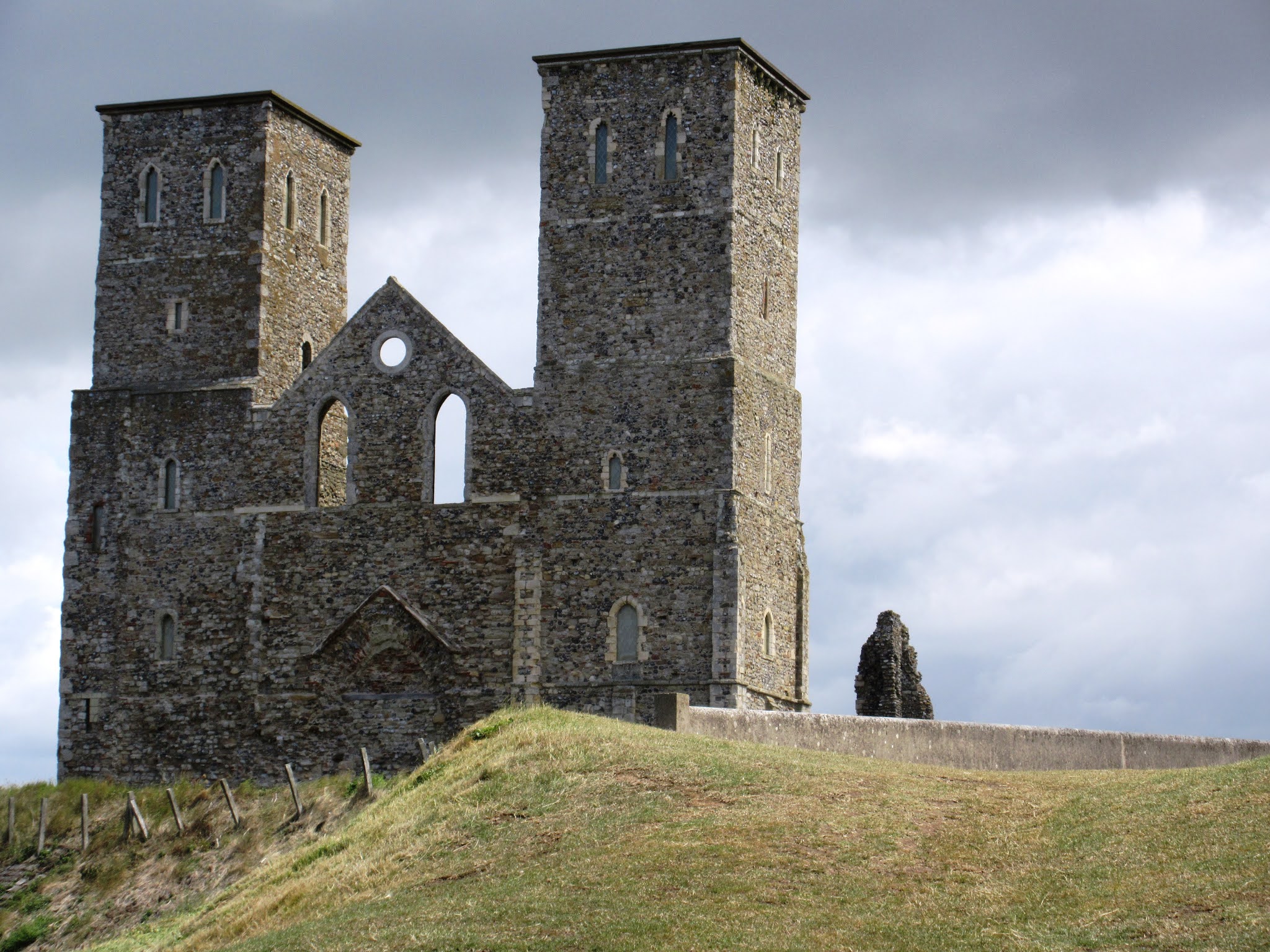
 Back to Kent and Reculver, the ruined church built within the footprint of a Roman fort. It is ruined because, even though it dated from Saxon times, the parish voted in 1808 to pull it down to build a new church inland.
The towers were kept up as a landmark to shipping and in this aerial photograph from 1920 they are still capped in a rather persnickety style.
Those caps had gone by 1931 and you can see a photo of the towers I took in 2015 below.
There is nothing quite like The Night of the Hunter. As Peter Kimpton has written:
At its heart, the film is a children's fairy tale - strange and idiosyncratic - but also a noir thriller, laced with the darkest elements of both genres: death, guilt, greed, poverty, cruelty, biblical references and a terrifying pursuit by the scariest of bogeymen.
The tragedy is that, because of its poor critical reception, its director Charles Laughton never made another film.
Here members of the cast and crew, including Lillian Gish, Shelley Winters and the peerless Robert Mitchum, remember making the film.
If you haven't seen The Night of the Hunter, you really should.
Five years ago a project to rewild the Welland through Market Harborough was completed. The river was given a more natural aspect as some of the damage caused by post-war flood prevention and land drainage schemes was reversed.
The Welland Rivers Trust is now working on a new project at Lubenham, a village a mile of two upstream, to address pollution, improve habitat and provide community access to an ailing section of the river.
You can read about the Welland Headwaters Improvement Project on the Welland Rivers Trust website and watch the video above.

In a presentation to Lib Dem MPs then, Mr Reeves mapped out three phases for the Coalition. The first had to be about unity on cutting the deficit, to show that coalition works and put down firm foundations. Phase two would be "differentiation" to show voters the Lib Dems were not the same as the Tories, before a natural divergence ahead of the 2015 election.
The national campaign accompanying the manifesto was widely and severely criticised amongst interviewees for its failure to integrate with their constituency campaigns or to win support from the public.
Some complained … that materials prepared for delivery in the constituency … had to be abandoned as unsuitable.


"During lockdown people have enjoyed their local spaces and paths as never before, and this use continues beyond the pandemic. We know there is a great disparity in the distribution and quality of open spaces, and that investment in these assets provides excellent value for money by improving people’s health and well-being."We therefore call on government, local authorities and communities to work together to ensure that everyone has access to good-quality green space close to home. This is a vital element of the green recovery after the pandemic. We have made proposals as to how this can be achieved."

A complaint has been made about Ed Davey’s campaign’s conduct in its communication with members as to their voting intentions, specifically that they instructed canvassers not to disclose the identity of the campaign they were actually calling on behalf in calls made on the 11th and 14th of July 2020.The Returning Officer has considered this matter carefully and has taken representations from the Campaign. The Returning Officer has found that the campaign, in so doing, acted in a way that was likely to mislead members.The Returning Officer has required the campaign to forthwith delete the data collected from these calls and has received confirmation that has been done. The Returning Officer reserves the right to take further action if on further consideration such is felt necessary.


We start on Wanstead Flats and pass through Aldersrbook, a model Edwardian suburb that is seen as a great example of the vernacular revival. Passing down Empress Avenue we look for the site of the Redbridge Nuclear Shelter near Empress Avenue Allotments. These allotments were used as a location in the Mike Leigh film Another Year.
The path takes us around the outer perimeter of the Wanstead Park, through the Epping Forest Exchange Lands and near the site of an isolation hospital. We pass beneath the pylons and cross the River Roding into the streets of Cranbrook.
The Cran Brook makes its confluence with the Roding on Ilford Golf Course which I was unable to access, but the course through the streets here is marked on the map in the video. The name, Cranbrook has its earliest use in 1233 as Cranebroc. We follow the Brook along Empress Avenue, Ilford, through an area called The Wash and into Valentines Park.
Valentines Park was featured in an episode of the radio show I produced and co-presented with Nick Papadimitriou on Resonance FM, Ventures and Adventures in Topography. It's one of my favourite London parks. Author Thomas Burke described it as The Eastern Queen in his 1920's book, The Outer Circle - rambles in remote London. The Valentines Estate had existed before Valentines Mansion was built in the 1690's for the widow of the Archbishop of Canterbury.
The Park once had a Lido which was demolished in 1994 and it is said to be the inspiration for the Small Faces song Itchycoo Park. Roman era burials were excavated in the grounds of the house in 1724. The Cran Brook can be seen flowing through the Park into the boating lake.
From Valentines Park we walk along Quebec Road, the go along the A12 Eastern Avenue and turn into Horns Road. We can see the shape of the river valley from Netley Road, Birkbeck Road and Perkins Road where the river runs beneath the Sainsburys Car Park.
We follow the alleyway that takes us over the Central Line behind Newbury Park Station and into Oaks Lane. From Oaks Lane we go into a field that leads us to where the springs gurgle to the surface giving birth to the brook not far from Barkingside Station.

From that point on, the legislation would require any haulier using designated roads in Kent leading to the Port of Dover and Eurotunnel to be in possession of a ‘Kent access permit’ (KAP), which would be digitally issued to drivers receiving a ‘green’ or ‘amber’ result from the SF service.Each KAP would be valid for 24 hours to cover a single trip, and police and DVSA enforcement officers could issue penalties to hauliers found heading for Dover or Eurotunnel without one. Thus, travelling in contravention of a ‘red’ result (being advised not to travel) or failure to use the SF portal at all and so not having a valid KAP, would be a fineable offence.
