Showing posts with label Hanging Houghton. Show all posts

Saturday, July 07, 2018

The lost manor house and gardens of Hanging Houghton

Hanging Houghton has not had a church for centuries, and the manor house that was built with its stone is long gone too.
I wrote on Monday.

The Victoria County History for Northamptonshire gives more of the story:
A chapel of some importance once existed at Hanging Houghton, but Bridges says that its ruins were used for the building of a manor-house, which in turn was left deserted in 1665 after the Montagu household had been carried off by the plague, which they had fled from London to escape.
And the Historic England listing for the site tells you about the substantial but subtle remains of the house:
The monument includes the buried and earthwork remains of a great house and gardens at Hanging Houghton, located on the crest and slopes of a south westerly projection of high ground at the western end of the hamlet. 
The house was owned by the Montague family from 1471 until it was abandoned in 1665, following the demise of the entire family during the plague. The house is depicted on a map of 1655, located in the north east corner of an elaborate formal garden including knot gardens and terraced walks. It survived as ruins as late as the 18th century. 
The remains of the house and gardens are represented by a series of rectangular areas defined by low earthworks and banks, measuring up to 0.75m high. The remains of the house are visible as a low rectangular building platform measuring approximately 40m by 30m in the north eastern angle of the garden. 
Illustrations from the 17th century suggest that the house was built with three bays and that its south elevation was symmetrical with a central porch, typical of a late 16th or early 17th century date rebuilding. 
Immediately to the west of the house there are earthwork enclosures marked by low boundary banks which indicate the location of formal knot gardens. 
To the west of the knot gardens are the remains of a large rectangular raised area, which is shown on the 1655 map as an area of garden planted with trees and surrounded by a system of formal paths. 
The boundary of the gardens is defined by a continuous curving bank, measuring up to 4m high and 2m wide, enclosing the site on the west and south sides.
I found this site on Monday. It was occupied by horses and sheep trying, like me, to cope with the heat.


Thursday, July 05, 2018

Industrial remains at Hanging Houghton


As I wrote the other day, Hanging Houghton used to sit in an industrial landscape.

The old Market Harborough to Northampton railway, now the Brampton Valley Way and part of a national network of cycle paths, is easy to find at the bottom of the hill.

As for relics of the ironstone tramways and aerial ropeway, the best candidate I could find was the concreted lane leading to a minor water treatment plant.


Tuesday, July 03, 2018

Looking for Hanging Houghton


"I've been driving this route for eight months," said the bus driver, "and you're only the second person to have got off there."

Hanging Houghton is a great name for a hamlet. It stands just off the Market Harborough to Northampton road between Lamport and Brixworth, above the Brampton Valley. I once suggested Brixworth's men in black had been dealing with the downing of a flying saucer here.

When you get there you find a surprising amount of housing - old and recent. But that is all you find.

The tableau above - a pillar box, a telephone box that now houses a defibrillator and a noticeboard for Lamport and Hanging Houghton parish council in front of the former school - are all the amenities it offers now.

Hanging Houghton has not had a church for centuries, and the manor house that was built with its stone is long gone too. There is, of course, no shop, though it may have had a sub post office until recently.

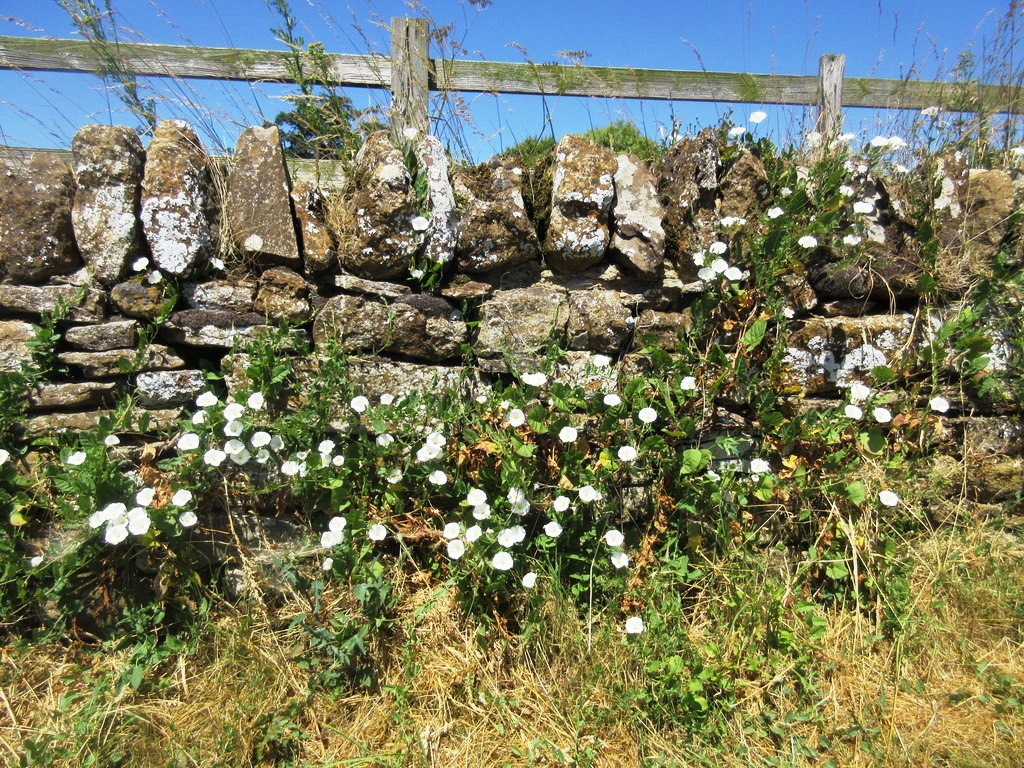
This is a landscape that will surprise some: dry stone walls are a common feature on Northamptonshire's uplands.

And until the 1960s it was an industrial landscape, with an aerial ropeway and broad-gauge and narrow-gauge tramways all connected with the local ironstone quarrying industry.

At the bottom of the hill you meet the Brampton Valley Way, a footpath and cycle path that occupies the trackbed of the old Market Harborough to Northampton railway. More of that another day.


Tuesday, May 08, 2018

Brixworth and the men in black


I arrived in Brixworth this lunchtime to find the place thronged with men in a black uniforms. They seemed to be in every street - sometimes alone or in pairs: sometimes in groups.

A local later told me they were staff from the Mercedes engine research facility in the village, but I prefer my original theory.

Last night a flying saucer was brought down at Hanging Houghton and they were there to mop up.