Showing posts with label Lamport. Show all posts

Monday, June 17, 2024

The rediscovery of a lost industrial railway engine shed at Lamport

This is a wonderful discovery, and a reminder that even a chocolate-box estate village like Lamport - which I know so well it has its own label on this blog - has an industrial history.

Many more videos like this from Steve at LeiceExplore on YouTube.

Tuesday, July 03, 2018

Looking for Hanging Houghton


"I've been driving this route for eight months," said the bus driver, "and you're only the second person to have got off there."

Hanging Houghton is a great name for a hamlet. It stands just off the Market Harborough to Northampton road between Lamport and Brixworth, above the Brampton Valley. I once suggested Brixworth's men in black had been dealing with the downing of a flying saucer here.

When you get there you find a surprising amount of housing - old and recent. But that is all you find.

The tableau above - a pillar box, a telephone box that now houses a defibrillator and a noticeboard for Lamport and Hanging Houghton parish council in front of the former school - are all the amenities it offers now.

Hanging Houghton has not had a church for centuries, and the manor house that was built with its stone is long gone too. There is, of course, no shop, though it may have had a sub post office until recently.

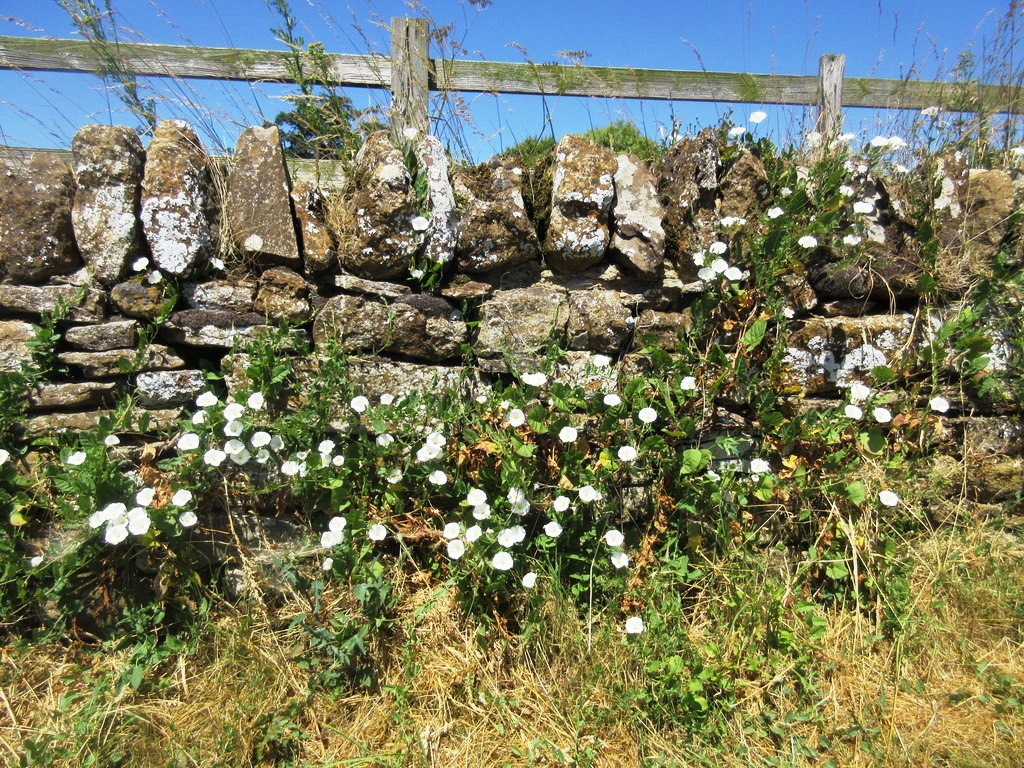
This is a landscape that will surprise some: dry stone walls are a common feature on Northamptonshire's uplands.

And until the 1960s it was an industrial landscape, with an aerial ropeway and broad-gauge and narrow-gauge tramways all connected with the local ironstone quarrying industry.

At the bottom of the hill you meet the Brampton Valley Way, a footpath and cycle path that occupies the trackbed of the old Market Harborough to Northampton railway. More of that another day.


Thursday, April 21, 2016

Denys Watkins-Pitchford ("BB") remembered


There is a pleasant programme about the Northamptonshire writer and illustrator Denys Watkins-Pitchford on the BBC iPlayer at the moment.

The photo above shows his birthplace, Lamport Rectory, and I seem to remember seeing him about Market Harborough in the 1980s.

Deny Watkins-Pitchord also got a mention in my Masters dissertation on Richard Jefferies as one of the many later writers for children who used Bevis as a touchstone.

Monday, May 18, 2015

Industrial railways at Lamport, Scaldwell and Hanging Houghton


Precious footage of these long-vanished railways in operation.

This complex of lines tapped the ironstone of the countryside around the Market Hatborough to Northampton line.

And you have to admit that Hanging Houghton is a great name for a village on the side of a hill.

Sunday, April 25, 2010

A mud wall in Little Bowden

I was too busy delivering for Zuffar Haq yesterday to get out of Market Harborough, so this week I shall be sharing a few curiosities from my files.

This mud wall stands in my own village of Little Bowden, near the Rectory. While you will find dry stone walls in villages on the Northamptonshire Uplands, like Lamport and Draughton, in more low-lying parts of the county mud was often used as a building material.

I don't have a photograph to prove it, but I think the heavy tiles on top - it is important to keep the rain off mud walls for obvious reasons - are a recent addition. Until a year or two ago the wall was topped with corrugated iron, which suggests that it was originally thatched.

You can read more about mud structures in the Harborough area in an article on the local historical society's website.

And, yes, I know Little Bowden is now in Leicestershire, but it was in Northamptonshire until late in the 19th century. The county boundary used to be the Welland, but was moved because Market Harborough had started to spread to the south of the river. You can still see what used to the Northamptonshire police station and magistrates court for that part of town in the Northampton Road.

This means, incidentally, that my cottage, which is now firmly in Leicestershire, was in Northamptonshire when it was built.

Friday, April 23, 2010

Lamport and Maidwell, churches and houses

There is no solution to the current problem of care and maintentance unless it is recognised that an ancient and beautiful Church fulfils its primary function merely by existing. It is, in itself, an act of worship.

Such a church, whatever its surroundings, is a perpetual reminder of spiritual values. In Shakespeare's phrase it is "a sermon in stone" and its message is delivered, not just for an hour on Sunday, but for every hour of every day in the year - not merely for those who enter, but to all who pass by.

This passage is quoted on the title page of Sir Gyles Isham's guide book to All Hallows, Lamport. As I cannot find it anywhere on the net, I assume that it is taken from Isham's longer work about the church, All Saints' (All Hallows) Lamport, published in 1950.

I have chosen to illustrate it with a picture of St Mary the Virgin, Maidwell. This is because All Hallows, Lamport, after the changes they wrought upon it in the 18th century, is dedicated at least as much to the glory of the Isham family as to that of God.

Next to St Mary the Virgin stands Maidwell Hall, now an expensive prep school. This puts me in mind of another passage. This one comes from The Dog Beneath the Skin by Auden and Isherwood:

I see barns falling, fences broken,
Pasture not ploughland, weeds not wheat,
The great houses remain but only half are inhabited,
Dusty the gunrooms and the stable clocks stationary.
Some have been turned into prep-schools where the diet
.....is in the hands of an experienced matron,
Others into club-houses for the golf-bore and the top-hole.

Friday, April 16, 2010

All Hallow's Church, Lamport

On our last visit to Lamport for a while, let's look at the church.

All Hallow's (as the guidebook calls it - the apostrophe looks to be in the wrong place and Pevsner calls it All Saints) is dominated by Lamport Hall and was clearly heavily made over in the 18th century to serve as the estate church. There is a Georgian porch, a Venetian window at the East end and numerous family monuments. (One of these was retrieved from the lost church of St Denys at Faxton.)

But it has a friendly atmosphere and you can buy a few modest souvenirs of BB (Denys Watkins-Pitchford) there. There was also a copy of a magazine article that claimed a bullet fired by the young Denys can still be found embedded in one of the East windows, but it eluded me.

The guidebook they sell is written by Sir Gyles Isham and billed as the fifth edition, abbreviated from a long work on the church he published in 1950.

It discusses lists the past rectors, including BB's father. The Revd W.M. Watkins-Pitchford, who held the living between 1903 and 1944), we are told, "was a keen musician and revived folk-dancing in the district. He was a friend of Sir Cecil Slarp (sic)."

But just as this Tory vision of England is beginning to appeal, you come across the fact that Robert Isham, who held the living, between 1845 and 1890, was chairman of the Brixworth Board of Guardians.

And we read all about Brixworth workhouse last June.

Other recent posts on Lamport

Thursday, April 15, 2010

The first garden gnome in England

Lamport? Let me see. I have shown you Shortwood House and the Rectory. But there is more.

The first garden gnome in England.

I had forgotten this story, just as I had forgotten that Sir John Farr, for years the Tory MP for Harborough, used to live near Lamport. But Jim Hill Media has reminded me, even though he is not too sure about how to spell Isham:

Sir Charles Ishman was the 10th Baronet of Lamport Hall. As a vegetarian and a practicing spiritualist, he was considered something of an eccentric. He had inherited a love of gardening from his mother and sometime in the mid 1840's, Charles decided he wanted to design a garden on the grounds at Lamport.

Being a bit offbeat, he chose an unusual theme. He chose an Alpine garden with a rockery. He imported over 20 lawn gnomes from Germany and gave them tools as if they were working the rock garden as a mine. The gnomes were the first known in England and many gardeners found them enchanting. Sir Charles had started a minor garden fad.

He goes on to record that the gnomes were disliked by Charles's daughters, who - to their credit - had them all removed after his death. Or so they thought.

One gnome managed to survive in a hidden niche in the rocks. He was rediscovered and is now known as "Lampey" and recognised as the first stately gnome of England.

One other point: Jim Hill Media mentions Sir Gyles Isham, the twelfth and final baronet, who bequeathed the Hall and its contents (gnome included) to the charitable trust that now runs the estate.

Gyles Isham acted in several films in the 1930s and you can find him on IMDB.

And the picture, which shows a replica of Lampey, comes from Wikipedia.

Wednesday, April 14, 2010

Lamport Rectory: Birthplace of Denys Watkins-Pitchford ("BB")

My trip to Lamport on Saturday - which led me to Shortwood House - was chiefly to see this building. Lamport Rectory was the birthplace of the writes and illustrator Denys Watkins-Pitchford.

He was born there in 1905 when his father was the rector. As Wikipedia records:
Denys was himself considered to be delicate as a child, and because of this was educated at home, while his younger twin, Roger, was sent away to school. He spent a great deal of time on his own, wandering through the fields, and developed a love of the outdoors, which was to influence his writing.
Pevsner tells us that the Rectory was built in 1727-30 for the then rector, Dr Euseby Isham. The Ishams were the owners of the neighbouring Lamport Hall.

Monday, April 12, 2010

The MasterChefisation of British cooking

This is the Swan at Lamport. As you will see, it is "passionate about food". Now where have I heard that before?

Sure enough, the menu included a starter of scallops with belly pork, though it should be black pudding for the full cliche.

The food was good but not brilliant, and the portions were a little small for the price. Still, that does allow those of us trying to lose weight to enjoy three courses without being greedy.

I read somewhere - I think it was in Arthur Mee's Northamptonshire - that Lamport was thought the bleakest place on the stagecoach route between London and York. I had imagined that those coaches went via the Great North Road, but the Swan is certainly a very large inn to find in such a remote location, so it must have been important at one time.

To reach it the main road from Market Harborough to Northampton crosses the Brampton valley with a magnificent S bend. At the bottom it crosses the trackbed of the old railway line between the two towns - I can remember being held up one nght by a freight train at the level crossing here as recently as 1980. Then it climbs the other side of the valley to reach Lamport and the Swan.

Saturday, April 10, 2010

Shortwood Lodge, near Lamport


I was planning a trip to Lamport for this afternoon, chiefly for its connections with the writer and illustrator Denys Watkins-Pitchford (or "BB" as he signed his books, reserving his full name for his illustrations - BB was a grade of shot used by wildfowlers).

BB wrote natural history books and also wrote stories for children. He got a mention in my Masters dissertation because when his heroes run away to live in the woods in Brendon Chase they are careful to take a copy of Richard Jefferies' Bevis with them. And Watkins-Pitchford's illustrations, often using scraperboard, are very much to my taste.

His books now change hands for a lot of money. I remember thinking back in the early 1980s that he was a writer whose books would soon become more sought after; unfortunately, I did not have the money to stock up with them in those days. I also seem to recall that he came to Market Harborough quite regularly in those days. (He died in 1990 at the age of 85.)

Planning today's trip to Lamport, I picked up Pevsner's Buildings of England for Northamptonshire (as one does) and looked at the entry for Lamport. There was plenty of interest there, but my attraction was drawn by a note at its end referring the reader to another page for details of Shortwood Lodge.

Turn to that page and you find the following:
Hawking Tower: A three-storeyed tower of c. 1720 with two-storeyed wings, their two storeys being as high as the ground storey of the tower...
That sounded agreeably eccentric and there is a connection with BB there too. The BB Society website tells us that:
Shortwood, the home of Lady Susan Farr with its medieval hawking tower featured in Wild Lone BB's classic tale of Rufus the Pytchley Fox.
Pevsner makes it clear that the tower is not medieval, but this reference made me still keener to see it.

And writing this post tonight I have realised that Lady Susan Farr must the the widow of Sir John Farr, who was for many years the Conservative MP for Harborough. (Shortwood Lodge is more than five miles into Northamptonshire and was thus not in his constituency.)

As you can see from the photograph above, the tower now forms part of a larger house, though the modern extensions (the work of Sir John?) do nothing for it.

To the south, the boundary of the grounds is formed by a ha-ha so as not to interrupt the views of the Northamptonshire Uplands. That view includes the site of Faxton, a village that was abandoned as recently as 1960. Seeing the destruction of its church was one of the things that made J.L. Carr determined to save St Faith's at Newton in the Willows.

And if I had followed the bridleway from Lamport to Shortwood for another mile, I would have arrived at the site of Harrington airfield, home of the Carpetbaggers and the Thor nuclear missiles.

The more you discover around here, the more there remains to find out.