Showing posts with label Oscar Wilde. Show all posts

Thursday, April 09, 2026

Lord Harborough's Curve and Oscar Wilde's first biographer

Lord Harborough's Curve: photo by John Sutton

Many railway enthusiasts will know the story of the Battle of Saxby and Lord Harborough's Curve, told here by the Leicestershire Museum Collections site:
In mid-November 1844, railway surveyors were making their way slowly through the Leicestershire countryside. George Stephenson had sketched out his preferred route for the Syston & Peterborough Railway and now they were taking the levels. 
Four miles east of Melton, near the village of Saxby, they reached the estate of Lord Harborough, whose ancestral home of Stapleford Hall stood nearby. His Lordship hated the very idea of railways and had put up signs warning the surveyors to keep off his land. 
The railway men attempted to avoid causing offence by following the towpath of the Oakham Canal, but this added insult to injury, as Lord Harborough was a shareholder in the canal, which faced ruin if the railway was built. His servants and estate workers set about removing the surveyors by force, leading to four days of fighting between the two sides.
Sidetracked adds some colour:
Pistols were allegedly drawn by surveyors, clubs and iron pointed staves carried and bare fists used.  Artillery was even mentioned! The estate Fire Engine was deployed as a primitive water cannon and the railway company was threatened by letter that:

"We have barricaded the towing  path and have in readiness a few cannons from Lord Harborough’s yacht. If you force us to use them, as a last resort, the blood will be upon your hands."

Lord Harborough won his dispute with the railway company, so its engineers were forced to construct a tight curve in order to avoid his land. "Lord Harborough's Curve", as it was known, remained in use until 1892, when a route through Stapleford Park was finally built. You can see the wooded embankment of Lord Harborough's Curve in the photograph above. But the title died with him, as he did not father any legitimate children.

In another part of the forest, I have noticed that whenever I search for pictures of Market Harborough in photo libraries, portraits of a writer called Robert Harborough Sherard come up. He was a friend of Oscar Wilde and his first biographer.

Sherard's father was the Revd Bennet Sherard Calcraft Kennedy, who turns out to have been one of three illegitimate children that our Lord Harborough had with an actress called Emma Love. Through his mother, Sherard was also a great grandson of the poet William Wordsworth.

Sadly, he is not an attractive figure. His books on the poor of England generally lay the blame for their sufferings at the door of Jewish landlords.

Still, we have our Trivial Fact of the Day: Lord Harborough who won the Battle of Saxby was the grandfather of Oscar Wilde's first biographer.

Tuesday, November 18, 2025

The Joy of Six 1437

Sienna Rodgers takes us inside the power struggle at the top of Your Party: "There is talk that the leadership race could feature at least one other candidate; a non-MP perhaps with a 'plague on all your houses' campaign aimed at highlighting the chaos that has emerged under those running the show so far."

"The whole estate shares the same creaking water, electric, sewage and gas systems, most of which are interconnected across the buildings – meaning shutdowns for repair affect the whole estate. According to the official Restoration and Renewal unit, there are 'also hundreds of miles of rusting pipework, obsolete electrical cables and gas pipes, and the giant, inefficient Victorian steam heating, all of which need replacing'." The Palace of Westminster is falling down, reports Simon Wilson.

Tom Chidwick pays tribute to Lord Taverne - Dick Taverne - whose victory in Lincoln in 1973 was, along with the Liberal Party by-elections triumphs of that era, one of the things that got me interested in politics.

"The reason I cannot understand Shakespeare is that I want to find symmetry in all this asymmetry. It seems to me as though his pieces are, as it were, enormous sketches, not paintings; as though they were dashed off by someone who could permit himself anything." William Day seeks to explain Ludwig Wittgenstein's dislike of Shakespeare.

Georgia Poplett emphasises the Leicester roots of Adrian Mole and his creator Sue Townsend: "As a teenager and young adult, the aspirant Leicester Tolstoy moved between jobs, working in retail and at a garage where she spent most of her time reading books on the forecourt. She was sacked from a clothes shop for reading Oscar Wilde in the changing rooms."

"Bitterns are elusive and well camouflaged. They hide in the dense reed beds, popping out to catch eels, fish and amphibians, and quickly darting back under cover. This makes them a secretive bird and extremely hard to spot in their environment with their unique plumage. Typically, it’s their call, the Bittern boom, that announces their hidden presence." Leslie Cater remembers his encounters with Britain's loudest bird.

Friday, October 24, 2025

Oscar Wilde's grandson at the National Liberal Club last week

Oscar Wilde was born in 1854, yet here is his grandson Merlin Holland speaking at the National Liberal Club last Friday.

He was the speaker at the 33rd Oscar Wilde Birthday Dinner, talking about his new book After Oscar: The Legacy of a Scandal. He has made it his business to clear away the myths that have accumulated around his grandfather, and he discusses some of his discoveries here.

Merlin Holland was born in 1945 when his father Vyvyan Holland, Oscar Wilde's second son, was 58. Vyvyan Holland gets a mention in another post on this blog. For Market Harborough's connection with Oscar Wilde, see another post again.

As a good Liberal, I recognised the venue from the tiles alone. 

Friday, August 01, 2025

From Sherlock Holmes to Mandy Rice-Davies: John Rogers explores Marylebone

A walking tour around the London district of Marylebone, made famous by Sir Arthur Conan Doyle's Sherlock Holmes stories, in the company of John Rogers.

His blurb on YouTube says:

The fictional detective lived at 221b Baker Street and we visit the address, now home to the Sherlock Holmes museum. But our historic London walk starts The Langham where Conan Doyle dined with Oscar Wilde in 1889. We then turn into Wigmore Street and pick up Marylebone Lane where the buried River Tyburn runs beneath the street. 

This ancient thoroughfare recalls the time when Marylebone was owned by the Knights Templar. The name is derived from the presence of the river and the church of St Mary - St. Mary-a-le-Bourne or St.Mary by the Tyburn. It was developed in the 1700s and gained a reputation as a medical area around the famous Harley Street and Wimpole Street. 

One such medical practitioner was the osteopath Dr Stephen Ward who lived in Wimpole Mews with Christine Keeler and Mandy Rice-Davies. The Profumo Affair that involved Ward, Keeler and John Profumo MP became the biggest British political scandal of the 20th Century.

Our walking tour also takes in Manchester Square and the Wallace Collection, Marylebone High Street, Daunt Books, Paddington Street Garden and Marylebone Station.

John blogs at The Lost Byway and has a Patreon to support these videos.

Friday, June 06, 2025

The Joy of Six 1368

Green redevelopment at Nottingham Broad Marsh
"The answer was a two-pronged attack. The first was a wholesale culture war against 'social justice', which presented BLM, climate, feminist and migrant rights activists as a fifth column determined to bring the country to a halt. The second was passing new and draconian legislation to tackle this so-called left-wing 'threat'." Open Democracy researches the tactics used by the last Conservative government to ban protest.

Mic Wright looks at the way the 'no English food on my holiday' woman was stitched up by the local and national press.

Chris Taylor pulls no punches on the crisis at De Montfort University: "At the heart of the DMU crisis is an executive clique led by the VC, with enormous power and infused with a business ethos of detachment. They live different lives, speak a different language and have different priorities from the people they manage. For them, the profit imperative comes above any duty to people or place and justifies them taking money from Leicester to speculate in richer cities."

Judging by this interview with Philip Win, the redevelopment of Nottingham's Broad Marsh is going to be less innovative than many hoped.

Dinah Birch on the very uncosy crime novelist P.D. James: "She once told me, disconcertingly, that her experience in the Home Office had persuaded her that murders are more common than people think, and that with level-headed planning they could remain undetected with relative ease."

"Despite its imposing beauty, the space was purposefully designed to look like a larger chapel than it actually is through the trickery of decoration. Its decoration is beautiful though and in the words of Oscar Wilde, this chapel is 'the most delightful private chapel in London'." Voyager of History visits the chapel at Great Ormond Street Hospital.

Tuesday, December 10, 2024

Victorian women in crinolines were the ultimate fashion victims

Embed from Getty Images

Content warning: This is a horrible passage of 19th-century history.

A number of factors combined in crinolines to make them a ridiculously dangerous death trap for anyone wearing them. During the peak of their popularity they killed at least 3000 people in the UK alone according to an 1860 article in the Lancet, and in 1864 a Bulgarian doctor reported that over the previous 14 years he believed that at least 39,927 women had died in crinoline fires.

This is from a horrifying article in the Christmas Fortean Times. Crinolines - stiff petticoats worn to hold out a skirt - were the height of fashion for women from the 1840s to the 1860s, and enjoyed intermittent revivals later in the century. Latterly, a metal frame replaced most of the petticoats.

They were such a fire hazard for two reasons. First, the skirt above became huge and unwieldy, so it was easy for a woman to brush against a fire or lighted candle. Second, the crinolines themselves were made of swathes of light, gauzy material, none of it treated to make it fire resistant.

The result is that the article, The Crinoline Inferno by Ian Simmons, is stuffed with barely credible horrors. One such runs:

In another incident in 1861 an entire corps de ballet - seven dancers in total, including the four English Gale sisters - died together when they tried to help each other after one dancer's costume ignited at the Continental Theatre in Philadelphia.

And that was nothing to the 126 people, mainly aristocratic ladies wearing highly flammable crinolines and corset, who died in a fire at the 1897 Bazaar de la Charité. Still less to the two or three thousand who died in the 1863 Church of the Company fire in Santiago.

Fashionable victims included:

the teenage Archduchess Mathilde of Austria, who died when she was surprised smoking by her father and hid the cigarette behind her back touching her dress as she did so and going up in flames instantly. 

Two illegitimate half-sisters of Oscar Wilde also died after crinoline fires - "both died a lingering death several days later". Little was said about their deaths as their father, a prominent Dublin doctor, did not want to draw attention to the family and its scandals.

As a result, the tale remained part of the secret folklore of Dublin for many years, growing in the telling to include a mysterious black-draped woman who regularly visited the girls' grave and. later. their father on his deathbed. It is not clear whether Oscar knew of his sisters' fate. or indeed their existence.

A further hazard was added when the colour Paris Green became fashionable in women's fashion. The die that produced it included arsenic, and women became ill through poisoning just from wearing this shade as a result.

Finally, the crinoline remained lethal even in the 20th century. In 1930 Nita Foy, a dancer appearing in a period film at Twickenham Studios, died in crinoline fire after her costume brushed against an electric fire in the dressing room of one of the actors. The room, says Matthew Sweet in his Shepperton Babylon, became a site of ghoulish pilgrimage.

Wednesday, November 13, 2024

Continued on next monument: A tribute to Timothy West

Or, to be precise, a tribute to Timothy West and Bradley Hardacre.

There were three seasons of the Channel 4 comedy Brass in the early 1980s. It was written by two Coronation Street veterans, John Stevenson and Julian Roach, in the days when that soap contained some of the funniest writing on British television.

Brass was a parody of everything from Charles Dickens' Hard Times, via novels by the likes of A.J. Cronin and Francis Brett Young to the works of Catherine Cookson, which were everywhere at the time it was made.

An old Guardian article recommending the boxed set sums it up well:

Self-made man and owner of the village mine, mill and munitions factory, Bradley is the head of the Hardacre clan, which comprises his three sons, Bentley (deceased), Austin and Morris; as well as two daughters, Charlotte (passionate about doing good works and, says her father, "innocent to the point of simplicity") and Isabel, whose bedpost is more notch than wood. Then there's his wife, Lady Patience, a wheelchair-user ever since her terrible tambourine accident.

On the other side of the colliery tracks is the Fairchild family. George, its nominal head, worships the ground his employer Bradley treads him into, while his magnificently-cleavaged wife Agnes, so poor-but-proud that she irons her clothes before washing them, rails with fury at all life throws at her. 

They have two sons. One is hardworking Jack, who has inherited his mother's socialist leanings, but is periodically diverted from bringing down capitalism by his secret and exhausting life as Isabel's sex-monkey. ("I love him hopelessly! Passionately! Recklessly! Frequently.") 

The other is poetry-writing Matt, who is determined, once he has made the final payments on the family pencil, to go to Cambridge despite his love for Charlotte H ("Thou are more lovely and more interesting/Rough winds do shake the darling buds of May but that's quite another thing") and his good job – "a job wi' a stool!" - at the mine works.

The whole cast of Brass was great - I once saw Morris Hardacre playing Oscar Wilde in Terry Eagleton's Saint Oscar at the Leicester Haymarket - but its undoubted leader was Timothy West as Bradley Hardacre.

Let this tribute to his character serve as a tribute to the actor. Continued on next monument.

Thursday, November 07, 2024

God save me from former Cambridge Footlights members stretching their brand


I was in Sainsbury's the other week when Ben Miller came on the PA. You will remember him from the sketch show Armstong and Miller. (Or was it Mitchell and Miller? Or Miller and Webb?)

What was he doing in the supermarket? Plugging his latest children's book.

Not long after that, Humanists UK announced a collection of essays, What I Believe. (It was actually published today.)

And among the contributors - indeed listed first on the page announcing it - are two former Footlights members, Sandi Toksvig and Stephen Fry.

Also announced recently was the presenter of the BBC's eagerly awaited new series Chess Masters. Any guesses? 

It was Sue Perkins.

The British left has accorded comedians too high a status for decades now, perhaps because their politicians have been so uninspiring. Future historians will have to account for the cultural eminence Fry enjoyed for so long.

There used at least to be a second route into BBC comedy - the Socialist Workers Party. But now the SWP is too toxic for any ambitious comedian to associate themselves with it, the Footlights has an open field.

Of course, a person can be good at more than one thing, and, of course, Cambridge takes some of the brightest and best.

But I am reminded of the days when I helped produce Liberal Democrat News at conference. One of the things that made it so enjoyable was that I got to talk about the Archers with Jock Gallagher, who produced the programme for many years, and to talk about the Footlights with Adrian Slade, the man who auditioned Peter Cook for the society.

I remember Adrian saying that Cook was the funniest person he had ever met. He would have you laughing for a whole evening, yet the next day you wouldn't remember a thing he had said. This, I think, was because Cook’s greatest contribution to British comedy - and he was enormously influential - was his absurdist attitude to serious things and important people.

But Adrian also said that there is all the difference in the world between being a stage actor and being a revue actor, where you put on a hat and a funny accent for 90 seconds and then move on.

You see that, I think, in Cook's films. If acting is reacting, then he gave his fellow cast members nothing to work with, because he seems wholly detached from what is going on around him. This sort of works with the characters he plays in The Rise and Rise of Michael Rimmer and Bedazzled, but beyond that it certainly doesn't.

You can see something of the limitations of revue acting in the later careers of David Mitchell and Stephen Fry. In his latest success, Ludwig, Mitchell is essentially playing himself. Fry is a better actor, but even in his finest hour, the film Wilde from 1997, you came away with the idea that Oscar Wilde must have been very like Stephen Fry.

Add to this the way the British tend to confuse an upper-class accent with intelligence - something that has fuelled more than one recent political career - and the increasing funding gap between private schools and the rest, and you realise that the future for former Footlights people will be like the present - only more so.

Thursday, July 06, 2023

Charles Dickens calls at The Admiral Nelson, Braunston


The Admiral Nelson at Braunston was kept for a time in the 19th century by George Adams Dickens, who was a cousin of Charles Dickens.

He was once visited unexpectedly there by the great novelist, who was travelling from London to Birmingham by canal.

Which may explain why, in The Old Curiosity Shop, Little Nell and her grandfather travel by canal for a short stretch of their flight into Shropshire:
A confused sound of voices, mingling with her dreams, awoke her. A man of very uncouth and rough appearance was standing over them, and two of his companions were looking on, from a long heavy boat which had come close to the bank while they were sleeping. The boat had neither oar nor sail, but was towed by a couple of horses, who, with the rope to which they were harnessed slack and dripping in the water, were resting on the path.

‘Holloa!’ said the man roughly. ‘What’s the matter here?’

‘We were only asleep, Sir,’ said Nell. ‘We have been walking all night.’

‘A pair of queer travellers to be walking all night,’ observed the man who had first accosted them. ‘One of you is a trifle too old for that sort of work, and the other a trifle too young. Where are you going?’

Nell faltered, and pointed at hazard towards the West, upon which the man inquired if she meant a certain town which he named. Nell, to avoid more questioning, said ‘Yes, that was the place.’

‘Where have you come from?’ was the next question; and this being an easier one to answer, Nell mentioned the name of the village in which their friend the schoolmaster dwelt, as being less likely to be known to the men or to provoke further inquiry.

‘I thought somebody had been robbing and ill-using you, might be,’ said the man. ‘That’s all. Good day.’

Returning his salute and feeling greatly relieved by his departure, Nell looked after him as he mounted one of the horses, and the boat went on. It had not gone very far, when it stopped again, and she saw the men beckoning to her.

‘Did you call to me?’ said Nell, running up to them.

‘You may go with us if you like,’ replied one of those in the boat. ‘We’re going to the same place.’

The child hesitated for a moment. Thinking, as she had thought with great trepidation more than once before, that the men whom she had seen with her grandfather might, perhaps, in their eagerness for the booty, follow them, and regaining their influence over him, set hers at nought; and that if they went with these men, all traces of them must surely be lost at that spot; determined to accept the offer. The boat came close to the bank again, and before she had had any more time for consideration, she and her grandfather were on board, and gliding smoothly down the canal.

The sun shone pleasantly on the bright water, which was sometimes shaded by trees, and sometimes open to a wide extent of country, intersected by running streams, and rich with wooded hills, cultivated land, and sheltered farms. Now and then, a village with its modest spire, thatched roofs, and gable-ends, would peep out from among the trees; and, more than once, a distant town, with great church towers looming through its smoke, and high factories or workshops rising above the mass of houses, would come in view, and, by the length of time it lingered in the distance, show them how slowly they travelled. Their way lay, for the most part, through the low grounds, and open plains; and except these distant places, and occasionally some men working in the fields, or lounging on the bridges under which they passed, to see them creep along, nothing encroached on their monotonous and secluded track.
The Old Curiosity Shop is one of the books I read at my mother's bedside in her last weeks.

It's probably best know today for containing the death of Little Nell and in particular for Oscar Wilde's remark that it would take a heart of stone not to laugh, though whether Wilde ever said it is open to debate.

But the novel is full of good things, such as the young buck Dick Swiveller, who owes money to so many people that he has to cross London by circuitous routes to avoid meeting them:
"I enter in this little book the names of the streets that I can't go down while the shops are open. This dinner today closes Long Acre. I bought a pair of boots in Great Queen Street last week, and made that no throughfare too. There's only one avenue to the Strand left often now, and I shall have to stop up that to-night with a pair of gloves. The roads are closing so fast in every direction, that in a month’s time, unless my aunt sends me a remittance, I shall have to go three or four miles out of town to get over the way."
The Admiral Nelson at Braunston was originally a farm building, but began to serve beer to the navvies building the canal. Later it became a boatmen's pub and today it caters for leisure boaters and people like me who just fancied a walk along the canal.

Tuesday, July 04, 2023

The Joy of Six 1142

"There’s been a fair bit of discussion about Lib Dem housing policies and our record recently. It’s become obvious to me that many members, especially Young Liberals, don’t appear to know what our national housing policy is, or our track record." Mattthew Pennell sets out some of the housing achievements of local authorities run by the party.

George Llewelyn makes an unexpected discovery: "More interesting perhaps is the change in mood from the Brexit voters I spoke to in 2021. Many of them have graduated from Eurosceptics with a general dissatisfaction at how things turned out to becoming ardent rejoiners themselves."

Our suspicion of anyone who expresses the ambition to be a politician is one of the reasons for the poor quality of our MPs, says Adam Hawksbee.

Emma Fergusson, Shona Reed-Purvis and Lucy Foulkes argue that "some young people’s emotional and behavioural difficulties are now too readily being viewed as problems that require (and require only) medical intervention, typically in the form of assessment and one-to-one treatment from a mental health professional."

"These Spiritual Defenders of the game stood, using the theatrical backdrop and the powerfully echoing acoustics of their private cricketing palace to bray and honk like entitled asses." Emma John on the behaviour of MCC members on Sunday.

John Walsh remembers Martin Amis: "Although he was seen, by some critics of his first three novels, as a sex-obsessed snake in the garden of fiction, he was also the most self-consciously literary of writers. The names (or allusions to the works) of D.H. Lawrence, E.M. Forster, Ernest Hemingway, Henry Fielding, Sigmund Freud, Oscar Wilde, Philip Larkin, Gerald Manley Hopkins, A.E. Housman and William Shakespeare are all dropped in the first thirty pages of The Rachel Papers. By page 60, Dickens, Dylan Thomas, William Blake, Jane Austen, George Herbert and Franz Kafka had also been press-ganged into the action."

Monday, May 01, 2023

Richard Greene was not the grandson of William Friese-Greene

Enjoying a leisurely breakfast before some Bank Holiday delivering, I put Talking Pictures TV on. They are showing The Card, a adaptation of Oscar Wilde's play Lady Windermere's Fan.

One of the stars is Richard Greene, in his matinée idol period and before he took to wearing Lincoln green and riding through the glen.

Looking Richard Greene up on IMDb, I find that he was the grandson of the film pioneer William Friese-Greene.

Why didn't I know that? I was even interested in the Friese-Greene family early in this blog's history.

I didn't know it because it isn't true. 

The Wikipedia entruy for Richard Greene says it's not true and sends you to an article by Paul Pert that is pretty conclusive:

It is not known when or how a relationship to Friese-Greene was first mooted, but it could have potentially arisen or been misinterpreted from a Metro-Goldwyn-Mayer Players Biography, in which it states ‘Greene's great-grandfather was one of the first to introduce motion pictures to British audiences. He hired a hall, erected a screen and invited all comers’.

The MGM entry obviously related to showing motion pictures and not contributing to their invention, and would tie-in with a theatrical/showman family background, but could be where the relationship story had its roots, with others looking round for someone with a 'Greene' surname connected with early cinema.

So the judges have declined to make a Trivial Fact of the Day Award.

But the video above does give me the chance to mention the bride who asked for "The song from Robin Hood" to be played at her wedding, meaning Bryan Adams's (Everything I Do) I Do it for You.

The organist, however, being from an older generation...

Monday, October 05, 2020

Oscar Wilde, Vaughan Wilkins and Dangerous Exile


I have mentioned the historical novelist Vaughan Wilkins, whose career flourished for 20 years or more from the mid 1930s, a few times here.

One post was about his first novel, And So - Victoria, which the censors of the day thought far too disrespectful of the royal family to be filmed. And I also went to a Nottinghamshire village to photograph his grave.

A film was later made of one of his books: Dangerous Exile was an adaptation of the novel A King Reluctant.

You can find Dangerous Exile on YouTube. Richard O'Sullivan, the hardest working British child actor of the 1950s, plays the Dauphin, the young son of Marie Antoinette and Louis XVI, who has been smuggled out of his prison in revolutionary France.

It's not a great film, but I did spot something interesting in the opening titles the other day: Vyvyan Holland is credited as historical adviser.

Vyvyan Holland was one of the sons of Oscar Wilde. He turns out to have several such credits on IMDB, including one for The Trials of Oscar Wilde, in which Peter Finch played his father.

At start of the 19th century Europe was alive with tales that the Dauphin had escaped his captors and with young men who claimed to be him. 

They even reached America - think of 'the dolphin' in Huckleberry Finn.

But recent DNA analysis of what has always been thought to be the boy's heart confirmed that he had died in France in 1795.

What is it with revolutions and killing children?

Tuesday, April 28, 2020

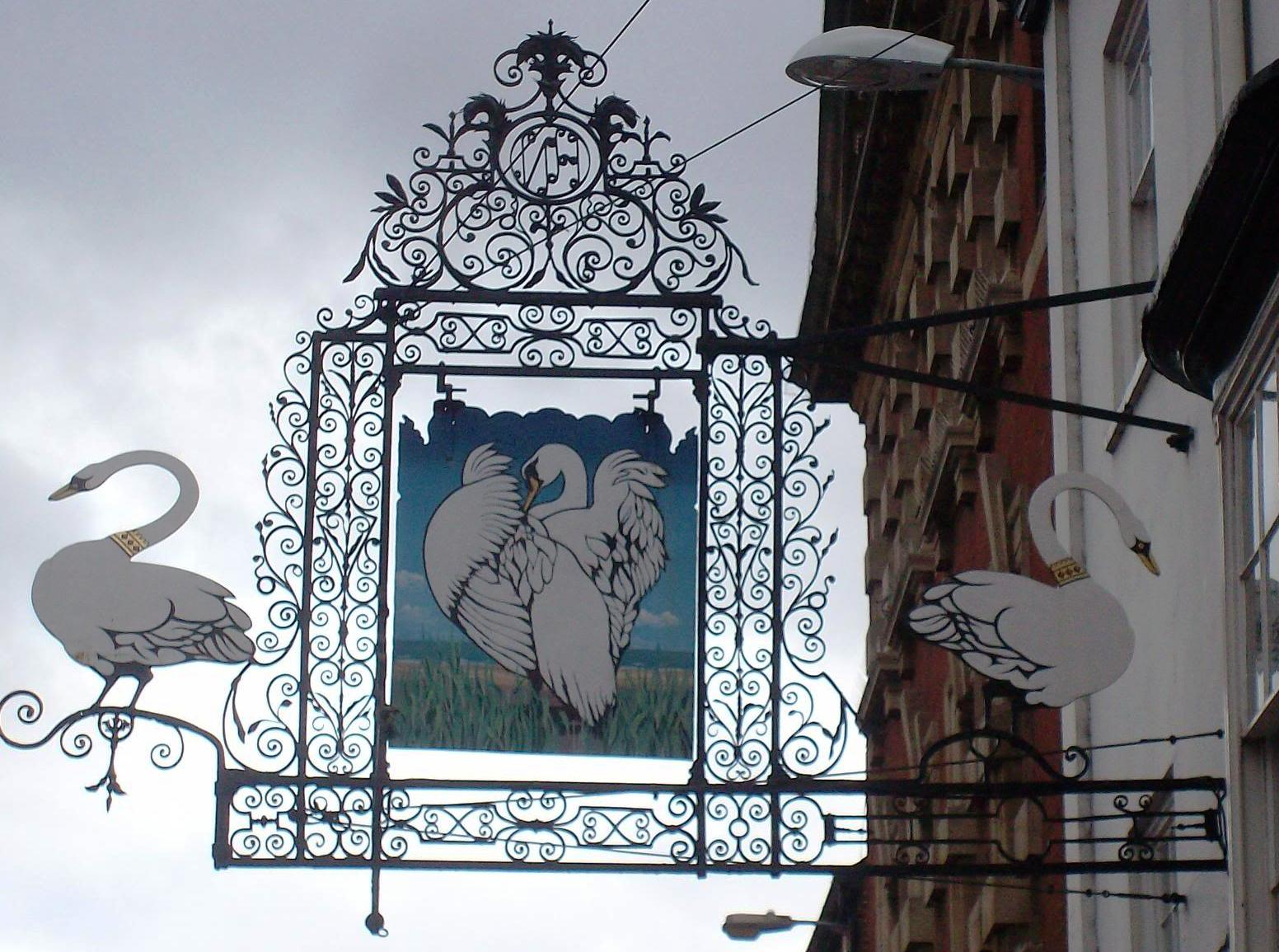
A 1939 cigarette card of the Three Swans, Market Harborough

Embed from Getty Images

In 1939 the Three Swans was kept by the writer and eccentric John Fothergill.

Bryan Magee, who was evacuated to Market Harborough during war, wrote of him:
What impressed me about him more than I can express was that he had written one of the books we had at home, An Innkeeper's Diary. He must have been the first author I met. Needless to say, I had not read the book, but I was familiar with it as an object, and knew that it was about the job I was seeing him doing, namely running a hotel. 
He must have been the best-known hotelier in Britain at that time, because his book had been a best-seller in the thirties and was currently in Penguin Books at a time when Penguins were the only mass-circulation paperbacks. 
I saw him as an outlandish figure. He wore his hair to his shoulders, and buckle shoes, and went out of doors in a cape, none of which I had seen a man do before. Yet he was not effeminate. He had a wife and two sons, and was very much the boss, both of his family and of the hotel. 
He spoke to everyone in a direct way that I found disconcerting. He was simply saying what he thought and felt, but I had never heard anyone do that. If he thought you had an ugly face he told you so. Sometimes you could scarcely believe your ears. ...  
But some of the most interesting things about him were things I did not know, and would not have understood. He had been a close friend of Robert Ross, who in turn was the closest and most loyal friend of Oscar Wilde. After Wilde's imprisonment, Fothergill visited him in France and stayed with him there. 
A mere eight of nine years after I knew Fothergill, the opportunity of asking him about all this would have been valuable beyond price, but it was wasted on me when I was ten.

Friday, February 16, 2018

Tom Baker reads Sredni Vashtar by Saki


As Chris Power once wrote in the Guardian:
What a strange bird Saki is. His stories, written between 1900 and his death at the Somme in 1916, bear the hallmarks of Oscar Wilde and Henry James, are as funny as Wilde, Wodehouse and Waugh, possess plotting exquisite enough to bear significant elaboration but rarely last longer than three pages, and are brought off with a wonderfully light touch, while presenting a disturbingly chilling portrait of humankind.

Saturday, October 29, 2016

Six of the Best 637

Mark Pack introduces us to Fiona-Natasha Syms. She sounds like a parody but is in fact a possible independent Conservative candidate in the Richmond Park by-election.

The public schools' domination of British sport is strengthening not weakening, argues Tim Wigmore.

Sean Dodson offers four reasons why listicles and clickbait are killing real journalism.

"Unlike a lot of great writers, you can learn from Orwell. I learned for instance that you could be subjective and objective at the same time, that you had to look for the tangible moment, that all sentences must be subjected to the severest literacy test, that there can be no criticism without moralism and all moralism is vulnerable." Robert Colls, who taught me on my Masters course many ago, on George Orwell.

Britain's black miners are reclaiming their place in history, says Frances Perraudin.

The death of Oscar Wilde's two half-sisters in a fire was hushed up for years because of a family scandal, reports Mariana Zapata.

Thursday, January 28, 2016

David Boyle on 'Scandal: How homosexuality became a crime'

We all know that homosexuality was largely decriminalised in  England and Wales by the Sexual Offences Act of 1967. (Scotland and Northern Ireland followed later.) But we know little about how it was criminalised in the first place.

That episode is the subject of Scandal: How homosexuality became a crime, a new book by David Boyle.

I recently spoke to David about the forgotten history he has uncovered.

Your book shows that homosexuality was criminalised suddenly, and rather unexpectedly, in the summer of 1885. How did that come about? 

 The story goes back to the Phoenix Park murders of 1882, when republican terrorists stabbed the Irish Secretary to death – accidentally, as it turned out: he happened to be walking with the intended victim.

The murders shocked the public on both sides of the Irish Sea, and to claw back the moral high ground, Irish Nationalist MPs launched a campaign to identify homosexuals in the Irish government, or part of the establishment in Dublin in some way – starting with the senior detective in charge of the Phoenix Park case, James Ellis French. The campaign led to huge torchlight processions and mass demonstrations, with bands, in many towns and cities of Ireland.

Most of the defendants were acquitted – the main issue at stake was whether it was physically possible to commit sodomy in a hansom cab (sodomy was the only charge that could be brought at that time, which had been illegal since Henry VIII but was, for obvious reasons, hard to prove).

The so-called ‘Dublin scandals’ barely ruffled feathers in London, except among campaigners linked to the Irish nationalist cause, or political friends of their parliamentary leader, Charles Stewart Parnell. Among these, the maverick Liberal radical MP Henry Labouchère, was particularly frustrated that sodomy had been so difficult to convict.

So when the opportunity arose the following summer in 1885, as the Criminal Law Amendment Act - designed to raise the age of consent for women from 12 - crawled through Parliament, Labouchère seized his chance. His amendment was debated at night in a few minutes and only one MP queried whether it was relevant to the debate. But for the next eight decades, it put men – it only applied to men – in a perilous position if they loved anyone of their own gender.

And you found that you had a family connection with these events...

Well, I always knew my family was basically Irish, and I always knew the old story about how my banker great-great-grandfather escaped from Dublin wearing a false nose in 1884. Why he went, and what he had been afraid of, had been lost in the mists of time – except that his photo remains torn out of the family album.

But now that Victorian Irish newspapers can be read online, I was finally been able to uncover some clues – and following them was what led me to this strange story about the Labouchere amendment and what followed. I was looking for something else entirely when I absent-mindedly put the name ‘Richard Boyle’ into the search engine at the British Library, and read for the first time the phrase ‘Dublin Scandals’, which dominated the Irish press that summer.

It took me some time to track down what happened to him later, feeling reluctant to reveal what he had tried so hard to hide, but I couldn’t leave the trail alone. I tracked him to a new career as a stained glass artist, among the glass industry in Camberwell, and – among other revelations – living with a man who was with him when he died, during the terrible London smog of Christmas week 1900.

But I also found strong evidence that he fled a second time, in the spring of 1895.

Is it right to say the new law did not much have much effect until the trial of Oscar Wilde in 1895? 

There were prosecutions, but there was something about Wilde’s arrest that turned public concern on the issue into outright moral panic. The Dublin scandals were the first gay political scandal. Ten years later, something about the moral climate made it ripe for this kind of sexual witch-hunts. 

Contemporary letters imply that many others fled the night Wilde was arrested – maybe many hundreds of them: one correspondent reported that there were 600 passengers queuing for the Calais ferry. There were reports about well-known names seen in Paris or Nice or other parts of the continent for the rest of the year, and rumours of a major purge of the establishment. It was linked with the fall of Rosebery’s Liberal government a few months later.

It may be that this was an unprecedented moment of fear in modern UK history – one of the very few times people have fled (if they were wealthy enough) from London to Paris, rather than the other way around. It may even have been a unique moment of intolerance and fear in our history.

Do you see modern parallels with these events – say in the prevalence of accusations of the sexual abuse of children? 

I do. There are lessons today about the dangers of political witch-hunts about sexual behaviour, the stock-in-trade of politicians since time immemorial. Whatever the arguments for investigating child sex abuse by the establishment – and we do have to investigate – if it is used to drag down people for political reasons, these campaigns can take on a terrifying life of their own, as the events in Dublin showed.

The campaign by Irish nationalists in Dublin led directly to a bitterly illiberal law which ruined many tens of thousands of lives. We have to be careful.

I gather this is the first book from a new venture of yours – the Real Press.

I’ve been writing books for a couple of decades now and it isn’t easy to make a living that way, partly because nobody seems to have developed new ways of paying the poor authors. Well, it seems to me that it was up to people like me to develop one – and I have! I’m planning, if possible, to publish ebooks and print on demand paperbacks in line with the themes I’ve been writing about in my blog. That’s why I’ve launched (actually relaunched) The Real Press.

Scandal: Why Homosexuality Became a Crime is the first – I hope it will be one of many, fiction, non-fiction and self-help – and they won’t all be by me either!

Tuesday, October 27, 2015

Six of the Best 548

Nick Barlow is right to wince at calls to "take the politics out of" things.

"It’s 'mystifying' that Britain is persisting with the deal for Hinkley Point, Michael Liebreich, founder of Bloomberg New Energy Finance said ... 'It seems to me that when you’re in a money hole, you should stop digging'." Alex Morales and Rachel Morison on the financing of the power station.

Chris Hanretty explains why Daniel Hannan and Owen Jones are both wrong about Portugal.

Matthew Lynn asks how long W. H. Smith, once a much-respected newsagent and bookseller, can keep squeezing profits out of falling sales and disgruntled customers.

She told the family of a severely disabled man that she could help him to communicate with the outside world, but the relationship that followed would lead to a criminal trial. Daniel Engber tells an extraordinary true story.

"As Christopher Hitchens noted ... Vidal was as close a figure to Oscar Wilde as America has ever had. He spoke in perfect epigrams, devoting his versatile intellect to matters high and low, and he lived his life in defiance of bourgeois sexual norms." Jennifer Senior reviews a life of Gore Vidal.

Wednesday, April 24, 2013

Six of the Best 345

"Rumours persist that the Government is going to try to sneak the Communications Data Bill into the Queen’s Speech. There are so many reasons this is a bad thing it’s hard to know where to begin ... but the whole idea of the bill is what I've previously described as a ‘Despot’s Dream’, allowing the authorities free rein to monitor everything any of us does on the internet, to profile us in every detail." Paul Bernal on the lack of consultation behind the likely resurrection of the snooper's charter.

The New Statesman interviews Duwayne Brooks 20 years on from the murder of his friend Stephen Lawrence.

"Wellesley Road has become a symbol for me of the failures of local government to rise to the challenge of local economic development, to understand where the money flowing through their the local economy actually goes, and find ways of keeping it for longer." David Boyle considers the significance of a Croydon thoroughfare on the NewStart magazine site.

Open Culture has a video of the last days of Leo Tolstoy.

"She was admired by women, desired by men, painted by Whistler, praised by Twain, close friends with Oscar Wilde and Prime Minister William Gladstone, and most famously was the lover of, amongst others, Albert Edward (Berty), Prince of Wales who later became King Edward VII." The Legends of London celebrates the career of Lillie Langry.

IanVisits takes up an unfashionable cause - the rebuilt Euston station: "Just as St Pancras and King’s Cross are being restored to their Victorian grandeur, why shouldn’t Euston be cleaned up and restored at least superficially to the vast open spaces and clean lines it enjoyed in the 1970s?"

Saturday, August 13, 2011

Denis Compton, John Fothergill and Market Harborough

Today I picked up a copy of An Ambition Realised, a privately published memoir by Tony Hackett, who grew up in Market Harborough during World War II. Rather alarmingly, I recognise several figures in it from my teenage years in the 1970s.

Looking at the early chapters, two points of interest has struck me.

The first is that, in his benefit year, Denis Compton's XI played a benefit match here against Market Harborough. Compton himself scored a century and lit a cigarette as he walked back to the pavilion after eventually being dismissed. Hackett does not give a date for the match, but it must have been in 1949.

The second is that Hackett had dealings with John Fothergill at the Three Swans:
I delivered newspaper to the hotel and most days he complained that I was late with them. He usually dressed in a smock, often dirty, and underneath wore breeches, stocking and silver buckled shoes.
Someone else who was in Market Harborough at the time, Bryan Magee, remembered Fothergill in his Growing Up in a War:
What impressed me about him more than I can express was that he had written one of the books we had at home, An Innkeeper's Diary. He must have been the first author I met. Needless to say, I had not read the book, but I was familiar with it as an object, and knew that it was about the job I was seeing him doing, namely running a hotel. 
He must have been the best-known hotelier in Britain at that time, because his book had been a best-seller in the thirties and was currently in Penguin Books at a time when Penguins were the only mass-circulation paperbacks. 
I saw him as an outlandish figure. He wore his hair to his shoulders, and buckle shoes, and went out of doors in a cape, none of which I had seen a man do before. Yet he was not effeminate. He had a wife and two sons, and was very much the boss, both of his family and of the hotel. 
He spoke to everyone in a direct way that I found disconcerting. He was simply saying what he thought and felt, but I had never heard anyone do that. If he thought you had an ugly face he told you so. Sometimes you could scarcely believe your ears. ... 
But some of the most interesting things about him were things I did not know, and would not have understood. He had been a close friend of Robert Ross, who in turn was the closest and most loyal friend of Oscar Wilde. After Wilde's imprisonment, Fothergill visited him in France and stayed with him there. 
A mere eight of nine years after I knew Fothergill, the opportunity of asking him about all this would have been valuable beyond price, but it was wasted on me when I was ten.
You can read more about John Fothergill in a recent Leicester Mercury article. Fothergill wrote two other books about the hotel trade, including My Three Inns, the last section of which deals with his years at the Three Swans.