Showing posts with label Shrewsbury. Show all posts

Sunday, August 02, 2026

The Joy of Six 1556

"Dartford Warblers skim across the heather before diving into the vegetation, defying all but the quickest observers. At dusk Nightjars churr from the isolated trees or fly overhead, the males clapping their wings in display flight." David Jobbins mourns what has been lost to the fire at Dunwich Heath.

Sam Power explains why Reform UK will find it hard to shake off questions about its donors: "An important thing to note is that the legal onus rests almost entirely on the donor. The party in receipt of the donation simply needs to show that it has conducted a permissibility check on them. In the case of Reform, some of its biggest donors (like Tice) are effectively woven into the party apparatus. This makes it much harder for the party to be seen to be one step removed from the money."

An increasingly narrow English curriculum, with its emphasis on phonics and 'teaching to the test', is squeezing reading for pleasure out of our primary schools, experts in the field tell Lydia Chantler-Hicks.

Rebecca Johns finds that British scientist James Lovelock warned executives of the risks of burning fossil fuels in the 1960s. Rather than share his reports with the public, claims an imminent legal case, Shell responded by funding the Global Climate Coalition – an industry group that pursued multimillion-dollar influence campaigns promoting climate denial and misinformation.

Leanne Tritton reports on the fate of Shrewsbury's Shirehall, the modernist former home of the Shropshire County Council.

"Dirk Bogarde came in for some stick from certain quarters for his portrayal of General Sir Frederick 'Boy' Browning, who was under considerable pressure from Monty to deliver Operation Market-Garden. Dubious about taking Arnhem, Browning stated that they’d be going 'a bridge too far.' He said this before the operation, but there is no scene with Montgomery in the film, instead Bogarde gets the line after the snafu, coming across like an aloof clever-dick 'told you so' type." Tim Pelan looks back to to 1977 and the making of A Bridge Too Far.

Thursday, July 30, 2026

Trapped pigeon freed from netting under bridge in Shrewsbury with ‘verbal encouragement’ by firefighters


Our Headline of the Day Award goes to an old friend of this blog, the Shropshire Star.

When I showed the judges this photograph, which has the bridge in question at its centre, albeit in the background, they said: "Oh well, I suppose it will have to do."

Tuesday, June 16, 2026

Three Lions but no St George's flags


I went for a walk across the town after lunch today and saw this Three Lions flag. What I didn't see was any St George's flags.

Twenty years ago, I was in Shropshire during the 2006 World Cup and I can remember St George's flags in the upstairs windows of houses in some very leafy streets in Shrewbury. I expect the children of the house demanded them for their bedroom windows. This year in Market Harborough, there's nothing.

It looks as though the far right has put us off our national flag by making it a symbol their thuggish politics. They couldn't be more unpatriotic if they tried.

Friday, April 03, 2026

Good Friday in Shropshire

From The Folklore of Shropshire by Roy Palmer:

Until the 1860s, when the well was drained, it was the custom on Good Friday to dip one's hand in the water, deemed good for weak eyes, of St Margaret's well at Wellington. 

Much more recently, comfortably into the 20th century, the congregation of Lords Hill Baptist Church met at Snailbeach in the afternoon and perambulated the area, pausing to sing hymns to the accompaniment of a brass band. 

Until the 1930s, most places of work closed on Good Friday. People traditionally spent the time in their gardens, and this was considered a good time for planting potatoes. Formerly, bread baked on this day was believed to have curative properties. 

Many Shrewsbury families trekked to Haughmond Hill, following the canal towpath to Uffington. Children played and picnicked on the hill until the Second World War ended the custom.

Saturday, November 15, 2025

Pollution from Shropshire lead mines still reaches the Severn


This information from an Environment Agency page will come as no surprise to regular readers:

There is evidence of lead mining in the Minsterley area of the Shropshire Hills since pre-Roman times. The importance of lead mining grew during the medieval period and had become a major part of the economy of Snailbeach and Minsterley by the late 16th and 18th centuries, respectively. 

This continued to grow throughout the 17th and 18th centuries, until the 19th century, when the mining activity was at its peak. During the 1870s the Stiperstones area was one of Britain’s main sources of lead.

But the page goes on to say that these long-abandoned mines still present a significant pollution problem:

Minsterley Brook is polluted in its headwaters by cadmium, however after the input of a mine water discharge known as Wood Adit at Gravels, the watercourse is polluted along its length for cadmium, lead and zinc down to the confluence with Rea Brook. 

Hogstow Brook is polluted along its length by cadmium, lead and zinc from its source at the outflow of the Boat Level mine drainage tunnel. Further metal polluted inputs enter the watercourse from Snailbeach. 

After the confluence of Rea Brook and Minsterley Brook, Rea Brook is still polluted at the sampling point at Hook-a-Gate Bridge near Bayston Hill. However, Rea Brook is not polluted, when assessed as an annual average, approximately 8km downstream of Hook-a-Gate Bridge at Coleham in the centre of Shrewsbury. 

Rea Brook flows for 25 miles from Marton Pool near the Welsh border to the Severn at Shrewsbury, passing Minsterley, Pontesbury, Hanwood, Hook-a-Gate and Bayston Hill on the way. 

It is joined at Minsterley by the Minsterley Brook, which rises on Stapeley Hill and runs through the wooded Hope Valley. The Hogstow Brook is a smaller stream that joins the Minsterley Brook shortly before its confluence with the Rea Brook.

There is another page on the pollution of these rivers on Restoring Europe's Rivers, but it's 10 years old and I don't know its provenance.

But, for what its worth, it says:

The mines were worked for mainly lead ores, but also zinc ore and latterly barites until closure in the 1940s, leaving spoil deposits and drainage adits which discharge to Minsterley Brook at various points. The mines are a significant source of heavy metal pollution in the catchment, and the discharges from them represent one of the longest continuous sources of pollution in the whole Severn River Basin.

Environment Agency routine monitoring found there were high levels of zinc in Minsterley Brook over most of its length, exceeding the Environmental Quality Standards (EQS) for the brook (75ug/l). As a result, the watercourse isn't achieving the 'Good status' for water quality as set out in our Severn River Basin Plan. 

The Boat Level adit discharge is the main source of the zinc (around 3000kg per annum) and other heavy metals, such as cadmium and lead, and discharges these pollutants into the Hogstow Brook. Immediately downstream of the Boat Level adit the zinc concentrations are up to 47x the EQS. 

At Minsterley, the zinc concentrations are 8x the EQS. Downstream of the mines, concentrations exceed the EQS for over 15km, until the Rea Brook reaches Hanwood and dilution from other rivers lowers the concentration to below the EQS.

Ecological surveys of the brooks have found aquatic insects were suffering as a result of these heavy metals, which can settle in river sediments. There is also a lower than expected population of small fish species.

To end on a happier note, the pretty little bridge in the photograph above crosses the Minsterley Brook in the churchyard of Holy Trinity, Hope.

Sunday, October 26, 2025

For Central Bylines: The forgotten Shropshire tragedy that inspired The Mousetrap


I met the editor of Central Bylines for coffee while I was on holiday in Shrewsbury. "Did you know that The Mousetrap was inspired by a real-life case that took place in Shropshire?" I asked.

So that's what my second article for the site is about.

Too often victims of crime are seen only as victims, so I was pleased to be able to include this from a news report of the trial:

Mrs Connop, who had previously fostered them and their younger brother Freddie in Herefordshire, described them in her evidence as "happy-go-lucky and harum-scarum, but nothing else" and Dennis himself as a "forgiving and sweet boy".

On which note, the photo below, which must be copyright to the O'Neill family, shows (from the left) Terry, Dennis and Freddie O'Neill in their days with Mrs Connop.

I've written before for Lion and Unicorn about the influence of this case on an earlier play: No Room at the Inn. And also about its uncanny parallels with what is now my favourite Malcolm Saville story Seven White Gates.

Tuesday, June 17, 2025

High Court overturns approval of 200,000-bird intensive poultry unit in River Severn catchment area near Shrewsbury

The River Severn at Shrewsbury

River Action is hailing a "turning point" for the movement against polluting factory farming. The High Court has overturned the planning permission Shropshire Council granted for a 200,000-bird intensive poultry unit near Shrewsbury in the River Severn catchment area,

The campaign group says:
The case was brought by local campaigner and River Action board member Dr Alison Caffyn, supported by River Action. The judgment quashes Shropshire Council’s planning decision and marks a major turning point in the fight against the irresponsible and harmful spread of factory farms and the protection of the UK’s iconic rivers.

This victory sends a clear message that planning authorities must:
  • Assess the cumulative impacts of having multiple intensive agricultural developments in one river catchment before granting permission for another. 
  • Consider how livestock production units dispose of the waste from treatment facilities downstream, including from anaerobic digestion plants.
You can read the full High Court judgment online. Shropshire Council, which has been run by the Liberal Democrats since last month's local elections, has announced that it will not appeal against it.

Saturday, May 03, 2025

The Lib Dems didn't just win Shropshire: They won Shrewsbury too


On Thursday the Liberal Democrats won a majority of seats on Shrewsbury Town Council for the first time. The council had been controlled by Labour since 2013.

Shropshire Live quotes Alex Wagner, who won Quarry and Coton Hill ward for the Lib Dems:
"This is a truly incredible result, more than we could have hoped for. We know that we now have a huge amount of work to do and a strong mandate to deliver change for residents.

"We’re going to prioritise protecting local services. Whether that’s investing in keeping Shrewsbury tidy, making our parks the best in Britain, or stepping up to fill the space left by the County Council as it goes through financial turbulence - we’re on your side.

"Thank you to everyone who supported us, and to everyone who turned out to vote in general. This is a mandate for change and ambition in how we deliver services.

"We fully intend to repay the trust people have put in us with hard work all year round."
And the report also gives the voting figures for the town council election:
Liberal Democrats - 10 seats, 8,158 votes, 37.1%
Labour - 4 seats, 4,440 votes, 20.2%
Reform - 1 seat, 4,280 votes, 19.4%
Green - 2 seats, 2,995 votes, 13.6%
Conservative - 0 seats, 1,689 votes, 7.7%

With the Lib Dems also taking control of Shropshire Council after making 29 gains, it was a truly remarkable day for us in the county.

Wednesday, February 26, 2025

Malcolm Saville visits Shrewsbury in 1963


Malcolm Saville was a Sussex man, but his most popular books were those set in the Shropshire hills.

This advertisement from the Wellington Journal (12 January 1963) shows him making an appearance at a Shrewsbury bookshop to sign books before giving a talk at the town library.

Saville had long worked in publishing - I believe he was even Enid Blyton's publicist at one time - and did not give up that day job when his career as a children's writer took off.

Sunday, January 12, 2025

DarwIN Shrewsbury Festival, February 2025

Charles Darwin was born on 12 February 1809, and the 21st DarwIN Shrewsbury Festival celebrates his legacy with a month-long programme throughout his birth month.

About 40 events are scheduled, including guided tours, music, lectures, art exhibitions and interactive activities

An extensive programme of music and talks will highlight Darwin’s life story, home and garden, impact on modern science, relationship with his wife, Emma Darwin, and musical connections

Interactive educational opportunities for children and families will run throughout February half-term.

Full details here.

Wednesday, November 20, 2024

Santa's new sleigh delayed by snow and won't feature in tonight's Shrewsbury Christmas lights switch-on

Embed from Getty Images

Sad news from Shrewsbury, but at least the Shropshire Star wins our Headline of the Day Award.

Tuesday, September 24, 2024

The Joy of Six 1271

"Council estates are not Labour. Tower Estate, which had Labour councillors continually for almost five decades, now has three Lib Dem councillors all elected on around 50 per cent of the vote. Lincoln’s Liberal Democrats have proven we can win anywhere." Darryl Smalley says it’s time for us to march into the council estates.

Andy Cowper on the Darzi review of the NHS: "It’s interesting how much the Darzi review emphasises Lansley’s NHS reforms. It’s also politically smart, because they were a total failure. Choice, competition, and clinical commissioning achieved nothing in the English NHS over the past 12 years. The Darzi review’s main, unstated purpose is about the allocation of political blame. It does that quite effectively."

"The first government minister who kept a cat with him when on government business was Cardinal Thomas Wolsey, Lord Chancellor to Henry VIII. It was said he travelled with a number of cats, took them to Mass and that they sat in at meetings with him. The statue of Cardinal Wolsey in Ipswich shows a cat peeping around his robes." Nicola Cornick sets out the long history of political cats.

"Despite the grave fate that awaits Mary, for the most part Yield to the Night is a quiet film that relies on the emotional dexterity of its star for a narrative engine. At every juncture, Dors was not just convincing, but compelling. It was a mammoth, and yet searingly intimate, performance." Chloe Walker celebrates Diana Dors' wonderful performance in the anti-death-penalty film Yield to the Night (1956).

Matt McManus wants the left to read the philosopher Alasdair MacIntyre.

Shroppie Mon will tell you all about a Shrewsbury dragon.

Saturday, July 06, 2024

The Joy of Six 1245

"Lots of people left that meeting thinking: 'Fuck him. Fuck the PM. Fuck all this. I’m going to go look for a job.'" Emilio Casalicchio has talked to the people who watched the Conservative election campaign unravel from the inside.

James Graham offers some hot takes on the election result. Impressively, this post was written before a vote had been counted.

"While these accounts can no longer draw on RT or Sputnik for information, as they have been banned in the UK since Russia’s full-scale war against Ukraine began in 2022, both these Russian influence accounts draw heavily on GB News and its presenters." Peter Jukes investigates Russian interference in the election.

Alison Bagley examines the rise and fall of Northamptonshire's Chief Constable: "He embellished his ‘modest’ Naval career, adding eight years’ service and claimed to be a 'Commander' who had piloted a boat as a Coxwain in charge of junior officers, had been a military negotiator in Haiti – a country to which he had never been – and fought in the Falklands War."

Paul Flynn on why Bronski Beat's Smalltown Boy still resonates after 40 years: "Smalltown Boy documents in empathetic, kitchen-sink detail the feelings of rejecting one archaic value system and moving to the big gay city to find your own. The choirboy falsetto of singer Jimmy Somerville, set against the chiming electronics of the musical moment, have resisted fossilisation."

"A meeting of the vestry concluded that Thomas Telford was exaggerating, and only the most rudimentary support was given to the cracked column. On the 8th of July [1788], during a funeral, the bells shook the tower so violently that the church was evacuated. The following morning, the clock struck 4am, the bell rang and the tower collapsed, taking a good chunk of the church with it." Steve Bishop finally gets inside what remains of Old St Chad's in Shrewsbury.

Friday, June 14, 2024

On being a member of the Four Tops in an insane place

There was a headline on Sky News the other day:

Four Tops star says hospital put him in straitjacket and ordered psychological examination after not believing he was famous singer

I thought it too serious for my Headline of the Day Award, though 'funny' headlines often stop being funny if you think about them for more than a moment.

But this story did make me think of several things.

The first was a description of Shelton Hospital, Shrewsbury, in the 1960s:
The hospital consumed 865 pints of milk per day. The grounds were infested with feral cats, which were a source of ringworm. There was a single post box, by the front door, for patients, staff and the hospital itself, which was often full to overflowing, meaning that letters often went missing. Nurses smoked constantly, in part to block out Shelton all-pervading smell: of a house locked up for years, in which stray animals had occasionally come to piss. The kitchen had a butcher with an attitude problem and the laundry sometimes went wrong, meaning that patients were forced to wear socks shrunk to half their normal size.
That comes from Sam Knight's book The Premonitions Bureau, which I still heartily recommend, and I first quoted it in a column I wrote for the the Journal of Critical Psychology, Counselling and Psychotherapy.

Yes, mental hospitals are strange and intimidating places, particularly the old county asylums like Shelton. 

I once went to meet a psychologist at Queen's Park Hospital, Blackburn, in the course of my old day job. The signage for the clinical psychology department ran out before I got there, so I had to ask someone the way. 

I had visions of the conversation going: "I'm from the British Psychological Society." "Of course you are, dear. Come with me." (When I told this story back at the office, my colleagues kindly said they would have denied all knowledge of me if the hospital had rung them up.)

So how do you show you are sane in such a strange place? Alexander Morris, who is the lead singer of the current incarnation of the Four Tops, struggled to do it and I think I would have too.

But don't just take our word for it. Here is the beginning of the abstract of a famous paper on the subject - the second thing the headline made me think of:
It is clear that we cannot distinguish the sane from the insane in psychiatric hospitals. The hospital itself imposes a special environment in which the meanings of behavior can easily be misunderstood. The consequences to patients hospitalized in such an environment - the powerlessness, depersonalization, segregation, mortification, and self-labeling - seem undoubtedly countertherapeutic.
That paper is On Being Sane in Insane Places by David l. Rosenhan, which was published in Science in 1973.

The paper itself is behind a paywall, but you can read a more lay account of the experiment it describes by Rosenham on The Wayback Machine. And that experiment has its own Wikipedia entry - Rosenhan experiment:
In the first part, psychiatrically sane people said they heard hallucinations, to get admitted to a psychiatric ward. This was done to test how the psychiatric hospitals would react. The second part was the reverse. Rosenhan told the hospitals, he would send fake patients. But he did not send any fake patients.

The results of the study were very controversial. When Rosenhan sent the people, the hospitals were unable to detect them. On the other hand, when he told them he had sent some patients, but really did not, the hospitals recognised a large number of fake patients. The study said that it was impossible to tell a difference between the sane and the insane.
And the third thing the headline made me think of was a story about a therapeutic poetry study group in a hospital on the Isle of Wight where an elderly patient rightly declared that, years before, he had written one of the poems they were studying.

I found it in a piece by a hero of this blog, Iain Sinclair:
[David] Gascoyne's rescue, his return to life in the suburban house on the Isle of Wight, was brokered by two remarkable people. Judy Lewis, a vet's estranged wife, who read his "September Sun: 1947" to a depressed group at Whitecroft Hospital, provoked the previously mute writer to speech. "I am the poet." "Yes, dear. I'm sure you are." But it was true. He was the poet and it was always 1947. He became a living quotation recovered from a midden of fragments: "All our trash to cinders bring." There was to be a notable late flowering for the willowy and disconsolate figure in the bow tie, the time traveller from the 30s. Gascoyne married Judy. He had found his loving companion and chauffeur.
You can read more about David Gascoyne in his Wikipedia entry.

As I said, Alexander Morris is the current lead singer with the Four Tops, but I've gone back to the band's glory years for my choice of video above.

I'm not sure his predecessor would have faired any better though:
"We've got a patient here who says he's Levi Stubbs." 
"Sure, and I'm Sam Cooke."

Thursday, June 06, 2024

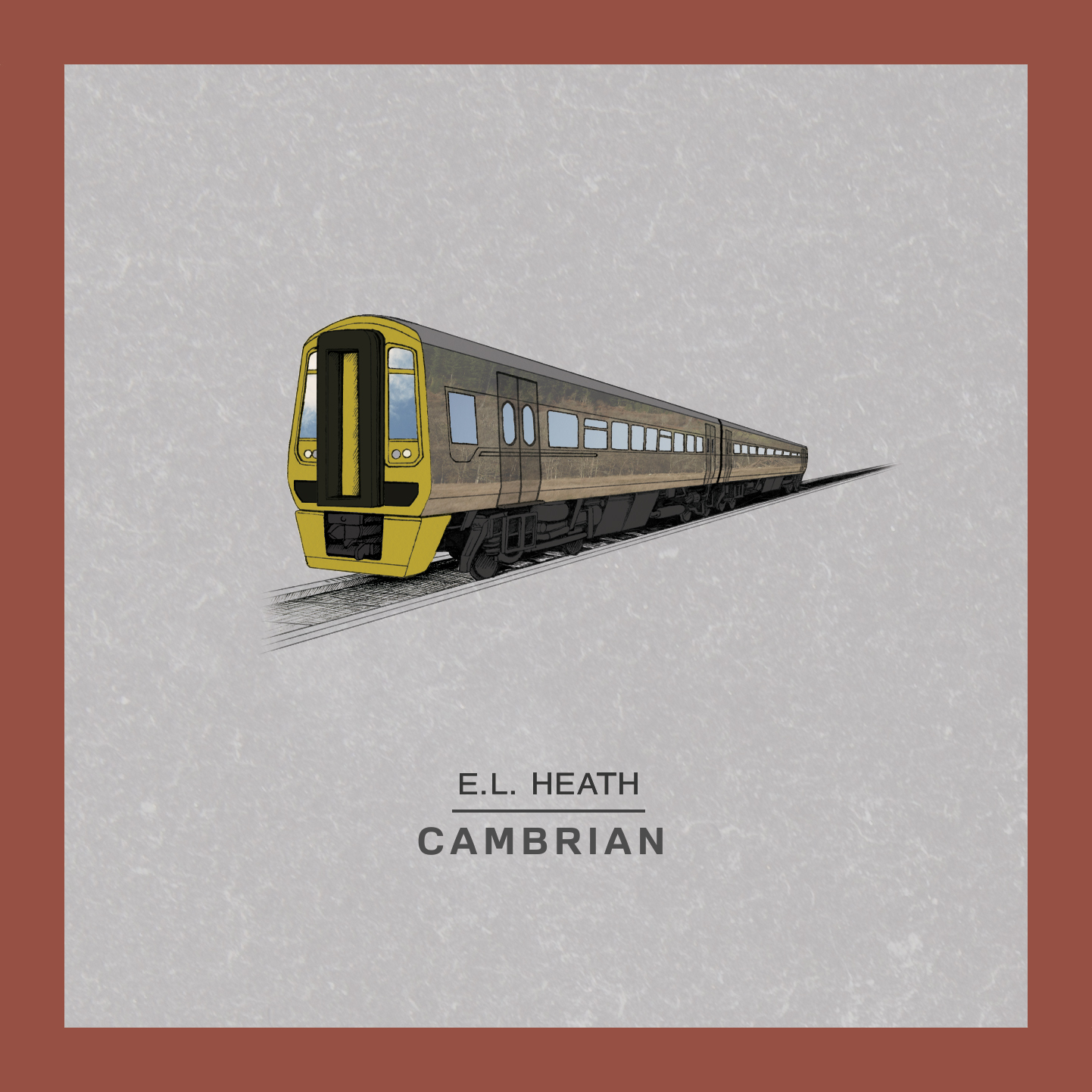
GUEST POST Singing the songs of the Cambrian Railway

Eric Loveland Heath has turned his fascination with the Cambrian Railway into a CD of songs.

I’ve lived near to railways much of my life. As a young child, I remember crossing a bridge near to my home in Clapham, south London, which spanned a fair number of lines, each running strictly parallel. I was fascinated by these, and the trains which ran along them, often running up to it if I heard a train coming, or standing for a while trying to catch sight of one before it passed underneath, the first seeds of a lifetime interest in railways and their trains.

When my family moved to Snailbeach in rural Shropshire, our gardenponte backed onto the old Snailbeach District Railways line, which was by then little more than a track down towards a field. Originally it linked the lead mine at Snailbeach with the main line at Pontesbury, however by 1950 all traffic had ceased, with the remaining locomotives cut up for scrap. 

Some 10 years later, we moved down into the valley, and once again I could hear the trundle of passing trains, looping through Yockleton only a mile or so in the distance, on their way to Shrewsbury or Mid Wales. I sometimes used to run or ride my bike down to the crossing there, the vision of every child who has seen public information films on the matter – STOP LOOK LISTEN – and what would happen if you did not.

Where I live now, the same line passes along the other side of the valley from my house. This is the ‘Cambrian Line’, which splits at Dovey Junction and leads either to Aberystwyth or along the Cambrian Coast Line to Pwhelli. It’s an epic journey (around 3 ½ hours) with much of it spent facing the sea, the huge curve of Cardigan Bay ever present as it bends towards the LlÅ·n Peninsula. For much of this journey, the line remains exposed, and while flooding is a common issue, occasionally the line itself is washed away. 

Only recently it was closed for a number of months in order to renovate the famous viaduct at Barmouth. At these times, as with much of life around the communities which span this line’s route, journeys are made by bus. 

At best, the line itself has a bi-hourly service, which is less conducive to travel than hopping on and off a bus. A proposed hourly timetable for the summer months only has brought little cheer, as it gives the impression that such a service is only needed when the tourists come.

I’ve been fascinated by this line whenever I’ve travelled along it. You can walk from Barmouth, across the viaduct, passing the pretty station at Morfa Mawddach (formerly Barmouth Junction) which stands at the head of the Mawddach Trail – itself a former railway line – which leads down the estuary, terminating at Dolgellau. 

If you decide to continue along the coast, you’ll reach Fairbourne, a village built by an Englishman where no Welshman would. Currently the inhabitants of this low swept village find themselves in a quandary, as the piles of giant stones placed to protect it from the sea are not seen as viable, with the suggestion that the entire place could be “decommissioned” and returned entirely to the salt marsh.

Often journeys along the ‘Cambrian’ give glimpses into the lives lived through these trains (currently Class 158 DMUs which are due to be replaced in the coming years). I’ve seen someone get on with a pig, and another with a chicken. I’ve watched a schoolkid get off the train at one of the tiny halts along its route, get into her dad’s Land Rover and power up the side of a hill. 

In the summer the trains are hot and crowded with tourists, in the winter you can watch solitary seabirds feed amongst the marshes. At Dovey Junction, on the Aberystwyth line, you can observe an Osprey on its perch at the nearby Dovey Osprey Project.


When I learned that the Class 158s were to be replaced, in the midst of lockdown, my heart sank somewhat. I’ve watched these old workhorses more than half my life. I’ve sat on countless and watched a few (in their green Arriva Trains Wales livery) blend into the distant landscape, lit only by their tail lights, and wanted to capture this feeling, and this curious and tenuous line along which these trains run.

Eventually this formed into a collection of songs, marrying these thoughts with the harsh reality of coastal erosion, with its effects on landscape and community, entitled ‘Cambrian’. It’s something I’m incredibly proud of, from the artwork to the songs themselves, it was pieced together at home with my partner Victoria over the last few years.

‘Cambrian’ is released tomorrow, Friday 7 July, on Wayside & Woodland Recordings, available through their Bandcamp site on CD (in a beautifully printed digipak sleeve) and as a digital download. 

On Friday they will also be premiering the official video for the title track ‘Cambrian’, drawn from archive Hi8 footage recorded over many years at locations along the line.

You can follow Eric Loveland Heath on Twitter and Instagram.

Monday, March 25, 2024

101 Charles Darwins gather to boost campaign against Shrewsbury's North West Relief Road

As local government in England subsides through lack of central funding, the Conservatives running Shropshire become more determined to build an environmentally damaging road - the Shrewsbury North West Relief Road - even though it's by no means clear that the funding for it is in place.

The people campaigning against the road have highlighted one of the many trees that will be felled if it goes ahead. That tree is estimated to be 550 years old, and the campaigners have christened it the 'Darwin Oak' because the Darwin family lived nearby.

They reason that Charles must have known it, even climbed it, as a boy. He certainly investigated the geology of nearby quarries as a young man.

On Saturday, 101 people dressed as Charles Darwin assembled by his oak to publicise the campaign against the road. And here they are.

Thursday, March 14, 2024

Alstom will run trains from Euston to Shrewsbury and Wrexham


The French rolling stock manufacturer Alstom has been revealed as the company behind the planned open access railway between Euston, Shrewsbury and Wrexham.

An announcement on the company's website says:

The proposal envisages a service of five trains per day in each direction Monday to Saturday, with four travelling both ways on Sundays. 

Trains will stop at Gobowen, Shrewsbury, Telford Central, Wolverhampton, Darlaston, Walsall, Coleshill Parkway, Nuneaton and Milton Keynes on their journey between Wrexham General and London Euston.

It also says that the service, which will be known as the Wrexham, Shropshire and Midlands Railway, could be begin as early as next year, though it's not clear whether the scheme has yet been formally approved.

And, most importantly, I will be able to change at Nuneaton for a direct train to Shrewsbury.

As I speculated in an earlier post, these trains will use the freight-only line through Sutton Park to get from Coleshill to Walsall.

Here is a photo of Sutton Park station in Sutton Coldfield, taken in 1982 when it was still standing and in use as a Post Office depot. The photo above, as it will tell you if you hover your cursor over it, shows Shrewsbury station.

Wednesday, January 31, 2024

Helen Morgan welcomes plans for new London to Shrewsbury and Wrexham rail service


The Shropshire Star reports:

The new Wrexham, Shropshire and Midlands Railway Company (WSMR) is proposing to bring back a direct service to and from London in 2025.

The plan would see new, daily train services between Wrexham General and London Euston, serving existing rail stations at Gobowen, Shrewsbury, Telford Central, Wolverhampton, Walsall, Coleshill Parkway, Nuneaton and Milton Keynes Central.

WSMR intends to be an ‘open access’ train operator which is wholly commercial and does not require government subsidy.

And Time Out quotes Helen Morgan, the Liberal Democrat MP for North Shropshire, welcoming the proposed new service:

"One of the main issues on the doorstep here in north Shropshire is the lack of decent public transport links. A new link between Wrexham, Gobowen, Shrewsbury and London is very good news, and will bring an important improvement to our links with other areas.

"This is also an exciting prospect for Oswestry, which is set to be connected to Gobowen by rail in the coming years.

"They could see the benefits of additional services to Shrewsbury and Wrexham as well as to London Euston, making the case for reopening the line even stronger."

A similar open access service, the Wrexham and Shropshire, operated between 2008 and 2011. You can see one of their trains above and read the post I wrote after catching it.

Looking at the new service's proposed list of stops, I wonder if they plan to use the freight line through Sutton Park to get from Coleshill to Walsall.

Sunday, January 14, 2024

Mental Hospitals: Another column for the Journal of Critical Psychology, Counselling and Psychotherapy


More about the JCPCP on the Egalitarian Publishing site. I've slightly lost the thread of which issue which column has appeared in, but this one came out some time last year.

I reviewed The Premonitions Bureau on this blog.

Sighcology

The hospital consumed 865 pints of milk per day. The grounds were infested with feral cats, which were a source of ringworm. There was a single post box, by the front door, for patients, staff and the hospital itself, which was often full to overflowing, meaning that letters often went missing. Nurses smoked constantly, in part to block out Shelton all-pervading smell: of a house locked up for years, in which stray animals had occasionally come to piss. The kitchen had a butcher with an attitude problem and the laundry sometimes went wrong, meaning that patients were forced to wear socks shrunk to half their normal size.

That’s Sam Knight writing about Shelton Hospital, Shrewsbury, in the 1960s in his The Premonitions Bureau. 

And could anyone agree what such county asylums were for? Was it cure? Containment? Elimination?

Around a dozen people died every month at Shelton, mostly from old age. But every few weeks, someone would throw themselves out of a bathroom window, or hang themselves from a tree by the cricket pitch, or escape and throw themselves in front of a car. The primary means of discharge was death.

******

It was Enoch Powell, as a health minister in Harold Macmillan’s government, who brought the questioning of the need for these strange institutions into the political mainstream. In a speech to the National Association for Mental Health in 1961, emboldened by the promise of newly introduced psychiatric medication, Powell talked of his desire to see greater provision of community care for mental health patients.

He estimated that the number of psychiatric beds could fall by 75,000 within 15 years, with the result that many institutions would no longer be needed. He emphasised that their buildings were not fit for purpose and should be closed rather than found other functions.

Powell continued in what one wishes were the words he is best remembered for:

"This is a colossal undertaking, not so much in the new physical provision which it involves, as in the sheer inertia of mind and matter which it required to be overcome. 

"There they stand, isolated, majestic, imperious, brooded over by the gigantic water-tower and chimney combined, rising unmistakable and daunting out of the countryside – the asylums which our forefathers built with such immense solidity to express the notions of their day. Do not for a moment underestimate their powers of resistance to our assault."

******

Why did these hospitals have those gigantic water-towers and chimneys? Dr Claire Hilton, the historian in residence at the Royal College of Psychiatrists, once discussed the question on the college’s website.

One reason was the institutions’ remoteness, whether this was dictated by a Victorian faith in the restorative powers of country air or a more 20th-century desire to hide the unfit away. It meant they often lacked mains water – many villages were not connected until after the second world war – so pumping water up to a storage tank at the top of a tower was the only way to ensure a sufficient and reliable supply. And the size of the asylums, which might have over 2,000 residents, dictated that those tanks would be huge.

Hilton quotes an 1894 book on the management of asylums as recommending the water tower be at least 20 feet higher than the highest part of the rest of the building and the tank capacious enough to hold at least 48 hours' supply. And in those days, the pumping this entailed meant the hospital needed a powerful steam engine – hence the chimneys.

The water supply had another use: fighting the fires to which their conditions made these buildings vulnerable. Many asylums, says Hilton, formed their own fire brigades of staff and patients.

******

If you had an engine in steam every day, then you got through a lot of coal. And that coal had to be brought to the hospital, often over inadequate rural roads. The solution many hospital boards and councils came up with was a railway: sometimes a whole complex of lines.

In 1896 the London County Council purchased the Horton Estate in Surrey with the intention of building a cluster of mental hospitals and other institutions there. A railway system, linked with the main line, was built to carry materials for the construction of the hospitals and then carry the coal and other goods they required for day-to-day operation. The cluster, naturally, had its own power station.

In the 1920s the volume of coal and coke delivered to the power station, and to glasshouses at one of the hospitals, reached a peak of 15,000 tonnes per year.

This railway system was little used during the second world war, when some of the hospitals were given over to wounded and recuperating soldiers, and it was scrapped not long after hostilities ceased. But before it closed, enthusiasts in sports jackets and flannels came to photograph the operations for railway magazines. It is said you can still find traces of the lines among the housing estates, private roads and golf courses that now occupy the Horton Estate.

******

By 1968 Shelton had long relied on the Shropshire Fire Brigade to fight its fires, but whatever fire-prevention measures it had in place that year failed. Soon after midnight on 26 February, a blaze broke out and 21 female patients died.

An investigation found staffing at Shelton to be ‘on the low side’, the night staff had no training in evacuation and locking patients into wards was accepted practice. The Shrewsbury Fire Brigade reported that the 10-minute delay between a night nurse discovering the fire and the alarm being raised contributed to the death toll.

In The Premonitions Bureau Knight says:

The fire alarm system, which had been installed in 1962, was tested every day at noon. Three large bells and a siren, mounted on the hospital roof, sounded across the grounds. But barely anyone knew how it worked.