"Well written, funny and wistful" - Paul Linford; "He is indeed the Lib Dem blogfather" - Stephen Tall "Jonathan Calder holds his end up well in the competitive world of the blogosphere" - New Statesman "A prominent Liberal Democrat blogger" - BBC Radio 4 Today; "One of my favourite blogs" - Stumbling and Mumbling; "Charming and younger than I expected" - Wartime Housewife
When I first discovered Iain Sinclair he was obscure enough for me to feel I had him largely to myself. That notion encouraged was by the fact that his early novels – my first was White Chappell Scarlet Tracings – were published in Uppingham by Mike Goldmark.
But that was 40 years ago. Now psychogeography is no longer a novel idea and its big beasts are getting distinctly long in the tooth. So this conversation between Sinclair and Alan Moore, who has fished in the same waters, has a valedictory touch.
I used to count Moore, along with Jeremy Seabrook and Ray Gosling, as part of a post-war Northampton working-class renaissance. Now I've discovered Henry Bird, I may have to move back the date of its commencement.
Thanks to John Rogers for posting this – you can find the earlier video he refers to on this blog too. John has a Patreon account to support his videos and blogs at The Lost Byway.
This East London walk takes is into the surprising hidden corners of the London Borough of Hackney. Our urban stroll explores the historic areas of Shacklewell and De Beauvoir Town, both with rich and fascinating histories. Starting on Mare Street we follow Amhurst Road to Shacklewell Lane and the site of Shacklewell House which had been an important country house from at least the 16th century.
We then take a look at the Somerford Grove Estate designed by Frederick Gibberd in the late 1940s and winner of a prize at the Festival of Britain of 1951. Crossing Kingsland Road we then wander the streets of one of London's most beguiling hidden neighbourhoods, De Beauvoir Town. Developed in the 1830s this Victorian area was saved from demolition in the 1960s and remains one of London's true hidden gems.
It didn't make this YouTube blurb, but towards the end we also see the home of the Hackney Mole Man, who was made famous by Iain Sinclair.
Jago Hazzard posted this, his thousandth video, a couple of weeks ago. And he found a fitting subject for it.
Iain Sinclair once referred to "the bat-chewed pinnacles" of St Pancras, which struck me as exactly right. Old St Pancras church and its churchyard are well worth visiting if you have time to kill at the station. The Beatles went there on their Mad Day Out.
Backlisted has devoted a second podcast to David Seabrook's book on Kent, All the Devils Are Here.
Iain Sinclair wrote about it for the London Review of Books when it was first published in 2003:
His book, the first to do justice to the transcendent weirdness of this boot of land that isn’t London, should be treasured. By living so long in the immediate past, by digging and listening and making the phone-calls, Seabrook has hallucinated an alternate English history.
Margate Sands as the pivotal moment for Modernism, nothing connected to nothing. The Mystery of Edwin Drood not so much solved as rewired: John Jasper as schizophrenic dreamer, the paradigm for Stevenson’s Jekyll and Hyde, the divided man of future gothic. Artist/driller killer. Choirmaster/opium addict. A De Quincey stalker who rehearses his crimes in drugged sleep, thereby infecting Richard Dadd. So that the site of the murder is more significant that the identity of the murderer.
Dig through the rubbish of seaside junk pits and pinball arcades, Seabrook suggests, read the shilling-shockers, and the pattern will reveal itself. English fascism hidden in the pages of John Buchan. A schoolteacher living in retirement who remembers William Joyce as a benevolent father.
Schuyler Mitchell argues that the national security state is a wonderful tool for a skilled authoritarian to crush American democracy: "If you tell an FBI agent to proactively go out and find anarchists, violent extremists, before they can act, they’re going to look for someone with that ideology. Now you have Trump telling people to go out and look for antifa, which means they can be opening assessments on people who they, for whatever reason, feel have this nebulous, broad ideology."
"Arendt did not strive for consensus – in her view, politics had to be antagonistic and, if needed, controversial. What mattered most was the act in itself. Her whole body of work could be summarised as a call to democratic action. Speak, criticise, engage with others – do anything you can to avoid the peril of silence, and the temptation of violence." Marc Le Chevallier elucidates Hannah Arendt's belief that open dialogue and debate are vital to the health of democracy.
Justin Kadi explains why Vienna has been described as "a renters' utopia".
"He took inspiration from the deluge of countercultural books in the 1960s concerning earth mysteries, typically trying to decode the neolithic constructs of Silbury Hill, Avebury, and the stones of Cornwall. With a Blakean grandness fuelled by a quasi-Situationist eye, he sought to establish a sacred geometry to link the Hawksmoor churches together." Robert Davidson talks to Iain Sinclair to mark the 50th anniversary of his influential book of poems Lud Heat.
Colin Burrow reviews a biography of Muriel Spark and the first volume of her collected letters: "By 1963 she had arrived. She was rich enough to buy green and blue Hermès suede gloves in Paris. She was also suave enough to conceal beneath those gloves (most of the time at least) the knuckle-duster with which she had established herself as a Famous Author."
Modernism in Metroland on Maxwell Fry and the rise of the high-street electricity showroom.
"We don’t have a political system, more like the US, where people are more empowered to act for their area, to act independently. I think the British political system and MPs individually would rise in the public’s esteem if they were able to act with more independence on an everyday basis and say what they really feel. Maybe we’d have a more vibrant political debate if people went into interviews and said what they were feeling, as opposed to what they’ve been told to say." Andy Burnham talks to Hardeep Matharu from Byline Times.
Stewart Lee once described Twitter as "a state surveillance agency staffed by gullible volunteers". Jason Koebler and Matthew Gault come to much the same conclusion about more recent developments: "The CEO seemingly having an affair with the head of HR at his company at the Coldplay concert is a viral video for the ages, but it is also, unfortunately, emblematic of our current private surveillance and social media hellscape."
Gary T. Gunnels reviews Hayek's Bastards by Quinn Slobodian: "Slobodian’s central thesis is that Hayek’s intellectual edifice, rooted in his arguments for spontaneous order and market mechanisms, has been warped by a group of unwanted 'bastards' into a justification for a racially hierarchical social order."
Kate Moore argues that, for many people, ageing means lost independence in a digital online world built without them in mind."
"I first heard of Baron from Iain Sinclair's description of him (and Gerald Kersh) as being amongst 'the Reforgotten' – British writers brought back in and out of fashion over the decades." Discontinued Notes on Alexander Baron.
Kelefa Sanneh considers the strange persistence of prog rock: "The genre’s bad reputation has been remarkably durable, even though its musical legacy keeps growing. Twenty years ago, Radiohead released 'OK Computer,' a landmark album that was profoundly prog: grand and dystopian, with a lead single that was more than six minutes long. But when a reporter asked one of the members whether Radiohead had been influenced by Genesis and Pink Floyd, the answer was swift and categorical: 'No. We all hate progressive rock music.'"
No psychogeographic rambling with John Rogers this month: rather, a visit to a single church to hear about the plans for its restoration.
But then St Anne's, Limehouse - the Cathedral of the East End - is one of the Nicholas Hawksmoor churches that inspired the London writings of Iain Sinclair and the Peter Ackroyd. The latter's Hawksmoor remains a terrifying novel.
I once went to a comedy performance in the crypt of another Hawksmoor church - St George's, Bloomsbury. Sitting there, I couldn't help being aware of the tremendous weight of stone above our heads, but Hawksmoor obviously knew what he was doing as I'm here to tell the tale.
"Al-Fayed died before he could face justice but imagine how many women’s lives would not have been ruined if anti-SLAPP legislation had been in place and journalists had been able to report freely on the case," Labour MP Joe Powell tells Gareth Davies et al. from The Bureau of Investigative Journalism.
Aaron Rabinowitz says we need to talk about men: "Trump has doubled his share of Black male voters, and across all racial demographics his gains were highest among younger men. As always, problems like this are intersectional and multifaceted, but one of the crucial facets we need to discuss is clearly the persistent problem of disaffected men."
"For the last decade, the question of who gets to interrogate historical questions, and why they are motivated to do so, has become very fraught in Britain. And the topics that have become most central to this controversy are the British Empire, British imperialism, and ideas about race, identity and belonging in the British nation." Charlotte Lydia Riley reflects on recent controversies in history and the emotional register of the debate.
"In The Secret Agent, you go from a shop in Soho into a space like Greenwich Park, where the bomb incident takes place – quite an interesting journey in itself – and then, at the end, there’s an extraordinary marching-away into the suburbs of one of the characters who walks through endless anonymous, curious areas." Iain Sinclair chooses five favourite London novels.
Tanya Lynch visits the Poetry Pharmacy in Bishop's Castle: "From the moment I stepped inside this Aladdin’s Cave, I was immersed in a world where poetry and books are the ultimate remedy for the soul. Shelves lined with carefully selected publications, pages that invite you to lose yourself in their rhythm, and beautifully designed stationery, that makes you want to pick up and a pen and start journaling your heart out - honestly this store is a bibliophile’s paradise.
Northampton's history doesn't get the attention it deserves, says Mike Ingram, plugging his book in an interview with Northants Live.
The building he talks about in particular is the working men's club in St Giles' Street. That's the club we saw John Rogers and Iain Sinclair discuss in a video recently. The one I used to play chess for in the national club knock-out cup.
Ingram says the club was established in 1863 to provide evening classes and was intended to be "a diversion from public houses".
It was the idea of the Rev Robson from St Giles' Church in Northampton, and he secured a donation from George Whyte-Melville to help fund it. Whyte-Melville was the author of numerous sporting novels, one from 1861 entitled Market Harborough.
There is a pub named after him at Boughton, a village near Northampton, and the club he helped finance was still known to members as "The Whyte-Melville" in the days when I pushed a pawn there.
The club lost some of its early high-mindedness, and alcohol was sold from 1869. At the same time the management of the premises was handed over to the members' committee.
Ingram told Northants Live:
"Numbers shot up and [it] was soon boasting a number of societies (at least one still survives) and a debating club.
"By 1893 it was regarded as a hotbed of Liberalism."
There's a moral there about the importance of self-government (and alcohol).
I agree with Mike Ingram that Northampton deserves more attention from the historians. His book Northampton: 5,000 Years of History is on Amazon.
Four Tops star says hospital put him in straitjacket and ordered psychological examination after not believing he was famous singer
I thought it too serious for my Headline of the Day Award, though 'funny' headlines often stop being funny if you think about them for more than a moment.
But this story did make me think of several things.
The first was a description of Shelton Hospital, Shrewsbury, in the 1960s:
The hospital consumed 865 pints of milk per day. The grounds were infested with feral cats, which were a source of ringworm. There was a single post box, by the front door, for patients, staff and the hospital itself, which was often full to overflowing, meaning that letters often went missing. Nurses smoked constantly, in part to block out Shelton all-pervading smell: of a house locked up for years, in which stray animals had occasionally come to piss. The kitchen had a butcher with an attitude problem and the laundry sometimes went wrong, meaning that patients were forced to wear socks shrunk to half their normal size.
That comes from Sam Knight's book The Premonitions Bureau, which I still heartily recommend, and I first quoted it in a column I wrote for the the Journal of Critical Psychology, Counselling and Psychotherapy.
Yes, mental hospitals are strange and intimidating places, particularly the old county asylums like Shelton.
I once went to meet a psychologist at Queen's Park Hospital, Blackburn, in the course of my old day job. The signage for the clinical psychology department ran out before I got there, so I had to ask someone the way.
I had visions of the conversation going: "I'm from the British Psychological Society." "Of course you are, dear. Come with me." (When I told this story back at the office, my colleagues kindly said they would have denied all knowledge of me if the hospital had rung them up.)
So how do you show you are sane in such a strange place? Alexander Morris, who is the lead singer of the current incarnation of the Four Tops, struggled to do it and I think I would have too.
But don't just take our word for it. Here is the beginning of the abstract of a famous paper on the subject - the second thing the headline made me think of:
It is clear that we cannot distinguish the sane from the insane in psychiatric hospitals. The hospital itself imposes a special environment in which the meanings of behavior can easily be misunderstood. The consequences to patients hospitalized in such an environment - the powerlessness, depersonalization, segregation, mortification, and self-labeling - seem undoubtedly countertherapeutic.
That paper is On Being Sane in Insane Places by David l. Rosenhan, which was published in Science in 1973.
The paper itself is behind a paywall, but you can read a more lay account of the experiment it describes by Rosenham on The Wayback Machine. And that experiment has its own Wikipedia entry - Rosenhan experiment:
In the first part, psychiatrically sane people said they heard hallucinations, to get admitted to a psychiatric ward. This was done to test how the psychiatric hospitals would react. The second part was the reverse. Rosenhan told the hospitals, he would send fake patients. But he did not send any fake patients.
The results of the study were very controversial. When Rosenhan sent the people, the hospitals were unable to detect them. On the other hand, when he told them he had sent some patients, but really did not, the hospitals recognised a large number of fake patients. The study said that it was impossible to tell a difference between the sane and the insane.
And the third thing the headline made me think of was a story about a therapeutic poetry study group in a hospital on the Isle of Wight where an elderly patient rightly declared that, years before, he had written one of the poems they were studying.
I found it in a piece by a hero of this blog, Iain Sinclair:
[David] Gascoyne's rescue, his return to life in the suburban house on the Isle of Wight, was brokered by two remarkable people. Judy Lewis, a vet's estranged wife, who read his "September Sun: 1947" to a depressed group at Whitecroft Hospital, provoked the previously mute writer to speech. "I am the poet." "Yes, dear. I'm sure you are." But it was true. He was the poet and it was always 1947. He became a living quotation recovered from a midden of fragments: "All our trash to cinders bring." There was to be a notable late flowering for the willowy and disconsolate figure in the bow tie, the time traveller from the 30s. Gascoyne married Judy. He had found his loving companion and chauffeur.
You can read more about David Gascoyne in his Wikipedia entry.
As I said, Alexander Morris is the current lead singer with the Four Tops, but I've gone back to the band's glory years for my choice of video above.
I'm not sure his predecessor would have faired any better though:
"We've got a patient here who says he's Levi Stubbs."
My latest video from John Rogers is a real treat. John and the daddy of psychogeography, Iain Sinclair, visit Northampton and walk its streets so that Sinclair can visit Alan Moore.
I have been to several of the sites they visit and can help on a couple of points.
St Peter's is looked after by the Churches Conservation Trust, and it is some years since I have found it open myself.
The trust has been restoring the historic pub next door to the church with a view to moving its national office there. Perhaps the church will be open more often when that work is finished.
But I did get into the church in 2011, and here is the Green Man John Rogers and Iain Sinclair were looking for.
The other thing I can help with is the working men's club where the armed man turned up.
I can say with some confidence that the Whyte Melville club was far too respectable for that.
Around 1990 I occasionally played chess for Northampton Working Men's Club. They took part in the national club knock out championship, which was something the Market Harborough team did not aspire to.
The building where we played in Northampton was often referred to as "Whyte-Melville" because George [Whyte-Melville] had founded it.
While it would be nice to be able to make your opponent a draw offer he can't refuse, in my experience chess and firearms rarely go together.
John Rogers has a Patreon account to support his videos and blogs at The Lost Byway.
The obituary for Rigby Graham quoted at the beginning of this video describes him as an "irascible painter whose idiosyncratic landscapes are among the 20th century's best".
Though I met Graham as a teenager, I never experienced that irascibility, but I agree with the obituarist's judgement of his work. I wonder that Graham is not better known, even wildly popular.
In the video, the gallery's owner Mike Goldmark, who published Iain Sinclair's early novels at Uppingham, talks about Graham, his art and his working methods.
I visited Uppingham - Rutland's second city - on Thursday. When I came to file away the photos I had taken, I was surprised to find I was last in the town in December 2016.
Because Uppingham used to be a town of second-hand bookshops, with the result that I went there regularly. On Thursday I found none of them still trading.
The photograph above shows Don Paddy's, a wine bar and coffee house on the Market Place. But I can remember when the first floor of the building was occupied by a bookshop. And if you doubt me, a little exploration of the area will yield this frieze of books, that marks what used to be the rear entrance to the shop.
Goldmark's is still there in Orange Street, but no longer sells books from its extensive premises. These days it concentrates on selling 20th-century British art and is well worth a visit if that's your taste. Mike Goldmark, its owner. has also been a publisher and brought out Iain Sinclair's early novels.
There used to be another bookshop in Orange Street and, after taking local advice, I can say it was in this modern building. I remember fishing a Roger Fulford paperback on Queen Victoria's Wicked Uncles out of the bargain box here once.
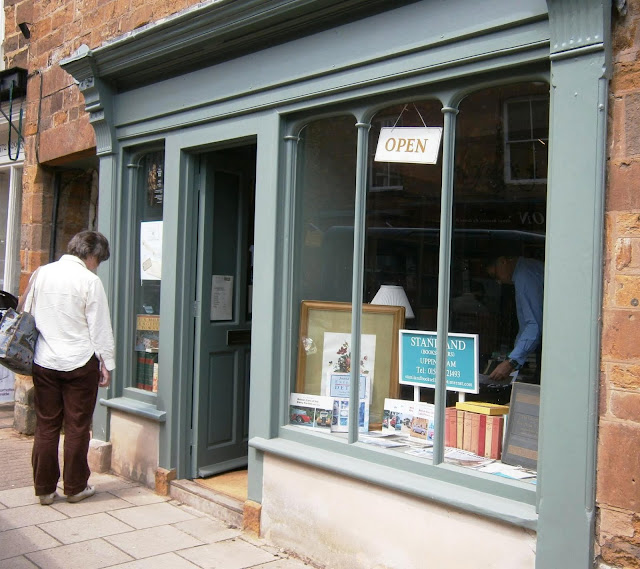
I looked for Staniland Books in High Street East, where it had moved from Stamford in 2011 or thereabouts, only to find the shop empty. The photo below was taken when it was still very much open.
On to High Street West and what used to be Forest Books, a shop that used to go back and back forever. It was the people in the print shop who told me where the other shop in Orange Street used to be.
They also told me of another shop in Uppingham that used to sell second-hand books and records that I can't place, so this post is clearly not a comprehensive list.
And, a few doors down, I wasn't surprised to find that The Rutland Bookshop wasn't trading. Over the years, a fair percentage of my collections of T.H. White and Richard Jefferies came from trips up the narrow staircases to its upper floors.
But let's end on a hopeful note: this sign was in the shop's window.
Our latest walk with John Rogers finds him accompanied by the daddy of psychogeography, Iain Sinclair, and Stephen McNeilly of the Swedenborg Society.
Together they follow the footsteps of 18th-century Swedish scientist, philosopher and mystic Emanuel Swedenborg.
The blurb on YouTube says:
Our walk starts in Warner Street Clerkenwell where Swedenborg had his most famous vision in a Chop House. We then walk on along the course of the River Fleet to Bakers Yard / Cold Bath Square where Swedenborg died in 1772.
From here we walk along Saffron Hill and Hatton Garden to Fetter Lane, the site of the Moravian Chapel that Swedenborg attended.
Our Swedenborg walk takes us along Fleet Street and up Ludgate Hill to Paternoster Square linking together a series of locations associated with Swedenborg's publishing and writing career.
We then head out to East London, passing along Leman Street, Cable Street, past Wiltons Music Hall to Swedenborg Gardens where Swedenborg was buried in the Swedish Church.
When The Hardy Tree in Old St Pancras churchyard came down last December, I dutifully repeated its accepted history:
When the Midland Railway built its line from Bedford to St Pancras, part of the churchyard of Old St Pancras Church was sacrificed to make way for it.
The man in charge of clearing the burials in the path of the line was a young Thomas Hardy. It's no wonder his novels turned out like they did.
Hardy had some of the redundant gravestones piles around the base of an ash tree in the remaining portion of the churchyard, and its roots later spread amongst them. It is this tree that has fallen.
But the current issue of Fortean Times suggests that Hardy had nothing to do with the tree and that this story dates from the late 20th century.
In support of its scepticism, the magazine cites an article on The London Dead:
There is no evidence that Hardy had anything to do with the tree named after him but even so I had, like most people, assumed that the gravestones had been arranged around the tree in the first place.
It was with something of a jolt therefore that I came across a photograph of "St. Pancras churchyard and it’s disturbed gravestones" in 'Wonderful London' a book edited by St. John Adcock and published in 1926.
The caption to the photo mentions the Midland railway Company obtaining an Act in 1863 allowing them to build a viaduct over the churchyard and says "the rockery made of tombstones is a result of the headstones being removed and 'dumped'".
The photograph shows the familiar circular arrangement of headstones but with one significant difference; there is no tree!
In 1926 the Hardy tree did not exist. The tree, presumably self-seeded, has grown since the late 1920’s and is less than one hundred years old.
The article goes on to quote an account by Hardy of his work at Old St Pancras that makes it clear he was not in charge of the exhumations but merely dropped by in the evenings to keep an eye on progress.
So where does the legend of Hardy and his tree come from?
The London Dead says:
In ‘Lights Out for the Territory’ Iain Sinclair tells us that he was working on a long London poem provisionally entitled RedEye and gives an extract from the abandoned work (‘May 16, 1973: at St Pancras Old Church. Drawn against the repetitive boredom of the pavements to investigate the building - its slight eminence....’) which goes onto to mention Hardy and his supervision of the exhumations and "his ever-recurrent interest in churchyards".
Later he describes the photographer Marc Atkin’s fascination with the Hardy tree "with its cluster of surrounding headstones - like a school of grey fins circling the massive trunk, feeding on the secretions of the dead."
This was in 1997 which is as close as I can get at this stage to the naming of the Hardy tree - sometime between 1978 and 1997.
It isn't just Sinclair and Atkin who had a deep interest in Old St Pancras in those years: Aidan Dun published a visionary poem about this corner of London, Vale Royal, in 1995. Like Sinclair's early books, it was published by Mike Goldmark in Uppingham.
I think it's from Dun – but I don't actually know; I just associate this with him - maybe I made it up? - that I heard a legend claiming that St. Pancras Old Church, stranded on its small hill behind the train stations next to the old London Hospital for Tropical Diseases, is actually the secret burial place of Christ.
The church, obviously, was built much later, as a means of marking the site - at the same time keeping silent its little secret.
I suspect The London Dead is right, and the legend of The Hardy Tree originated somewhere in this neo-Blakean, psychogeographic, Sinclairian school of literature. And the idea that his experiences at Old St Pancras had a profound on Hardy and thus his novels does seem to date from 1997 and Iain Sinclair's Lights Out for the Territory.
A walk with writer Iain Sinclair in Tilbury on the River Thames in Essex, exploring some of the territory covered in his forthcoming book The Gold Machine.
This fascinating Essex walk through Tilbury Town and along the Thames foreshore to the Bata Factory in East Tilbury goes to the heart of the landscapes that have inspired much of his work since his book Downriver published in 1990.
The Last London is an elegy for a London that is now over. The artists, the homeless, the eccentrics - the people Sinclair has always been on the side of - are moving out, or being moved out. The city seems to want him out too. He receives cards from estate agents urging him to "sell up, cash in, get out".
His children and grandchildren have been forced out by rising rents, part of the great London exodus to the coast: "Artists settling, mobbing like gulls at the tideline, after being expelled from their London warehouses and railway arches." (Sinclair himself bought a flat in St Leonards-on-Sea a few years ago, though he’s yet to sever the umbilical cord completely).
Global capital and political meddling have conspired to bring about, he concludes, "a strategic destruction of the local".
The Judith Stone stands, or squats, in a field near East Farndon, a Northamptonshire village to the south of Market Harborough in peril of being absorbed into Market Harborough. They call it Little Bowden Syndrome.
Geologists maintain that it is a glacial erratic - a stone differing in size and type from those found in the area because a retreating glacier left it there when the Ice Age went out of fashion.
Historians say Judith was a niece of William the Conqueror and was granted land hereabouts. And. as a local landmark, the stone was used as a boundary marker.
I visited it decades ago and was back there again today. I found the East Farndon Psychogeographical Society (Ovine Division) holding a meeting when I arrived.
Could I arrange for Iain Sinclair to come and address them? they asked. Or maybe John Rogers?
I also found that some joker had left a slice of a quartzite rock next to it.
John Rogers joins Iain Sinclair on a walk. The route takes them from Liverpool Street station through the City of London to the Thames, then east through Wapping to the street mentioned in W.G Sebald's novel Austerlitz at Stepney