Thursday, August 18, 2011

Voting in the Total Politics Blog Awards 2011 closes tomorrow

Click here to vote in the Total Politics Blog Awards 2011


Was there something you meant to do today?

Voting in the Total Politics Blog Awards 2011 closes at midnight tomorrow (Friday). Click on the button to go to the magazine's site and cast your votes.

If you did feel moved to cast a vote for Liberal England, I would be very grateful.

Leicester after the riots


Martin Brookes has taken some photographs of boarded up shops in Leicester following last week's riots. Seeing that a pound shop and shoe repair board shop were attacked does not encourage one to seek a sophisticated political explanation of those events.

The problem with Centre Forum's "five-a-day" parenting campaign

A few days ago I was down in London for a social media training day on the Robin Hood Tax, which I have never got around to writing about.

It took place near King’s Cross and I had to walk past the front of the station to get there. Among the busy crowds I saw a mother and father with two small children. The children each had a scooter and a safety helmet.

I took it as a perfect picture of modern parenting.

On the one hand, the parents do not feel confident enough to say no to their children. It is obviously a very bad idea for a child to try to ride a scooter among such a throng, but the parents did not feel they could say so.

Similarly, I am amazed by the number of mothers I see carrying scooters away from the local primary school in the morning. Whatever happened to mothers who said things like “I’m not carrying that all the way home, just so you can ride it to school”?

On the other hand, the parents feel a sense that their children are at dreadful risk. Yet on any objective view the idea that children on scooters need helmets, particularly when they can hardly move for the crowds, is simply ridiculous.

I thought of this vignette when Centre Forum published its call for a “five-a-day” parenting campaign – prophetically, if you see a parenting deficit as playing some parts in the genesis of last week’s riots. (There is a short news report about it on Children & Young People Now and you can download the full report from the Centre Forum website.)

You may recall that the five elements were for parents, every day, to:

  • read to their child for 15 minutes
  • play with their child on the floor for 10 minutes
  • talk with their child for 20 minutes with the TV off
  • praise them frequently
  • give them a nutritious diet.

There is nothing any sensible person could object to there, but the challenge we face goes deeper than this. It is how we encourage good parenting without leaving parents feeling even more disempowered than they do today.

Featured on Liberal Democrat Voice

Wednesday, August 17, 2011

The Bridges, Ratlinghope


After Stiperstones I got back on the bus to go round to Bridges. The pub here used to be called The Horseshoes and when I first went there it was, rather improbably, an Adnams pub. It is a long way from the Stiperstones to the Suffolk coast.

Now it has been renamed The Bridges and taken over by the people who run the Three Tuns Brewery in Bishop's Castle.

The pub has been thoroughly refurbished - the bar is now in its third different position since I first visited it some 15 years ago - and every table inside had been booked for Sunday lunch. But this did not matter as it was a sunny day (though look at that sky) and you can sit outside. In fact the best place to sit is the other side of the lane by the stream.

I am not an expert on the pub trade, but if you have bikers and pony trekkers drinking at the same time, you are probably doing all right.

And you will find a better selection of Three Tuns beers at The Bridges than you will even at the Three Tuns itself.


Tom Brake is wrong about retribution

According to BBC News:
Liberal Democrat MP Tom Brake said sentences "should be about restorative justice", not retribution.
I share the concern that some of the sentences being handed down after the riots are too severe. And, as I tweeted the other day, in the long run such sentences will undermine public confidence in the judicial system rather than reinforce it.

But I do not share the view, often expressed by liberals and apparently expressed by Tom Brake here, that retribution should not be a part of punishment. Because retribution - the idea that people must suffer because they have done wrong - is a necessary part of punishment for two reasons.

The first is that it hard to do justice our sense that the punishment should fit the crime without it. The feeling that some recent sentences are too severe presupposes that we know what a just amount of retribution would be.

The second is that dispensing with the idea of retribution makes it hard to explain why we should limit punishment to those convicted of a crime - particularly if we adopt the alternative approach of reforming people that is often espoused on the left.

After all, there are many of us who could do with being reformed, who could be better people. If we remove all idea of retribution from punishment it is hard to see why we should not seek to reform them too. Think of the way that Dr Barnardo took to stealing poor children from their parents because he operated without any constraints.

The alternative approach of restorative justice, which Tom Brake advocates, is attractive, if only because it promises to give young offenders a measure of moral education. They will be made to face the effect of their offending on other people and thereby, we hope, come to understand that it was wrong.

However, the concept is as yet poorly developed in Britain and, for adult offenders at least, I am not convinced that we can wholly separate it from retribution. Is there not some requirement on the offender to do things they would rather not do as part of restorative justice? After all, if a millionaire committed a crime, no cheque, however large, could satisfy the need for restoration unless it were accompanied by a sense that the offender had put himself to trouble in some way that he would rather not have done.

One other point while we are discussing the philosophy of punishment. When I studied philosophy at York 30 years ago, I do not recall the most popular argument in favour of imprisonment these days - that it keeps offenders off the street and prevents further offending - ever being used. There were Utilitarian arguments in favour of prison, but they were always couched in terms of deterring future offences by that offender or deterring others from offending.

Today prison is defended as a way of warehousing the wicked. I am not convinced that this represents progress in our moral thinking.

Headline of the Day

The winner, yet again, is the Shropshire Star:

Reindeer head is stolen from Wem home

Later: An honourable mention to the Bradford Telegraph & Argus for:

Consultation on Bradford heavy horses "was a sham"

Tuesday, August 16, 2011

Rumours of new Half Man Half Biscuit album

Not only that, but this post on Half Man Half Biscuit Lyrics Project board suggests that one of the tracks will be called "Descent of the Stiperstones".

Surely this is too good to be true?

Stiperstones Primary School


My first stop on the Shropshire Hills Shuttle was the village of Stiperstones. I wanted to have a coffee at the Stiperstones Inn and to see how the primary school was getting on.

As you can see from the photo above, it is convinced that its future is safe because it is entering a federation with  the school at Chirbury. I do hope these celebrations do not prove premature.

Six of the Best 180

In a powerful piece for Liberal Democrat Voice, Ewan Hoyle argues that our flawed drug laws were at the heart of the riots: "What if the only affluent men with big cars and ostentatious 'bling' living in these communities are the ones who have made that money by exploiting the drugs market? While the rare footballing and musical successes might up sticks and leave, the all too common drug dealer remains to demonstrate to all the children in the area that they can achieve wealth and power. They don’t need to work hard, train, or practise skills. They just need to fall in with the right gang and they’ll receive a cut of the spoils."

We should stop coddling the super-rich. Says who? Says Warren Buffett in the New York Times.

Liberal Vision fears we should be mourning the death of liberal Conservatism: "It’s clear that some of the policy prescriptions offered by Cameron are evocative of the draconian gimmickry of the last Labour government. And with that the Prime Minister seems to have traded in his liberal Conservative credentials for the return of the title 'Heir to Blair'."

Wonderland catches the Daily Mail photos "knowingly and commercially" using her photos, despite being denied permission to do so.

London Reconnections looks at the major renovation that, almost unnoticed, has been taking place at King's Cross: "Within the old parcel office can be found the space that will be occupied by the new station pub. This is a surprisingly large space, which contains some of the last remaining original timbers within the station."

But to find a really overlooked corner of London you must visit Postman's Park and its Memorial to Heroic Self-Sacrifice with Historical Trinkets (from whom I have borrowed this photograph): "The Memorial ... was the brainchild of artist George Frederic Watts and his wife Mary. The Memorial consists of a covered walkway with memorial tablets commemorating ordinary people who had given their lives whilst attempting to save the lives of others."

Duncan Hames and Simon Wright become PPSs

News reaches me from Cowley Street that two Liberal Democrat MPs have been appointed as parliamentry private secretaries.

Duncan Hames (Chippenham) has been appointed PPS to the Energy and Climate Change Secretary, Chris Huhne. And Simon Wright (Norwich South) has been appointed PPS to the Children and Families Minister, Sarah Teather.

Congratulations to both.

Sunday, August 14, 2011

Nick Clegg should be grateful that Lord Bonkers is less punitive than he is

I have been trying to write a post over the weekend arguing against the idea that the families of those convicted (apparently merely charged in some cases) of offences to do with last weeks riots should be evicted if they live in social housing.

Because I have not been well, this post never quite happened, but my basic argument would have been that, though I am something of a hawk when it comes to punishing rioters, it is unjust for one social class to be punished more heavily than another for the same offence. No middle-class family would lose its mortgage because a child got into trouble with the law, so no working-class family should face this sanction either.

So I was disappointed to read in the Observer this morning that Nick Clegg was supporting the evictions of tenants in social housing. The quotation in which he does so seems to have disappeared from the Guardian website, but you can find it in the Daily Mail:
'"f you go out and trash other people's houses, you burn cars, you loot and smash up shops - in other words, if you show absolutely no sense of respect to your own community - then, of course, questions need to be asked whether the community should support you in living in that community. 
"I think that is a perfectly fair question to ask, but how you apply it needs to be done in a case-by-case way. 
"The principle that if you are getting some support from the community, you are going to have to show some loyalty to that community is a really, really important one."
Nick, you may recall, was involved in a bit of lawbreaking himself in his younger days. He was lucky that the victim was a certain peer from Rutland who made no mention of evicting the Clegg family:
The pride and joy of my gardener Meadowcroft is his collection of rare hairy cacti. He gathers them from the arid south of Rutland and tends them in the way that a particularly attentive she wolf looks after her whelps.

I well remember his fury when a young whipper-snapper from Westminster School burnt down the glasshouse where he keeps them. My first reaction was to hand the lad over to the Proper Authorities, but learning that he was some sort of nephew of my (how shall I put it?) old friend Moura Budberg, I relented and dealt with the matter myself. I informed the errant youth that he would work for Meadowcroft until he had made full and proper restitution for the loss of the aforementioned prickly crop.

Over the years Nick Clegg (for it was he) has had himself elected to the European Parliament and the Commons, but he still comes to the Hall regularly to do odd jobs. (What with compound interest and the strength of the Rutland pound, debts can take a long time to pay off.)

This afternoon Meadowcroft and I find Clegg perched on a garden seat writing a speech. “Never mind being a scholard,” says my favourite horticulturalist, belabouring him with a broom, “get out and sweep up they leaves.” “I think Clegg has just left his comfort zone,” I observe as he rushes out to work in the garden.

Dando Shaft: Rain


Three years ago I wrote about the wonderful Polly Bolton. I was looking for a Dando Shaft track that featured her, but I liked this one best. The band must have recorded it before she joined them. The loose, rhythmic guitar playing put me in mind of Nick Drake.

I turned to Electric Eden, hoping to that Rob Young had written about them, but they get only a passing mention. But I did find that he now has a blog called Electric Eden too.

Saturday, August 13, 2011

Denis Compton, John Fothergill and Market Harborough

Today I picked up a copy of An Ambition Realised, a privately published memoir by Tony Hackett, who grew up in Market Harborough during World War II. Rather alarmingly, I recognise several figures in it from my teenage years in the 1970s.

Looking at the early chapters, two points of interest has struck me.

The first is that, in his benefit year, Denis Compton's XI played a benefit match here against Market Harborough. Compton himself scored a century and lit a cigarette as he walked back to the pavilion after eventually being dismissed. Hackett does not give a date for the match, but it must have been in 1949.

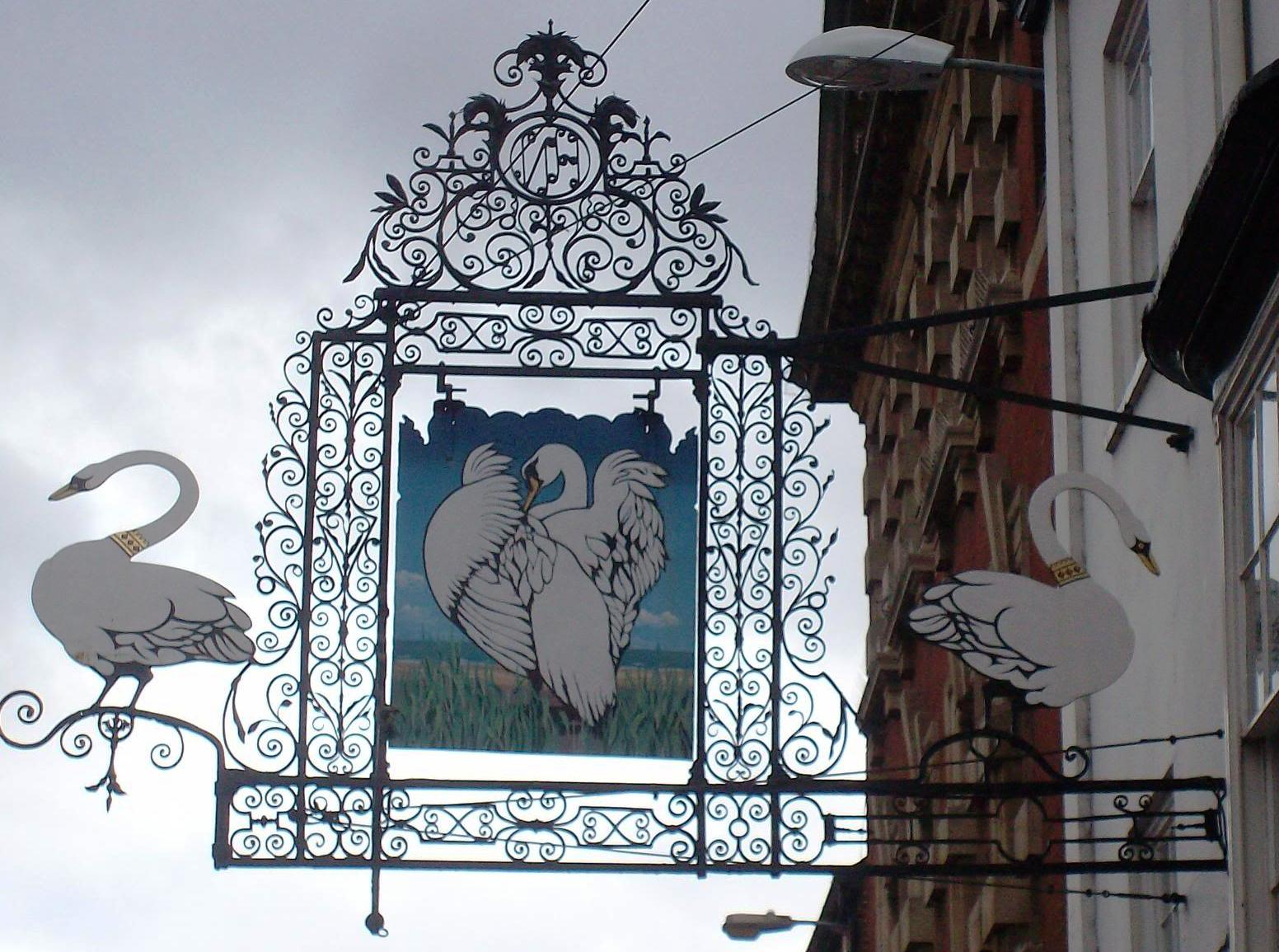
The second is that Hackett had dealings with John Fothergill at the Three Swans:
I delivered newspaper to the hotel and most days he complained that I was late with them. He usually dressed in a smock, often dirty, and underneath wore breeches, stocking and silver buckled shoes.
Someone else who was in Market Harborough at the time, Bryan Magee, remembered Fothergill in his Growing Up in a War:
What impressed me about him more than I can express was that he had written one of the books we had at home, An Innkeeper's Diary. He must have been the first author I met. Needless to say, I had not read the book, but I was familiar with it as an object, and knew that it was about the job I was seeing him doing, namely running a hotel. 
He must have been the best-known hotelier in Britain at that time, because his book had been a best-seller in the thirties and was currently in Penguin Books at a time when Penguins were the only mass-circulation paperbacks. 
I saw him as an outlandish figure. He wore his hair to his shoulders, and buckle shoes, and went out of doors in a cape, none of which I had seen a man do before. Yet he was not effeminate. He had a wife and two sons, and was very much the boss, both of his family and of the hotel. 
He spoke to everyone in a direct way that I found disconcerting. He was simply saying what he thought and felt, but I had never heard anyone do that. If he thought you had an ugly face he told you so. Sometimes you could scarcely believe your ears. ... 
But some of the most interesting things about him were things I did not know, and would not have understood. He had been a close friend of Robert Ross, who in turn was the closest and most loyal friend of Oscar Wilde. After Wilde's imprisonment, Fothergill visited him in France and stayed with him there. 
A mere eight of nine years after I knew Fothergill, the opportunity of asking him about all this would have been valuable beyond price, but it was wasted on me when I was ten.
You can read more about John Fothergill in a recent Leicester Mercury article. Fothergill wrote two other books about the hotel trade, including My Three Inns, the last section of which deals with his years at the Three Swans.

Nick Clegg in the Leicester Mercury - or not

A tweet from the Mercury's political correspondent David MacLean.


Simon Hoggart and the way we live now

How quickly we have become accustomed to being treated like cattle.

Here is Simon Hoggart writing in the Guardian this morning:
Coming home the other day we found ourselves in one of those endless lines waiting for immigration. But a TV screen told us that, as they had little camera logos on the front, we possessed e-passports and could jump the queue.

So I stood at the gate, pushed my passport on to the scanner, and waited for a minute or so while brilliant lights shone in my face.

And, having satisfied itself that the ugly mug in front of it was the same as the grumpy individual on the passport, the machine let me into the UK.
The sad thing is that Hoggart is not complaining about his treatment. He is praising the technology and even preening himself a little on receiving preferential treatment.

The Shropshire Hills Shuttles


If you are visiting the Shropshire hills I recommend the Shropshire Hills Shuttles:
The Shuttles are 16-seater mini-buses which provide easy access into the Shropshire Hills AONB for walking, sightseeing, pub lunches, picnics and more.

The Stiperstones and Long Mynd Shuttle will run from 16 April until 25 September 2011, every weekend and Bank Holiday Monday.
Sadly, the service is not as good this summer as it was last year. Then the buses reached as far as Clun, Bishop's Castle and Craven Arms. But they will still take you from Church Stretton over the Long Mynd and the Stiperstones to Pontesbury and Minsterley.

Another point worth knowing is that the first two outward journeys (and the last two return journeys) of the day start from Shrewsbury.

The advertised stop is the rather intimidating "English Bridge Gyratory", so I took the precaution of scouting it out the previous day. I found a stop outside the antiques shop near the bridge and there was a poster for the shuttle up in the shelter. Sure enough, it arrived there the next morning.

Friday, August 12, 2011

Six of the Best 179

The police behaved brilliantly in the riots and David Cameron was wrong to criticise them, argues Political Parry.

"I'm upset for the decent hardworking people who's lives and property that have been wrecked. And yet again I find myself upset at the easy stigmatisation of working class communities and young people from many people who's only knowledge of these communities is from what they read in the Guardian or the Telegraph whilst drinking their skinny lattes." Carl Minns reacts to reactions to the riots.

Jackie Pearcey celebrates the efforts to clean up Manchester the morning after the riots: "Well done to everybody who helped today and showed that most people in Manchester aren’t the looters, we’re better than that."

"Boris Johnson ... says that poor people have too much sense of entitlement. Boris Johnson is like the embodiment of the Platonic ideal of too much sense of entitlement." The Ex-Communicator is not impressed by the Mayor of London.

Under a Watling Street asks if the riots will reverse the trend towards the banning of traffic from city centres: "These pedestrian precincts become 'wastelands' after shops close and are basically only used for perhaps 8-9 hours day."

To end on a happier note, Welcome to Spiderplant Land discovers Woking Palace and Lady Margaret Beaufort.

Conservatives lose Eton

That must really hurt.

From BBC News:
An Eton College teacher has won a council seat in the Berkshire borough of Windsor and Maidenhead.

Liberal Democrat George Fussey was elected in a by-election for Eton and Castle ward, following the resignation of Conservative Liam Maxwell.

Mr Fussey won on Thursday night with 208 votes, beating Tory candidate Adam Demeter who had 182 votes.

Thursday, August 11, 2011

The collapsing churches of Shrewsbury

They have had mixed luck with their churches in Shrewsbury. One morning in 1788 the parishioners of old St Chad's awoke to find they had a pile of rubble but no church. You can still see the ruins today, but St Chad's was rebuilt to a remarkable circular pattern elsewhere in the town.

Naturally, this collapse impressed the people of Shrewsbury and they hurried to rebuild another of their Medieval churches. My town trail booklet says of the reconstruction of St Alkmund's:
The limited decoration and use of cast iron tracery in the nave windows may reflect that only £2000 was available for this work. The new building, however, cost twice as much, demolishing the church was unnecessary and 10 years later, expensive repairs to the new roof were incurred.
Still, that cast iron window tracery looks fine today. The St Alkmund's website says they were made at Coalbrookdale, and one of them is shown in the photograph above.

The work at St Alkmund's did not end Shrewsbury's problems with churches. In 1894 part of the Medieval spire of St Mary the Virgin (the finest church in town and now in the care of the Churches Conservation Trust) fell through the roof.

My town trail says that the vicar of the day preached that the spire had been "thrown down by God" because Shrewsbury people were organising a memorial to Charles Darwin. I do not know what He will make of the website Darwin's Shrewsbury.

Simon Hughes to sue News International over phone hacking

The Guardian website is reporting this evening that Simon Hughes is to sue News International over phone hacking.

It quotes him as telling the Evening Standard:
"It is important now that all those who were clearly the subject of criminal activity help to get to the bottom of what happened during this dark period in British journalism."

The Guardian goes on to say that Simon's decision is significant because the private investigator employed by the News of the World has already been convicted of targeting his mobile phone.

Glenn Mulcaire pleaded guilty to hacking into Hughes's messages, along with those left of seven other people, in 2006.