Showing posts with label Brighton. Show all posts

Friday, October 25, 2024

"The number 72 was enunciated with something like reverence": An outside view of this year's Lib Dem Conference

Embed from Getty Images

Greg Taylor has written about his impressions of the three main political parties' conferences this autumn on the LSE British Politics and Policy blog.

Here's what he made of the Liberal Democrats:

The Lib Dems, up first as usual, were so full of zest that their hair practically stood on end from the moment they piled out of Brighton Station (those that had some, anyway). In debates, in speeches, and in casual conversation the number 72 was enunciated with something like reverence, something like disbelief. 72, the number of Lib Dem MPs elected in July, the party’s most ever and a jump of 645% from their devastating 2019 result. 72, the Shibboleth that elicited lusty cheers that only increased in volume over four long days.

Fringe debates on social care, on environmentalism, on education, drew hundreds of eager ears. Too many for piddling meeting rooms, leaving latecomers lingering gloomily by closed doors. Lib Dems now represent the UK’s northern reaches, its most southern tip, and urban and rural areas in-between. Their Conference gave all of them their first forum to grapple with what this means and how they should act as the third party in Westminster and hold the government to account.

Sir Ed Davey – an ever-present, bungee-jumping beacon during the election campaign, morphed into a serious statesman. Mostly. Usually ever-present around conference, this year he was barely glimpsed. Assumedly wining and dining donors, and enmeshed in serious backroom meetings, a rare spotting of the Leader was greeted with post-resurrection giddiness by the throngs.

The energy fizzed, especially during the infamous Glee Club on the final night, when attendees let their hair down by crooning specially-written hymns to Lib Demmery, set to pop tunes, in raucous unison. You could just tell they can’t wait for Conference 2025.

Monday, May 27, 2024

The soft man of Brexit? Steve Baker goes on holiday during the election campaign


Steve Baker, who had a majority of 4214 over Labour in his Wycombe constituency in 2019, has flown off to Crete for a holiday, despite the general election.

The Mirror reports:

Northern Ireland Minister Steve Baker defiantly told The Mirror that he had continued with his holiday plans despite Rishi Sunak calling a snap election. He said that before he booked his break, he and fellow MPs were assured by the PM that it would be ok to head off to the beach this week.

Baker has also complained that Sunak's National Service policy was sprung on ministers and MPs by special advisers without being properly discussed.

But let's stay with his holiday because it gives me an excuse to quote one of my favourite passages from one of my favourite political memoirs.

Here's Julian Critchley in his A Bag of Boiled Sweets:

David James, who retired from Parliament as Member for Dorset North in 1979, was dotty. His reputation for eccentricity dated from 1964 when as Tory MP for Brighton, Kemptown, he lost his seat to Labour by seven votes. 

When, a few days after Alec Douglas-Home's defeat (and my own at Rochester), I went to Conservative Central Office to interview the then chairman of the party John Hare, I murmured some words of sympathy. We had, after all, just lost a general election after thirteen years in office.

"It's all that silly bugger David James's fault," cried Hare. "The fool spent most of the three-week campaign in Scotland looking for the Loch Ness Monster." Indeed, he had, and the tabloid press had been full of it. 

The papers claimed that every so often a cable would arrive from some godforsaken Scottish village addressed to the Kemptown Tory agent "Have almost found the Monster. Hope all goes well with the campaign."

There will be a full Lib Dem Conference in September after all


Good news for lovers of the Liberal Democrat Conference and for party democracy: there will be a full-length event in Brighton this September.

This was to have been the fourth year in five without a proper Lib Dem Conference. When everyone expected an autumn election, and shortly before Rishi Sunak scuppered those expectations, the party's federal board proposed that a greatly curtailed event should be held this year.

Now comes news that the board wants to return to the original plan: a conference at the Brighton Centre between 14 and 17 September. This decision is subject to review by the federal council, but I can't see why it should object.

Let's hope that something doesn't crop up at the last minute - civil war between East and West Sussex, plague in Peacehaven, an outbreak of violence in Brighton led by a teenage Catholic gangster - to spoil things.

Friday, February 16, 2024

The strange affair of the Brighton Labour councillors alleged to live in Leicester


There's an intriguing story in Rotten Boroughs in the current Private Eye about two Labour councillors from Brighton, Bharti Gajjar and Chandni Mistry, who have been expelled from the party amid questions about whether they live in the city at all. Both have roots in Leicester.

You can find more about the story on The Brighton Seagull:

When asking around the local party about councillors Gajjar and Mistry, words like 'mysterious' seem to come up. This rings some alarm bells, as most councillors tend to be active both in their party - having held local officer roles, or been an active campaigner - and in the community in other ways.

Like the Eye, the Seagull says the selection of Labour's candidates for the last Brighton and Hove council elections was taken over by the party's regional office:

Members were invited to apply to stand as councillors, but rather than applying to and being selected by the branches (which would allow them to choose in which ward they wanted to stand - and the ward's branch to choose whether they wanted them or not) they would be allocated to wards by the regional office.

This caused a great deal of frustration in the local party at the time, as members were understandably angry that their ability to vet the candidates, and exercise democratic control over the process, had been taken away. 

The regional office also took considerably longer to put together the slate of candidates than would normally be the case, with Labour's full slate only being announced in March 2023, a scant two months prior to the election. This made scrutiny - both internal and external - substantially more difficult.

According to the Seagull report:

As it was, according to Lloyd Russell-Moyle, Labour MP for Kemptown, they were only flagged when one of the councillors changed their listed address to one out of the city in September, after which questions were raised, the matter was escalated, and the whole affair came to light. 
Russell-Moyle told The Seagull that he's written to the police to request a fraud investigation be conducted.

Chandni Mistry has told the local press that she lives "in the heart of Brighton".

Monday, March 13, 2023

Shivering children 'overawed by Mayor' claim

Embed from Getty Images

Looking for something else in the British Newspaper Archive, I came across a story from the Gloucester Citizen (13 February 1945) that reads like a piece of satire by Dickens himself.

MAYOR, IN HIS ROBES, 'OVER-AWED' CHILDREN

Brighton Social Welfare committee was informed on Monday that following recent complaints improvements were made without delay in the conditions at Warren Farm Schools. 

One member declared Councillor L. Cohen, who led the recent criticism, had made the name of Brighton ''stink". 

Another suggested that the children who had been described as "too cold to cry" were actually over-awed by the presence of the mayor in his robes.

Councillor Cohen replied that if criticism had not been justified improvements now made were unnecessary.

After reading that, I'm pleased to discover that Councillor Cohen made it all the way to the House of Lords. There's a page about the Warren Farm Schools on a Brighton website.

Wednesday, January 18, 2023

A Richard Jefferies Wildlife Walk to mark his 175th birthday


From the Richard Jefferies Museum site:

This year, to commemorate and celebrate Jefferies' 175th birthday, we are planning a grand walk to expore the nature of "Jefferies' Land", and record it all in a book. Our route starts from Jefferies' grave in Worthing and take us via all the main places where he lived in his short life, ending up back at his birthplace (the museum) on his 175th birthday - 6 November 2023.

But don't worry, we're not trying to walk the whole thing in one go, and not on our own - will you join us?

After Worthing, the walk passes through Hove and Rotherfield in East Susses, before heading north to Eltham, Sydenham and Tolworth in South London. From there it heads for the Richard Jefferies Museum at Coate Water on the edge of Swindon.

Follow the link above for more on the project.

Saturday, September 10, 2022

This month's Liberal Democrat Conference has been cancelled


The Liberal Democrat Conference, which was to have taken place in Brighton from 17 to 20 September, has been cancelled.

Though I believe too many events are being cancelled, from the last night of the Proms to junior football, the party had no choice. Because the date of the Queen's funeral, Monday 19 September, falls in the middle of the conference.

Mark Pack sets out the different options the party considered and the reasons for choosing this oneL

Cancelling our Conference and postponing debates until Spring

With a heavy heart, we think this is the least bad option. It means that most of our members can recoup at least some of their costs, and does not ask people to spend even more money than they have already.

We are reviewing options around the Spring Conference in order to allow more items on the agenda and ensure that crucial debates can be considered properly and democratically.

Wednesday, February 16, 2022

A folk album inspired by Richard Jefferies' After London

Folk Radio reports a forthcoming album from the Brighton folk group Bird in the Billy:

In 1885 the nature writer Richard Jefferies published one of the strangest and most visionary novels in the whole of English literature. After London or Wild England was an early experiment in science fiction and perhaps the first example of what we might call an ecological apocalypse ever committed to the page, a lyrical depiction of a mysteriously depopulated country in which the monolithic edifices of the industrial revolution quickly return to nature and London is covered by stagnant water.

Brighton-based folk group Bird In The Belly (singer Ben ‘Jinnwoo’ Webb, Laura Ward on flute and vocals, guitarist and percussionist Adam Ronchetti and multi-instrumentalist Tom Pryor) have created a concept album that provides a kind of musical prequel or backstory to the novel, a creation myth for a future world, combining new lyrics with old ballads and poems as well as songs based on passages from the novel.

After the City will be issued by GF*M Records (GFM0013) on 25 February 2022. A launch event takes place on Saturday 26 February at The Harrison, King's Cross, London WC1H 8JFfrom 7.30pm.

Thursday, October 01, 2020

The Victorian Society names its 10 most endangered buildings


The Victorian Society has published its annual list of the 10 most endangered buildings. It includes the Brighton Hippodrome, which you can see in the photo above.

Griff Rhys Jones, the society's president, says:

Many of our Victorian gems have a depressing recent story. Often profit takes priority, and buildings are neglected until they have reached a complete state of dereliction. These buildings were built with great skill, and they brighten their urban environment. We know that restoring heritage of this kind adds value to an area. Never has there been a time, with the retail sector dealt another blow and the town centre fading as a business hub, for us to recognise that if we want our city centres to continue to be useful, visited and adored they had better look great.

Saturday, August 01, 2020

Colour film of Brighton in the Blitz


The blurb for this film on the British Film Institute site runs:
This truly amazing colour film features Brighton's Blitz, with domestic and public buildings taking the full force of Hitler's bombs. ARP personnel, aided by policemen and volunteers, rescue victims from the rubble while others work on salvage and repair. A rooftop observer reports to a Control Room, where men and women co-ordinate warnings and the rescue effort. An incendiary is shown burning as victims of the Blitz are seen salvaging their battered belongings.
Click on the image above to view it there.

The Argus has a page on the bombing of Brighton and Hove in the second world war.

Friday, April 19, 2019

GUEST POST Why we need a GCSE in Natural History

Mary Colwell says a GCSE in Natural History could be the first step in a revival of nature in our education system. 

Whenever I listen to Brain of Britain on Radio 4 my sense of inadequacy grows as the programme progresses. I simply don’t know that many facts.

In March, I caught the first heat in the quest to find the greatest knowledge-guru of 2019 and I barely got off the starting blocks. Maybe I could have answered one or two questions given more time, but I can’t recall fast enough. I hugely admire those who have this kind of info sitting in an accessible part of their brain.

Then, one of the questions was on natural history. The question master, Russell Davies, asked, “Daubenton’s, Brandt’s and Leisler’s are three species of which British mammal?” The answers proffered were hedgehog, otter, badger and shrew.

I found this surprising. Brandt’s and Leisler's are not as well-known as Daubenton's, but I was taken aback that not one of the highly intelligent and well-informed contestants guessed, or knew, they were bats. It was equally surprising that they thought there was more than one species of hedgehog, otter and badger in the UK.

This observation is in no way meant to put down the people taking part in the programme, but it did highlight that the names of common British mammals are considered specialist rather than common knowledge.

Why is this so important? Is it simply enough to know there are bats and badgers? Or is it useful to know that there is only one species of badger in the UK, but there are 18 species of bat, 17 of them breeding here? And – is it important to name them?

I think there is a good argument for doing so. When a creature is named it is conferred autonomy while at the same time we affirm its place alongside the rest of the nameable world. If we care enough to name something, we might be more inclined to embrace its existence alongside our own. 

Conferring the dignity of a name allows us to embrace the creature as familiar - the root of empathy. Understanding, familiarity and empathy are essential for a fully-human, holistic and meaningful relationship with the world.

As an example, that flitting shadow seen over the local park lake on a summer night is not just a generic, flapping animal, it is a bat. More than that, it is a Daubenton's bat, a fascinating creature that is sometimes referred to as a ‘water bat’ because it skims over the surface of water bodies feeding on insects flying close to the surface. Sometimes it scoops them up with its large feet.  After one night’s feeding it can increase its body mass by over 50 per cent.

Daubenton’s bats spend the winter in caverns underground, adding further mystery to their nocturnal lives.  A Pipistrelle bat, on the other hand, is our smallest and commonest bat. It is often found in urban settings and the one you are most likely to see in the garden or roosting in your roof. It can live in colonies of over a thousand.

Names matter if we want to add richness to our understanding of the world.

Bats, along with other wildlife, are not just biological specimens. They come marinated, as it were, in folklore and cultural attitudes. We are creative and inventive creatures, we love stories, and have long gazed at the life that accompanies us on our journey on earth and have conjured up all manner of associations.

Bats fly at night, at a time when we find it hard to see. We are easily scared by a flitting, frantic shadow. It is no surprise that bats have been, and still are, connected by our inner fears to death and the mystery of the unknown beyond life. Films about vampires and distressed souls feature bats to add a shock factor tinged with the unknowable.

To see a bat is to observe a flying amalgam of story and scientific fact. The animal that streaks past the streetlight seems to bring forth a range of emotions that enhance our existence.

Names matter, associations matter. Without the ability to look at the natural world around us and be able to name it and give it a place in our cultural lives, we become diminished.

In 2011, I came up with the idea of a GCSE in Natural History. It arose from a realisation that the world is unfamiliar to so many. Although we live here, breathe the air, eat what is grown in the earth and watch programmes that celebrate the natural world, many people know little about their surroundings.

This was not the case 50 years ago. There has been a steady erosion of the rock that kept us stable on the planet - our understanding of nature and our place in it. 

After a couple of attempts to drum up support, including a government petition in 2017, it wasn’t until Caroline Lucas, the Green MP for Brighton Pavilion, contacted me to ask if she could help that the idea was transported into the corridors of power and progress is being made.

A GCSE in Natural History isn’t just a qualification in naming things, it is a course that provides young people with the ability to observe, record and name the planet.

It will teach them to work with the realities of a messy, unpredictable world and be able to use the data they collect. It will require patience and an ability to think outside the box. It will sharpen the senses and broaden horizons. It will require an understanding of biology, geography, maths, English, technology and outdoor pursuits.

It will also, crucially, connect the natural to the cultural world through the relationship between nature and art, music, literature, poetry and digital media. A GCSE in Natural History will bring the nature into the heart of the city, the town and village. It will start to nurture those weakened connections to the living world that have been so eroded through the 20th Century.

If the GCSE is established then the school system will begin to gear up to prepare children through the primary and early secondary years. It may go on to an A Level, and who knows, I’d love to see degrees in Natural History.

The late and very great Aubrey Manning had the esteemed title of Professor of Natural History at Edinburgh University. I’d like to see those positions in every learned establishment.

A GCSE in Natural History is the first step in what I hope will be a revival of nature in our education system.

Mary Colwell is a producer and writer specialising in nature.

Sunday, November 19, 2017

Brighton Hippodrome is threatened with redevelopment


Brighton's daily paper The Argus has revealed that the city's derelict Hippodrome has been bought by a property developer:
In a recent update to his LinkedIn social media profile, Mr Sheikh wrote: “We are pleased to announce the purchase of a [sic] iconic site in Brighton. For the development of a boutique 5 star 70 bed hotel, 25 high end serviced apartments and a concert, theater[sic], conference and banqueting venue.”
This is the old theatre I blogged about in the spring when I was down in Brighton as part of the day job.

Caroline Lucas, the Green MP for Brighton Pavilion, is quoted opposing any such redevelopment:
"Such a move would be a real tragedy, if it meant that it destroyed any hope of returning this amazing venue back to its former glory. 
"If restored, the Hippodrome could be central to the regeneration of the Old Town area which has recently been listed as ‘at risk’ by Heritage Britain.The Hippodrome is still number one on the Theatres Trust’s list of Theatre Buildings at Risk ... for the fourth year running. 
"With that in mind, I have been doing all that I can to support the ‘Save the Hippodrome’ campaign group in their efforts to re-open Frank Matcham’s magnificent auditorium."

Friday, October 20, 2017

Norman Baker's new electric bus - and a Reform Club song


The former Liberal Democrat MP and transport minister Norman Baker, you may recall, is now the managing director of Brighton's Big Lemon bus company.

The city's newspaper The Argus caught up with the firm last month:
The Optare Solo EV has spent the last month on trial with Brighton-based bus company Big Lemon. 
Big Lemon MD Norman Baker has praised the new electric bus. 
He said: “Our mission is to enable everyone to get around their community in an affordable, enjoyable and environmentally-sustainable way and it would seem the Solo EV has delivered just that. 
“We have been extremely impressed with the Solo EV and all our drivers have loved driving it. 
“The feedback from passengers has been extremely positive with many commenting how quiet, comfortable and smooth the Solo EV is.”
Time for a song from Norman Baker and his band The Reform Club. I wonder who this song is about?

Monday, May 08, 2017

The old Hippodrome in Brighton


After my flirtation with restoration at Embassy Court, let's return to derelict Brighton.

The old Hippodrome is tucked in, rather unexpectedly, just behind the seafront.

It was built in 1897 and Wikipedia tells its colourful history:
Shows of all types were staged there, and top-name entertainers such as Sarah Bernhardt, Sammy Davis, Jr., Gracie Fields, Harry Houdini, Buster Keaton, Lillie Langtry and Laurel and Hardy appeared. 
Laurence Olivier played the venue early in his stage career—but fell over on his first entrance on his début. 
One of Charlie Chaplin's first roles was a bit-part in theatre impresario Fred Karno's comedy Saturday to Monday, staged in May 1907; and Vivien Leigh gave an acclaimed performance in George Bernard Shaw's play The Doctor's Dilemma. 
Local stars also featured: Max Miller, the Brighton-born music hall entertainer and comedian, appeared on many occasions during the mid-20th century; and conjoined twins Daisy and Violet Hilton, whose vaudeville career began in their home town in 1911 at the age of three, topped the bill with their variety show.
The article goes on to say that 4000 people attended concerts by the Beatles and the Rolling Stones in 1964, but that could not help the Hippodrome closing the following year.

It was bought by the Rank Organisation and turned into a Mecca Bingo hall and remained open in that guise until 2007.

Hopes of restoring it remain, those this whole quarter of the city seem run down at present. Our Brighton Hippodrome has the latest news.

The building's glory is its interior, as you will see from the video below.


Sunday, May 07, 2017

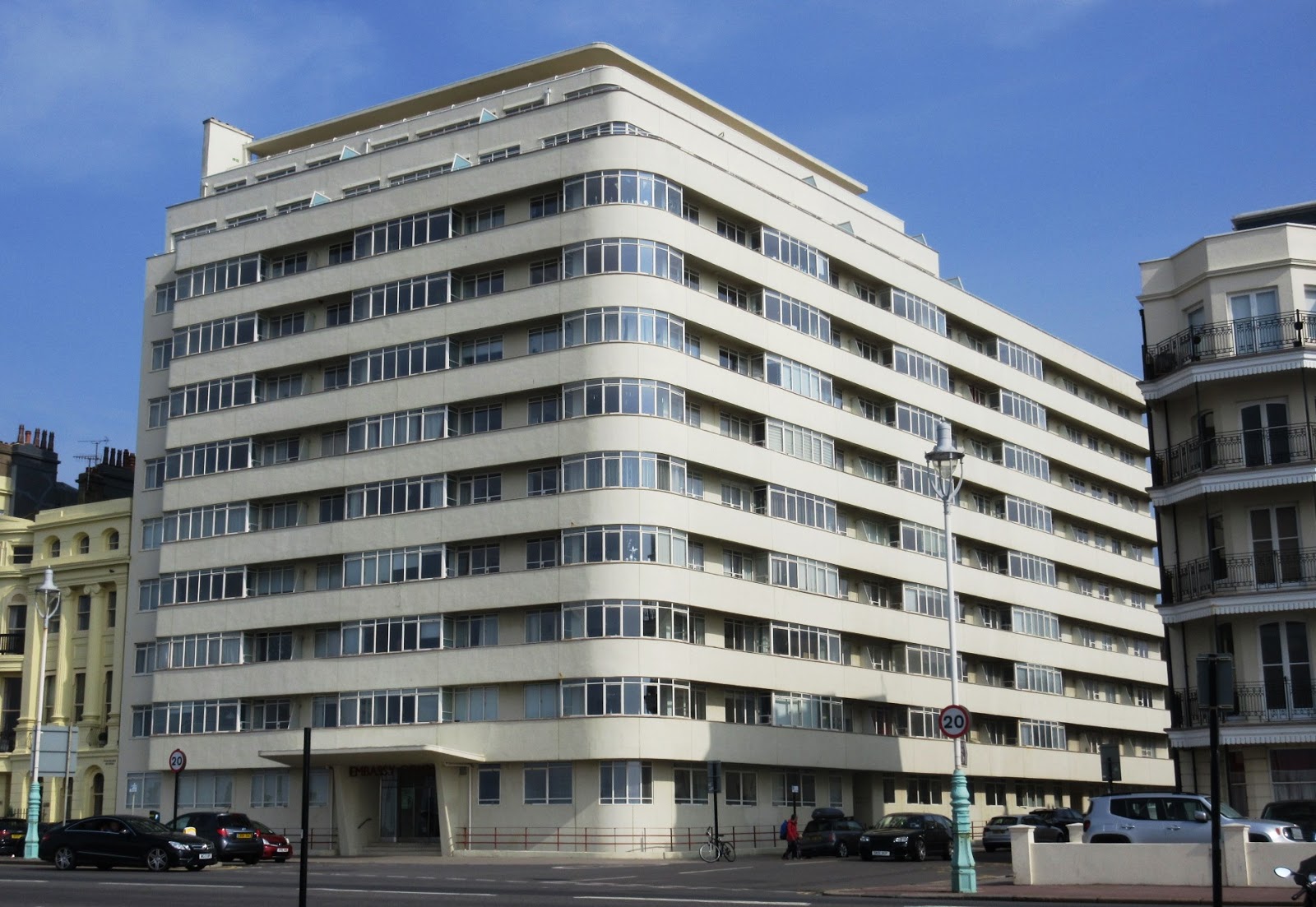
The revival of Embassy Court, Brighton


My photography, as regular readers will know, tends to feature derelict and decrepit buildings. So let's celebrate restoration for once.

Close to Brighton's West Pier is a modernist block of flats. A decade or more ago it looked in a bad way, yet you suspected it had been quite a building in its day.

That block turns out to be Embassy Court, once home to Rex Harrison, Terrence Rattigan, Max Miller and Keith Waterhouse. You can read a discussion of its celebrated residents and visitors on the Embassy Court site.

That page also explains the building's decline:
Embassy Court’s decline was decades in the making but the rot truly set in during the mid 1980s. A succession of freeholders came and went, seemingly with little interest in maintaining the block. The decline in the value of leases brought speculators and absentee landlords into the picture. During the 1990s some flats were abandoned, others were squatted, rented out to struggling economic migrants and – to the horror of some – students! 
These new arrivals at first sat uneasily alongside the often elderly and temperamentally conservative residents who had made their homes here in the 1970s.
The good news, as I saw when I was in Brighton last week, is that Embassy Court has been restored.

Conran + Partners tells the story:
Embassy Court is arguably Brighton’s finest twentieth-century building and an outstanding example of modernist design. With its roof terrace and 11 storeys of sea-view apartments, the building was once the glamorous home of the wealthy and famous, but after years of decline was left near-derelict. 
We were appointed by the management company Bluestorm to bring the 1930s building back to life. The work was completed in 2006, including the careful restoration of the exterior to its original appearance and drastic upgrading of services. The sun terrace – previously closed off due to a lack of railings – has also been reinstated allowing spectacular sea views. 
It received a Highly Commended Large Scale Residential Award in the 2006 Sussex Heritage Trust Awards.
By the entrance you will find a blue plaque commemorating the World War II hero Captain Edward Zeff, a former resident.


Saturday, May 06, 2017

The last days of Brighton's old West Pier


A sad aspect of visiting Brighton over the years has been the decline of the West Pier.

When I first came across it there were serious hopes that it could be restored: today the ruins are sad rather than magnificent.

A new arrival on the site is the British Airways 1360 - a sort of vertical pier - which I liked more than I expected to. Brighton is meant to be fun. It proved a challenge to photograph though.

Now there are dreams of a whole new West Pier. It's construction would involve the removal of the last ruins of the old.

You can read more about the history and future of the site on the West Pier Trust site.

Finally, when I collected my bag from the Metropole, I found they had a print of the opening of the pier in 1866.


Sunday, April 23, 2017

Former transport minister Norman Baker has his own bus company

Many former Liberal Democrat MPs are working hard to win their seats back on 8 June.
.
But, reports Mark Leftly in the Guardian, Norman Baker has other plans:
Rather than knocking on doors, Baker will be taking delivery of Britain’s first electric-powered bus on Monday. Last month, he became managing director at the Big Lemon, a 10-year-old, eco-friendly bus operator in Brighton, where its single-deckers run on cooking oil – 112 tonnes of fat was used to fuel 16 buses and coaches for nearly 220,000 miles last year. 
Partly through crowdfunding and two-year bonds of £100 each to the local community, the Big Lemon last year raised £250,000 to convert two 25-seater buses to run on electricity deriving from solar power. More than 120 panels have been installed on the depot in Brighton, where the buses will be charged at night.
Nor is Norman neglecting his music career:
As well as promoting his buses, Baker hosts local radio shows on Sundays and Mondays that play music from the past 100 years and obscure B-sides from the 1960s. Music rather than politics is Baker’s first love. 
He was once a regional director for Our Price and has been lead singer “on and off” of the Reform Club for 23 years. Indeed, when Cable and Davey are hitting the doorsteps on Saturday, Baker will be singing outside the Pump House pub near Brighton pier.
You can hear the Reform Club elsewhere on this blog.

Monday, September 19, 2016

Lord Bonkers' foreword to the new Liberator songbook

With the Glee Club about to get underway at the Liberal Democrat Conference in Brighton, it is time to share this with you...

Bonkers Hall
Tel. Rutland 7

Are we downhearted, fellow Liberal Democrats? No we are not!

Every day brings news of fresh triumphs. Why, only last week I read on Liberal Democrat Voice that we had come second in a parish council election in Cropwell Bishop.

With our clear stance on Europe – exemplified by that splendid new group ‘I’m As Much In Favour Of The EU As The Next Man But Did You See The Referendum Result In My Constituency?’ – I have no doubt that we shall return to government before we grow much older.

So we have good reason to sing tonight.

Just look at the pitiful opposition we face. The prime minister resembles the ink monitor in a particularly savage girls’ grammar school, while her chancellor must be the most insignificant figure to occupy 11 Downing Street since… What was the fellow’s name?

Someone asked me the other day what I thought of Brexit. I replied that I had always found his plays Terribly Dull. All that stuff about peasants and then an actor shouts at you just as you are dozing off.

Now it seems we need three ministers to deal with the fellow. I can’t see the point myself, but if he is so important why put the three stooges in charge?

And then there is the Labour Party. Can you see Corbyn and ‘Semtex’ McDonnell carrying Middle England?

I cannot either. Come to that, I can’t even see them carrying their own MPs.

So be of good cheer, fellow Liberal Democrats, and sing your hearts out.

The book before you contains all the songs you need to enjoy the Glee Club – many of them printed in a different order from last year’s edition.

The only sour note is the omission of that popular Rutland anthem ‘Hurrah for Lord Bonkers’, which is traditionally sung by the Well-Behaved Orphans when they are brought to St Asquith’s to return thanks to their benefactor.

The first verse runs:
"Hurrah for Lord Bonkers,
Who feeds us on gruel;
He’s ever so jolly
And not at all cruel."
Still, I suppose it will have to do.
Bonkers

Wednesday, March 02, 2016

Uckfield to Lewes - it's all kicking off


One of the causes closest to Norman Baker's heart, both as MP and minister, was the reopening of the railway from Uckfield to Lewes.

The project is now the subject of heated political debate, judging by this report from the Sussex Express:
This week Lib Dems have attacked what they perceive as inaction from the Tories since last year’s general election following the progress secured by the former Lewes MP and ex-rail minister Norman Baker. 
Baroness Randerson, the Lib Dems’ transport spokesperson, is set to question the Government on what action is planned between Lewes and Uckfield in the near future. 
However Maria Caulfield, Lewes MP, said that ‘once again the Lib Dems have got it wrong’, and explained that she had continually lobbied ministers about the ermits of opening a second Brighton mainline to Lewes. 
Rosalyn St. Pierre, a Lib Dem East Sussex county councillor for Ringmer and Lewes Bridge, said: “People in Sussex are forced to live with one of the worst performing railway networks in the country.”
Maria Caulfield would do better to emphasise the project's merits rather than its ermits.

Read more about the campaign on the BML2 (Brighton main line 2) site.

Friday, October 23, 2015

The homophobic monk is sentenced

A monk yesterday
From the Leicestershire Police website:
A man has been issued with a nationwide Criminal Behaviour Order (CBO) after being convicted of harassment. 
Damon Jonah Kelly, 53, formerly of Millais Road, Corby, Northamptonshire, was sentenced today (Friday 23 October) after pleading guilty to harassment at an earlier hearing. 
He appeared at Leicester Magistrates Court he was sentenced to a 12-month community order and issued with the CBO ...The conditions of the order are [that he will not]: 
  1. Distribute unsolicited material about religious, sexual or reproductive topics to any residential, commercial or academic address in England and Wales 
  2. Call at any residential premises in England and Wales, whether by doorbell, telephone, knocking or any other means, without the prior permission of the occupier for the purpose of distributing unsolicited material as in condition 1,
Mr Kelly (or should that be Brother Damon?) is better know to the press and readers of this blog as the homophobic monk.

The police statement goes on to quote PC 4350 Emma Jayne:
"Leaflets have been distributed in Market Harborough, Loughborough and Leicester, but also in a number of counties across the country including Lincolnshire, Brighton, Cambridgeshire, Warwickshire and Northampton. Kelly had no regard for the effect his leaflets would have on people, some of the recipients were vulnerable and the leaflets only added to their distress."