Showing posts with label Refugees. Show all posts

Friday, January 23, 2026

The Joy of Six 1465

"The evidence shows that when local people are involved in welcoming newcomers – helping to secure housing, navigate services, and build early social connections they learn local languages more quickly; move into employment sooner; and become part of community life in ways that benefit everyone." Tony Vaughan, Labour MP for Folkestone and Hythe, calls on his government to publish a clear plan for the implementation of a community sponsorship scheme for refugees.

Lewis Goodall posts some hard truths from Minnesota: "The United States under Trump is no longer our military ally (Greenland), our strategic ally (Ukraine and Russia), our political ally (a National Security Strategy which openly advocates backing far-right parties to disrupt European democracies facing 'civilisational erasure'), nor our economic ally (tariffs)."

"In its manifesto, Labour promised 'to restore and protect our natural world' and 'to unlock the building of homes … without weakening environmental protections'. Sadly, for me and many other Labour supporters, the tone of the language soon changed." David Jobbins says "growth at all costs" is threatening Britain's wildlife.

Jonathan Liew sees England's hapless cricket team as a metaphor for the country: "Of the under-19 squad currently playing in the World Cup in Harare, only four did not come through the private school system, where you are eight times more likely to have access to a turf pitch and 10 times more likely to have a qualified coach. The £35m in grassroots funding announced by Rishi Sunak in 2024 turned out not to exist."

Discontinued Notes comes across an unexpected book – a collection of short stories about wartime Germany by Antony Lambton, a former Conservative minister who resigned after a long-forgotten political scandal in 1973.

"As Colin Harper once observed, Briggs wasn’t just a singer; she was 'the bridge'. She made the ancient oral traditions of the British Isles credible, sexy, and attainable for a generation of icons, including Bert Jansch, Sandy Denny, Led Zeppelin, June Tabor, Christy Moore, Richard Thompson, and Dick Gaughan." KLOF Magazine on the importance of Anne Briggs.

Monday, January 05, 2026

The Joy of Six 1457

"What the US needs to understand is that hybrid warfare isn’t simply a weapon used between and against states. It’s a strategy being deployed by your very own government. This is both kinetic warfare – bombs and missiles – and information warfare – false constructs, false narratives, false justifications." America is not our enemy, but it's a danger to itself and the world, says Carole Cadwalladr.

Rowan Williams reminds us that migrants are at the heart of our culture: "Many of the most characteristic forms of western medieval architecture ... owe their development to the to-ing and fro-ing of engineers and architects between western Europe and the Middle East during the Crusades. And we find it easy to forget that most of the stylistic repertoire of modern western popular music would be unthinkable without the Black American tradition that itself adapted and reshaped African idioms in the new and terrible world of enslavement."

"Decades of research have demonstrated that our political beliefs and behaviour are thoroughly motivated and mediated by our social identities." David Roberts argues that the cure for misinformation is not just more information or smarter news consumers.

"Norwich, contrary to the county town image that some may have of it (though that too was true), was a densely-settled, industrial city which came under Labour control in 1933. The Council built over 7500 houses in the 1920s and 30s (twice the number of new private homes built in the same period) and rehoused some 30,000 people – almost a quarter of the population. Mile Cross was the finest of its new estates." Municipal Dreams on the history of a Norwich housing estate.

Francis Young reviews Chasing the Dark by Ben Machell: "[Tony Cornell] was wary of supernatural explanations but was open to a complex view of human psychology in which people who simulated paranormal phenomena were not always aware they were doing so, or did not necessarily see a distinction between their own agency and that of the supernatural power they believed in."

Petra Tabarelli explains the appeal of Midsomer Murders: "The characters are not merely bizarre, eccentric or exaggerated; they are condensed allegories, just as the Midsomer backdrop is itself an allegory for the idealised English landscape."

Saturday, December 13, 2025

The Joy of Six 1448

David Howarth says Liberal Democrats should attack Brexit, not just "the Tories' botched Brexit deal".

"Many have had to take extensive measures to protect their staff and service users. They’ve hired security guards, put trackers on phones, removed company listings and names from websites. In some cases, they’ve even installed safe rooms." Nicola Kelly describes how far-right attacks against refugee charities are causing workers to leave the sector to protect themselves.

"Unable to defeat Ukraine quickly or force political capitulation in Kyiv, Russia has expanded the battlefield into the daily life of European societies. Moscow’s objective is clear: weaken Western unity by creating a constant sense of vulnerability, without crossing the threshold that would trigger a formal NATO response. This pressure is increasingly visible in Poland and elsewhere in Central and Eastern Europe." Piotr Arak on Russia's use of sabotage to wear down Europe

Louise Murphy explodes three myths about NEETs – young people who are not it education, employment or training.

Pete Paphides celebrates Madness and their song The Liberty of Norton Folgate.

"The main robbery takes place around the industrial warehouses that once sat behind King’s Cross. As vast changes and development has taken place, exactly recreating these shots is difficult. However, using old maps of the area, many shots can be roughly mapped." Adam Scovell goes in search of the locations used by the makers of The Ladykillers in 1955

Saturday, November 22, 2025

The Joy of Six 1439

"The sections of Restoring Order and Control that mention children are chilling, suggesting that many asylum seekers bring their children not because they love and care for them but as a 'fact' to 'exploit ... in order to thwart removal'." Christopher Betram reads the government's new paper on its asylum and returns policy.

Morgan Wild believes municipal bond markets can save Britain: "This is one way to give public servants skin in the game. The team delivering the project should also raise the finance. Their decisions matter to them – cost overruns mean higher local taxes – in a way that they don't when they're trying to talk money out of the Treasury."

Why has government found it impossible to repair or replace Hammersmith Bridge? Do we need to replace it all? A fascinating investigation by Nick Maini.

Hetan Shah asks why no one cares that the British Library is in crisis.

"Carved from Forest of Dean sandstone, the structure was designed to appear as if gently rippling in the breeze. Blending Christian and Islamic symbols, the tomb reflects Burton’s lifelong fascination with Middle Eastern culture." Ian Visits reports that Conservation work has started on one of the most unusual mausoleums in the Roman Catholic world – the Bedouin tent shaped tomb of Sir Richard Burton and his wife, Lady Isabel, which stands in the churchyard of St Mary Magdalen in Mortlake.

Susan Major offers a new insight into York's history: "York’s back alleys hide a striking feature of the city's past: scoria bricks, made from the molten waste of Cleveland’s 19th-century blast furnaces. Distinctive for their silvery blue sheen and unusual shapes, these bricks tell a story of recycling, ingenuity and urban change."

Thursday, September 11, 2025

The Joy of Six 1408

Helen Charman dissects the claims of the flag-bearing demonstrators. "One slogan used to promote the hotel protests on social media, often emblazoned over a Union Jack or St George's Cross, is 'Safety of Women and Children before Foreigners'. There is a clear distinction being made here between British women and children and 'foreign' women and children. The category of the vulnerable always already excludes the marginalised group being targeted."

All good Liberals know the tale of Harry Willcock – "I am a Liberal, and I am against this sort of thing" – and his part in the abolition of national identity cards after the war, but there was another hero in his court case. It was the unexpected figure of the ferocious Lord Chief Justice, Lord Goddard. Neil Hickman explains.

"For over three years, the people of the UK have opened their homes to Ukrainian families and welcomed them into our communities. Offering them safety in the face of Russia’s indiscriminate shelling of cities and the illegal occupation of Ukrainian territory. However, at no point over these three years has our government provided Ukrainian families with certainty or stability." Rowan More looks ahead to a debate at the Liberal Democrat Conference.

Finlay McLaren finds that the chief effect of podcasting has been to give more publicity to people who were already famous.

James Wright suggests commercial interests may encourage the spreading of unverified stories and pseudo-archaeology connected to ancient buildings.

"Old Nick was so enraged he laid an everlasting curse upon them, and hence it was said that after Michaelmas Day, any blackberries on the bushes now belonged to the Devil Himself and it was most unwise to pick them." Jim Moon knows why you shouldn't pick blackberries after Michaelmas.

Wednesday, September 03, 2025

The Joy of Six 1404

Arthur Snell says the post-American world order is being created in front of our eyes.

"A Liberal choice exists, one that involves cooperation with other countries and sharing burdens. Labour seems so frightened of its own voters that it dare not even admit that this choice exists. Liberals should be braver." David Howarth has noticed the absence of Liberal (and Liberal Democrat) voices in the small boats debate.

Alexandra Hall Hall on the growing threat to US democracy: "A US President can declare a national emergency at any time, without approval from Congress, and without any legal definition as to what constitutes 'an emergency'. ... Trump could in theory use his powers to control the internet, take over tv channels, or freeze the assets of American citizens deemed to be 'hostile foreign actors', without judicial oversight."

"Rather than engage seriously with the reality of English sentiment and, yes, resentment, both Conservative and Labour governments have engaged in the serial ad hocery of constitutional change. They’ve played a never-ending game of constitutional Tetris in which plans for so-called English devolution are constantly made and remade. This process has, in turn, become a substitute for serious thinking about political voice and democratic influence within the state." Ailsa Henderson and Richard Wyn Jones argue that Nigel Farage is benefiting from mainstream politicians' habit of treating England as an afterthought.

"The zither score, by Anton Karas, is a masterstroke, because it centers every scene, regardless of its emotional temperature, within a wry and knowing acceptance of how hard life can be—and how tough, philosophical and willing to take a joke you’ll need to be if you’re to have any hope of getting through it. It’s the musical equivalent of the serenely smug yet  irresistible grin on black marketeer Harry Lime’s face when it’s revealed by light from an upstairs window." Matt Zoller Seitz celebrates the sensual pleasures of The Third Man.

JacquiWine reads A House and its Head by Ivy Compton Burnett - "widely considered to be one of the most original British modernist writers of the early 20th century".

Friday, March 14, 2025

The Joy of Six 1336

"The government is trying to solve the wrong problem. They are focusing on those who are out of work, when it is increasingly clear that one big reason people with disabilities are not in employment is because work environments have fewer roles they can fill." Ruth Patrick and Aaron Reeves argue that cuts and caps to benefits have always harmed people, not helped them into work.

Fred Garratt-Stanley, writing for The Lead, finds malaise, discontent and the rise of Reform UK at the English seaside. "When you take away someone’s belief in the place they live in, you lay the groundwork for radicalisation. And when progressives lose the argument and subscribe to the right-wing view on the roots of this deprivation, it creates a vacuum waiting to be filled."

Wendy Chamberlain reviews The List - a moving documentary about one family’s attempt to rescue hundreds of artists from the Taliban during the fall of Kabul in 2021.

Since Russia’s invasion of Ukraine in February 2022, the state-controlled international news channel RT has all but disappeared from Western screens. But, report Rina Nikolaeva, Anastasia Korotkova and Dmitry Velikovsky, vloggers are being paid to spread the same pro-Russian propaganda.

"In 1968, when I was 28, I wrote the first English book on art deco." Bevis Hillier talks to dezeen about the centenary of the style.

Jim McCarthy, in an extract from his book Flowers in the Rain: The Untold Story of The Move, writes about the band and drugs: "Trevor Burton was definite and truthful, about the path into drug taking, 'It was only Ace and me that took drugs in The Move. We were like kids in the sweet shop. Our other thing was amphetamines. When you’re gigging six nights a week - you don’t mind a little help.'"

Thursday, February 13, 2025

The Joy of Six 1324

"For so long the US has been the core UK and European ally, the backbone of NATO, the largest contributor to the WHO, and the loudest voice in proudly proclaiming its democracy. It seems unbelievable to state baldly that the US is a threat to the global economy, to global health and to global stability. But it is, and the sooner this is acknowledged the better." Christine Pagel shows that Trump is following the playbook that has seen democracy die in other countries.

Nataliya Gumenyuk explains why Ukraine wants to fight on: "The horror of Russian military rule has been felt not only in areas of the south and east, where much of the war has been fought, but also near Kyiv in the opening weeks of the 2022 invasion, when Russian forces committed widespread atrocities in the capital’s suburbs."

"I have been very anxious to show that these young people are not 'problem young people,' but young people with problems." Richard Kemp reminds us that one of his key themes as Lord Mayor of Liverpool are the problems faced by care-leavers and many other disadvantaged children in the city.

So concern for the Welsh language scuppered a nuclear power station? Rubbish, says Dan Davies.

Brian Klaas on what Detectorists has to teach us about the meaning of life: "Throughout the show, the allure of money and valuable treasure lurks, but whenever it seduces the detectorists and they lose sight of their intrinsic motivation, their lives begin to fall apart, cursed by a momentarily conversion to the False Gospel."

Colin Yeo, an immigration lawyer, reviews Paddington in Peru.

Friday, June 28, 2024

The Joy of Six 1242

"Between 2012 and 2019, austerity was responsible for an estimated 335,000 excess deaths. The rate of prescription of antidepressants in England has doubled since 2011: nearly 20 per cent of adults now take them. The average height of children who grew up under austerity fell relative to European benchmarks." William Davies on 14 years of Conservative rule.

Guy Shrubsole analyses Labour's environmental policies.

Naomi Fisher says we’re in the middle of a cultural clash in the way that we understand mental health: "The way that we understand distress is deeply rooted in our culture and time, but it doesn’t feel like that to us. We tend to think that the way we understand things now is the right way, superior to previous generations and other cultures."

"On the May Bank Holiday weekend, I was walking with a group of refugees. We managed a couple of short strenuous climbs, a gorge scramble and long open stretches along the contours of the hills. The walks were tiring and testing, and the wind, rain and sun took turns to blast us. But they were joyful and exhilarating walks. I saw people stretch out their arms and point their faces up to the sky as I do. Their eyes sparkled and their smiles broadened with the beauty and the expanse of it all." Stella Perrott believes the beauty and health benefits of the countryside must be shared with everyone, regardless of background or financial status

"Went the Day Well has been praised for its stark realism, including hostage-taking, numerous close-ups of shootings, threats to execute children and the murder of an elderly vicar during a church service.  Some critics find this surprising in the context of wartime propaganda.  But this is perhaps to misunderstand the film’s purpose, which was surely instructional as much as it was morale boosting." Jeremy Burchardt watches Went the Day Well?, Cavalcanti's 1942 masterpiece.

Emine Saner talks to Cyndi Lauper: "The song Girls Just Want to Have Fun wasn’t written by Lauper, but she changed the lyrics and the feel of the song and it became a huge hit. Suddenly she was famous, but isolated."

Sunday, March 24, 2024

The Joy of Six 1215

Charlotte Thompson, who lives there, challenges the government's contention that Rwanda is a safe country: "Many Rwandan citizens are extremely proud of the position their country is in now and support the government entirely, one can hardly be surprised having watched the transformation. But many do not, and the price of not supporting the government can often be, well, death."

Ofcom will have to change its attitude towards GB News as the general election approaches, says Stewart Purvis.

"Having just stepped into public life, Magyar is still unknown and somewhat of an enigma. On the one hand, he is extraordinarily self-possessed, sharp, tough, articulate, and strikingly patriotic. On the other hand, he often comes off as idealistic and naïve. Like an escapee from Plato's cave, only slowly adjusting to the light and coming to recognize the extent of his previous illusions, Magyar is a man who still doesn’t fully understand the nature of the political regime he's turned his back on." H. David Baer asks if Péter Magyar is the leader the Hungarian opposition has been looking for.

Jonathan Haidt argues that we underprotect children in the virtual world and overprotect them in the real one.

"In the suppression of the Mau Mau, Britain defaulted to blunt collective punishment, detaining thousands of suspects behind barbed wire, under observation from watchtowers. As a boy in Kenya, even if he’d been made aware of it, such action would have been unfathomable to Rankin. 'What I could not conceive, as I sat on the floor of my father’s study in my shorts and shirt and Bata sandals, was that we, the brave British who I knew had won "The War" ... were now building ... concentration camps.'" Colin Grant reviews Kenya, Mau Mau and Me by Nicholas Rankin.

Tim Rolls remembers the night in 1971 that Chelsea, 2-0 down from the first leg, beat Bruges 4-0 in a European Cup-Winners Cup quarter final at Stamford Bridge: "After the third goal Osgood 'jumped the dog track and fell to my knees and saluted the human cauldron that was The Shed. In that moment, the fans and I were one, united in euphoria. It was a special moment in my life.' It was also, arguably, his greatest moment at Stamford Bridge."

Tuesday, July 11, 2023

The Joy of Six 1144

At the end of a tribute to Peter Hellyer, William Wallace puts his finger on the Liberal Democrats' dilemma: "Britain still needs radical change, but the painful adjustments that will involve are not welcome to voters whose lives are more comfortable as things are.  We are a radical party dependent on centrist support."

Benny Hunter spends a day watching asylum seekers being jailed.

Matthew Pennell argues that, on education, the Lib Dems need to snap out of a call-and-response dynamic with populists: "What do pupils and parents actually want from the education system? Surely it’s that children are taught in a safe and attractive learning environment and the approach to education equips them for the 21st century world as best as it can be anticipated – soft skills (hello English and other modern languages, relevant to the latest tech trends (hello Computer Science) and playing to our strengths as a nation in sectors such as creative industries (hello Arts, Music and Drama)."

How do you recognise a temperate rainforest in Britain and Ireland? John Healey has the answer.

Eoin Morgan says cricket has institutionally marginalised huge parts of society: "Barriers around class, gender and ethnicity are conspiring to ensure that many young people face insurmountable obstacles before they get near the elite pathway system, let along the professional game."

The University of Southampton extraordinary four-year battle to prevent diaries and correspondence from Lord and Lady Mountbatten being made public is revealed by Martin Williams.

Friday, June 30, 2023

News from Labour: Neal Lawson has been expelled and Thangam Debbonaire won't commit to stopping Rwanda flights

Neal Lawson, the head of the cross-party campaign group Compass, writes in the Guardian:

Last Friday an email from the Labour party – of which I’ve been a member for 44 years – broke my political heart. They wrote coldly to tell me that back in May 2021, I’d committed a crime: retweeting a Lib Dem MP’s call for some voters to back Green candidates in local elections, accompanied by my suggestion that such cross-party cooperation represented “grownup progressive politics”. My punishment? Expulsion.

I'm told that if you're a Labour member who wants a political career you have to be careful who you're seen talking to. Sometimes it seems internal repression is the only relic of socialism the party has preserved.

And if you are minded to vote Labour because at least they're not the Tories, don't get your hopes up too high. 

Here's Thangam Debonnaire declining to say that Labour would cancel flights of asylum seekers to Rwanda.

Monday, June 05, 2023

The Joy of Six 1137

Caroline Lucas, Wera Hobhouse MP and Olivia Blake argue that the Climate and Ecology Bill is our best chance to tackle the climate crisis.

"The root of the asylum controversy in the UK is that our system for determining refugee status works so poorly. It should allow the country quickly to decide who is a refugee and who is not. But it is set up and operated so that most refugees do not have their claims properly recognised in a timely way." David Cantor sets out an alternative to the Illegal Migration Bill.

"From the bin crews in Cambridge Council to Citizens Advice, Dunelm, Atom Bank, some NHS trusts and Sainsburys, the idea is spreading and growing in popularity. Soon it may be the employers who have not tried this who are left behind." Mo Kanjilal asks if it's time we all moved to a four-day week.

"When the historian Nicolas Bell-Romero started a job researching Cambridge University’s past links to transatlantic slavery three years ago, he did not expect to be pilloried in the national press by anonymous dons as 'a "woke activist" with an agenda'." Samira Shackle on the backlash against research into slavery.

Nathan J. Robinson on a Jordan Peterson fan who lost his faith and the lessons we can learn about drawing people away from right-wing ideology.

James Brooke-Smith spent lockdown watching vintage chat shows: "Instead of the torrent of bile and invective and dark mutterings about secret paedophiliac plots orchestrated from pizza parlours in Washington - as the less salubrious corners of the internet would have it - I entered a halcyon world of charm and erudition, wit and glamour."

Tuesday, April 11, 2023

The Joy of Six 1124

"It was an absolute stain on our country that we once kept children locked up in immigration removal centres, such as Dungavel in Scotland. To make the mistake once was bad enough. To return to the policy would be unconscionable." Alistair Carmichael says detaining child migrants is a stain on our country will not deter small boats.

"The review’s findings suggest that, although Washington has since 2014 imposed multiple rounds of sanctions on Russia due to its invasion of Ukraine, the Justice Department under the Obama and Trump administrations did not prioritize prosecutions related to that war - filing relatively few cases until after Putin escalated it in 2022." Nahal Toosi examines how the US let Russia off the hook after its annexation of Crimea.

Samira Ahmed on the uncovering of the tape of the Beatles concert at Stowe School: "He brought along an extract that we played through the stage PA system turned up as loud as possible to match the experience he’d had back in 1963. It was emotional for all us, including two young A level music students who came along to listen. It was like time travel."

Pen Hemingway lays bare the brutal history of British prison hulks.

"The film met with both critical acclaim and considerable controversy upon its original release. But thinking about Life of Brian as a parody of biblical epics is both the best way to appreciate it and serves, paradoxically, to illuminate the aspects of the Christian faith that even Monty Python could not puncture." Jack Butler offers a Christian reading of Python.

Mike Klein looks at the chess career of Emory Tate, father of the obnoxious Andrew. who was a trailblazing African-American player.

Friday, March 31, 2023

A reminder that the UK already uses restraint on children in the care system

There has, rightly, been an outcry against the Home Office announcement that child asylum seekers will be forcibly restrained if they 'resist deportation'. But we shouldn't forget that restraint is widely used on children living in the care system.

In July 2021, Children & Young People Now reported:

Dozens of MPs have joined forces to call on the government to ban the use of handcuffs on children in care.

Ministers are backing the Hope Instead of Handcuffs campaign, launched by Emily Aklan, chief executive of children’s social care provider Serenity Welfare, which is calling for legislation allowing a child in care to be handcuffed during secure transportation to be scrapped.

It is currently legal for private transport providers to physically restrain children at their discretion without the accountability of regulation or monitoring of restraint.  

The magazine quoted the Labour MP Bell Ribeiro-Addy, who had tabled a parliamentary motion stating that a child who has not committed or is not suspected of committing a crime should not be placed in handcuffs or any other form of physical restraint:

"The rising use of restraint against children in the care system reflects a whole series of policy failures and wider lack of early intervention. If we're going to keep children safe, we need transparency about how they're being treated. 
We must shine a light on practices which have been allowed to stay in the dark away from public knowledge for far too long and start acting to stop the social care system causing further harm to already vulnerable children and young people."

Emily Aklan, who launched Hope Instead of Handcuffs, said:

“I’ve seen far too many children with red marks around their wrists with massive distrust towards the system which is supposed to be helping them. 
But with no need to monitor and report any use of handcuffs and safeguarding issues preventing children from being able to share their stories, it’s been incredibly difficult to prove just how widespread this issue is.”

Concern over the lives of children in the care system does break out now and then, though it tends not to last long, but there was some good news last year.

As I blogged at the time, Wales became the first UK nation to protect children from being handcuffed or restrained when being transported between care settings.

Sunday, March 26, 2023

The Joy of Six 1120

"We live in a global, interconnected community and it is ridiculous to think that if we only act in our own self interest, there will not be consequences to our ability to engage internationally. It’s not as if we are anywhere near the top of the league table of countries where refugees flee." Tim Farron says that if Rwanda can support the wellbeing and integration of refugees, then so can the UK.

Pam Jarvis argues that changes to education have created a toxic environment of overbearing discipline, 'zero tolerance' and the rote learning of a narrow curriculum.

Lucinda Dickens Hawksley, Charles Dickens' great-great-great-granddaughter, talks to the Mirror: "The gap between the rich and poor in Dickens' time was huge, and in recent years the gap has grown again. We have never been so like the Victorian age in terms of the haves and have-nots. People lived hand to mouth, they weren’t saving to buy a home. They were trying to cover their rent - there is similarity today." 

"Wolves are making a dramatic comeback across mainland Europe, but the controversial prospect of their return to the UK remains unlikely for the foreseeable future. Instead, the growing focus here is on the lynx, a much less well-known predator, but one that many believe could prove less challenging to live with. So, how realistic is a lynx reintroduction and what might it mean for us, should we find ourselves sharing familiar spaces with this unfamiliar cat?" Hugh Webster asks if we could learn to live with the lynx.

Pitchfork choses the 50 best Britpop albums.

"It’s nearly 10 years since I last visited the ruins of Ruperra Castle, in the county borough of Caerphilly, but, to judge from photographs, this magical and unexpectedly sequestered ruin between Newport and Cardiff has only grown more melancholy with the passage of the years." John Goodall makes the case for saving Ruperra Castle.

Sunday, November 27, 2022

The Joy of Six 1093

"The Homes for Ukraine scheme, which has housed more than 100,000 people in Britain since the start of the war, is now at risk of collapse. Without early and drastic intervention, the scheme will compound rather than ease the suffering of the Ukrainian families it was meant to help." Keir Giles explains what has gone wrong with the government's effort to help war refugees from Ukraine.

Eleanor Rylance remembers helping a young mother of two children living in appalling housing conditions: "We should be viewing this as a national scandal, not demonising young and vulnerable people living in terrible housing stock."

The Guardian interviews the clinical psychologist Richard Bentall, a penetrating critic of conventional views of mental illness.

Gale Sinatra and Barbara K. Hofer explode five myths that fuel the rejection of science.

"Morgan was superficially a 'swinging London' movie – made by a man who was, to the best of my knowledge, not heavily involved in the hedonism of the time: his main hobbies were gardening, collecting art and playing bridge. Yet he and writer David Mercer tapped into the fierce debates, associated with the radical psychiatrist RD Laing, about whether insanity can sometimes be a “rational” response to a mad world." Matthew Reisz on his father Karel's contribution to post-war British cinema.

The Britten Pears Archive examines the composer's rich creative relationship with the boys' choir from the state-sector Wandsworth School.

Wednesday, November 02, 2022

The Joy of Six 1086

"The idea of the 'illegal' asylum seeker is a falsehood that has been actively peddled by the Home Office and the Home Secretary in recent years. When people talk about asylum seekers coming to the UK 'illegally', what they really mean is asylum seekers arriving via informal and unofficial routes, such as crossing the Channel via small boat. However, asylum seekers are legally allowed to come to the UK even when making an 'illegal entry'." Amelia Susserott explodes the myth of the illegal asylum seeker.

Peter Hain says British politicians have failed Northern Ireland: "What a colossal, devastating failure by British politicians over Northern Ireland. The current impasse - with the Northern Irish Assembly still suspended and another set of elections now required, the second since May - is the product of terrible neglect by the British government starting in 2010, accelerated and deepened by Brexit, which has shattered the delicate power-sharing balance required for functioning Northern Irish institutions."

A growing number of children with mental health problems are being treated on adult psychiatric wards as services struggle to cope with a surge in demand, reports Shanti Das.

James West is critical of the way the media covers climate change: "This is one area where many people with no qualifications in science, with largely arts and humanities training and who have no authority in science, feel able to express opinions on climate science and expect to be taken seriously."

"Watching that scene we, the excited children of black Jamaican migrants in Luton, let out a collective 'Yes!'. Sidney Poitier was one cool dude on and off screen - and we loved, absolutely loved Virgil Tibbs, the actor who played him and all he stood for." Colin Grant surveys the career of Sidney Poitier.

Robert Edgar traces the roots of folk horror back to Thomas Hardy.

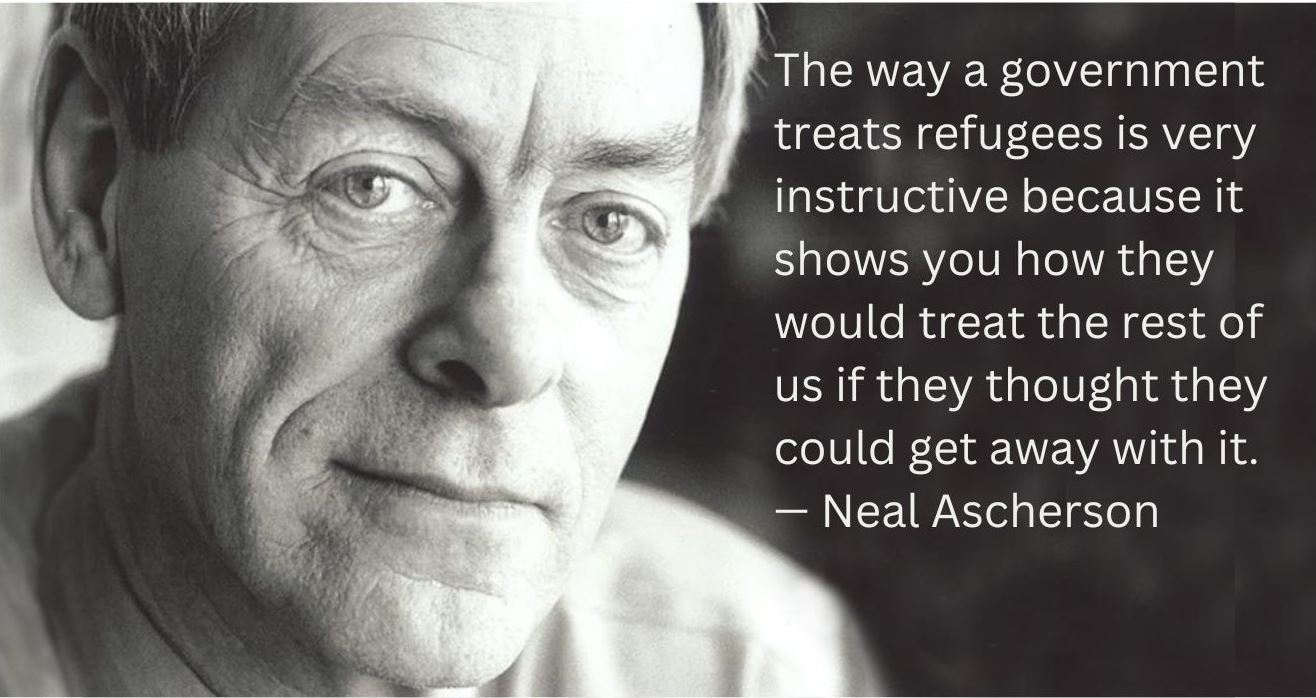
No, Tony Benn didn't say that about governments and refugees

There's a very good quotation that pops up on Twitter from time to time. It runs:

The way a government treats refugees is very instructive because it shows you how they would treat the rest of us if they thought they could get away with it.

Almost invariably, these words are attributed to Tony Benn, but he did not say them. Rather, they were written by the Scottish journalist (and sometime Lib Dem Holyrood candidate) Neal Ascherson.

The history of the quotation is as follows.

In 1996 Ascherson wrote an article on the al-Masari affair in the Independent, where he said:
The al-Masari affair overflows in all directions with moral relativism. My own view is that to expel a political asylum-seeker because his country threatens to cancel business contracts with Britain is absolutely wrong. 
And it is not only wrong but dangerous in the long term to us all. This is because of one of the Laws of Politics that I wrote long ago into my little black notebook: "The way a state treats its aliens is the way it would treat its own subjects if it dared".
And in 1999 Francis Wheen paraphrased Ascherson to produce more or less the quotation we know today:
We should always watch how politicians treat refugees, Neal Ascherson once wrote, because that's how they would treat the rest of us if they thought they could get away with it.
Neal Ascherson, incidentally, has passed 90 and is still going strong. You should be able to read some of his articles on the London Review of Books site before its paywall kicks in.