Showing posts with label Stamford. Show all posts

Wednesday, April 08, 2026

An Edward VIII postbox on Ryhall Road, Stamford


Today I bagged another Edward VII postbox. Having stalked and photographed the three examples in Leicestershire (on the Saffron Lane Estate and in Earl Shilton and Hugglescote) a couple of years ago, I was looking for more worlds to conquer. Then I read online that there was a box in Stamford.

And here it is. You'll find it on Ryhall Road, not far from Greyfriars Gatehouse.

Monday, October 27, 2025

The 17th-century Stamford Canal

The Stamford Canal was an artificial cut that paralleled the River Welland between Stamford and Market Deeping. It was nine and a half miles long and had 12 locks.

It was opened in 1670, and so predates the canals of the Industrial Revolution. I believe it was constructed by the Dutch engineers who were responsible for the draining of the Fens.

This video from Jay Naylor Films – like and subscribe – shows the Stamford end of the canal.

Thursday, October 23, 2025

Charles Dickens describes flooding in the Welland Valley

My Lady Dedlock has been down at what she calls, in familiar conversation, her “place” in Lincolnshire. The waters are out in Lincolnshire. An arch of the bridge in the park has been sapped and sopped away. The adjacent low-lying ground for half a mile in breadth is a stagnant river with melancholy trees for islands in it and a surface punctured all over, all day long, with falling rain. My Lady Dedlock’s place has been extremely dreary. 
The weather for many a day and night has been so wet that the trees seem wet through, and the soft loppings and prunings of the woodman’s axe can make no crash or crackle as they fall. The deer, looking soaked, leave quagmires where they pass. The shot of a rifle loses its sharpness in the moist air, and its smoke moves in a tardy little cloud towards the green rise, coppice-topped, that makes a background for the falling rain. 
Bleak House has a strong claim to be Charles Dickens' greatest novel, and Rockingham Castle, near Market Harborough, played an important part in its genesis:
Charles Dickens was a regular visitor to the castle and a great friend of the then owners, Richard and Lavinia Watson. In November 1849, he spent several days here and delighted his hosts by acting out scenes from Nicholas Nickleby and School for Scandal alongside Mrs. Watson's cousin, Miss Boyle. 
The house and grounds certainly wove their magic upon the author's fevered imagination. As "the first shadows of a new story" began "hovering in a ghostly way" around him, he made several visits to Rockingham Castle to commit to memory in preparation for its becoming "Chesney Wold" in his novel Bleak House.
Rockingham Castle is in Northamptonshire and looks out across the Welland Valley to Leicestershire and Rutland. Stamford, where Lincolnshire begins, is some 15 miles away.

All of which means that in the passage above Dickens is describing flooding in the Welland Valley below Market Harborough.

This is not the only connection between the great novelist and this part of the world – see my post I could have voted in Dickens's Eatanswill by-election.

Monday, November 20, 2023

The River Welland from its source to the sea

This is a lovely video that follows the Welland for 65 miles from its source at Sibbertoft in Northamptonshire, through Market Harborough, Stamford, Market Deeping, Crowland, Spalding and The Wash.

I once looked for the spring at Sibbertoft that is said to be the source of the Welland, but was unable to find it. The makers of this video seem to agree with the people behind the local rewilding project of 10 years ago: these days there is no sign of a flow above the village sewage works.

Don't tell Lord Bonkers, but the reason the river seems to shrink before it reaches Stamford is that water is pumped into Rutland Water.

Thursday, March 04, 2021

Welland Valley Rail Partnership calls for Rutland reopening


A short stretch of reopened railway line in Rutland could reconnect the communities of Kettering, Corby, Stamford, Peterborough together with Luffenham, Whittlesey, March and Wisbech.

That's the claim of the Welland Valley Rail Partnership, which describes its plans like this:

The largest piece of infrastructure is a 3.5 mile section of track between Seaton and South Luffenham. This section is a small part of the Rugby & Stamford railway, opened in the 1800s, closed by Beeching in the 1960s.

This track is required because trains coming from Corby in the south can’t turn right at Manton junction to head towards Peterborough ...

There are 8 houses on the historic trackbed, but we have identified two alternative routes that would avoid any houses. 

The next stage of the project would be a feasibility study to evaluate these alternatives running past South Luffenham, along with the viability of the entire project.

Sunday, February 28, 2021

Cupid's Inspiration: Yesterday Has Gone

Here's a song that anyone who likes sixties music will know, even if many will be pushed to remember which band had a hit with it.

Yesterday Has Gone was originally recorded by Little Anthony and the Imperials, though the strong vocal by Terry Rice-Milton makes it reasonable to prefer this cover version.

What really interests me about Cupid's Inspiration is that they came from one of my favourite nearby towns: Stamford in Lincolnshire.

And to prove it, here is a 2019 story from the Stamford Mercury:

Original members of the Sixties band Cupid's Inspiration are returning to their roots with a show at Stamford Corn Exchange Theatre.

Lead singer Terry Rice-Milton and bass guitarist Laughton James will take to the stage with a new line-up as part of the Sixties Invasion show.

The Stamford-based band shot to fame in 1968 when their hit Yesterday's Gone reached number four in the charts. Their follow up song My World reached number 33 a few months later.

The band has performed on and off with various line ups over the years but as a Stamfordian Terry is looking forward to playing again in his home town.

He said: "It means a lot to come back. A couple of years ago I remember pulling up at the traffic lights and hearing someone shout my name.

"It's strange to still be recognised after 50 years!"

Wednesday, September 30, 2020

Six of the Best 963

Jonathan Chait offers a way of understanding Donald Trump: "He is a brilliant con man, who has, throughout his career in business and politics alike, honed the singular skill of identifying marks and exploiting them with spectacular lies."

"Senator Bankhead, the uncle of Tallulah, managed to get a bill drafted in Congress which would have authorised $1 billion of stamp scrip to be issued the following year." David Boyle girds up to make the case for local money again.

Jessica Grose says that though devices for tracking children calm parents' fears, they hamper the children's development.

"'Sport confirmed that in England, you could do as you pleased,' he writes, and to this end he takes us on a dizzying journey from the bull-runners of Stamford to the public school cricketers of ­Uppingham, from the militaristic pomp of the fox hunt to the bloodied bare-knuckle heroes of the prize-fighting ring, from the Peterloo ­massacre of 1819 to the stirrings of modern football." Jonathan Liew reviews This Sporting Life: Sport and Liberty in England, 1760-1960 by Robert Colls, who taught me on my Master's course at Leicester many years ago.

Adrian York celebrates Kate Bush's election to fellowship of the Ivors Academy, the independent professional association UK for music creators.

Will Carr looks at Anthony Burgess as a Mancunian.

Sunday, May 26, 2019

Stamford crew called out to school book on fire

Stamford before the fire

Our Headline of the Day Award goes to the Stamford Mercury.

The judges were complimentary about this new excuse for not having done your homework.

Thursday, April 25, 2019

The view from Stamford Meadows


Stamford Meadows are celebrated for their views of the town and their wildlife - which on Saturday seemed to consist largely of swans and dogs.

It was on this walk that I found the town's old medicinal spring and by the end of it could see the heroic industry of Ketton cement works.


Wednesday, April 24, 2019

The history of Stamford's medicinal spring


The other day I promised you a video about the history of Stamford's medicinal spring.

Here it is - a few in jokes and hobbyhorses too many, but still interesting to anyone who loves this remarkable town.

It also explains why I included a photo of Tinwell pumping station in that first post about the spring.

Saturday, April 20, 2019

Stamford's baths and medicinal spring


These baths stand on the edge of the Welland meadows in Stamford, and incidentally mark the outer wall of the castle once built to protect the river crossing.

I had assumed the elegant building once housed a fashionable spa, but it turns out to have been home to public baths built because of the poor sanitary conditions in the town.

Yet Stamford did once have a medicinal chalybeate spring and today I found it.

It is in those same meadows, but some way out of the town. You can find it near the bridge that takes the A1 over the river.

An online forum carries memories of childhood Sunday walks to the spring to fill bottles.

I have found a video that gives the history of the spring and explains why it is now dry. I will post it here one day.

In the mean time, here are the photographs of it I took today. The nearby weir is part of Tinwell pumping station, that sens water from the Welland to Rutland Water.


Tuesday, January 29, 2019

Stamford Water Street station in 1947


In 2013 I visited and photographed the former Stamford Water Street or Stamford East station. The terminus of the short line to Essendine, it closed to passengers in 1957.

You can see both the station building and the goods shed in the upper half of this 1947 photograph.

They stand beside the River Welland as it makes its way from Market Harborough to the sea.

Sunday, October 28, 2018

Trail of the Stamford panther


Exciting news from the Rutland & Stamford Mercury:
A Stamford man who claimed to have seen a black panther on Tuesday night returned the following day and took a photograph of a large pawprint. 
Steve Kelly was so intrigued by the sighting that the following day he returned and managed to capture a photograph of a pawprint left by the creature. ... 
The father-of-four has since contacted BBC wildlife expert Chris Packham and is trying to get in touch with a university zoologist to find out more.
It is two years since the same newspaper reported a sighting of "the elusive Rutland panther" between Teigh and Market Overton.

Wednesday, October 10, 2018

The Victoria: A Stamford ghost sign


This ghost sign is to be found in Stamford near Greyfriars Gatehouse.

What Pub reveals that The Victoria was a one-roomed pub originally known as the Parting Pot Inn. It changed its name for Queen Victoria's Jubilee in 1886.

Saturday, October 06, 2018

More medieval Stamford: Greyfriars Gatehouse


St Leonard's Priory wasn't the only relic I found when I went to look for medieval Stamford.

Greyfriars was a Franciscan friary that flourished in the town from the early 13th century until Henry VIII suppressed it. Joan of Kent, wife of the Black Prince and mother of Richard II, was buried here.

All that remains of the friary today is this gatehouse beside Stamford Hospital and it does look as though it was much altered in later centuries.


Sunday, September 23, 2018

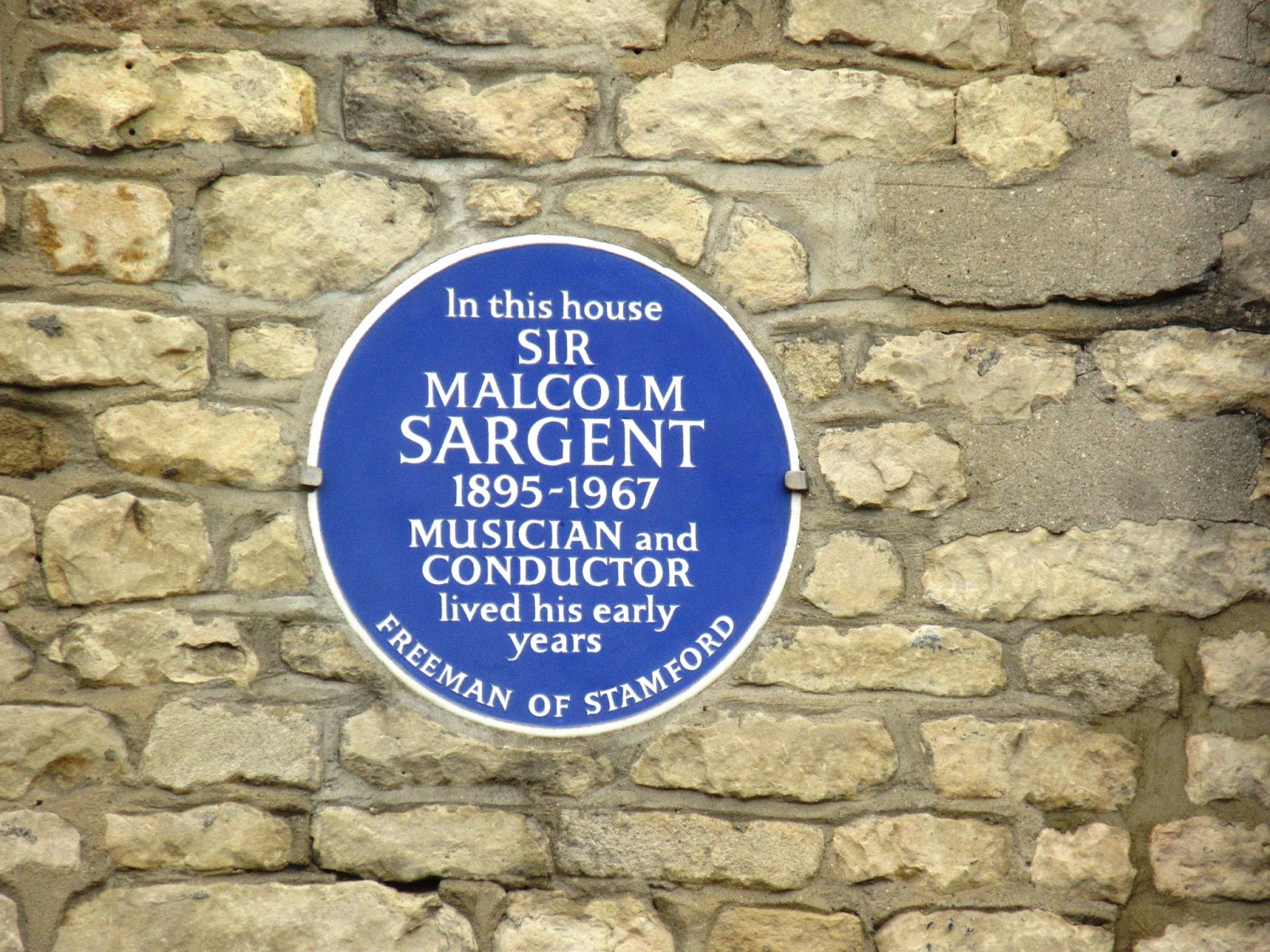
A Stamford plaque for Sir Malcolm Sargent


This modest house in Wharf Road, Stamford, as the plaque records, was the boyhood home of Sir Malcolm Sargent.

Sargent began as the church organist in Melton Mowbray - there is a plaque on the house where he lived there too -  but thanks to his extraordinary musical talents and skill at social climbing he ended as a celebrated conductor and star of the Proms.

His nickname of 'Flash Harry' may tell you something of his reputation among orchestral players. Yet I was seven when he died and remember it being a big news story and how sorry people were.

There is a good piece on Sargent's current reputation by Ivan Hewett.

Wednesday, September 19, 2018

Lost bookshops and Iain Sinclair in Stamford


In Stamford the other day I mourned the loss of secondhand bookshops. I could think of three that have disappeared from the town (though one of them has moved to Uppingham). These days, when most trade in books is done online, there is less point in paying the rent on a shop.

Another of those lost shops was to be found in the Wharf Road part of town. I seem to remember an old warehouse that you entered from the yard at the rear.

When you don't visit a town regularly the buildings tend to shuffle themselves, making individual shops hard to find. But I am pretty sure that the warehouse has been demolished and the site redeveloped. I think the modern flats beside the Welland in the photograph above stand on that site.

My reason for blogging about the shop is that I suspect it has been immortalised in Iain Sinclair's 1987 novel White Chappell, Scarlet Tracings, where the narrator and three other bookdealers descend upon 'Steynford':
Mossy Noonmann's bookshop, if we afford it the courtesy of that title, was probably the only one open in the whole of the Midlands, from Wolverhampton to Boston, and out into the North Sea. And he was the least likely proprietor. How he come here nobody knew and few cared to guess. ... 
Noonmann was a New Yorker, veteran of Peace Eye Bookstore, who, not fancying an engagement in South East Asia in the mid-60s, had returned to the Europe of his forefathers by way of Liverpool, then, briefly the centre of the universe. A single evening disproved this conceit: Noonmann found a mattress in Westbourne Grove. 
There were minor misunderstandings over rent books, social security paperwork, import/export regulations concerning self-administered resins from the Middle East; there was a misplaced briefcase of ounces, and Mossy decided to hit the road. 
Two hours up the A1 and the Camberwell-domiciled holder of a Heavy Goods Vehicle Licence was ready to turn it in rather than carry Mossy another mile. He walked down the hill into Steynford. He's been there ever since, and never walked so far again.
One must allow for Sinclairian exaggeration (and avoid libel suits), but I remember the proprietor of my bookshop as a large, shambling American who rather fits this description.

And if the shop was as decrepit as Sinclair painted it, it is no surprise that is has long since been demolished.

Monday, September 10, 2018

Medieval Stamford: St Leonard's Priory


Stamford means Georgian architecture, doesn't it?

It does, but there is more to this amazing town that that. Because Stamford was also a walled medieval town.

Even today there are fragments of those walls left if you know where to look. And the bus station occupies the site of a Norman castle.

I was in Stamford today and looked for its medieval past. I found St Leonard's Priory.

Founded in the 12th century as an administrative base for the Diocese of Durham's more southerly properties, it was dissolved in 1538.

It was later used as a farm building - you can see where the masonry was hacked back to make room for a barn door.

The ornate Western front collapsed and was rebuilt in the 19th century.

Today the site acts as a park off one of the quieter roads into Stamford.


Wednesday, August 22, 2018

Northampton had a university in the 13th century


Yesterday I blogged about the way the dominance of Oxford and Cambridge was enforced. Between 1334 and 1827, their graduates had to swear an oath - the Oath of Stamford - not to teach anywhere else.

By one of those odd coincidences, a Guardian article that morning had begun:
Thanks to sour grapes and special pleading by scholars at the University of Oxford, in 1265 Northampton’s university was dissolved by King Henry III.
Sure enough there is a Wikipedia article on University of Northampton (13th century):
The University of Northampton was founded in the reign of King Richard I (the ‘Lion-heart’) as a school. Richard patronised the institution and, according to at least one historian, between 1176 and 1193 the school at Northampton "rivalled or even eclipsed the Oxford schools". 
The school lost a powerful supporter with the death of King Richard. However, it still enjoyed the patronage of Simon de Montfort through the reign of King John and his son Henry III. ... 
In 1261 Henry III was requested to give, and granted, permission for the settlement of a university in the town.
The existence of the University was brief. Four years after it was established, during the siege of Northampton, the scholars resisted the entry of the King’s forces, which resulted in Henry III revoking the town’s licence to have a University.
The article goes on to mention the alternative explanation for its demise given by the Guardian author.

I have been guilty of the past of underestimating Northampton and this story emphasises what an important town it was in the Middle Ages.

It's original university, of course, flourished at too early a date to be affected by the Oath of Stamford.

Tuesday, August 21, 2018

"The Stamford Oath": How Oxbridge's dominance was maintained

It's not just that Oxford and Cambridge are the dominant English universities: until surprisingly recently they were the only English universities.

The third English university, Durham, was not established until 1832 and even at the the end of the 19th century there were only three more: Kings' College and University College in London and Victoria University, which became the University of Manchester.

As an article in History Today by William Whyte says:
This was in sharp contrast to the European experience. Just as Oxford and Cambridge were establishing and policing their unique right to produce graduates, ever growing numbers of universities were being founded across the Continent. In the 14th century new institutions appeared in towns from Pisa to Prague; from Kraków to Cahors.  
In the years that followed, the gap in numbers between English universities and those on the Continent grew even greater, with over 100 founded or refounded in Europe after 1500. Oxford and Cambridge remained the only universities in England. Indeed, even as Morton’s teaching career began in the mid-17th century, universities were springing up in such unlikely places as the small towns of PreÅ¡ov in Slovakia and Nijmegen in the Netherlands.  
The English experience was also very unlike that of the Scots, who acquired five universities between 1451, when Glasgow opened, and 1582, when Edinburgh was established.
And this Oxbridge duopoly in England was rigidly enforced. From 1334 until 1827 the graduates of the two universities had to swear an oath not to teach anywhere else.

I have mentioned this oath before in my post on the legend of Stamford University, but it turns out that it did not just apply to Stamford.

The Stamford Oath, as it was known, obliged graduates of Oxford and Cambridge not to give lectures outside those universities.

You could argue that we are still struggling with the effect of this enforced Oxbridge dominance today.