Showing posts with label Brixworth. Show all posts

Tuesday, March 03, 2026

Mercia rediscovered: The Synod of Gumley and Brixworth church

Reviewing Max Adams's The Mercian Chronicles: King Offa and the Birth of the Anglo-Saxon State AD 630-918 for the London Review of Books, Tom Shippey wrote of the difficulty in recovering the history of the kingdom of Mercia:

Adams’s title is deliberately ironic. There are no ‘Mercian Chronicles’, the fact of which has caused historians headaches for centuries. 

For Northumbria we have Bede’s History of the English Church and People, written in Jarrow and finished in 731. For Wessex we have The Anglo-Saxon Chronicle, first compiled under the aegis of King Ælfred in the 890s, but including much earlier information and then kept up in various locations year by year. 

But for the land in between we have nothing: or rather, "no independent narrative", apart from a short interpolation into two manuscripts of The Anglo-Saxon Chronicle known as ‘the Mercian Register’ and covering only the years 902-24. For the rest, the historian has to work from often biased, often hostile enemy sources, and from indirect evidence: coins, charters, archaeology and, on occasion, suggestive silences.

For this reason, Mercia does not perhaps enjoy the prominence in our early medieval history that it deserves.

I looked at Adams's book, and its index in particular, in Waterstones and knew I had to buy it. It discusses the Synod of Gumley of 749, held close by that slightly village near Market Harborough, and also the magnificent Saxon church down the road at Brixworth.

Here is Adams on Gumley:

Two years after the second Clofesho council, in 749, Æthelbald convened a further council at a place called Godmundesleach. This time the site can be identified with satisfying precision. 

The small village of Gumley, lying on a back road between Market Harborough and Leicester, is surrounded by once-tilled arable lands now turned over to grazing for sheep and horses. A couple of hundred yards south-west of Gumley's single, house-lined street, in steeply undulating park lies a natural amphitheatre containing a pond known as the "Mot", overlooked by a prominent tree-covered mound. By general acceptance 

This is the site of the council of 749 and to further royal councils held in 772. and 779. Its present obscurity may be misleading: It lay close. to one of the sources of the river Welland, which may have formed a significant Middle Anglian boundary in the eighth century.

The location of Clofesho is not known. Adams favours a location near Hertford, while other candidates include Brixworth in Northamptonshire.

When Adams does get to Brixworth, he says:

the scale and evident expense of the church here strongly implies royal, possibly episcopal patronage: it is public architecture of the highest order.

He also says that the stone for the bulk of the church originated from quarries near Leicester, implying that it was indeed repurposed after being taken from the ruins of Roman Leicester.

Reader, I bought the book. You can see my photos of Gumley and above and All Saints', Brixworth, below.

Saturday, December 06, 2025

Like Mr Bumble, one master of Brixworth Workhouse ended as an inmate of his own establishment

Replying to a comment on my post on Brixworth, I referred a the writer to a page on Brixworth Workhouse. Having done a little more research on the place, I have found a story with strong Dickensian echoes.

In the final chapter of Oliver Twist, Dickens tells us what becomes of his characters in later life. Charley Bates, for instance, seeing what has befallen his criminal associates, resolves to mend his ways and, after toiling as a farmer’s drudge and a carrier’s lad, finds himself "the merriest young grazier in all Northamptonshire".

Others are not so lucky:

Mr. and Mrs. Bumble, deprived of their situations, were gradually reduced to great indigence and misery, and finally became paupers in that very same workhouse in which they had once lorded it over others. Mr. Bumble has been heard to say, that in this reverse and degradation, he has not even spirits to be thankful for being separated from his wife.

And the same thing, says the Brixworth History Society site, happened to one of the masters of Brixworth Workhouse:

Brixworth Workhouse had eight Masters during its 98 year history with all their wives acting as Matrons. One Master, a James Macdonald in the 1890s, was a man with exceptional physique who would deter tramps from entering the Workhouse by exercising outside with a set of Indian clubs. It was the same Master who adorned his lavish sitting room with autographed photographs of Queen Mary and her brothers. 

Despite having taught deportment and physical exercise to royal pupils, when he left the Workhouse in 1898 he fell upon hard times himself and on returning to the Workhouse as an inmate, he died there a pauper.

I've also discovered that a study of the Brixworth Union – the collection of parishes that operated the workhouse – has been published. It's Protesting about Pauperism: Poverty, Politics and Poor Relief in Late-Victorian England, 1870-1900 by Elizabeth T. Hurren.

The more you find out, the more books there are to buy.

Thursday, December 04, 2025

Folk horror, Saxons and the workhouse: Brixworth on a sunny winter's afternoon


I went to Brixworth yesterday afternoon. It's a large village between Market Harborough and Northampton famous for its Saxon church. (The spire is a 14th-century addition.)

A low winter sun and bare tree branches always make for shadows that look like they are out of a folk horror film.

There is a horrible irony about the village. It's workhouse was notorious:

Soon after the Workhouse had opened the Secretary of State had to send a Bow Street Runner to Brixworth to investigate the strict policy being adopted by the Guardians regarding the payment of "out relief" to the poor and needy of the parish. Brixworth became known as the "dark portion of rural England" due to its almost complete withdrawal of "out relief".

Conditions inside the building were often criticised too as being prison like and spartan and Mrs Briddon, one of the cooks, described the food as meagre and tasteless. It was an institution feared by the old and needy, a place where families were split up and accommodated in single sex dormitories.

The surviving central block of the workhouse – it used to be considerably larger – now houses a cafe. I always feel guilty when I order my avocado toast and latte there.


Thursday, June 27, 2024

Sunday, June 23, 2024

A walk round Brixworth in election season

It's tempting to say that Brixworth is dominated by its Saxon church, but really you have to go looking for it. As is common in Northamptonshire, the ancient village centre was bypassed by the later road network.

Anyway, here are some photos of houses near the church that I took the other day. You may notice that Jonathan Harris, Brixworth's councillor and the Liberal Democrat candidate for the Daventry constituency, is doing rather well here.


Wednesday, January 03, 2024

Jonathan Harris chosen as Lib Dem PPC for Daventry


Jonathan Harris, who represents Brixworth ward on West Northamptonshire Council, is to stand for the Liberal Democrats in Daventry at the next general election.

He has an extensive career in leadership development and change management and has worked with many different types of organisations in sectors including engineering, retail, financial services, construction and the motor industry. He continues to work in the UK, Europe and internationally. 

Jonathan wants to build on his experience in local government and fight for causes that affect everyone in the Daventry constituency, particularly the cost of living, rural isolation, the lack of investment in transport, the broken care system, the underdevelopment of social and affordable homes, supporting small businesses, championing nature protection and fighting for action to tackle the climate crisis. 

He has also seen how the government’s disastrous Brexit deal has damaged many small businesses and farmers alike.

Jonathan says:

"The Liberal Democrats offer positive alternatives to the way that this government have run this country and I look forward to meeting people with a positive message of hope."

Monday, August 28, 2023

The Joy of Six 1157

"The never-not-mentioned 'slick campaigning machine' of the SNP was true in about 2006-11, but after the landslide 2011 election and especially after the referendum, complacency allowed it to dwindle." And that's just one of the Scottish Nationalist Party's problems, according to Robert McAlpine.

Matthew Pennell says an overarching health and wellness policy for children must include play.

"[Devon Malcolm] and his England colleague Phil DeFreitas - who received death threats from the Nazi National Front - successfully sued Wisden Cricket Magazine in 1995 for an article titled 'Is It In The Blood?', which accused England’s foreign-born and black players of being insufficiently committed." Andrew Stone goes deeper into the recent finding that racism, sexism and elitism are "baked into the structures" of cricket.

"In 2013 the late Labour MP Paul Flynn told the Commons that a Brethren campaign for charitable status was 'the most egregious example of intensive, million-pound lobbying by hundreds of people that I have experienced in my 25 years in the House'." Pippa Bailey takes us inside the Exclusive Brethren sect.

Travis Elborough watches No Two The Same, a 1970 film essay on Pimlico by the architectural writer Ian Nairn.

Howard Williams considers the Saxon church at Brixworth in Northamptonshire as a 'landscape of memory': "The later medieval sculptural fragments (many from tombs) are given no pride of place and stacked out of the way without heritage interpretation in a side-chapel at the east end of the south aisle."

Thursday, April 20, 2023

Brixworth: Britain's most feared workhouse is now a cafe


It's almost 14 years since I first came across Brixworth Workhouse. When I came back from that encounter, I wrote a blog post that quoted the website of the village's history society:

The first Master of the Brixworth Union Workhouse in 1837 was a Mr Baillie with his wife appointed as the Matron, and the first meeting of the Board of Guardians took place in the Workhouse on May 4th of the same year. Within five years of the Workhouse opening the cost of "out relief" in Brixworth had been reduced to £0-9s-0d a week for those entitled to it. By 1902 the figure had dropped to £0-5s-0d for a single person and £0-7s-0d for a couple, with cases of as little as £0-2s-5d not uncommon.

Soon after the Workhouse had opened the Secretary of State had to send a Bow Street Runner to Brixworth to investigate the strict policy being adopted by the Guardians regarding the payment of "out relief" to the poor and needy of the parish. Brixworth became known as the "dark portion of rural England" due to its almost complete withdrawal of "out relief".

Conditions inside the building were often criticised too as being prison like and spartan and Mrs Briddon, one of the cooks, described the food as meagre and tasteless. It was an institution feared by the old and needy, a place where families were split up and accommodated in single sex dormitories.

I went to have a look at it today, to find that it has become a cafe called The Workhouse - "a place to meet for brunch, lunch or sweet treats throughout the day."

This was too much irony for me to handle, but I will have a coffee next time I'm in Brixworth.

And the brand's doing well, because you can buy sandwiches from The Little Workhouse on the Northampton Road.

Reader's voice: You mean people asked for more?

Friday, July 19, 2019

Liberal Democrats gain Brixworth

An extraordinary result in yesterday's Daventry District Council by-election. Congratulations to all involved.

It gives me an excuse to post a photograph of "the finest Romanesque church north of the Alps".

Tuesday, April 23, 2019

The last aerial ropeway in England


This is the last surviving industrial aerial ropeway in the country.

They used to be common - a cheaper way of transporting heavy loads than building a railway.

You found them in the Northamptonshire iron ore fields. One crossed the Market Harborough to Northampton road just south of Brixworth. Another passed close to Rushton Triangular Lodge.

And as any reader of Malcolm Saville's Seven White Gates will know, you found them in the Shropshire lead mining country too.

So enjoy this one while you can. There is something satisfying about the way the loaded buckets negotiate the pylons.

Sunday, November 11, 2018

Market Harborough to Northampton bus service to be halved


By the time I had finished chasing rainbows at Great Oxendon yesterday, it was threatening to get dark. So I abandoned my plan to walk home and caught the bus instead.

Even before I checked the timetable, I knew there wouldn't be too long to wait. There are two buses an hour between Northampton and Market Harborough.

That is soon to change. 

A service update from Stagecoach says it has been through a 
process of reviewing its entire bus network across the Midlands. Over this period detailed analysis has taken place to review passenger numbers on each route and ways of tackling services which are not commercially viable.
And when you get to the detail, the update says:
On Mondays to Saturdays service X7 will run hourly between Leicester - Market Harborough - Brixworth - Northampton - Milton Keynes. 
Additional journeys will run between Leicester and Market Harborough & between Brixworth and Northampton to provide two buses an hour on these sections of route during most of the day. 
The X6 & X7 combine to provide two buses an hour between Northampton, Grange Park and Milton Keynes.
In other words, there will continue to be two buses an hour on the route except between Market Harborough and Northampton (or, more precisely, between Market Harborough and Brixworth).

This is a commercial decision by Stagecoach and there is, of course, no prospect of Northamptonshire County Council stepping in to maintain the service.

Tuesday, July 03, 2018

Looking for Hanging Houghton


"I've been driving this route for eight months," said the bus driver, "and you're only the second person to have got off there."

Hanging Houghton is a great name for a hamlet. It stands just off the Market Harborough to Northampton road between Lamport and Brixworth, above the Brampton Valley. I once suggested Brixworth's men in black had been dealing with the downing of a flying saucer here.

When you get there you find a surprising amount of housing - old and recent. But that is all you find.

The tableau above - a pillar box, a telephone box that now houses a defibrillator and a noticeboard for Lamport and Hanging Houghton parish council in front of the former school - are all the amenities it offers now.

Hanging Houghton has not had a church for centuries, and the manor house that was built with its stone is long gone too. There is, of course, no shop, though it may have had a sub post office until recently.

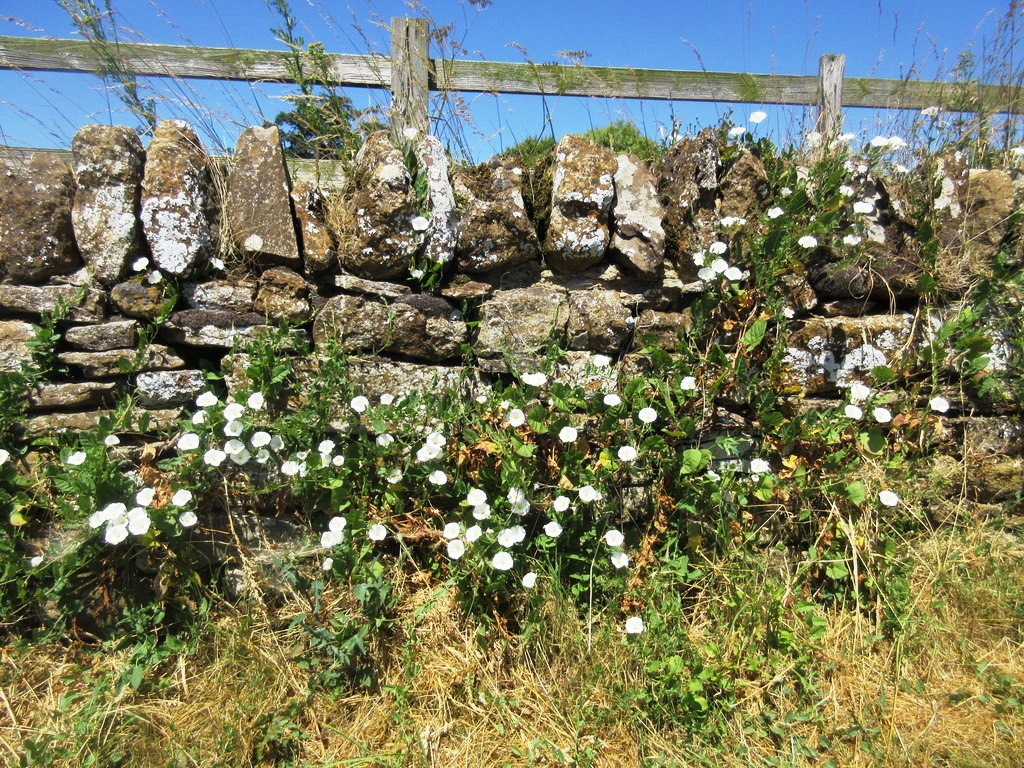
This is a landscape that will surprise some: dry stone walls are a common feature on Northamptonshire's uplands.

And until the 1960s it was an industrial landscape, with an aerial ropeway and broad-gauge and narrow-gauge tramways all connected with the local ironstone quarrying industry.

At the bottom of the hill you meet the Brampton Valley Way, a footpath and cycle path that occupies the trackbed of the old Market Harborough to Northampton railway. More of that another day.


Sunday, May 13, 2018

Saxon and after: St Andrew, Brigstock


My tactic of getting off the bus at the first stop in a small town or village and walking into the centre paid off at Brigstock because I found St Andrew's by following a path beside a stream.

It is not Brixworth, but it is still a fine church with Saxon remains and a similar circular stair tower. You can read all about the architecture in its Grade 1 Listing.

Inside (besides the monument to a Liberal cabinet minister) there is a carved wood screen that is said to have come from Pipewell Abbey.

Outside in the churchyard there is a magnificent tree. Does anyone recognise the species? I assumed it would be a yew, but the leaves are wrong for that.


Wednesday, May 09, 2018

The Brixworth Eagle


I escaped the men in black by going to church.

All Saints Brixworth is the largest Anglo-Saxon church in Britain and it used to be larger still. A monastery standing on a hill.

There is much Roman tile incorporated into it. Though there is talk of it coming from a local villa, tests suggest much was carted in from the Roman buildings of Towcester and Leicester.

The picture above shows an ancient sculpture of an eagle, known as the Brixworth Eagle. Pevsner says this is the Eagle of St. John, dating from the 9th century; others, says Sacred Destinations, think it could be a mason's mark or a reused symbol of a Roman legion.

Whatever the truth, I have turned the photo as the eagle currently lies on its right side just inside the church's porch.

While I was at All Saints a small coach party arrived. They turned out to be from Peterborough Civic Society and I was invited to attach myself to them and get a free cup of tea in The Heritage Centre.


Tuesday, May 08, 2018

Brixworth and the men in black


I arrived in Brixworth this lunchtime to find the place thronged with men in a black uniforms. They seemed to be in every street - sometimes alone or in pairs: sometimes in groups.

A local later told me they were staff from the Mercedes engine research facility in the village, but I prefer my original theory.

Last night a flying saucer was brought down at Hanging Houghton and they were there to mop up.