Showing posts with label Beer. Show all posts

Saturday, February 28, 2026

Ben McGuire fights to save Sharp's Brewery in Rock

Ben McGuire, the Liberal Democrat MP for North Cornwall, has called the planned closure of Sharp's brewery in his constituency "devastating" and urged its American owners to think again.

ITV News reports that he has also said it would be "unacceptable for Molson Coors Beverage Company to market its products as Cornish if it moved out of the Duchy".

The brewery at Rock, which produces the UK's best-selling cask ale Doom Bar, is due to close by the end of the year with the loss of 50 jobs.

Ben told ITV News:

"I’m really disappointed to hear this devastating news that more than 50 local people are going to lose their jobs at this iconic local brewery. We have been so proud to see their beers sold the length and breadth of this country. ...

"I hope the parent company approaches the consultation in the spirit that it should be approached with and they listen to local residents and they come up with a solution to keep those jobs here, or at least some of the skilled jobs. They cannot use our Cornwall brand without production here in Cornwall."

Boak & Bailey wrote about the rise of Doom Bar back in 2008. And Rock always used to be where the upper classes dumped their unwanted teenage offspring for the summer, though I don't suppose they interfered with the brewing.

Friday, February 27, 2026

The Joy of Six 1481

"Other guests at the party included Mandelson’s good friend Nathaniel (Nat) Rothschild, a financier and heir to the Rothschild fortune (Mandelson often stayed at his villa in Corfu), and Rothschild’s old schoolmate, the then shadow chancellor George Osborne." Tamsin Shaw looks back to the Yachtgate scandal of 2008 and argues that we misread it at the time.

"Across the country, thousands of children are quietly lingering in ORR [Office of Refugee Resettlement] facilities, unable to reunite with parents or relatives because of new Trump administration policies limiting who can sponsor them. According to a class action lawsuit filed by immigration advocacy groups last week, children are 'being separated from their loving families, while the government denies their release, unnecessarily prolonging their detention'." Julia Lurie on the cruelty of the Trump regime.

Tanya Park believes Liberals should care about the collapse of serious Conservative journalism: "Not because the Spectator and the Daily Telegraph were ever friends to progressive politics (they weren't), but because a functioning liberal democracy depends on a press that engages honestly with reality across the political spectrum."

Steven J. Vaughan-Nichols predicts that general-purpose AI will poison itself: "We're going to invest more and more in AI, right up to the point that model collapse hits hard and AI answers are so bad even a brain-dead CEO can't ignore it."

"Alcohol has its many downsides as I can attest having a childhood punctuated by my father’s alcoholism, but it lowers people’s inhibitions making them willing to talk. It’s why you’re more likely to spark up a conversation over an interesting cask beer instead of waxing lyrical to the person next to you about the smooth flavour of an Arabica coffee bean." When it comes to social cohesion, beer beats coffee, says David Jesudason.

Ian Jones reminds us that Kenneth Williams was never off the television: "Yet over the next two decades he failed repeatedly to be – in one of his catchphrases from the BBC radio show Round The Horne – 'properly serviced' by the small screen. Despite all that graft on stage, he never landed a leading role in a TV drama series. For all the comic virtuosity that poured out of him in the Carry On films and his radio series with Tony Hancock and Kenneth Horne, he not once played lead in a TV sitcom." 

Wednesday, February 18, 2026

The Joy of Six 1477

Martin Parr looks at successful and unsuccessful attempts to depose a prime minister: "Labour, significantly, has never toppled a prime minister. It’s not in the culture of so cooperativist a party: there’s no equivalent of the 1922 Committee. And whenever it might have happened, the challenger blinked: Herbert Morrison with Attlee; Roy Jenkins with Wilson; David Miliband with Brown; Wes Streeting may have just joined the roster of the rueful."

Sumaiya Motara on the brutal contest for low-paid work: "It’s like The Hunger Games, but you’re all trying to get a job in a shop where you’re going to be folding clothes all day, for just over minimum wage."

"The case took a dramatic turn in November when Erin’s teenage son ... ran away from his father’s home and hired his own solicitor. After a period in foster care and a series of urgent hearings, he was later reunited with his mother for their first Christmas together in six years." Hannah Summers reports on a hearing that highlights the issue of unregulated psychologists appearing in court as expert witnesses.

Some major news organisations are limiting or blocking access to their content in the Internet Archive’s Wayback Machine. They are doing so largely out of concern that generative AI companies are using it as a back door for large-scale scraping. Mark Graham argues that these concerns, though understandable, are unfounded.

"Whilst Landlord continues to power its way across the country ... it has to be hoped that the company doesn't forget its roots and the locality that sustained it for much of its existence." Real Ale, Real Music visits Keighley, home of the brewer Timothy Taylor.

Robert Hugill praises the new Opera North production of Benjamin Britten's Peter Grimes.

Sunday, January 25, 2026

The Joy of Six 1466

Jess Asato, Labour MP for Lowestoft, says AI nudification is the latest weapon of violence against women and girls: "Using AI to strip a woman of her clothes is the modern equivalent of locking her in stocks in the town square and throwing rotten fruit at her. It is a weapon of shame, designed to humiliate. Like other pillories, it is meant to send a message to everyone else: do not do what this woman has done."

"The shortage of legal children’s homes across the UK is fast becoming a national crisis. Last week, a Public Accounts Committee report revealed that nearly 800 children were sent to live in illegal accommodation in 2024, staying an average of around six months each." Gareth Davies and Tom Wall report on a national scandal.

Chris Grey on Donald Trump, Greenland and Mark Carney: "Carney’s speech can be read as a general prescription for middle powers, of which the UK is one, in the rapidly emerging new order. It can also be read, not coincidentally, as a devastating repudiation of the core propositions of Brexiters and of Brexitism."

Emma McClarkin argues that Britain's tax regime is forcing pubs to raise the price of a pint.

"After she finished The Left Hand of Darkness in 1968, she worked for Eugene McCarthy’s primary campaign, stuffing envelopes and writing newsletters in his Oregon field office. In 1972, recovering from the first draft of her novel The Dispossessed, she did newsletters for McGovern." Julie Phillips on Ursula Le Guin the political activist.

"As I walk, I wonder what one ought to put on the grave of a cat." Natalie Guest visits Ilford pet cemetery.

Monday, November 10, 2025

The Joy of Six 1433

Before his books about the Royal Family, Andrew Lownie wrote about Britain's intelligence services. He found them much more helpful than royals have been. Here he talks to Peter Geoghegan about the way that British institutions protected Prince Andrew for years.

Peter Oborne reports that Alistair Burt, the former Middle East minister, admits he was wrong to give Israel unconditional support and wonders if other British politicians will follow his lead.

Polly Mackenzie maps the limitations of the 'add it to the school curriculum' mentality. "If we want a society that is literate in money, media, and citizenship, we need an infrastructure for lifelong learning that reflects how adults actually live. Schools are only one node in a much bigger information system, and we’ve been neglecting the rest." 

"[Ewen] Cameron destroyed the lives of his subjects, many of whom were exceptionally vulnerable, and achieved nothing of scientific value. His work is a catalogue of exploitation and abuse. Yet there is no comprehensive account of Cameron’s studies to be found anywhere in the bioethics literature." Carl Elliott on the way that scandals in scientific research are conveniently forgotten.

"Imagine walking out of Camden Town tube station, turning north towards Camden Market and finding yourself facing a twelve-lane concrete motorway full of roaring traffic. This was the intended outcome of the 1960s Ringways plan to drive four giant circular roads through the capital in order to enable millions of Londoners to drive their private cars straight through the heart of the city." Jim Waterson meets the man who has spent 20 years researching that plan.

Boak & Bailey discover Rustic Ale and what became of it.

Tuesday, October 28, 2025

Wadworth brewery in Devizes transformed by demolition


For what I believe is the first time, Wiltshire's Gazette & Herald wins our Headline of the Day Award.

Don't worry: the historic parts of the brewery have not been razed – the judges just liked the headline.

Wednesday, August 06, 2025

Bishop's Castle: The Poetry Pharmacy and a shuttered Three Tuns


I went back to Bishop's Castle last Friday, when all the shops were open. The most important recent addition to the town is the Poetry Pharmacy which sells books (not just poetry books) and does cake and good coffee.

It's to be found towards the top of the High Street, where - as you can see - it gets really steep. 

Round the corner in Salop Street, you are met with the sad sight of a closed Three Tuns. I remember when it was boarded up in the early Nineties and then reopened by a consortium of friends led by Sir Louis Blom-Cooper.

The brewery next door is not affected, and you can buy their beers in the other pubs in the town.


Thursday, July 31, 2025

Wits in Felixstowe: The genesis of Oh, Whistle, and I'll Come to You, My Lad

Filmed at King's College, Cambridge, and on the Suffolk coast, Wits in Felixstowe looks at the genesis, influences and setting of M.R. James's famous story Oh, Whistle, and I'll Come to You, My Lad.

Writer and presenter Robert Lloyd Parry takes a fresh look at James’s character. He finds, behind the academic and bibliophile, a man surrounded by diverse and intriguing friends: the millionaire Liberal Felix Cobbold, the prolific essayist Arthur Benson and the tragic publisher, poet and Ripper suspect J.K. Stephen.

Thursday, July 24, 2025

Book Review... All the Wide Border: Wales, England and the Places Between by Mike Parker

This review appears in the new issue of Liberator. You can download it free of charge from the magazine's website.


All the Wide Border: Wales, England and the Places Between

Mike Parker

Harper North, 2024; £10.99

The Welsh border is the most intoxicating landscape I know, and Mike Parker is a companionable guide to it. Immune to the tendency to complain that things aren’t what they used to be – when were they ever? – he is interested in the towns and countryside as he finds them today.

Parker made the journeys he describes in this book during the Covid pandemic, a period that may turn out to be little represented in our literature. An English-born Welsh Nationalist, he found the more collectivist traditions of his adopted country served people better in that time of trial.

Along some stretches of the border, it’s easy to forget which country you are in. I remember once coming down off the hills to Kington and being almost surprised to find myself in a red-brick Midland town with Burton beers in all the pubs. Further north, around Chester in particular, Parker shows the border is still a hard reality that affects the economy and society on both its sides.

Much as I enjoyed All the Wide Border, it’s a reminder of how personal our reaction to places can be. The first chapter takes you to a place I’ve been many times: the country west of the Stiperstones up to Shropshire’s border with Powys. 

For me it means the remains of the lead-mining industry; the children’s books of Malcolm Saville; Ronnie Lane and one of his rock star mates, down to use the studio at Lane’s place a couple of fields into Wales, playing unannounced at a remote pub; the death at a farm of the foster child Dennis O’Neill, which led both to the 1948 Children’s Act and Agatha Christie’s play The Mousetrap. Parker’s chapter mentions none of these, yet I still found it as interesting as any in the book.

Jonathan Calder


Thursday, June 19, 2025

Hunting for the Bonkers Arms in Medbourne


I went to Medbourne today. The county's new on-demand bus service has made dozens of villages easy to reach - it's just a shame that so many rural pubs are closing.

One that is thriving is Medbourne's Nevill Arms (on the left of the photo above). Some scholars have concluded it is  the model for the Bonkers Arms (I would say it is at most one of the models), and if it is then it's more Freddie and Fiona than Meadowcroft these days.

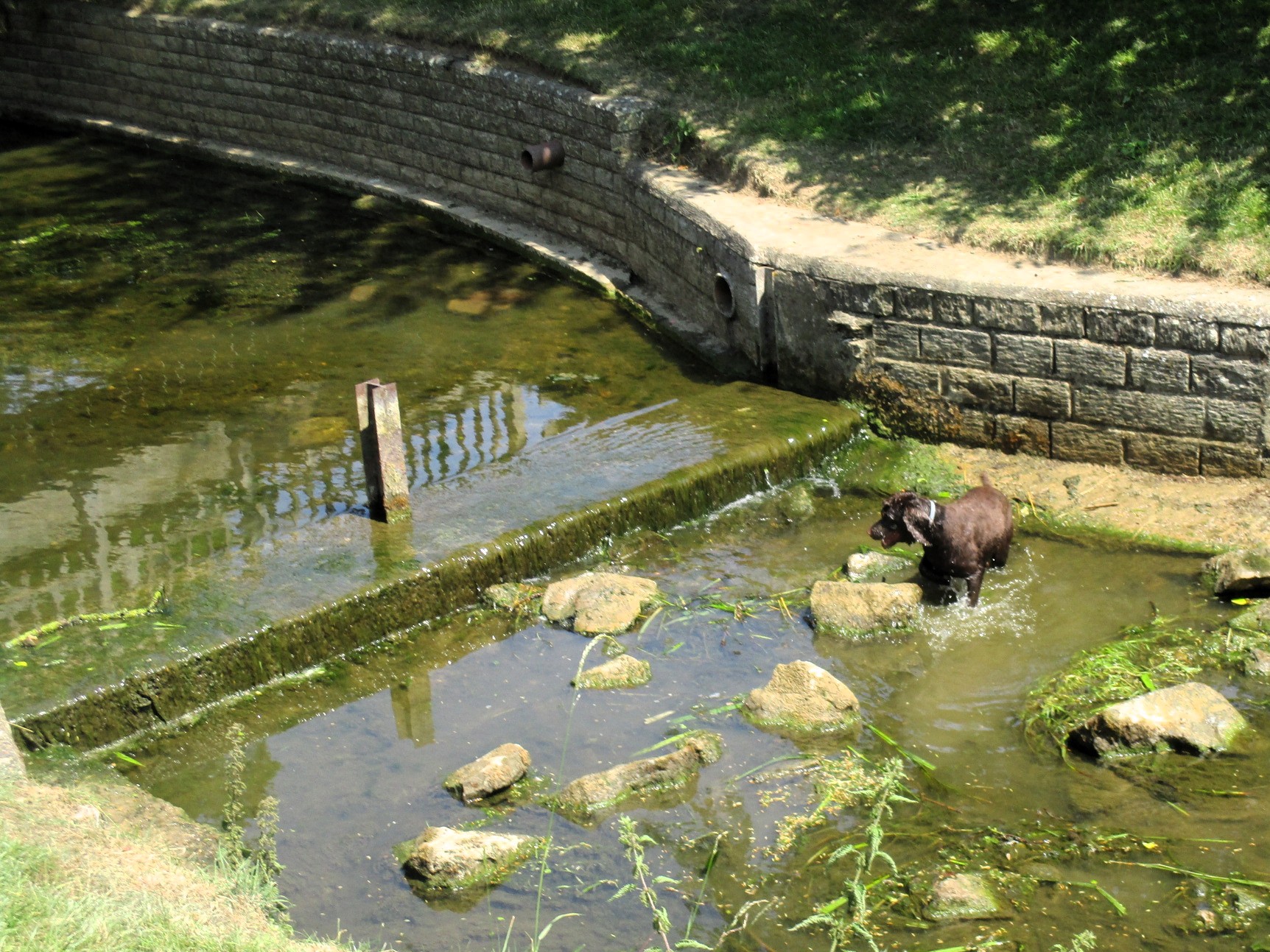
But it was a lovely day to sit outside above the brook. I drank Birrificio Angelo Poretti, because it was chilled and I liked the cinema advert, and enjoyed the entertainment in the water.

Monday, June 02, 2025

Lord of the Flies: Had William Golding read Richard Jefferies?

Accounts of the writing of William Golding's Lord of the Flies tend to emphasise the influence of R.M Ballantyne's The Coral Island on the book. Golding both borrowed Ballantyne's plot and subverted his view of the world.

But I have lately come to wonder if Golding had read another Victorian novel: Richard Jefferies' Bevis: The Story of a Boy. Because, in it, Bevis and his friend Mark maroon themselves on an island and live like explorers. Gradually, like the boys in Lord of the Flies, they become convinced they are sharing the island with a beast.

Bevis and Mark were better organised than Golding's boys:

Poles were nailed across the open sides from upright to upright, not more than six inches asunder right up to the beam on two sides. This allowed plenty of space to shoot through, but nothing of any size could spring in. On the third, the poles were nailed across up to three feet high, and the rest prepared and left ready to be lashed in position with cords the last thing at night.

When these were put up there would be a complete cage from within which they could fire or shoot arrows, and be safe from the spring of the beast. Lastly, they went up on the cliff to see what could be done there. The sand was very hard, so that to drive in stakes the whole length of the cliff edge would have taken a day, if not two days.

They decided to put up some just above the hut so as to prevent the creature leaping on to the roof, and perhaps tearing a way through it. Bevis held the matchlock this time and watched while Mark hewed out the stakes, taking the labour and the watching in turn. With much trouble, these were driven home and sharpened nails put at the top, so that the beast approaching from behind would have to leap over these before descending the perpendicular cliff on to the hut. The fortification was now complete, and they sat down to think if there was anything else.

That's from chapter 45 of the classic Jonathan Cape edition of Bevis, which has illustrations by E.H. Shepard. 

But it was originally chapter 11 of volume 3 - a reminder that, though the book puts a child's perceptions at its centre in a way that was unprecedented in 1882, it was published as a novel for adults and in a form to suit commercial libraries.

Anyway, there's more about the beast in the next chapter:

At the water’s edge some flags were bent, and then the tall grass, as high as their chests, was thrust aside, forming a path which had evidently been frequently trodden. There was now no longer the least doubt that the creature, whatever it was, was of large size, and as the trail was so distinct the thought occurred to them both at once that perhaps it had been used by more than one. From the raft they could see along it five or six yards, then it turned to avoid an alder. While they stood looking Pan came back, he had run right through and returned, so that there was nothing in the reed-bed at present.

Bevis stepped over the bulwark into the trail with the matchlock; Mark picked up the axe and followed. As they walked their elbows touched the grass each side, which showed that the creature was rather high than broad, lean like the whole feline tribe, long, lean, and stealthy. The reed-grass had flowered and would soon begin to stiffen and rustle dry under the winds. By the alder a bryony vine that had grown there was broken and had withered, it had been snapped long since by the creature pushing through.

The trail turned to the right, then to the left round a willow stole, and just there Pan, who trotted before Bevis, picked up a bone. He had picked it up before and dropped it; he took it again from habit, though he knew it was sapless and of no use to him. Bevis took it from his mouth, and they knew it at once as a duck’s drumstick. It was polished and smooth, as if the creature had licked it, or what was more probable carried it some distance, and then left it as useless. They had no doubt it was a drumstick of the wild duck Mark shot.

The trail went straight through sedges next, these were trampled flat; then as the sedges grew wider apart they gradually lost it in the thin, short grass. This was why they had not seen it from the land, there the path began by degrees; at the water’s edge, where the grasses were thick and high, it was seen at once. Try how they would, they could not follow the trail inland, they thought they knew how to read "sign," but found themselves at fault. On the dry, hard ground the creature’s pads left no trail that they could trace.

I was reminded of the beast on the island by a Twitter account that was tweeting Bevis line by line. It stopped suddenly, which made me worry that Bevis and Mark had been devoured by the beast. But I've now found the service is being continued on Bluesky.

So let's end with a shocking reminder from Bevis of the delinquency of Victorian schoolboys as they assemble the provisions to take to the island:

Mark took care that there should be some salt, and several bags of flour, and two of biscuits, which they got from a whole tinful in the house. He remembered some pepper too, but overlooked the mustard. They took several tins of condensed milk. From a side of bacon, up in the attic, they cut three streaky pieces, and bought some sherry at the inn; for they thought if they took one of the bottles in the house, it would be missed, and that the servants would be blamed. Some wine would be good to mix with the water; for though they meant to take a wooden bottle of ale, they knew it would not keep.

Foxes on a speedboat: Birrificio Angelo Poretti's Welcome to the Lake cinema commercial

I enjoyed The Phoenician Scheme, but maybe the highlight of the afternoon was this commercial for Birrificio Angelo Poretti.

Don't think you'll be getting a taste of the real Italy though: it's brewed by Carlsberg in Northampton.

Monday, May 19, 2025

GUEST POST The state of our canals - and canalside pubs - today

Fresh from a canal holiday made difficult by unannounced closures, Peter Chambers looks at the many challenges facing the Canal & River Trust.

The British have been using waterways for a long time: we are told that the canal called the Fossdyke was created by the Romans. 

Things started to get busier as entrepreneurs such as the Duke of Bridgewater and Josiah Wedgewood raised capital for specific ventures that would pay for something that by-passed the toll roads of the day – iron mining and pottery in their cases. 

This was the start of the first Industrial Revolution in the 1700s. Once these connections existed, the marginal cost for other uses dropped and more firms used them. The logic of places such as Birmingham became evident, as you were taught in O level Geography. The more you link, the more profitable it is to link more.

At the time. each new major canal required an Act of Parliament. Limited liability companies solicited funds, and shopped around for an MP to propose another Canal Bill. The canal age had started. The emergent network was a strange one. Different fees, widths, depths, keys, windlasses, heights and naming conventions. It topped out at about 8000 miles. Today we have the best 2000 in preservation.

The canals survived into the 20th century. They played a part in winning the two world wars, helped by a big public works programme run by Herbert Morrison in the 1930s.

Then reality caught up. The combination of the post-war car economy and the railways removed most of the profitable trade. The network was taken into public ownership under the British Transport Board. The canal network was put under the British Waterways Board (BWB). Even today there are artefacts stamped BWB. 

The Department of Transport debated the future of the waterways with its boards. However, despite attempts at running high-latency cargo, leisure was the only viable long term use identified. The BWB settled in for a long stretch running a national ‘linear leisure park’. 

During this time a large number of restoration societies restored hundreds of additional miles to use. They then handed over the restored mileage to the BWB, often during ceremonies involving the Queen. Or Prunella Scales.

This led to a happy time for many people. The canals had been built by thirsty 'navvies' for whom real-ale pubs had been constructed. These pubs were retained for the thirsty boatmen who worked the boats during and after the first Industrial Revolution. 

Generally, blond continental beer was kept away from key waterway junctions for decades. Additional supplies of real ale could be supplied by breweries such as Wadsworth's at Devizes on the Kennett and Avon Canal, which operates today and runs tours ending in a small shop only a short walk from the Caen Hill flight of locks.

The restoration effort even benefited from additional charitable funds from the National Lottery. An umbrella body – The Waterways Trust – was formed in 1999 to use charity funds to open new facilities and attract new interest and spending to the waterways. 

Restorers entered a peak activity phase, linking up old routes, and pushing into Wales with the Montgomery Canal past Offa’s Dyke. The "Monty", as it is known, is only a few miles away from the award-winning real-ale pub The Bailey Head in Oswestry (dogs welcome). 


It is probably best to moor outside the Queen’s Head (closed on Mondays) and make your way into town. Alternatively you can cross the border near Chirk and press on to Llangollen, with its excellent hostelries. Ideally do both.

Time, however, moved on. In 2012, during the time Justine Greening was transport secretary, all of British Waterways responsibilities and assets in England and Wales were transferred to a new charity, the Canal & River Trust (CRT). This had the advantage of removing the liabilities of the waterways from the books of the government. 

The CRT was endowed with the assets of the BWB. It was also intended that it would receive tapered funding from the state. It would continue to provide a public benefit, but would increasingly stand on its own thousand feet. One day licence fees and other charges would have to rise, and the ageing physical infrastructure of the endowment would require gradually increasing maintenance charges. 

The restored plant of the waterways had been stabilised, but no programme of replacement or upgrade was baked into the system. There would be no refresh, only an endless set of repair patches, done in priority order. The staff and facilities of the BWB started to age out. After a while the maintenance capability became increasingly contractorised.

Following the Covid pandemic, many old canalside pubs closed. They lacked the financial 'bottom' of large chains, and often served distinct local clienteles. A victory for continental lager seemed certain,, with blond 'craft beer' often substituted to tempt the unwary.

In 2025 there exist many unplanned remedial works that will consume millions in unbudgeted funds. This will mean that planned work to partly remediate the effects the pandemic will not happen, and the deficit of the CRT will rise above £10m. A general review of fees is promised, with all up for grabs – widebeam fee increases, loss of green initiatives, possible closures.

In addition to the effects of long-postponed asset failures, the long-term effects of climate change are making themselves felt. Several waterways this year have restrictions or stoppages due to low water conditions. The Pennines are all but closed. The Macclesfield is in doubt. The Rochdale looks rather dry. The Trent is low, but usable. When planning journeys in these areas, the bleating of the fossil-fuel shills sound particularly self-serving.

Finally, I could mention the pollution levels and the water companies. It is enough to say that you should wash your hands every time you go indoors afloat. I mean it.

Peter Chambers is a Liberal Democrat member from Hampshire.

Thursday, April 10, 2025

Wish I had been the first to find the real David Watts

Oakham's Big Pop Flop

say the headlines. And:

Organisers blame fantastic rumours of a rowdy and dangerous evening for failure

This is the Stamford Mercury for Friday 26 August 1966, reporting events the previous weekend:

The much publicised big beat show on Saturday night Oakham proved to be very much off-beat. With The Kinks as the star attraction, supported by three other well-known "pop" groups, the promoters hoped for a crowd of between five and six thousand on the agriculturkl show ground, but only just over 2,000 turned up.

"It was a financial failure and we're bitterly disappointed. We had hoped to raise a considerable sum for Langham village charities, Mr Tony Ruddle, one of the organisers, told the Mercury.

Special trains were put on, including one calling at Market Harborough, but they not enough to override the bad advance publicity, at least as the organisers told it.

Now, to anyone who knows their pop history, the conjunction of the Kinks and Rutland will ring a loud bell. Here's Ray Davies talking about the genesis of the song David Watts:

As Ray Davies confirmed in The Kinks: The Official Biography by Savage, "David Watts is a real person. He was a concert promoter in Rutland." He goes on to relate how the real Watts was gay and demonstrated an obvious romantic interest in his brother Dave Davies. In this light, lines such as "he is so gay and fancy free" and "all the girls in the neighbourhood try to go out with David Watts... but can't succeed" provide a second level of interpretation based on this ironic in-joke.

The band members were invited back to Watts' home for a drink one night after a concert. Ray Davies recalled to Q magazine in a 2016 interview: "My brother, Dave, was in a flamboyant mood and I could see that David Watts had a crush on him. So I tried to persuade Dave to marry David Watts because he was connected with Rutland brewery. See, that's how stupid my brain was."

If we're talking about the Kinks meeting a Rutland pop promoter, it must surely have been at the failed Oakham event.

So I searched the local papers for the name David Watts and came up with nothing - the organisers mentioned were all members of the Ruddle family. (Ruddle's beers had a vogue in the Eighties, so much so that they became easier to find in London than Rutland. Then the Ruddle family sold out to Watney's and their brewery at Langham was closed and demolished.)

There was one tantalising glimpse of a David Watts though. In the late Sixties and early Seventies, the dart players of Oakham competed for the David Watts Trophy. 

And then I found an online obituary for a Major David Watts.

David Watts, who died on 16 September 1990, joined the 3rd Hussars at Sarafand in Palestine in 1946, having recovered from being severely wounded while serving with the 1st Royal Tank Regiment in Normandy.

He was one of those men of whom it is true to say that he was devoted to his Regiment.

Although he carried out two appointments on the staff with competence and flair, he was first and foremost a Regimental soldier with the 3rd Hussars, The Queen’s Own Hussars and very happy and successful as Training Major with the Warwickshire and Worcestershire Yeomanry.

And so on until you reach:

After retiring, he lived in Rutland and worked in the brewing industry for a short time before going back to Devonshire where his family have lived for many years.

I don't know how much truth there is in Ray Davies's recollections, but this Major must be our man.

For a few days I felt very pleased with myself, then I discovered that a Kinks Facebook page had got there three years before me. I knew how Captain Scott felt when he reached the South Pole only to find Amundsen's Norwegian flag flying.

I am just going outside and may be some time, so I'll leave you with the Kinks.

Sunday, March 09, 2025

A walk across the fields to the new Braybrooke Beer Co. taproom

A few years ago the Braybrooke Beer Co. set up a brewery at a farm outside the Northamptonshire village of that name to produce lager. The company was formed with the London market in mind, but you can buy their beers at the Beerhouse in Market Harborough and no doubt it has other outlets beyond the capital.

They have just opened a taproom at the brewery, and there is a surfaced path leading to it from the Brampton Valley Way - the old Market Harborough to Northampton railway. On Friday, I set out to walk that path.

I was surprised there was no signpost at the turn off from the Brampton Valley Way, and I wasn't convinced at first that I was going the right way. But if you leave the Way by a few muddy steps and set off diagonally across a field - see the photo above - you're doing fine.

Cross the bridge, and you will find a surfaced path - suitable for wheels as well as boots - and a pleasant landscape.


When you cross the River Jordan, on its way to flood Little Bowden and then join the Welland by Market Harborough railway station, then you are almost there.


And at the business end of the path, there is a sign.


There are also signs along the way for horses, which are very intelligent in this part of Northamptonshire and value politeness.


Finally, though I didn't manage to photograph the start of the new path or the taproom itself, I did capture this disturbing image.

My theory is that these are the ghosts of Iron Age warriors, disturbed by an archaeological dig that all the locals advised against.

Friday, January 17, 2025

The Bailey Head, Oswestry, is CAMRA's Pub of the Year


Congratulations to Grace Goodlad and Duncan Borrowman whose Oswestry pub The Bailey Head has been named Pub of the Year by the Campaign for Real Ale .

Grace and Duncan were both Liberal Democrat councillors in Bromley. Duncan is also a former Lib Dem parliamentary candidate and was a member of party staff at Cowley Street for many years.  I visited their pub last summer.

Grace told the Mirror today:

"We are thrilled, we hope we can live up to the award. In our wildest dreams we never thought we would win CAMRA Pub of the Year. From small beginnings nine years ago, we have taken everything one step at a time, through COVID, slowly improving to the point where we now have twelve handpulls serving six cask beers and six ciders and perries, plus sixteen other draught lines.

"When we bought the pub nine years ago it was failing and had been listed as an Asset of Community Value by the local CAMRA branch. That listing made it possible for us to save it from potentially becoming housing and turn it into the pub it is today."

Friday, January 03, 2025

The Joy of Six 1307

'Graham', a victim of John Smyth, explains why the attitude of the Church of England means that he cannot move on: "victims have no closure. We do not yet have the truth. We do not yet have personal apology. We do not yet have justice. We do not feel that anything has changed."

"Cottesmore Hunt were about to be forensically challenged - and in real time.  Along with Chris and Megan was Fabian who, armed with a live broadcast camera, captured all the action as it happened and shared it via a live social media stream. The only veil of secrecy the Cottesmore could call upon was the thick mist which shrouded the killing fields."  Northants Hunt Saboteurs are joined for a day by Chris Packham and Chris Packham and the zoologist Megan McCubbin.

Will Tavlin on the strange economics of streaming services: "For a century, the business of running a Hollywood studio was straightforward. The more people watched films, the more money the studios made. With Netflix, however, audiences don’t pay for individual films. They pay a subscription to watch everything, and this has enabled a strange phenomenon to take root. Netflix’s movies don’t have to abide by any of the norms established over the history of cinema: they don’t have to be profitable, pretty, sexy, intelligent, funny, well-made, or anything else that pulls audiences into theatre seats."

J.J. Jackson explores East Anglia's hidden man-made and explosive dangers.

A tour of some of the grandest interwar public houses of East and South London in the company of Modernism in Metroland.

"Coming away from a light-hearted festive flick often feels like being sloshed on a cocktail of capitalism and corporate greed. Can’t connect with your children? Just buy their affection with an expensive toy, like Arnold Schwarzenegger in Jingle All the Way. Want a turkey but there’s hardly any left in stock? Fight with a rival shopper, as per Jamie Lee Curtis in Christmas with the Kranks." Sam Quarton suggests a Christmas horror flick for the anti-festive film lover: The Legend of Hell House.

Monday, September 02, 2024

A walk along Roman Stane Street from London Bridge to Tooting with John Rogers

John's blurb on YouTube explains:

Part of a series of videos exploring Roman London, this walk follows the Roman Road that led from the Thames at London Bridge to Chichester. Our journey starts at London Bridge and a stop at the Wheatsheaf pub. The road leads us through Elephant and Castle, Kennington, Stockwell, Clapham, Clapham Common, Balham, ending at Tooting in the Trafalgar Inn.

A collaboration with Young's Beer.

John has a Patreon account to support his videos and blogs at The Lost Byway.

Sunday, September 01, 2024

The Bailey Head, Oswestry: One of the 17 best pubs in Britain


I have been to one of the best 17 pubs in Britain.

Remembering a post from July about Grace Goodlad and Duncan Borrowman's pub in Oswestry, the day after showing the philosophers around Malcolm Saville Country I broke all my rules and customs and headed for the north of Shropshire.

The Bailey Head occupies a great position in the centre of town, and the orange umbrellas outside display a Liberal Democrat's knowledge of which colour stands out best from a distance.

I found Grace and Duncan behind the bar. We talked Shropshire politics, I sampled their beers and the regulars were friendly.

One of the best 17 pubs in Britain? When I blogged about the pub in July, it was to say that it had just been named as the CAMRA's West Midlands Cider Pub of the Year.

Now, reports Shropshire Live:

The Bailey Head in Oswestry has been named as one of the top 17 pubs in the UK as part of the Campaign for Real Ale’s (CAMRA) prestigious Pub of the Year competition.

The pub has one of the largest beer ranges of any in Shropshire, claiming to have sold over 3,400 different draught beers since March 2016.

Six constantly changing cask beers, always including one dark beer, are supplemented by eleven other draught beers, plus four ciders and a perry. The pub also has a substantial range of canned and bottled beers from across the UK and overseas.

The Society of Independent Brewers (SIBA) named the pub the UK’s Best Rural Independent Craft Beer Pub or Bar in 2020 and has been a finalist many times since. Regular tap take overs and meet the brewer events, among other activities are organised for the local community. The Bailey Head is very dog friendly, being voted Most Dog Friendly Pub in the West Midlands in 2017 by DogBuddy.

17 fantastic pubs have battled it out with thousands of pubs across the UK to be crowned the winner in their area. Pubs in the competition are scored on their atmosphere, decor, welcome, service, inclusivity, overall impression, but most importantly – the quality of live beer, real cider and perry.

The regional and national finalists will now compete for the UK National Pub of the Year award, with judges whittling the 17 pubs down to just four in late September. CAMRA’s esteemed National Pub of the Year title is the topmost accolade the campaigning group can bestow upon a pub. The overall winner will be announced in January 2025.

Good luck to The Bailey Head!

Thursday, July 13, 2023

Bishop's Castle celebrates the 450th anniversary of its charter

The Shropshire Star reports

This weekend marks the moment when 450 years ago the first Queen Elizabeth granted Bishop's Castle its charter to rule itself.

The town is now bedecked in flags and bunting, including some specially created for the event in the Tudor colours of red, white and green. ...

The culmination of the celebrations will be a street fair on Sunday from 10am - 4pm, where Queen Elizabeth I herself will make the presentation of the charter to the Mayor.
As it's Bishop Castle we're talking about, a new beer has been brewed to celebrate the occasion.

You can see scenes from the 400th anniversary celebrations in 1973 in the silent film above.