Showing posts with label Medbourne. Show all posts

Tuesday, December 23, 2025

"The horrible ghost up on Nevill Holt hill"

The Market Harborough Advertiser and Midland Mail for Thursday 19 August 1954 has a report on a benign ghost to be found at the Manor House in Medbourne.

In those days the house belonged to a Mrs Beadon, who tells the paper she has seen the ghost on quite a number of occasions but has never resented his presence because he is a "perfectly good-tempered old man".

She then added:

"Not like the horrible ghost up on Nevill Holt hill, who makes the village people scared to walk up there after dark."

Nevill Holt Hall, you may remember, is now accepted by most scholars as the chief inspiration for Bonkers Hall, though I don't recall the old boy reporting any hauntings there. Come to think of it, he never mentions Bonkers Hall being on a hill either.

So I wonder if the ghost was really the headmaster of the notoriously abusive prep school at Nevil Holt manufacturing a haunting to keep prying eyes away, like a Scooby-Doo villain.

The Guardian discovers the Welland Valley: "An unsung alternative to the Cotswolds"


We've all heard of The Notswolds, and an article in the Guardian today adopts my definition of Les Notswolds profonds: the Welland Valley between Market Harborough and the Welland Viaduct.

Ben Lerwill visits Market Harborough:

The town itself has ancient Saxon roots and is easy to like, with a head-turning mix of Jacobean, Georgian and Victorian architecture. I stumble on Quinns, a cracking independent bookshop tucked down an alleyway, then devour a curry bowl at a lively cafe called Two Old Goats. 

A board on the street lists notable town residents through the ages, the most recent being rugby giant Martin Johnson. I read this, then turn and immediately see him on the pavement 10 metres away. It’s unclear if this clever routine is something he does for all visitors, but he’s hard to miss in any case.

He visits Foxton Locks:

The real pull of the Welland valley is the countryside, a slow-moving world of hushed green dales and drifting red kites. On local advice, I head to rural Foxton Locks – Britain’s highest combination of staircase canal locks, where 10 adjacent early 19th-century locks transport boats up and down a 23-metre hillside – for a gawp and a wander. “It takes 50 minutes for boats to get from one end to the other,” says volunteer Malcolm, who seems delighted to have a visitor to talk to. The neatly painted locks rise up handsomely beside us.

And he visits Medbourne to stay at one of the models for the Bonkers Arms:

My base is nearby Medbourne, one of numerous placid, calendar-pretty villages that stud the Welland valley. Medbourne has a clear stream, a lovely pub – the Nevill Arms, where I spend the night in a four-poster and enjoy exactly the kind of warming, candle-lit dinner you’d want from a country inn in winter – and cottages built of tough, reddish Leicestershire ironstone.

Best of all, be mentions a cafe in Great Easton I didn't know about.

Friday, June 20, 2025

Medbourne station and the emptiness of the countryside between Leicester and Peterborough

I went to look for Medbourne station, which closed as long ago as 1916. You may remember that I blogged about a 1922 campaign to reopen it.

The station master's house survives, but you can't get a good photo of it from the public road. You can see a picture of it on the Medbourne village website.

So all I can show you is the pillars at the entrance to the station, which are quite a way from where the platforms would have been. The second pillar is next to the litter bin, if you're struggling to locate it.

And below is a heavily altered (Notswoldised?) terrace of railwaymen's cottages, which stands close to the station entrance.

In 1910 the Great Northern Railway ran a service from Leicester Belgrave Road to Peterborough North (the present-day Peterborough station), which called at Medbourne. It probably took a more direct route than the Leicester to Peterborough trains via Melton Mowbray, Oakham and Stamford do today.

What brings home the emptiness of this part of the world is the list of stations the GNR trains called at between Leicester and Peterborough. After the Leicester suburb of Humberstone, there was not a place of even middling size among them.

The list ran: Humberstone, Thurnby & Scraptoft, Ingarsby, Lowesby, Tilton, East Norton, Hallaton, Medbourne, Rockingham, Seaton, Wakerley & Barrowden, King's Cliffe, Nassington, Wansford, Castor.

Thursday, June 19, 2025

Hunting for the Bonkers Arms in Medbourne


I went to Medbourne today. The county's new on-demand bus service has made dozens of villages easy to reach - it's just a shame that so many rural pubs are closing.

One that is thriving is Medbourne's Nevill Arms (on the left of the photo above). Some scholars have concluded it is  the model for the Bonkers Arms (I would say it is at most one of the models), and if it is then it's more Freddie and Fiona than Meadowcroft these days.

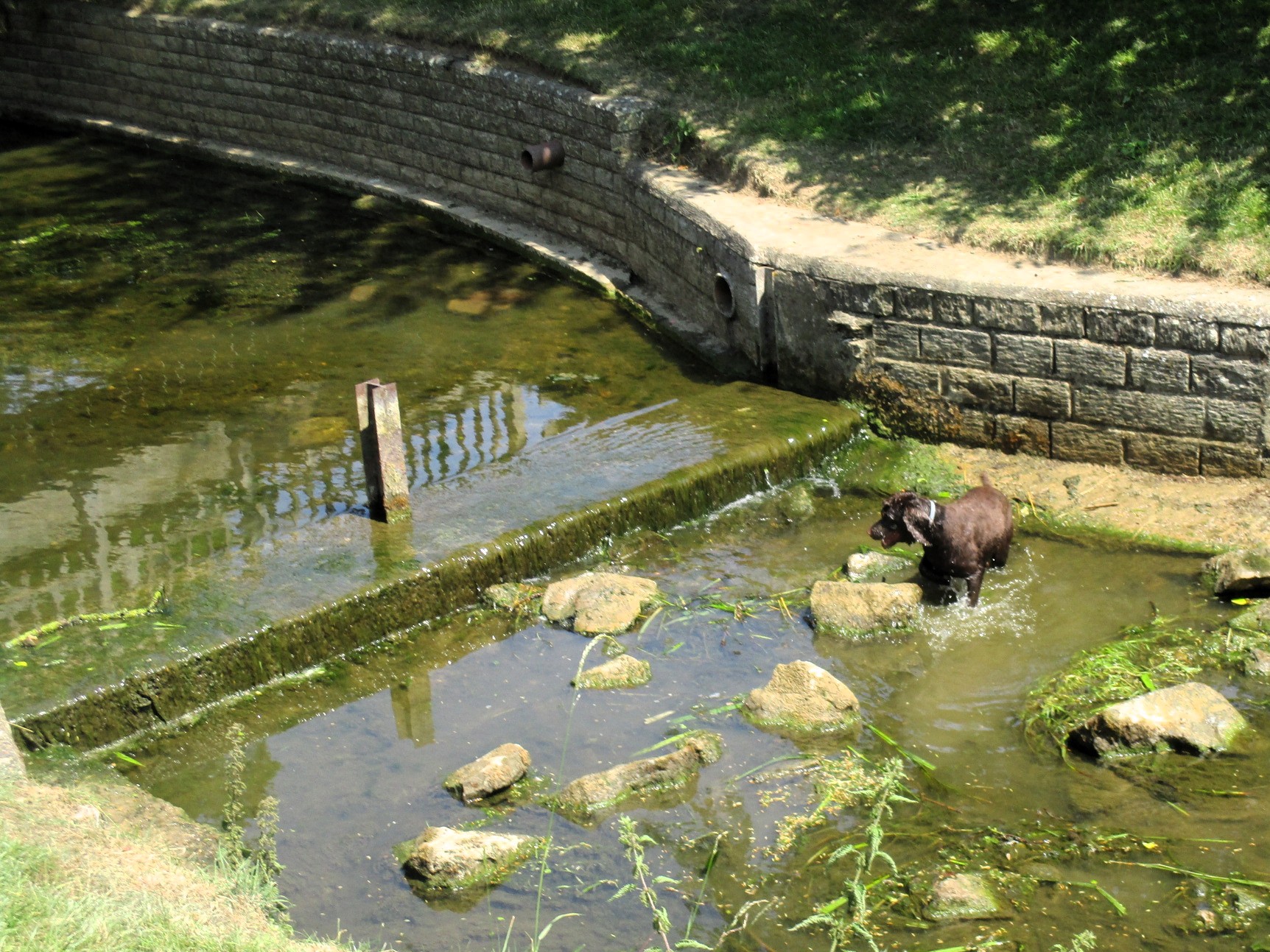
But it was a lovely day to sit outside above the brook. I drank Birrificio Angelo Poretti, because it was chilled and I liked the cinema advert, and enjoyed the entertainment in the water.

Saturday, March 29, 2025

Now The Bonkers Arms is in The Notswolds


Remember The Notswolds? There's another article on the concept, this time in the Evening Standard:
The Welland Valley is part of an area often dubbed 'the Notswolds' on account of it being as beautiful as the Cotswolds, but without the price tag. 
Residents of this stretch of south Leicestershire and north Northamptonshire flanking the River Welland will tell you there’s no comparison, though - it’s more picturesque, more accessible and more affordable.
As to exactly where the region is:
Debate rages over exactly where the Welland Valley starts and finishes, but the stretch between Market Harborough and Harringworth represents the "heart" of this beautiful area to Ellie.
Ellie is Ellie Upall from Three Goats, a company that owns three pubs in this part of the world.

One of them is mentioned in the article:
Convinced of its potential as a getaway spot for capital-dwellers, the Three Goats has invested £3m in The Nevill Arms, a boutique country hotel and pub in Medbourne, one of the Valley’s most iconic villages. 
"Medbourne epitomises this region," she says. "It has a brook, lots of stone and thatched houses, a village hall, a shop-cum-post office, a pre-school, a church and a sports club. 
"There’s a strong sense of community and many residents work from home or commute to London. Having Market Harborough and Uppingham nearby is a big bonus, plus you don’t have to travel too far to be in Leicester or Nottingham."
Ellie has noticed an upturn in visitors to The Nevill Arms on "scouting missions" ahead of potentially relocating here. "They’re always surprised how easy it is to get to," she says.
If, as most scholars maintain, Nevil Holt Hall is the model for Bonkers Hall, then Medbourne must be "the village" Lord Bonkers talks about and The Nevill Arms must be The Bonkers Arms.*

Of course, I was on to The Notswolds before it was fashionable. In a Guardian article from 2008, I quoted W.G. Hoskins on eastern Leicestershire: "a landscape of sharp hills, woodland, stone-built villages and many fine churches".

And I quoted Peter Ashley, who is mostly on Instagram these days:
On his blog Unmitigated England, the writer and photographer Peter Ashley describes one of his favourite Midlands locations, the lane that circles Cranoe church in a hairpin bend as it drops into the Welland valley: "I once used to say to companions on this road 'Look at this. You could be in Dorset. Or Devon. You'd never think you were in Leicestershire.'" 
But he has managed to raise his consciousness: "I have now realised what a fatuous remark this is. This is Leicestershire, and in fact very typical of the eastern side of the county."

* To be honest, I envisage the Hall being closer to the village than this. Bonkers Hall has an impressive drive, but I'm sure the pub is no more than a pleasant stroll away if you nip out of a back gate. The fact that there is is a secret passage from the Hall that comes out in the cellar of The Bonkers Arms strengthens the case for their not being far apart. A visit to The Bell Inn at East Langton, handy for J.W. Logan's home at East Langton Grange, will give you an idea of what I have in mind.

Thursday, March 27, 2025

A 1922 campaign to reopen Medbourne railway station


From the Grantham Journal, Saturday 16 December 1922.

Medbourne

Re-Opening Railway Station Wanted. - At a meeting of the Parish Council, steps were decided upon with a view to inducing the G.N.R. Company to re-open Medbourne Station, which was closed during the war,, and the train service from Leicester to Peterborough, via Seaton Junction, suspended.

Medbourne station was open for only 33 years. It and the short line through it opened in 1883, the line was singled in 1905 and the station was closed as a wartime economy measure in 1916.

After that the line was used chiefly for storing wagons, but wasn't lifted until the 1960s.

One problem with the station was that the GNR's Leicester Belgrave Road to Peterborough service, which called there, took a circuitous route - though probably no more so than the Leicester to Peterborough service that runs today via Melton Mowbray, Oakham and Stamford.

The Medbourne Village site suggests that people there would rather have had a train to Market Harborough.

One irony is that the village sat inside a triangle of lines, so whichever way you left Medbourne, you crossed a railway. No wonder there was a campaign in 1922 to get their station back.

Saturday, February 24, 2024

Christopher Brasher goes to the Hallaton bottle kicking


Click on the image above to go to the BBC Rewind website and see a 1964 report by a bemused Christopher Brasher on the Hallaton bottle kicking.

This is in essence one of those football games between villages that claim medieval roots and are the ancestors of modern football and rugby. Wikipedia calls these contests 'folk football', which I rather like.

Brasher, incidentally, interviews Jack Stamp, founder of Market Harborough's most celebrated undertakers.

Read more about bottle kicking on the Medbourne Village website.

Friday, January 26, 2024

Harborough District Council may add more buildings to its list of heritage assets


Harborough District Council, reports the Harborough Mail, has launched a consultation on adding a number of historic buildings to its list of heritage assets.

  • Former Nat West, Barclays and HSBC banks in Market Harborough
  • Former Station, Kibworth Beauchamp
  • Husbands Bosworth Airfield, Sibbertoft Road, Husbands Bosworth
  • Tollgate Cottage, Lutterworth Road, Bitteswell
  • Village Shop, Springbank, Medbourne
  • Auburn Place, Bitteswell Road, Lutterworth
  • Engineering Factory, Fairfield Road, Market Harborough

The consultation will run until 27 February. The council has been run by a Liberal Democrat, Green and Labour coalition since last May.

Wednesday, December 02, 2020

York Road and Maiden Lane: Two lost stations north of King's Cross


York Road was on the Piccadilly Line, closing in 1932. Its revival has often been forecast but never taken place.

Jago Hazzard, whose video this is, thinks Maiden Lane on the North London Line may be a better bet. It closed as early as 1917 in the first round of closures to hit the British system. Medbourne in Leicestershire went at the same time.

Saturday, February 22, 2020

The Cunards at Nevill Holt


The Medbourne Village website has a good page about the Cunards and their tenure of Nevill Holt,

Edward Cunard purchased the Nevill Holt estate in 1876. The following year it was inherited by his brother Sir Bache Cunard:
By 1886 Sir Bache found himself in constrained financial circumstances which caused him to mortgage the Estate to some clients of Peake and Company, Solicitors in London. By 1893 however the mortgagees wished to foreclose on the mortgage and Particulars of Sale were prepared. However, his marriage in 1895 to Maud Burke enabled the Estate to be maintained.
Maud Burke was yet another of those American heiresses who married into the British aristocracy in this era. And many of them, like Maud Burke, rescued the finances of the family they joined.

But it was not to last:
In 1911, after leaving her husband in Leicestershire, Maud moved to London with Nancy and became a leading light in London society becoming known as a lavish hostess. Later in 1911 the Cunards separated and Maud fell in love with Sir Thomas Beecham the conductor, becoming recognised as his companion. ... 
In the 1930’s she formed a friendship with Wallis Simpson the fellow American who had a liaison with Edward Prince of Wales. Thinking that Wallis would become Queen, Maud hoped to secure a position in the Royal Household but her dream was dashed when Edward abdicated in 1936.
His wife’s departure from Nevill Holt left Sir Bache in financial difficulties again and the mortgage was foreclosed in 1912. After the original purchaser of the estate died, it was auctioned again at the Assembly Rooms in Market Harborough on 19 August 1919.

The house itself and surrounding land were purchased by the Reverend C.A.C. Bowkler for use as a preparatory school. That horribly abusive establishment closed after a police raid in 1998.

Given that most scholars now accept that Nevill Holt is the model for Bonkers Hall, one has to wonder if the first Lady Bonkers was also American,

Thursday, August 09, 2018

Talking chess at The Bonkers' Arms


If, as literary scholars increasingly maintain, Bonkers Hall was modelled on Nevill Holt, then Medbourne must be the inspiration for the village at its gates.

Which means that the Nevill Arms in Medbourne must be the inspiration for the Bonkers' Arms, that source of good beer, good conversation and good political sense..

If I am honest, the Neville Arms is rather neater than I imagine the Bonkers' Arms. Nor does it serve Smithson & Greaves Northern Bitter.

But it is a good pub and also home to cafe that serves food in the courtyard all day.

When I arrived there after photographing Nevill Holt I found that someone I work with in Leicester was there with her husband, who used to be one of Leicestershire's best chess players.

I first met him back in the 1970s when his mother gave me a lift to a tournament in Kettering.

We talked of chess openings and Leicestershire players that are gone.

Saturday, August 04, 2018

Medbourne station was lost 50 years before the Beeching closures


David Southwell once gave my name to the chairman of the Blaxwich Chamber of Commerce who tired to assassinate Dr Beeching in 1965, but the first railway closures took place 50 years before that.

Here is P. Howard Anderson writing of the Great Northern lines in High Leicestershire in his Forgotten Railways of the East Midlands:
The GNR based its passenger operations on Leicester Belgrave Road station where for some years there were daily departures for Grantham, Newark and Peterborough. 
The last of these three services was short lived however. It had commenced on 2 July 1883 with four trains in each direction, but the 50-mile route via Tilton, Medbourne, Seaton and Wansford somehow managed to avoid all settlements other than small villages and in 1916 the two surviving Peterborough trains were withdrawn as a wartime economy measure. 
This brought about the closure of Medbourne station, which later burnt down.
You cross the railway on the way to Bonkers Hall Nevill Holt, though the station was a little way to the north where the Uppingham road crosses it.

Today pigs forage on the trackbed, but perhaps they remember that the line remained open for goods until 1964 or have seen the vintage photographs on the Medbourne Village site.


Thursday, August 02, 2018

Medbourne still has a village shop


After I climbed the hill to Nevill Holt - regarded by most scholars as the inspiration for Bonkers Hall - I quoted something I wrote in Liberator to mark 20 years of Lord Bonkers:
As a teenager, armed with a water bottle and Ordnance Survey map, I cycled out to find Bonkers Hall many times, only to return defeated on every occasion.
I did cycle the countryside around Market Harborough when I was a teenager and am still haunted by the thought of what I must have seen and could have photographed.

But one thing is wrong in that quotation: I never took water with me in those days.

In part it was because I was slimmer and fitter, but it was also because I knew that when I arrived in a village of any size there would be a shop where I could buy a cold drink.

In the 40 years since then those shops have all closed.

But not quite all.

I was pleased to find that Medbourne still has a village shop. Better, though Medbourne is a village that attracts the wealthy, it is not full of artisan quinoa. It sells the everyday goods that village shops sold in the 1970s.


Thursday, July 12, 2018

Today I went to Bonkers Hall - or to Nevill Holt at least


Celebrating 20 years of Lord Bonkers' Diary I wrote:
Growing up in Market Harborough, it was hard to ignore Lord Bonkers. If you climbed any of the hills that ringed the town then the slender spire of St Asquith’s, the gaunt pinnacles of the Home for Well-Behaved Orphans and, most impressive of all, the towers, domes and follies of Bonkers Hall and its grounds, would dominate the view to the North. 
Lord Bonkers himself was rarely seen in town, though his longevity – he had ceased to be Liberal MP for Rutland South-West as long ago as 1910, people said wonderingly – and his generosity to local charities were often spoken of. 
That said, his incursion into the Market Harborough North Ward by-election of 1982 – and the subsequent court case – kept us in gossip for months. 
As a teenager, armed with a water bottle and Ordnance Survey map, I cycled out to find Bonkers Hall many times, only to return defeated on every occasion. Those towers and domes seemed clear enough from a distance, but when you neared them strange things began to happen. 
Rounding the final bend that would surely bring you face to face with the Hall, you found that it was not there after all but somewhere over your shoulder instead. Turn your bike round to complete the pursuit and the same thing would happen. The harder you pedalled towards the place, the more quickly it seemed to retreat.
Today I went to Bonkers Hall again - or at least to Nevill Holt, which many scholars believe to be the model for it.

Nevill Holt stands on a hill a mile or more from the village of Medbourne. Before making the ascent I had a fortifying pint at the village's pub, the Nevill Arms, which those same scholars suggest is the model for the Bonkers' Arms.

As you can see from these photographs, Nevill Holt is more than a house - it is practically a village in its own right. And it commands wonderful views over the surrounding countryside, including what Lord Bonkers always calls "the broad valley of the Welland".

It was for many years the home of the Cunard family until they vacated it in 1912. It was standing empty in 1914 when suffragettes tried to burn it down.

In 1919 a prep school for boys was opened here. It closed suddenly (as prep schools for boys will) after a police raid in 1998.

A lighthearted post on this blog has steadily acquired comments about life at the school ever since it went up in 2010. Some of them have been picked up by the Nevill Holt Preparatory School site, which says it is investigating abuse at the school.

Nevill Holt has since become a private home again. It is owned by David Ross, who made his fortune from the Carphone Warehouse.

He has recently opened an opera house in the stable block, making Nevill Holt the Glyndebourne of the East Midlands.

There are also sculptures scattered about the grounds and even a copy of the Ed Stone.

Most amazing of all today, I was passed by what looked very like a service bus as I began the descent to Medbourne.

It must surely be some kind of dial-a-ride service, but one day I mean to catch the bus to Bonkers Hall.



Friday, April 06, 2018