Showing posts with label W.G. Hoskins. Show all posts

Saturday, June 06, 2026

Knaptoft: The very heart of England

The passage below is from W.G. Hoskins' Midland England. Published as part of Batsford's The Face of Britain series, that book captures the charm of this part of the world better than any other I know:

There is, for example, the green deserted country around Knaptoft in the south of Leicestershire, where the pastures of central England hardly touch five hundred feet above the sea and yet they are the watershed between Trent and Severn; and streams gather here that end in the Humber, the Wash and the Bristol Channel.

This, more than anywhere, is the very heart of England: Knaptoft, with its ruined church, its font under the trees, its village under the sheep-pastures since Henry VII's time, its medieval manor house marked only by a rectangular island within a drying moat, and the later Elizabethan hall itself falling into slow ruin at the top of the field.

Once full of life, a thriving village of plough-land and meadow in the thirteenth century, the squire within his moat and the parson in the newly built church, now it dreams its life away in the autumn sunshine, deserted by all save occasional blackberry-pickers.

Saturday, March 29, 2025

Now The Bonkers Arms is in The Notswolds


Remember The Notswolds? There's another article on the concept, this time in the Evening Standard:
The Welland Valley is part of an area often dubbed 'the Notswolds' on account of it being as beautiful as the Cotswolds, but without the price tag. 
Residents of this stretch of south Leicestershire and north Northamptonshire flanking the River Welland will tell you there’s no comparison, though - it’s more picturesque, more accessible and more affordable.
As to exactly where the region is:
Debate rages over exactly where the Welland Valley starts and finishes, but the stretch between Market Harborough and Harringworth represents the "heart" of this beautiful area to Ellie.
Ellie is Ellie Upall from Three Goats, a company that owns three pubs in this part of the world.

One of them is mentioned in the article:
Convinced of its potential as a getaway spot for capital-dwellers, the Three Goats has invested £3m in The Nevill Arms, a boutique country hotel and pub in Medbourne, one of the Valley’s most iconic villages. 
"Medbourne epitomises this region," she says. "It has a brook, lots of stone and thatched houses, a village hall, a shop-cum-post office, a pre-school, a church and a sports club. 
"There’s a strong sense of community and many residents work from home or commute to London. Having Market Harborough and Uppingham nearby is a big bonus, plus you don’t have to travel too far to be in Leicester or Nottingham."
Ellie has noticed an upturn in visitors to The Nevill Arms on "scouting missions" ahead of potentially relocating here. "They’re always surprised how easy it is to get to," she says.
If, as most scholars maintain, Nevil Holt Hall is the model for Bonkers Hall, then Medbourne must be "the village" Lord Bonkers talks about and The Nevill Arms must be The Bonkers Arms.*

Of course, I was on to The Notswolds before it was fashionable. In a Guardian article from 2008, I quoted W.G. Hoskins on eastern Leicestershire: "a landscape of sharp hills, woodland, stone-built villages and many fine churches".

And I quoted Peter Ashley, who is mostly on Instagram these days:
On his blog Unmitigated England, the writer and photographer Peter Ashley describes one of his favourite Midlands locations, the lane that circles Cranoe church in a hairpin bend as it drops into the Welland valley: "I once used to say to companions on this road 'Look at this. You could be in Dorset. Or Devon. You'd never think you were in Leicestershire.'" 
But he has managed to raise his consciousness: "I have now realised what a fatuous remark this is. This is Leicestershire, and in fact very typical of the eastern side of the county."

* To be honest, I envisage the Hall being closer to the village than this. Bonkers Hall has an impressive drive, but I'm sure the pub is no more than a pleasant stroll away if you nip out of a back gate. The fact that there is is a secret passage from the Hall that comes out in the cellar of The Bonkers Arms strengthens the case for their not being far apart. A visit to The Bell Inn at East Langton, handy for J.W. Logan's home at East Langton Grange, will give you an idea of what I have in mind.

Monday, April 18, 2022

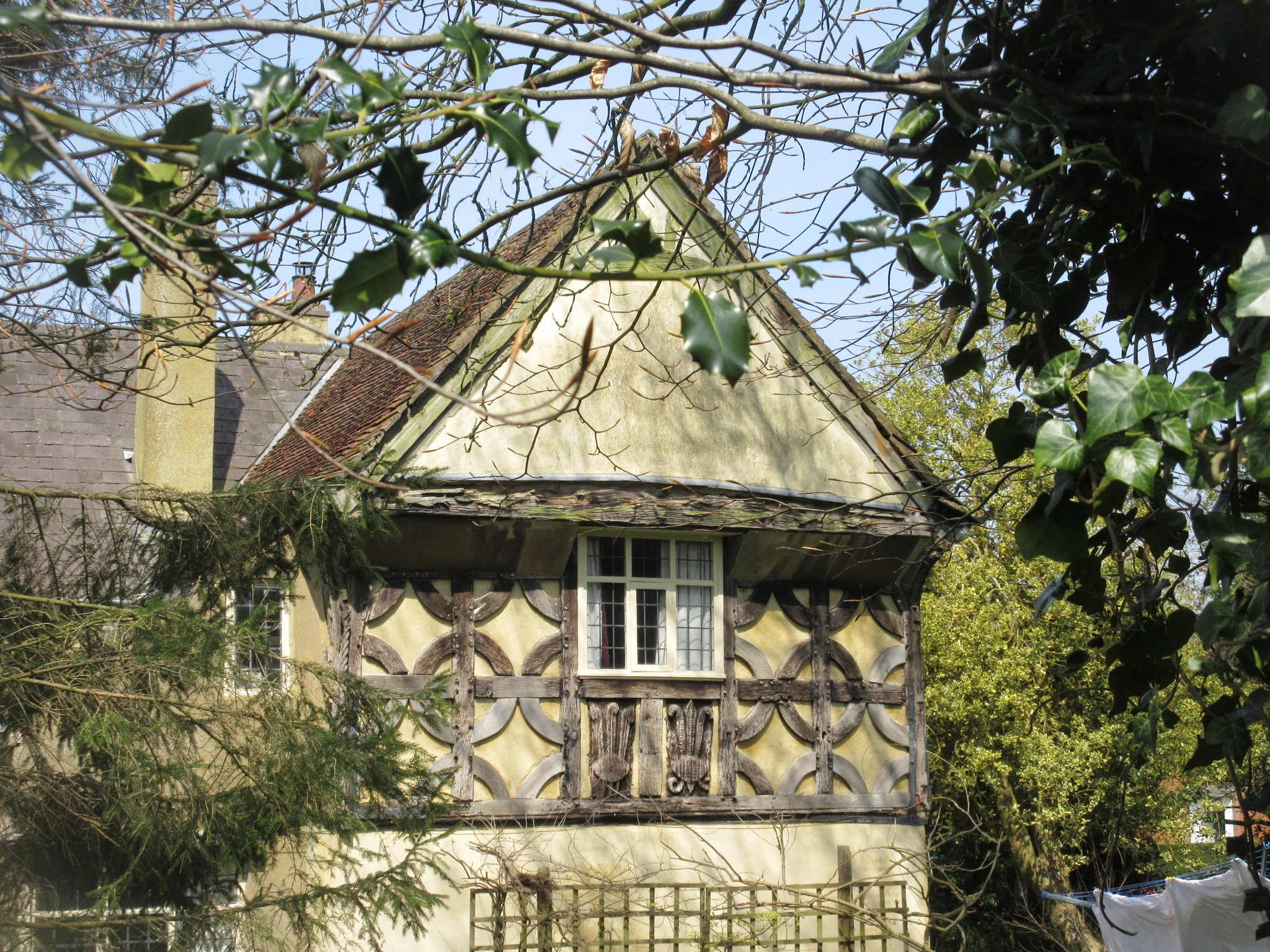
The Timbered House, South Kilworth

It wasn't just the Reverend Doctor Pearson's Observatory I missed the first time I visited South Kilworth.

When I got home that day I found that Pevsner also lists The Timbered House, parts of which date from the 15th and 16th centuries.

I found the house easily enough on Saturday, but it is a little way back from the road. Even taking a footpath into a neighbouring field, which contained the relics of a moated site and fish ponds, did not give a clear view.

And it's not just me. A google search throws up no photograph of The Timbered House at all.

Eventually I did find a photo in W.G. Hoskins' The Heritage of Leicestershire from 1950, where it is listed as one of several outstanding examples of yeoman houses in the county.

So with these photos I hope I am not outraging The Timbered House's obvious desire for privacy.


Tuesday, November 03, 2020

Six of the Best 972

Garry Kasparov says we must prepare for the worst from Donald Trump: "We cannot know exactly what Trump will do in these final days, only that whatever it is, he will be thinking only of himself. If he declares victory on election night, regardless of the uncounted ballots, what then? What if he calls the entire election a fraud, a hoax, and demands that the counting stop? Or if armed Trump supporters heed his call to intimidate voters at the polls? What if he takes to Twitter with "LIBERATE AMERICA!" and his MAGA zealots respond?"

"In Nebraska I walked the main street of a former town district where the street and the curbs and the lines for angle parking were still there, but the rest of the place was just foundations and neatly tended grass. In western Kansas I drove through a boarded-up town with a sign along the highway asking passersby to pray for the town." Ian Frazier calls on the Democrats to reconnect with rural America.

Political decision-making is failing our urban green spaces, argue Nicola Dempsey and Julian Dobson.

Corinne Silva and Val Williams are studying the collaboration between the local history pioneer W.G. Hoskins and the photographer F.L. Attenborough (father of Richard and David): "Attenborough ... depicted the remoteness of the Leicestershire Hills and the edge of Rutland, the expanses of heathland, fragmented buildings, and the ridges and furrows of medieval farming."

A sensitive young rebel before James Dean and a 'Method' man before Marlon Brando, Montgomery Clift has a complicated legacy. But why isn't he remembered like those burning out young and beautiful? Brogan Morris investigates.

Manfred Mann remembers the kindness of Burt Bacharach.