Showing posts with label Boughton. Show all posts

Monday, July 15, 2024

A hotbed of Liberalism in Northampton


Northampton's history doesn't get the attention it deserves, says Mike Ingram, plugging his book in an interview with Northants Live. 

The building he talks about in particular is the working men's club in St Giles' Street. That's the club we saw John Rogers and Iain Sinclair discuss in a video recently. The one I used to play chess for in the national club knock-out cup.

Ingram says the club was established in 1863 to provide evening classes and was intended  to be "a diversion from public houses".

It was the idea of the Rev Robson from St Giles' Church in Northampton, and he secured a donation from George Whyte-Melville to help fund it. Whyte-Melville was the author of numerous sporting novels, one from 1861 entitled Market Harborough.

There is a pub named after him at Boughton, a village near Northampton, and the club he helped finance was still known to members as "The Whyte-Melville" in the days when I pushed a pawn there.

The club lost some of its early high-mindedness, and alcohol was sold from 1869. At the same time the management of the premises was handed over to the members' committee.

Ingram told Northants Live:
"Numbers shot up and [it] was soon boasting a number of societies (at least one still survives) and a debating club. 
"By 1893 it was regarded as a hotbed of Liberalism."
There's a moral there about the importance of self-government (and alcohol).

I agree with Mike Ingram that Northampton deserves more attention from the historians. His book Northampton: 5,000 Years of History is on Amazon.

Tuesday, January 23, 2024

Merry Tom Crossing to Spratton: The Northampton & Lamport Railway's proposed northern extension

On 30 March the Northampton & Lamport Railway will open its half-mile southern extension from Pitsford and Brampton to a new station at Boughton.

After that, eyes will turn northwards to the line's proposed mile-and-a-half extension from Merry Tom Crossing to Spratton.

This enthusiastic video shows us the route, starting from Spratton and walking south towards Merry Tom Crossing, which is currently the northern end of the line.

Saturday, May 13, 2017

Stalking the Obelisk, Boughton

The Obelisk, which was built by Wentworth as a memorial to his friend William Cavendish, the fourth Duke of Devonshire, loomed up in the distance as I walked around Boughton on Saturday. 
One day I will go back and photograph it close up, though I have the feeling that it is one of those buildings that will move around the landscape if you try too hard to pin it down.
That's what I wrote last summer after visiting Boughton and its follies, just to the north of Northampton.

I went back today, taking the Obelisk by surprise by approaching it from rear via Boughton village and a woodland walk.

If I had attacked it from the front - from among the bungalows that lap at its base - it would surely have seen me coming.

As I wrote last summer it was erected by William Wentworth, second Earl of Strafford, as a memorial to his friend William Cavendish, the fourth Duke of Devonshire. Cavendish was educated at Boughton as a boy.


Saturday, March 18, 2017

Kingsthorpe: Where Northampton has almost won


Pitsford surprised me. Boughton astounded me. But by the time you get to Kingsthorpe the encroachment of Northampton is almost complete.

The old village is still there amongst it all. So you get a road with an ironstone farmhouse on one side and Victorian terraces on the other. A village green bordered by mid-20th-century bungalows. Rural enclaves with 21st-century infill at the end of them.

And, says Wikipedia, it is something of a nursery for actors. Joan Hickson, Judy Carne and Lesley Joseph all lived here as girls.

I wonder if St Mary Mead is now like this?


Friday, December 02, 2016

Advent Calendar 2: Boughton, Northamptonshire


He stands atop of the gate pillars at Boughton Hall, on the edge of the village.

The other pillar has an equally fine griffin.

Friday, July 29, 2016

Whyte-Melville's working men's club in Northampton


After I had lunch at the Whyte Melville in Boughton, I blogged about the Victorian novelist the pub is named after and the days when I used to play chess for a team that was sometimes named after him too.

Last time I was in Northampton I photographed the working men's club where we played. It is now a pub called The Fox and Quill.


Wednesday, July 27, 2016

An Edwardian postcard of the fair at Boughton Green


Last month I blogged about the fair that used to take place at Boughton Green in Northamptonshire. You'll find the site across the road from the ruined church of St John,

Getty Images has this postcard of the fair, which it dates to c.1909. It looks to have been colourised to within an inch of its life, but I assume it was based on a photograph of the event.

Tuesday, June 14, 2016

An open-air service at St John's, Boughton


I thought I had finished with the old village green at Boughton.

But Getty Images has this picture of an open-air service held amid the ruins of St John's some time in the 1930s.

No doubt there are ghosts looking on if you study it closely.

Friday, June 10, 2016

The lost fair and turf maze at Boughton Green


Across the road from the kissing gate that admits you to the churchyard of the ruined church of St John outside the village of Boughton is a triangle of land enclosed by three roads.

This land is the old village green of Boughton and the original village stood around it.

The Victoria County History for Northamptonshire describes it:
Boughton Green was long associated with a fair, held annually, at least since it was granted to Henry Green in 1350, on the vigil, day, and morrow of St. John the Baptist; it used to be famed for brooms and wooden-ware, and the last day was given up to wrestling and other forms of sport, but during the last years of its existence it consisted merely of a large horse and cattle-fair and lost its social character. It was abolished during the War (1914–18); the horses formerly sold at Boughton are now sent to the cattle-market at Northampton; and the green has since been enclosed.
The fair, once famous across England, is not all the green lost during the First World War.

Sacred Texts gives us the text of Mazes and Labyrinths, by W.H. Matthews from 1922. Matthews wrote:
At Boughton Green, in Northamptonshire, about half a mile from the village of Boughton and near the ruined church of St. John the Baptist, was, until recently, a turf maze of like design but having the innermost convolutions of purely spiral form (Fig. 61). It was 37 ft. in diameter and was called the "Shepherd Ring" or "Shepherd's Race." The "treading" of it was formerly a great feature of the three days' fair in June, an event dating from a charter by Edward III. in 1353. 
In a "Guide-book to Northampton" by G. N. Wetton, published in 1849, the maze is spoken of as being in a neglected condition. In a later book, however, a novel named "The Washingtons," written by the Rev. J. N. Simpkinson in 1860, occurs the following passage: "He had just been treading the 'Shepherd's Labyrinth,' a complicated spiral maze traced there upon the turf; and was boasting of his skill, how dexterously and truly he could pursue its windings without a single false step, and how with a little more practice he would wager to go through it blindfold."
Another novel, "The Last of the Climbing Boys," by George Elson, contains a reference to it, in which it is spoken of as being "An attraction which was the origin of the fair"—a statement which it would be interesting to verify if possible. 
Unfortunately, this famous relic was destroyed by some of our soldiers in training during the Great War; trenches were driven right across it, and practically all traces of it are now obliterated.
The plan of the maze on Sacred Texts is rather small, so I have borrowed the larger one here from pages published by Michael Behrend. It comes from an article by a 19th century antiquarian.

If you want to see a similar maze today, go to Wing in Rutland.

So that ends my visit to Boughton. A ruined church, follies and much else - not bad for an area I had always assumed to be Northampton suburbia.

Thursday, June 09, 2016

The ford on Spectacle Lane, Boughton


The Spectacle stands, not unreasonably, on Spectacle Lane. Follow it and you come to this unexpected and pleasing ford.

Scroll down this page on the Northants Weather site for a picture of the little river in spate.

Tuesday, June 07, 2016

The Boughton Park follies and Jeyes Fluid


In the 18th century the Boughton Park estate was owned by the Earls of Strafford. William Wentworth, 2nd Earl of Strafford, built six follies there.

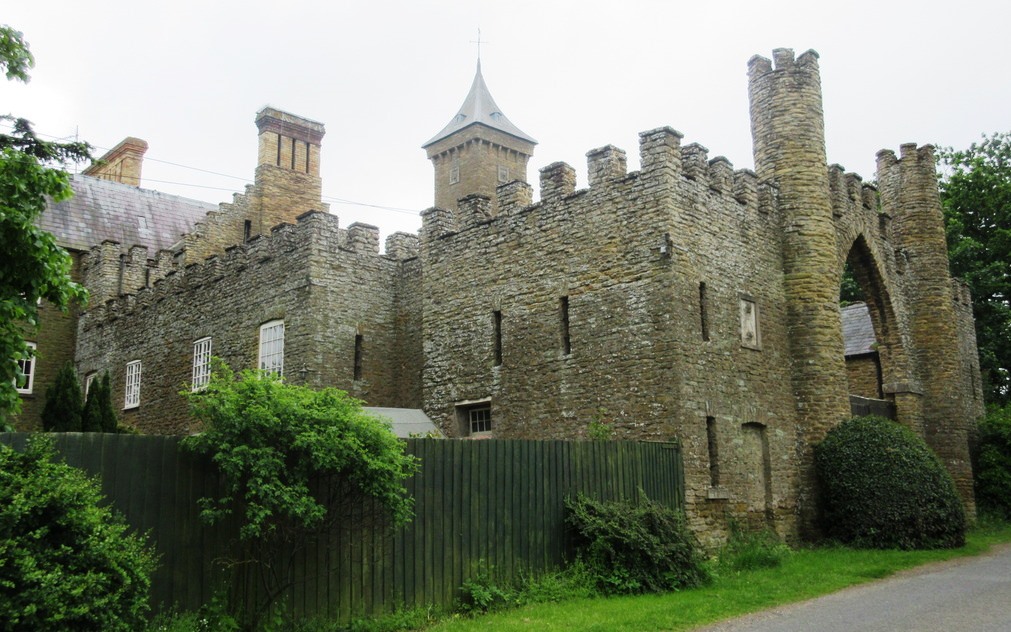
The photograph above shows The Spectacle, a castellated archway built to be seen on the horizon from Boughton Hall.

Near it stands a large house in similarly romantic style. this is not one of Wentworth's follies but Holly Lodge, which was built for the Jeyes family (as in Jeyes Fluid) in the following century.

Another of the Boughton Park follies is the Hawking Tower, which I have been looking for on the main road between Market Harborough and Northampton for decades without knowing what it was.

And The Obelisk, which was built by Wentworth as a memorial to his friend William Cavendish, the fourth Duke of Devonshire, loomed up in the distance as I walked around Boughton on Saturday.

One day I will go back and photograph it close up, though I have the feeling that it is one of those buildings that will move around the landscape if you try too hard to pin it down.

There is more about the Boughton Park follies on Painted Pixels and in an old newspaper article about Simon Scott, who has written a book about them.


Monday, June 06, 2016

George Whyte-Melville, the author of "Market Harborough"


Despite the presence of the ruined St John a little way out of the village, Boughton has a medieval church. St John the Baptist probably began life as a chapel for Boughton Hall.

Next to it is the village pub, The Whyte Melville.

It is named for the 19th-century Scottish novelist and poet George Whyte-Melville, whom I have run into a couple of times before.

He wrote many novels of the hunting field. One of them, published in 1861, was titled Market Harborough.

And around 1990 I occasionally played chess for Northampton Working Men's Club. They took part in the national club knock out championship, which was something the Market Harborough team did not aspire to.

The building where we played in Northampton was often referred to as "Whyte-Melville" because George had founded it.

Like so many such clubs, it has now closed. The premises are occupied by a pub called The Fox and Quill (which was previously the Goose on Two Streets).

Saturday, June 04, 2016

The ruins of St John, Boughton: the most haunted site in Northamptonshire


Boughton is a chocolate-boxy village just north of Northampton where for decades the wealthy of that town have chosen to live. Today it is threatened by its remorseless expansion.

But less than a mile to the east everything changes. This is the original site of Boughton and there you will find the ruins of the church of St John.

The Victoria County History described it thus in 1937:
The ruins of the old church of ST. JOHN stand to the north-east of Boughton Green on a site which falls from west to east. The building consisted of chancel, north chapel, nave, and west tower with spire and was of 14th-century date, but the remains have long been neglected and are undergoing a gradual process of disintegration by the agency of weather and the unchecked growth of ivy. The site is thickly overgrown and at the west end is a confused mass of rubble, broken gravestones, brambles, and nettles. Where the walls stand to any height their architectural features are generally hidden by ivy. Bridges, early in the 18th century, described the building as then 'in ruins, without a roof, the walls in several parts levelled with the ground', (but the tower and spire stood till about 1785.
But things were worse in the 16th century:
the rabbits invaded the churchyard itself, making the place so dangerous that the inhabitants were afraid to go to mass for fear of breaking their necks. It was said that the bones dug up by the conies would fill a scuttle and 'that a man can go skantly in a corner of yt but he shall fynde it full of dead mennes bones, a thing most pytyous to be seen'. One of the parishioners stated that a 'great number of conyes have so underminded the church yarde of Bouckton that it wold abhorre any Crystiane manys harte in the world to see it'.
Today the ruins are picturesque, but the steeply sloping churchyard makes it difficult to explore and there are disconcertingly recent burials.

There is also a spring issuing from beneath the east wall of the ruined chancel, making one think that this must be an ancient site whose sacredness predates Christianity.


It also has the reputation of being the most haunted site in Northamptonshire.

The Ghost Book says:
Around two hundred years ago, a young couple had been married only a few hours when the groom dropped dead. Grief stricken and unable to live without her love, the young lady ended her own life next to her husband's grave.
And it continues:
Following on from the tale of the doomed newly weds, the most famous ghost is said to be that of a beautiful red haired woman. She entices male passers by, and asks for a kiss. Be warned, for the legend follows that if you receive a kiss from this young woman, you will come to your death exactly a month after. 
This is said to be the fate of William Parker. He was passing by the churchyard on Christmas Eve in 1875 when he met a beautiful red haired girl. She invited him to sit with her for a while. After saying farewell, the young woman vanished and sure enough, William died exactly one month later, to the day. 
Again, on Christmas Eve, a moaning spirit makes his presence known. It is believed to be the spirit of Captain Slash, but why would he haunt the churchyard? Perhaps he is in search of the other members of his gang, ready to patrol the highways once more. 
The spirits of children have been reportedly seen amongst the grave stones. There is evidence that several children are buried on the site. 
A figure of a woman in white robes, and a headless man have also been seen.
I did catch sight of something in the corner a couple of times, but when I turned my head it had gone.

There was no sign of the beautiful redhead, Captain Slash or the ghost children, but I did take a lot of photographs.

And in my experience such things are more likely to appear if you print those photos in black and white.