Showing posts with label Desborough. Show all posts

Saturday, May 23, 2026

The lesser known parks of Desborough 2: The Pocket Park

Yesterday I discovered another park in Desborough. A couple of years ago it was Millennium Green: this time it was the town's Pocket Park.

It lies beside the Rothwell Road, but there are a couple of other entrances. I found one of them by wandering some back streets. You never know what you will find if you do that in London suburbs or small Midland towns.

Tuesday, April 07, 2026

Three Catholic churches have closed in Northamptonshire

Holy Trinity, Desborough

Opponents of the moved vowed to "take this fight to the Vatican", but as far as I know the closure of the Catholic churches in Desborough, Rothwell and Burton Latimer has gone ahead. Certainly, their websites have been closed down.

Holy Trinity, Desborough, was already up for sale when I photographed it last year – the estate agents' particulars say it is "offered for sale in need of significant repair or demolition" and describe it as a "perfect development site".

Taking Stock: Catholic Churches of England & Wales reveals that Holy Trinity was built as a Methodist chapel in 1894 and purchased for Catholic use in June 1971. Its altar is at the north end of the church, though latterly, services appear to have been held in the hall next door.

Holy Trinity, Desborough

I did not discover St Bernadette's. Rothwell, until my last visit to the little town, when I had a good wander. Taking Stock says it dates from 1959 and that alterations made in 1993 radically and detrimentally altered its appearance.

St Bernadette's, Rothwell

St Bernadette's, Rothwell

The Grotto, St Bernadette's, Rothwell

I've not made it as far as Burton Latimer, best known for being the home of Weetabix, so the photo below is by David Dixon on Georgraph. The church is dedicated to St Nicholas Owen, a Catholic carpenter and builder of priest holes who was martyred in 1606 and canonised in 1970. Taking Stock says it opened in 1972.

David Dixon: St John North, Burton Latimer

Friday, February 20, 2026

Mayor of Desborough called opponent a "prick" and a "sad wanker"

It's all kicking off in Desborough. The excellent NN Journal reports a walk out at last night's meeting of the town council after the mayor refused to stand down:

Last month Desborough Town councillor and North Northamptonshire councillor Bill McElhinney quit the Conservative Party after sending a message to a resident calling fellow town councillor Labour’s Andy Coleman a "prick" and a "sad wanker".

Cllr Coleman has put in a standards complaint about Cllr McElhinney, which is being looked at by NNC’s legal officer, and last night he boycotted the town council meeting along with Liberal Democrat Alan Window. [Hello Alan!]

Cllr Coleman’s three Labour colleagues attended the meeting, but after Cllr Tim Healy’s request for Cllr McElhinney to stand down was refused, the trio quit the meeting.

NN Journal reports McElhinney as saying that he regrets the comments and as complaining that the Labour group "are making as much of it as they possibly can".

He says he has put in a counter complaint about Cllr Coleman. whom he accuses of double standards in the light of his own comments about public figures on social media.

Cllr Coleman's complaint is being investigated by the legal office of North Northamptonshire Council, of which Cllr McElhinney is also a member. I'm not aware that whataboutery is a defence under the act.

Saturday, January 24, 2026

The end is near for Desborough's Lawrence Shoe Factory

The former Lawrence Shoe Factory in Desborough is likely to be demolished later this year, reports BBC News.

As I can catch a bus to Desborough and it's unusually pleasant Costa Coffee from across the road when I'm feeling too lazy to walk into town, I went there the other day to photograph the buildings again – maybe for the last time. You can read about their history on the Desborough Town Council website.

There was the usual talk from North Northamptonshire Council's Reform UK leadership of "eyesores" and preventing antisocial behaviour, but there is no sign of the long-sought developer for the site, so it will become wasteland.

At least the derelict shop, which must once have catered for the needs of the workers here, will survive the coming destruction.

Sunday, October 26, 2025

Redevelopment scheme for derelict Desborough factory site falls through – again


It comes as no great shock to anyone who has followed the site's history, but the Central Co-op has pulled out of a deal that would have seen it pay £1.5m for the derelict Lawrence Shoe Factory in Desborough.

It joins Aldi and Tesco in having planned to build a supermarket there and then decided against the idea. At one time it was also expected that 40 council houses would be built on the site.

Now, reports the Northamptonshire Telegraph, the owners, North Northamptonshire Council are back to square one in their attempt to sell it.

When I was in Desborough a couple of weeks ago – I like the Costa Coffee there – the wasteland in front of the old factory was looking particularly unkempt after a summer's plant growth, and the modern buildings more derelict than when I last saw them.

The Telegraph has included a link to the estate agent's particulars in its report in case you feel like buying the site yourself.

Tuesday, April 29, 2025

Market Harborough's British heavyweight champion Jack Gardner

Before Martin Johnson came along, the boxer Jack Gardner was Market Harborough's most famous sporting son. He beat Bruce Woodcock in 1950 to win the British and Empire heavyweight titles, and for most of 1951 held the European title too.

When Gardner retired from the ring in 1956, he took up farming locally. He died in 1978 aged only 52.

A second local British heavyweight champion is seen in the film: Reggie Meen, who grew up down the road in Desborough and held the title from November 1931 to July 1932.

And the Colonel Symington who presents Gardner with a watch is a member of the Market Harborough soup-making dynasty.

Thanks to the Leicester Evening Mail for the next day, I can tell you that this dinner was held on Thursday 7 December 1950 in "Symington's recreation room". This was in the corset factory in the centre of town owned by the other branch of the family.

Sunday, September 22, 2024

Where have all the wasps gone and should we worry?

Desborough continues to open new vistas to me. This time I discovered its Millennium Green, tucked away behind the church:

Desborough's Millennium Green Trust holds the Green in perpetuity for the people of Desborough. Designed by local people, it has ten dedicated benches, a scented raised bed and a butterfly corner.

The hedges were planted as wildlife corridors and the trees were selected as mainly native species (arrived between 5,000 to 10,000 years ago), together with three species introduced more recently by the Romans. 

The most striking feature near the entrance was the apple trees left over from the land's former use as a market garden.

Windfalls covered the ground there, and I suddenly thought "September ... decaying fruit ... wasps. Is this a good idea?" Then I looked more carefully and found there was not a single wasp there.

I posted a video here a couple of months ago that said insects doing badly in one wet summer is nothing to worry about, but the long-term decline in their numbers certainly is.

Today I've found an article on the decline in wasp numbers by the Guardian environment reporter Helena Hornet, which...

Sorry, that should be Helena Horton. She writes:

Professor Seirian Sumner is an entomologist at University College London who has spent her career studying wasps. She said she was “thrilled” that people were worrying about low wasp numbers because “usually they only get airtime when they start annoying people”.

And Professor Sumner says:

“The science tells us that cold, wet springs mean that foundresses – the big queen wasps that start appearing in spring – struggle to successfully grow a nest. This is because they are solitary at this time in the colony cycle and so need to do all the nest building, egg laying, prey hunting all by themselves.

“Rain and cold make this difficult; and of course their prey will have been affected by the poor weather too, compounding the challenge. So with fewer successfully founded nests in spring there will be fewer mature nests now. And predictably, fewer wasps bothering people.

“This is bad news. Wasps perform many important roles in the environment, as natural pest controllers, as pollinators and also in the case of the yellowjacket they are important decomposers – that’s why they happily scavenge the carrion at your BBQ,” said Sumner.

In the long term, wasp numbers were thought to be declining overall because of human activity, she said. “They will be affected in the same way as other insects by chemicals like pesticides – after all, these chemicals are designed to screw up insect physiology and neurology.”

So, yes, we should worry.

Other experts quoted in the article share her respect for wasps. I am reminded of the summer when my mother and here second husband were away on one of their long canal holidays and I found a wasps nest at their house. 

The man who came to deal with it was also respectful. "If they start a nest and it's not exactly right, they'll abandon it and start a new one." He could have been a minor character in a good British comedy.

I'll leave you with a memory of how things used to be.

Sunday, April 07, 2024

More photographs of what Desborough lost when it demolished its own high street

This slideshow gives a clear sense of what Desborough lost when the town's urban district council 'redeveloped' - i.e. demolished without replacement - its high street in 1970.

It also shows us some of the Desborough's lost factories. quarry railways and water tower. There's even a shot of the Midland Pullman at the railway station.

Sunday, March 24, 2024

I owe Earl Shilton an apology


Not Earl Stilton, who is probably an old friend of Lord Bonkers, the father of the Rutland heiress Paris Stilton and quite capable of being rude himself, but the Leicestershire settlement Earl Shilton.

Writing about one of those forgotten disasters or scandals that intrigue me, I described it as "a fairly nondescript village".

First, Earl Shilton is a town not a village. Second, I don't know how I thought myself qualified to judge it when I'd never been there.

Well, I went there on Friday and it's not "fairly nondescript at all". No place is dull to someone with eyes to see and a little knowledge or curiosity.

As you can see here, I found plenty of interesting buildings, including the headquarters of the town building society above. And I didn't get to the church, which has a castle mound nearby.

And the visit, whose first purpose was to photograph the town's Edward VIII postbox, also cast new light on my horror at Desborough's decision to demolish its high street.

Both Earl Shilton and Desborough have populations a little over 10,000. Earl Shilton has a long and straggling hight street lined with shops. Some are the result of piecemeal redevelopment, some are smart, some are shabby, some are empty, but the centre is as busy as the centre of a market town should be.

Desborough, by contrast, is quiet and empty.


Tuesday, March 19, 2024

Our problem is landlordism not a shortage of housing


The conventional wisdom is that house prices are so high in Britain because we do not build enough new houses. It also holds that this is because of restrictive planning laws and self-centred Nimby campaigners.

Several things puzzle me about this view. The first is that every town I know is ringed with street after street of new housing.

Take Desborough, whose vanished high street so occupied me last month. There is almost a second town at Desborough, built in recent years up the hill from the original town, that has its own Sainsbury's and M&S food store.

The second is that district councils cannot turn down planning applications just because they are unpopular with existing residents. They have targets for housing approvals to meet and the pressure on their budgets means that they are wary of turning down applications in case they have to bear the costs of a successful appeal.

And the third is something I blogged about five years ago. However many permissions to build councils grant, the interests of developers will dictate how many new houses are built.

In that post I quoted the late great Ian Jack:

The hardly radical figure of Oliver Letwin identified the real brake on house-building when he published the interim conclusions to his inquiry into low completion rates last year. What governed the numbers, he decided, was the absorption rate – "the rate at which newly constructed homes can be sold into (or are believed by the house-builder to be able to be sold successfully into) the local market without materially disturbing the market price". 

For ‘materially disturbing’ read ‘lowering’: to protect profits, developers are sitting on land that has been given planning permission. ‘Efficiency’ in this instance is a concept confined to the shareholder.

I have never seen anyone in the 'build baby build' camp address this point. They tend to see the answer as lying in even more market freedoms for developers and campaign for the loosening of planning controls. How those developers will be prevailed upon to act against their own economic interests is made clear.

But there is an article in today's Guardian that does address the point, and it agrees with Letwin:

The yimby argument has always seemed flimsy. Its strange logic is that speculative developers would build homes in order to devalue them: that they would somehow act against their own interests by producing enough surplus homes to bring down the average price of land and housing. That would be surprisingly philanthropic behaviour.

The article is by Nick Bano, who also argues that there is no evidence that Britain has a housing shortage:

In London, as the Conservative Home blog notes, there is a terrible housing crisis “even though its population is roughly the same as it was 70 years ago”, when the city was still extensively bomb-damaged by the second world war.

In terms of the Organisation for Economic Co-operation and Development countries, the UK has roughly the average number of homes per capita: 468 per 1,000 people in 2019. We have a comparable amount of housing to the Netherlands, Hungary or Canada, and our housing stock far exceeds many more affordable places such as Poland, Slovenia and the Czech Republic. It is impossible to make a case for unique levels of housing scarcity in Britain, in comparative international or historical terms. 

Bano argues that our problem is not a shortage of housing but its cost. And the reason for that is landlordism.

For an answer to our current crisis, he looks back to the Seventies. Then, as a response to the evils of private landlordism highlighted by the case of Peter Rachman, Labour and the Conservatives agreed that private rented dwellings should be taken over by local authorities.

So successful was the move that the private rented sector declined from nearly 60 per cent of dwellings in England and Wales in 1939 to just 9 per cent in 1988.

It was when the Conservatives then began to argue again that being a private landlord should show an attractive economic return that the seeds of our current crisis were sown.

I did know a fair bit about housing in the Eighties when I chaired Harborough's housing management subcommittee, but I don't know enough now to judge how accurate this historical account in Nick Bano's article is.

But he has encouraged me to think that the conventional wisdom on housing is wrong. I suppose though, in the current climate, it is easier to blame local authorities for our problems than promote them as the solution to them. But maybe that's what needs to be done.

Sunday, February 18, 2024

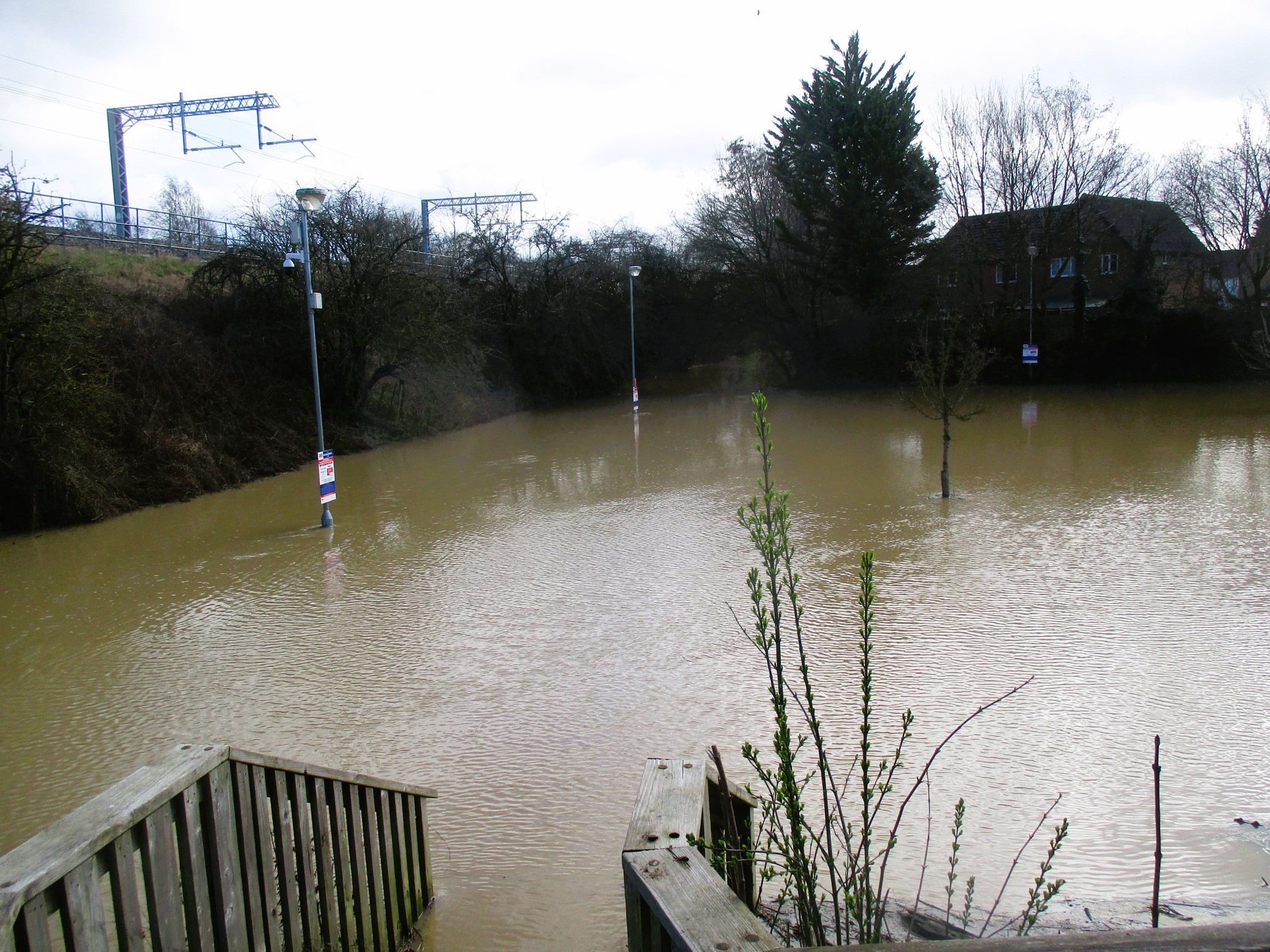
The River Jordan in spate this afternoon

The Jordan is Market Harborough's second river. It rises near Desborough, flows through Braybrooke and Little Bowden, and joins the Welland near Market Harborough railway station.

In summer it can dry to little more than a trickle, but you should have seen it today.

The photo above shows the Jordan entering the Welland. Between them they have flooded the commercial car park across the road from the station.

And the photos below, I hope in the correct order, show my walk to the station from my house this afternoon.

Saturday, February 17, 2024

What replaced Desborough High Street? Nothing

Back to one of my current rabbit holes: the demolition of Desborough ironstone high street in 1970, which seems inexplicable to us today.

This video shows you the buildings that were lost and what replaced them. In many cases you find that nothing replaced them. 

Even Station Street, which was the town's second shopping street and left untouched, seems to have dwindled since the calamity of 1970

I can say here just what I said in a post about the 1958 British film No Trees in the Street:

I am reminded of what I wrote about Wheat Street and Wharf Street in Leicester's most notorious slum district:

all that life was swept away as though Wharf Street was the city's dirty secret. The district was not improved: it was destroyed.

and:

Having cleared the slums decades ago, Leicester has found nothing to do with the area since.

You can see the same pattern in Nottingham, where the slums of The Meadows district were cleared and the area still feels empty today.

Except that Desborough High Street wasn't a slum area. It was a thriving shopping area with buildings that should have been cherished.

Tuesday, February 06, 2024

Deeper into the destruction of Desborough's high street


I've been looking deeper into the destruction wrought upon Desborough in 1970, both online and at the town's heritage centre.

It turns out that the catalyst for the demolition of the High Street was the widening of the A6, yet this road scheme need have affected only a small part of it.

Demolition on the scale that took place must have been done with money from the county council and central government, but the old Desborough Urban District Council seems to have been thoroughly on board.

It's job advertisements from this period all contain this boast:

Desborough has a population of 5,100, and is a progressive authority now involved in substantial redevelopment and expansion and consequently offers valuable experience.

And I don't know which party controlled Desborough UDC in those days, but the Desborough Labour Party website harks back to this era as a heyday:

The Labour Party has had a branch in Desborough for as long as anyone can remember. Working in the community, serving on the Council and campaigning on the issues that affect local residents.

Some residents may remember the work done by Walter Manton, Harold Goodman and Tony Allen in the days when we had our own Urban District Council. 

How did the local press cover the demolition of Desborough's High Street? The heritage centre has a cutting from an unnamed paper, dated Friday 24 July 1970, that has to be seen to be believed:

£300,000 Desboro' facelift under way

Desborough's £300,000 town centre face-lift has started. Bulldozers have moved into the redevelopment area and have begun a massive demolition job.

Fifty town centre buildings will be demolished and replaced by half a dozen shops, a new library, garages, 24 flatlets, 36 flats and a major realignment of the A6 in Desborough's biggest redevelopment scheme.

Bulldozers moved into the town's redevelopment are on Wednesday to start ripping down old Desborough.

The first houses to come down will include some over 300 years old. Town centre residents are being re-housed gradually as the redevelopment work gets under way.

As soon as the site is cleared work on building flatlets will begin.

The start of the town centre redevelopment is the first signs of four years careful planning by Desborough Urban Council.

The £150,000 0f the A6 through Desborough is not expected to start until 1972. The Ministry of Transport plan to realign the road from its junction with Gold Street to a point near the Co-op Society's corset factory in Rothwell Road.

The re-routing of the A6 has been before the Ministry since 1928.

House off High Street are the first victims of the bulldozers. Two bulldozers began tearing down houses that have stood for 300 years on Wednesday, so that sites can be cleared for the new buildings.

Town centre traders will be replaced and new shops built in the central redevelopment area.

Desborough Urban Council's development committee have arranged for a guide to the new town centre to go on public show.

The committee meet next week to finalise arrangements for the redevelopment exhibition.

Desborough did not so much get a facelift has have its head kicked in.

And the process went on and on. An ironstone inn in the High Street was pulled down by the new Kettering Borough Council as late as 1977.

I was chatting to someone at the heritage centre today who said the high street was narrow - "a double-decker bus filled it" - and mentioned the difficulties in transporting the Thor missiles stationed at nearby RAF Harrington around the countryside. You can see a picture of a missile on Rothwell on this blog.

But these were onsite there only between 1959 and 1963, so we can't blame the US military-industrial complex for this assault on Desborough.

So it looks as though the villains were local authorities who used the widening of the A6 as a pretext for wholesale destruction. The past is a foreign country.