Showing posts with label Horse racing. Show all posts

Sunday, June 15, 2025

The Joy of Six 1372

"What's happening in Gaza is a humanitarian and existential tragedy for the people living there, a moral and political disaster for Israel, the indirect, long-term result of past European barbarism and the subject of a damaging present European failure." Timothy Garton Ash reflects on European double standards and German cognitive dissonance.

Séamas O'Reilly reports from Ballymena: "To their credit, the PSNI have been clear-cut on this point, with the chair of their police federation Liam Kelly describing the violence as 'mindless, unacceptable and feral' and the actions of the rioters as 'a pogrom'. There is no interpretation of these acts, no nuance or context that can be added, that points in any other direction.

Hannah Al-Othman and Jessica Murray on increasing concerns over the quality of 'expert witness' evidence in British courts.

"I wanted to go back into the past and look at it with fresh eyes, to better understand the roots of this uncertainty. What I began to find was twofold: first, there were major shifts in power during the 1980s and ’90s – primarily away from politics and mostly toward finance, though also other areas. Second, there was a significant internal shift in consciousness. We are very different creatures from the human beings of 1978." Frieze interviews Adam Curtis about his new television series Shifty.

The car made pedestrians second-class citizens, and we shouldn't let driverless vehicles push us off the road altogether, says Adam Tranter.

Northolt Park Racecourse near Harrow was superbly equipped and the headquarters of pony racing in Britain, yet it had an active life of only 11 years. This local history site tells its story.

Monday, June 09, 2025

The abandoned church of St John the Baptist, Colwick, next to Nottingham Racecourse

We're used to Trekking Exploration searching for abandoned railway lines, but this time he searches for an abandoned church next door to Nottingham Racecourse in Colwick Park.

As the YouTube blurb explains:

The listed grade II church dedicated to St John the Baptist now stands in ruins near Colwick Hall. It was built by Sir John Byron in the 16th century incorporating 14th and 15th century sections from an earlier church. In the mid-17th century the church was repaired and a chancel and steeple built by Sir John Musters. Later in the century, the tower and chancel were rebuilt. Towards the end of the 19th century, a vestry and an organ chamber were added.

By the early years of the twentieth century, the church was in a poor state. Although repairs were continually made, the condition of the church deteriorated. In 1936 it was finally closed as being unsafe. A new Church of St John the Baptist was built in Colwick in 1950.

Wednesday, May 14, 2025

Nick Cohen's podcast: Don't back any horses tipped by Nick Tyrone

Embed from Getty Images

Nick Cohen's latest podcast dropped two days ago. His guest, billed as an expert on the Conservative Party, was Paul-Marshall-era Liberal Democrat turned Reform supporter Nick Tyrone.

In the course of their discussion Tyrone argued that when Robert Jenrick replaces Kemi Badenoch, as he surely will, he'll prove no more popular than she has.

He then suggested that the Tories should go for someone untainted by their 14 years in government and choose a leader from their 2024 intake of MPs.

Pressed for a name, he suggested Patrick Spencer, who was arrested the following day.

Spencer denies the charges against him and may go on to have along political career, even leading his party. But this exchange did reinforce the impression that Tyrone isn't the great political forecaster out there.

Because he has previous. Here he is in the Spectator on the eve of a 2021 by-election:

"The Chesham and Amersham by-election is on Thursday. Thank God it’s almost here — hopefully then we can stop hearing any rubbish about how the Lib Dems are set to tear down the Conservatives’ ‘blue wall’ in the home counties. As the campaign has demonstrated, the Lib Dems are miles away from being able to cause such an upset.

"Instead, the Lib Dems will lose on Thursday, most likely fairly badly, and they will have no one to blame but themselves. If they want to get back to being the by-election masters of old, they will have to do a lot better than this."

As you may recall, Sarah Green won the election for the Lib Dems with a 25 per cent swing from the Conservatives.

He was more confident about the Lib Dem performance in 2015:

Ahead of the 2015 General Election, Tyrone predicted that the Liberal Democrats would receive "17 per cent" of the popular vote and that the vote share for the two largest parties appeared "on course for an all time low". 
The two largest parties subsequently both increased their vote share, while the Liberal Democrats received 7.9 per cent.

Nor did he much admire Nigel Farage in the run up to the European Union referendum:

In 2015, Tyrone argued that fellow pro-Europeans should give their "gratitude to Nigel Farage for hanging around the British political scene just a little bit longer" as he believed it would ensure "the pro-Europeans win".

We all like to sound confident when we make predictions, but I wouldn't back any horse that Nick Tyrone tipped. 

Tuesday, November 12, 2024

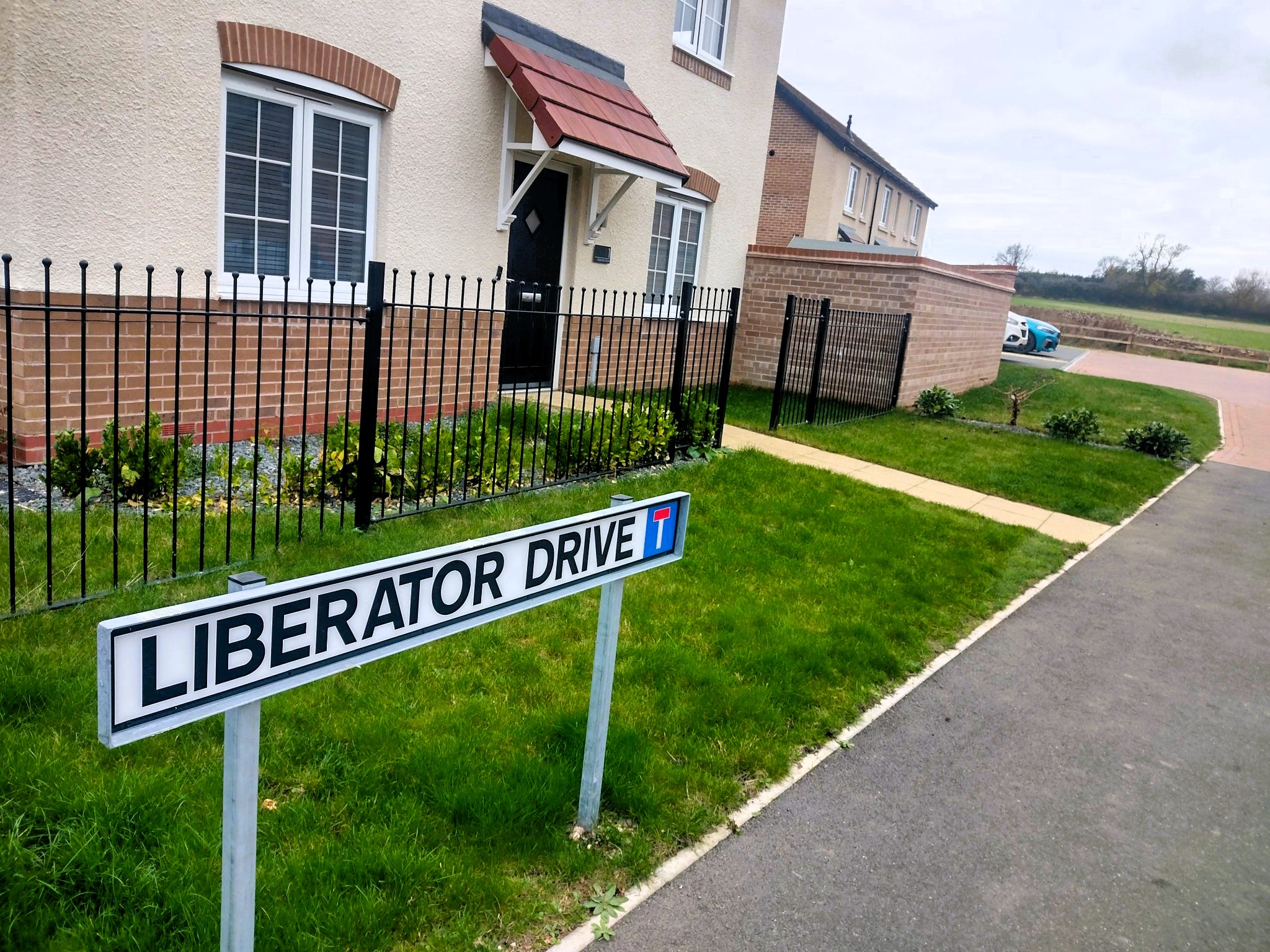
Hunting for Liberator Drive, Market Harborough


I had started to receive reports of a Liberator Drive on the new Farndon Fields estate here in Market Harborough. Google Street View wasn't much help: the road was on the map, but the houses were too reccent for Google's van to have been there. So I went to look for it.

And here it is, though any road that's called 'Drive' and points at open fields is unlikely to remain a dead end for long.

Here, while we're at it, is the website for Liberator magazine too.

The Farndon Fields estate is the sort of place you don't go to unless you know someone who lives there or you're delivering in a by-election. But I was impressed with it. The architecture is pleasant and the housing types varied, including some terraced houses.

I suppose the traditional architecture of the town is brick with a leavening of ironstone. You won't find that at Farndon Fields, but the houses don't feel out of place.


There are no shops there, and certainly no ghosts signs or repurposed tin tabernacles. But I did find an electricity substation.

I don't know how Liberator Drive got its name, but then the names of the new roads here seem a bit of a lucky dip: Charley Close, Summerhill Place, Bridgeroom Street. [Later. Mystery solved: the streets here, including Liberator Drive, are named after racehorses because of the race I mention below.]


One name does have an obvious derivation: Steeplechase Way. That's because in 1860 Farndon Field saw the first running of the National Hunt Chase Challenge Cup, a race that is still run each year as part of the Cheltenham Festival.

No doubt the ditch in my last photo is the result of drainage work carried out before the new houses were built, but I like to imagine that it predates them and is where a Victorian gentleman took a purler while leading the race.

Wednesday, October 30, 2024

Mr Logan's hunter Lottery was named after the famous racehorse


A reader has kindly directed me to a document on the neighbourhood plan review for East Langton parish, which mentions the monument to J.W. Logan MP's favourite hunter Lottery. (It's hard to link to, so I have pasted the relevant extract above).

As I blogged a couple of days ago, this is widely claimed to be the grave of Lottery, the winner of the first Grand National in 1839, or at least a monument to him. But my discovery that Logan had a horse called Lottery makes that beast a much better candidate for the dedicatee.

Because the story about the Grand National winner ending his days at East Langton never really added up. Thoroughbred Heritage tells us (scroll down the page, because most of it's about this Lottery's father, who was also called Lottery) that the horse was foaled in 1829.

After detailing his many triumphs, the site records Lottery's final days:

The last race of his career was at Windsor in April, 1844. For some time after his retirement, he served as his trainer's hack. Later, he was sent to a Mr. Hall, who had a pack of harriers at Neasden, and it is said he was put to ploughing when he was "too much played-out to stand cross-country work." He was buried at Astley Grange Farm stud at East Langton, Leicestershire.

The greatest Grand National horse, Red Rum, lived to be 30, and I believe that is a typical lifespan for a racehorse. So there is no way in the world that this horse lived until 1886 - at East Langton or anywhere else.

Lottery's sad decline after the end of his racing career reminds me of the hero of Anna Sewell's Black Beauty. I fear that when he became too old for ploughing, his next appointment was at the local glue factory.

Four quick points about the extract from the document above:

  • I love the detail that Paddy Logan named his hunter after the great racehorse. I shall take this as authentic local knowledge.
  • The same goes for this being a gravestone rather than just a monument, but it is, of course, dated 1886 and not 1896.
  • I suspect the, surely untrue, sentence about the Grand National winner Lottery also ending up at East Langton is taken from an earlier blog post of mine.
  • Why? Because they've used my photos from that post.

The idea that the winner of the first Grand National is buried at East Langton will probably prove one of those 'zombie facts' that keeps being repeated and will not die. I have played my part in passing it on, and I apologise.

But there is hope. The zombie fact that Reginald Gough, who was convicted of the manslaughter of Dennis O'Neill, later had his conviction changed to one of murder and his sentence lengthened by some unspecified process, is now specifically contradicted in the Wikipedia article on the case.

Monday, October 28, 2024

The Lottery buried at East Langton is not the winner of the first Grand National but a hunter owned by J.W. Logan MP


Later. There's a little more on Mr Logan's horse here.

I am reading John Masefield's The Midnight Folk, which is an earlier story about Kay Harker from The Box of Delights. Here Kay is tangling with his governess Sylvia Daisy Pouncer, who is also a witch and an acolyte of the villainous Abner Brown.

Early in the book, Masefield mentions "that famous horse Lottery at various stages of the steeplechase, the prints of which hung in the study". This name leapt out at me, because I once came across what Thoroughbred Heritage says is a monument to Lottery just outside the village of East Langton.

I set out to photograph it on my very first day out with a digital camera. Perhaps that's why I didn't take a better photo, though I do remember it was a baking hot day and I had to look south to take it.

Just now I searched the British Newspaper Archive for a story about the burial or commemoration of Lottery at East Langton. What I found was one that proved that this Lottery was not the winner of the first Grand National, but a hunter owned by this blog's hero J.W. Logan MP.

So here's the Market Harborough Advertiser and Midland Mail for 12 May 1939:
In view of the great interest taken by listeners acquainted with the Langtons. the writer of this thought the following particulars might be of interest to local readers of this paper. It was a pity no reference was made to Mr. Logan's famous hunter "Lottery." 
In the late seventies and early eighties, of the last century, every boy in the Langtons and adjoining villages could tell some amazing stories of this horse and Mr. Logan, his rider. “Lottery" was brought out of a plough team in Ireland by Mr. Logan, and it is said he never once had an accident or went lame, and never once missed his turn to carry Mr. Logan, who hunted and rode him till he was well on in his teens. 
One of his most amazing jumping feats was during a fast run of Sir Bache Cunard’s (now the Femie) Hounds. The fox and hounds had swam the canal and a field of two hundred horsemen and hunt staffs had go some distance round by a canal bridge. 
Mr. Logan was as usual, somewhere in the front rank of riders, left them and put his horse "Lottery." at the canal, and landed in the shallow water close up the towing path. With another spring he was out of the water and on the towing path, and went a few yards and then cleared the hedge, following the pack by himself and leaving the large field simply gasping with amazement. This happened in the Smeeton district and was the talk of the district all thot winter. 
It is said that several times “Lottery” jumped the Burton Overy brook, other riders following. and he could jump the country anywhere Of course, everyone knew that at that time Mr. Logan was one of the finest riders in the country and no one was surprised when a fair number of years later he won the House of Commons Steeplechase on "Chic.” 
During the later years of his hunting career Mr. Logan set a new fox covert which he called Home Rule Covert, though one never sees the name mentioned in foxhunting reports now.
I love Home Rule Covert, and it strengthens my theory that Logan's nickname of Paddy was given to him locally because of his pro-Irish sympathies.

Tuesday, October 22, 2024

Michael Heslop on his cover illustration for The Dark is Rising

This is a clip from Read On, a BBC schools programme broadcast on 9 February 1981. The presenter Vicki Luke reads a short passage from Susan Cooper's The Dark is Rising, then the artist Michael Heslop talks about how he produced his cover illustration for the book.

I have all five books in this series with covers by Heslop. I bought them in the mid Eighties. These days his work concentrates on horse racing and golf.

Thanks to Bob Fischer for tweeting about this video. Susan Cooper fans may also be interested in my post on the 1969 Jackanory dramatisation of Over Sea, Under Stone, the first book in the series.