Showing posts with label Neal Ascherson. Show all posts

Monday, October 06, 2025

Neal Ascheron on Frederick the Great and the draining of the Oderbruch

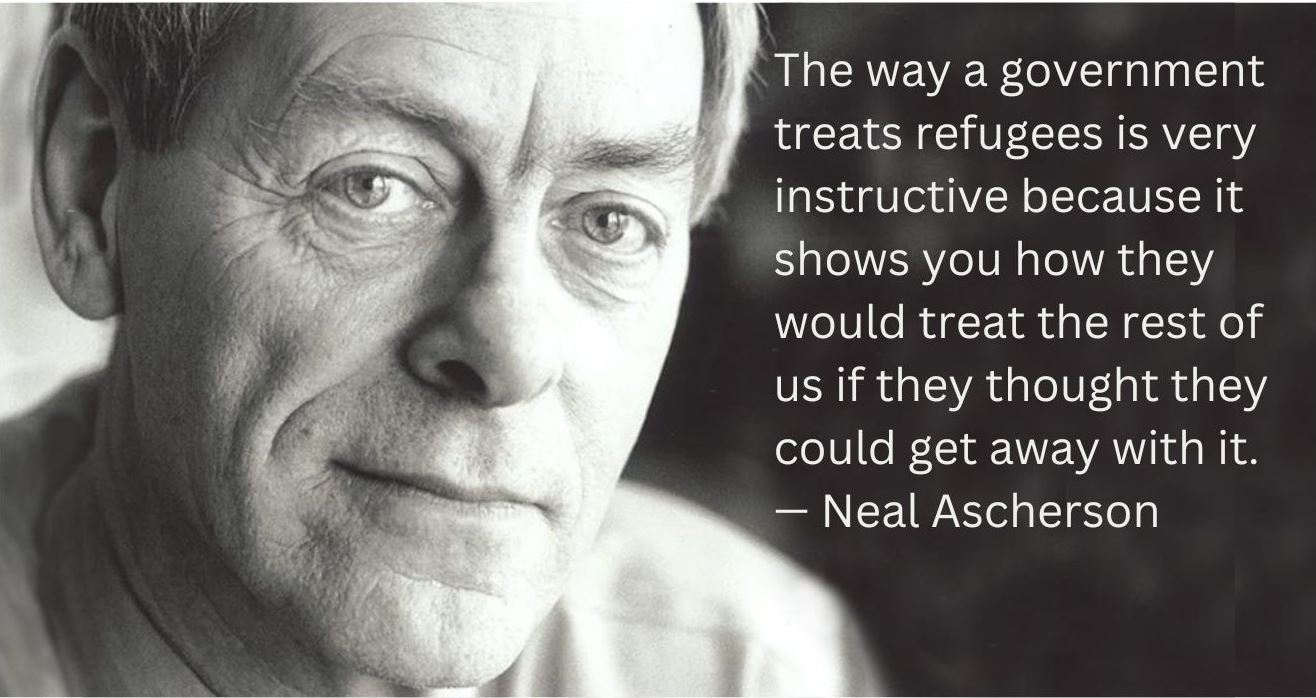
One of my favourite writers is Neal Ascherson. Among many other achievements, it was he, and not Tony Benn, who came up with the well-known quotation above. (There's chapter and verse on this blog.)

Here is Ascherson reviewing The Conquest of Nature: Water, Landscape and the Making of Modern Germany by David Blackbourn for the London Review of Books in 2006 - Frederick is Frederick II (Frederick the Great) of Prussia:

In Frederick’s time, marshlands were regarded as sinister, useless places, breeding malarial vapours and sheltering not only dangerous wild beasts but primitive human beings beyond the reach of law. Today, we would treasure the lost Oderbruch as one of the marvels of Europe. 

On its way to the Baltic, the river frayed into countless shallow channels and lagoons, into swamps, shoals and muddy islands. Twice a year, it flooded up to ten or twelve feet deep, nourishing a dense cover of waterlogged bushes. Here lived ‘an almost unimaginable range of insect, fish, bird and animal life’, including wolves and lynxes. 

Blackbourn has the sense to rely heavily on the travel writings of Theodor Fontane, the most lovable and observant of German writers, who explored the drained Oderbruch in the 1850s and collected memories of pre-reclamation times. Fontane was told of the enormous shoals of countless species of fish, of pike hordes so dense that they could be scooped up in buckets, of crayfish which escaped the hot summer shallows to swarm in trees from which they could be shaken down like plums. 

And he wrote also about the old inhabitants. They were not Germans but Wends, Slavs who had survived in the marshes since the Germans colonised the fertile land almost a thousand years before. The Wends lived on mounds hidden in the swamp, their huts encircled by ramparts of cow-dung which kept out the floods and served as pumpkin beds.

There's more about The Conquest of Nature: Water, Landscape and the Making of Modern Germany on the Penguin website.

Friday, December 20, 2024

The comforting lie de Gaulle told France after the second world war

This blog's hero Neal Ascherson has a piece in the new London Review of Books. It's a review of Julian Jackson's France on Trial: The Case of Marshal Pétain.

Pétain, a hero of the first world war, headed the collaborationist Vichy regime after the German invasion during the second. After the Allied victory, he was tried for treason, convicted and sentenced to death. Because of his age (he was 89), this was commuted to life imprisonment and he died in 1951.

Ascherson writes of the detailed charges bought against Pétain:

Nothing shows better than this trial the way perspectives on the Second World War have changed almost out of recognition in the course of the last eighty years. In much of the world, children can now leave school vaguely believing that the war was fought to save the Jews from the Holocaust. 

But in 1945 Pétain’s indictment included only a brief mention of ‘abominable racial laws’, referring to Vichy’s antisemitic discrimination, and said nothing specific about the mass round-ups and deportations to the gas chambers that were made possible by the collaboration of French police, ministry officials and railway managers.

Incredibly, no Jewish survivors of the camps stood as witnesses at the trial. Antisemitism lay somewhere in the background here, but more immediately important was de Gaulle’s shamelessly misleading version of French behaviour under the occupation. 

Almost everyone, it ran, had supported the Resistance in thought if not in deed, and France had been let down only by a small clique of traitors. This new myth plastered over the fact that Vichy and its policy of keeping the Germans contented had been accepted, with intense and bitter reluctance, by most of the population during the early war years.

Sunday, May 19, 2024

The Joy of Six 1230

"These British-induced uprootings - the emigration from India, the three million African slaves transported on British ships across the Atlantic, the millions who left Ireland after the 1840s Famine - permanently changed the world’s human geography. The empire changed global ecology too." Neal Ascherson reviews Empireworld: How British Imperialism Has Shaped the Globe by Sathnam Sanghera.

Laleh Ispahani and Jennifer Weiss-Wolf argue that: "Reproductive rights do not exist in a vacuum. Bodily autonomy is inextricably linked to the integrity and durability of the body politic - with threats to one reinforcing threats to the other."

"Next Monday [that's tomorrow] the Infected Blood Inquiry will release its report on the failures that led to more than 30,000 people being infected with deadly viruses, between 1970 and 1991, due to contaminated blood products. Attention will focus on how much NHS leaders and government officials knew about the risks being taken, as well as attempts to prevent families raising awareness of the issue." Sam Freedman tries to identify the injustices ITV will be making dramas about in 2030.

Frances Coppola looks into the shadowy offshore conglomerate that owns LBC.

Rob Baker on 1956, they year of the Suez Crisis, The Entertainer and the Angry Young Men.

"The English rapper and producer had heard a Reading Festival audience shouting his lyrics from his newly released debut album for the very first time. Where others might feel vindicated, Skinner was spooked. It was a warning to take his craft seriously." Fergal Kinney revisits The Streets’ A Grand Don’t Come For Free.

Saturday, December 16, 2023

Neal Ascherson and fables of the reconstruction of Germany

This blog's hero Neal Ascherson writes on the former East Germany in the current London Review of Books:

Travelling around Mecklenburg in 1991, in what had been the GDR six months before, was a disorienting experience. Again and again, I was reminded of Reconstruction in America, the traumatic aftermath of the Civil War. Here again was a sullen, defeated society. 
There had been no gunfire, but West Germany felt as victorious as the American North must have done in 1865. Here once more came the carpetbaggers, smart operators from Frankfurt or Düsseldorf pouring into East Germany to loot its collapsing industrial and service economy. While silent locals stood with their bicycles in the rain, gleaming black BMWs swept past carrying Treuhand officials on their way to privatise or close more state factories. 
As in the old South, a whole ideology justifying the power structure had been switched off, and its guardians – in this case, the SED, the National People’s Army and the immense web of the Stasi and its informers – found themselves out on the street.

Since then the gap between living standards in the former East and West, though still 26 per cent in 2020, has narrowed. And yet, just as sophisticated Manhattanites despair at the South’s refusal to forget a past that would be better forgotten, West German ‘Wessis’ are unnerved to find how many ‘Ossis’ insist on remembering a disconcertingly ‘other’ life in that phantom Germany.

Ascherson writes beautifully and is endlessly interesting. Another point he brings up is that the East German Communists saw themselves as the true heirs and interpreters of Karl Marx's thought, and thus morally and intellectually superior to the ruling party in the Soviet Union.

Friday, June 09, 2023

Neal Ascherson on women and the revolutions of 1848

Neal Ascherson reviewed Revolutionary Spring by Christopher Clark, a history of the revolutions that spread across Europe in 1848, for the London Review of Books last month.

Ascherson's paragraphs on the experience of women in those revolutions make the 1840s sound very much like the 1960s:

Women got absolutely nothing out of 1848. ‘It is difficult to decide what is more striking – the tireless advocacy of the women activists or the immovability of the patriarchal structure they were challenging,’ Clark writes. ‘Women were not enfranchised anywhere in Europe in 1848.’ 

And yet they fought and died, gun in hand, on the barricades of Paris, Berlin and Milan. In the Frankfurt Parliament, ‘the discussion of votes for women elicited guffaws and hoots from the deputies ... and was dismissed out of hand.’ This was to be branded a firmly male revolution, with women celebrated only for waving ribbons from windows at the marching men below. 

Some of the shrewdest and most detailed witness accounts of 1848 came from female observers – Marie d’Agoult and Margaret Fuller among them – and with their help, Clark’s coverage of women’s history in this period is the most sustained and exciting investigation in his book. 

He begins with the flame-throwing eloquence of Claire Démar in Paris in 1833: ‘There still exists a monstrous power,’ she announced, ‘a species of divine law ... the power of the father.’ Everything about marriage was unequal, she said, and marital love was little more than ‘a two-fold egoism’. ‘The liberation of the proletarians, of the poorest and most numerous class, is only possible through the liberation of our sex.’ 

Démar and other early French feminists such as Suzanne Voilquin and Jeanne Deroin had disillusioning contact with the utopian sects of the day, usually patriarchal and too often mistaking sexual liberation for submission to the lust of some bearded guru. 

The journalist Eugénie Niboyet asked why the stupidest man could vote when the most intelligent woman could not; why, indeed, should women pay taxes that they had not taken part in legislating? Everywhere, from France to insurgent Hungary, women came forward to act in the revolution and were met with degrees of male mockery. 

The ridicule (‘mannish blue-stockings and divorceuses’) ‘infiltrated the awareness of so many women, even the most politically active ones, who struggled to reconcile their activities with “inherited notions of womanliness”’.

Saturday, March 18, 2023

A tribute to Neal Ascherson on his 90th birthday

Last October one of my favourite journalists, Neal Ascherson, turned 90. To mark the occasion, he was interviewed by Tim Adams in the Observer:

There are certain writers who seem singled out to bear witness to their times. Neal Ascherson first had a graphic inkling of that fate when he was a small boy in Peterborough, where his father, a naval officer, was stationed at a factory making torpedoes. 

"It would have been the summer of 1940," Ascherson says, "and I was coming back to the village where we lived, from school, on the bus. I must have been seven. This aircraft appeared as I was walking back to our house. Like all small boys I knew my bomber planes and I recognised it as a German Dornier, flying low. I didn’t hear it firing, but my mother did. She was watching for me from a window and almost died of horror. 

"Some fucker in the belly turret of the plane let off some machine gun rounds at me. I was the only person in the whole landscape, a little boy with a school bag. The noise of the engine was so loud I didn’t hear anything, and obviously he missed, but afterwards the trees all along the road had these white scars where the bullets had gone in."

Ascherson is telling me this story, with a characteristic twinkling smile, from his sofa in the tall terrace house near Highbury Fields in north London where he has lived for 40 years with his second wife and fellow journalist, Isabel Hilton. 

The previous night he had celebrated his 90th birthday at the Polish Hearth Club in Kensington where his old friend, the playwright Michael Frayn, a youthful 89, had toasted him as a man of “rare charisma, like a 19th-century romantic hero, with a kind of nobility that has always seemed a kind of human gold standard”. 

Ascherson wears those traits lightly, but you glimpse them all the same. In some ways, that near-miss from the Luftwaffe established the pattern of his life: if European history was happening, he was never far away.

And my graphic? Yes, it was Neal Ascherson who said that and not Tony Benn.

Sunday, December 18, 2022

"An adored celebrity": Flora MacDonald after the Young Pretender had flown

Embed from Getty Images

Lately, I've been given to naming Ian Jack and Neal Acherson as my favourite journalists. But Ian Jack died in October, which leaves just Ascherson - the man who originated that quotation about the government and refugees usually attributed to Tony Benn.

In the latest London Review of Books, Ascherson reviews a book on the life of Flora MacDonald, the woman who kept Charles Edward Stuart from the British Redcoats after his defeat at Culloden.

Here he is on what happened to Flora after the prince had fled and the British caught up with her:

Flora was certainly brave and resolute. Had she been caught with the prince, she might easily have died in prison, or ended up as an indentured, enslaved servant in the Caribbean. But these were capricious, aristocratic times. 

Strictly, what she had done was treasonous. She had preserved the kingdom’s most dangerous enemy, helping him to escape and probably organise another Jacobite invasion. If it had succeeded, the Hanoverian dynasty would have been overthrown, the liberties of the 1688 revolution cancelled, the Anglo-Scottish Union of 1707 reversed, Ireland liberated and Britain’s elites colonised by Catholic appointees. And yet Flora emerged as an adored celebrity. 

During the Second World War, hundreds of young women who sheltered partisans or Allied airmen died in concentration camps. But in Georgian Britain, brutal enough to the lower orders, a good-looking girl with presentable manners touched a sporting reflex in upper-class officers, especially if they were Scottish. If the prince had been caught clambering into a boat with a barefooted lass who spoke only Gaelic, it would have been a different story.

Wednesday, November 02, 2022

No, Tony Benn didn't say that about governments and refugees

There's a very good quotation that pops up on Twitter from time to time. It runs:

The way a government treats refugees is very instructive because it shows you how they would treat the rest of us if they thought they could get away with it.

Almost invariably, these words are attributed to Tony Benn, but he did not say them. Rather, they were written by the Scottish journalist (and sometime Lib Dem Holyrood candidate) Neal Ascherson.

The history of the quotation is as follows.

In 1996 Ascherson wrote an article on the al-Masari affair in the Independent, where he said:
The al-Masari affair overflows in all directions with moral relativism. My own view is that to expel a political asylum-seeker because his country threatens to cancel business contracts with Britain is absolutely wrong. 
And it is not only wrong but dangerous in the long term to us all. This is because of one of the Laws of Politics that I wrote long ago into my little black notebook: "The way a state treats its aliens is the way it would treat its own subjects if it dared".
And in 1999 Francis Wheen paraphrased Ascherson to produce more or less the quotation we know today:
We should always watch how politicians treat refugees, Neal Ascherson once wrote, because that's how they would treat the rest of us if they thought they could get away with it.
Neal Ascherson, incidentally, has passed 90 and is still going strong. You should be able to read some of his articles on the London Review of Books site before its paywall kicks in.

Sunday, May 15, 2022

The Joy of Six 1050

"Those that claim to be the party of clever economics and fiscal responsibility would do well to remember this simple truth: the square root of fuck all is always going to be absolutely fuck all, no matter how creatively you’re told to to dice it." Jack Monroe asks why elected representatives and salaried journalists and presenters are trying to undermine the ten-year career and credibility of a food blogger.

Andrew Adonis reviews Chums: How a Tiny Caste of Oxford Tories Took Over the UK by Simon Kuper: "In place of Kuper’s plan, I would instead introduce a different 'levelling-up' reform challenge for Oxford. It needs to radically broaden the social intake of its state school recruitment, which today is too largely drawn from grammar schools, sixth-form colleges and academies in London and the southeast".

Helena Horton on ambitious plans to rewild London.

Neal Ascherson is always worth reading: here he discusses the history of the extraordinary Polish-Lithuanian Commonwealth.

"Tragically, he was discovered, captured, and deported during a raid in Toulouse in 1944 - first to Drancy, then to Auschwitz, and finally Kaunas-Reval in Lithuania. Of hundreds of people captured in Toulouse that day, only a handful survived. They perished without a trace." Janet Horvath says we should not forget the cellist and composer Pál Hermann.

"It was a big car park, but it was in bad shape. So in 2010, the Trinity Square high rise car park, an iconic brutalist building that dominated Gateshead’s skyline in the 1970s, was demolished, and a part of British film history was gone. Though not before the canny council sold tinned lumps of rubble to film fans for £5.00 a go." Tim Pelan watches Mike Hodges' 1971 film Get Carter.

Wednesday, March 31, 2021

Six of the Best 1001

"Most British governments since Thatcher’s have sought to stamp out what they see as a spreading ‘European heresy’: the notion that supreme law should stand above parliaments, that judges in a democracy may reverse the will of an elected government if it violates a constitution." So says Neal Ascherson, reviewing a book by Linday Colley.

What did Richard Kemp know about Liverpool's scandals?

Matthew Pencharz says that Londoners opposed to low traffic neighbourhoods will be glad of them in the end.

Are you local? Sophia Adamowicz explores the blend of the macabre and the mundane in the work of Steve Pemberton and Reece Shearsmith.

Huw Turbervill offers his selection of cricket's best (and worst) moments on film and TV: "Peter Davison's fifth Doctor wore a cricket costume and showed his skills in the two-part adventure, 'Black Orchid'. He looks an adequate seamer but could use his front arm more, but is a slogger with the bat. The director Ron Jones errs, though, allowing the umpire to signal a wide when a four is struck."

Look Up London tours the City's orphaned church towers.

Tuesday, November 17, 2020

The United Kingdom must break up for England's sake

In​ 2019, Boris Johnson became prime minister of the United Kingdom of Great Britain and Northern Ireland. In 2020, he shrank into being prime minister of England. For the second time in less than seven years, the union is in trouble. 

But this time the problem needs a new question. Forget: "Should Scotland be independent?" The Scots will take care of that. Ask instead: "Who in the rest of Britain needs this union with Scotland? And why?"

Neal Ascherson has another thoughtful piece in the London Review of Books - and to put it mildly, the prime minister has done nothing in the past two days to suggest his introduction is wrong.

The conclusion he comes to is a novel one: the United Kingdom must come to an end, not just for Scotland's sake, but also for England's:

In Scotland’s 2014 referendum campaign, one apparently humble word became the deadliest weapon. The word was "normal". Again and again, at pro-independence gatherings, I heard people say: "I just want my kids to grow up in a normal wee nation, like other countries." By this they meant a country which took its own decisions for better or worse, which could feel that its future was in its own hands. But they also meant that the UK was "abnormal". ...

At the core of the abnormality was England’s difficulty in accepting its Englishness. Not all Britishness is a deceit ... but in politics the moth-eaten remnants of imperial Britishness form a blindfold against the 21st-century world. 

Britain is an imaginary realm, floating in a category above mere nation states; England is a European country like its neighbours. 

Britain is exceptional and must express itself in superlatives ("world-beating", ‘"global leader", "most efficient on the planet"); England is a medium-sized country with first-rate scientists and rotten management.

Britain dreams of becoming a heavily armed, swaggering pirate power, defying international rules; England is a minor, sceptical nation with a taste for satire and democracy.

Saturday, October 10, 2020

Rewilding the Somerset Levels

With things so grim at the moment, it's good to look for hope. And I find it in the Somerset Wildlands project:

The Somerset Levels were once England’s Okavango Delta. From pelicans to lynx, beavers to sturgeons, it would have teemed with wildlife. While what remains is wonderful, too much is now gone. We will buy land to create space for nature and natural processes, and support the reintroduction of lost species.

I had to look up the Okavango Delta and it turns out to be in Botswana.

A parallel closer to home might be Germany's lost Oderbruch, as described by Neal Ascherson:

Today, we would treasure the lost Oderbruch as one of the marvels of Europe. On its way to the Baltic, the river frayed into countless shallow channels and lagoons, into swamps, shoals and muddy islands. Twice a year, it flooded up to ten or twelve feet deep, nourishing a dense cover of waterlogged bushes. 
Here lived ‘an almost unimaginable range of insect, fish, bird and animal life’, including wolves and lynxes. Blackbourn has the sense to rely heavily on the travel writings of Theodor Fontane, the most lovable and observant of German writers, who explored the drained Oderbruch in the 1850s and collected memories of pre-reclamation times. 
Fontane was told of the enormous shoals of countless species of fish, of pike hordes so dense that they could be scooped up in buckets, of crayfish which escaped the hot summer shallows to swarm in trees from which they could be shaken down like plums.

And he wrote also about the old inhabitants. They were not Germans but Wends, Slavs who had survived in the marshes since the Germans colonised the fertile land almost a thousand years before. The Wends lived on mounds hidden in the swamp, their huts encircled by ramparts of cow-dung which kept out the floods and served as pumpkin beds.

Friday, September 18, 2020

Six of the Best 960

"Through the long Covid months, it was only England that Boris spoke for, and spoke to, at those teatime briefings from Downing Street. Meanwhile, Scotland, Wales and Northern Ireland did their own devolved things." Neal Ascherson foresees the end of the United Kingdom.

Andrew Page presents 25 unquestionable benefits of Brexit - hear him.

We need to overhaul what we grow, and how and where we grow it, if we are to make the most of our land and fight climate change, says Natalie Bennett.

"Craigie was contributing to a new environment that encouraged the formation of modern identities for young women, who would write in with their problems, escape into the worlds of torrid romance stories, compare their lives to those of the stars or fashion their own appearances and lifestyles based on beauty, health and relationship advice." Hollie Price looks at the early journalistic career of the film documentary maker Jill Craigie (who later married Michael Foot).

"Though they come to us via our hubbub-filled Instagram feeds, these stand-alone pictures are as quietly stunning as any made by our greatest American artists of alienation and loneliness, from Edward Hopper to Arthur Dove." Naomi Fry appreciates The Simpsons as art.

Mark Valladeres tours Suffolk by public transport.

Thursday, April 02, 2020

Neal Ascherson on the nature of the British state

Embed from Getty Images

Neal Ascherson reviews Richard Norton-Taylor's 'pugnacious' The State of Secrecy: Spies and the Media in Britain for the London Review of Books.

His second paragraph runs:
The structure of the ‘British’ state is still essentially monarchical. Constitutionally, the rest of the democratic world has moved on, adopting variants of the Enlightenment notion of popular sovereignty. Power resides in theory with the people, whose communities lease upwards only those functions they cannot exercise themselves. But in Britain, its archaisms only lightly reformed, power still flows downwards. The absurd doctrine of parliamentary sovereignty – that weird English scrap of parchment – in effect means parliamentary absolutism, a hasty 1689 transfer from the divine right of kings. We don’t have ‘inalienable rights’, but are allowed to vote and speak freely only because the government, through Parliament, generously lends some of its power to its subjects.

Tuesday, December 31, 2019

Neal Ascherson remembers Jonathan Miller

Embed from Getty Images

In the current London Review of Books Neal Ascherson remembers his friend Jonathan Miller:
I first met Jonathan’s knees. This was because Cambridge sofas in the 1950s had broken springs. Once they had buoyed up culture heroes like Rupert Brooke, John Cornford or Guy Burgess. Now, as we trudged across the great Gromboolian plain of the 1950s, they had given up the struggle. 
Modish undergraduates perched on the arms. Jonathan, new to the place, tried to sit down and slid backwards into the depths. All I could see was these twin gatepost knees towering up. And then, peering over them, I saw the head of red curls and two urgent eyes searching – as they always did – for information.

Sunday, October 27, 2019

Neal Ascherson says Brexit threatens the Union

Embed from Getty Images

Neal Ascherson, one of my favourite political commentators, writes in the Guardian:
Theresa May went around preaching about "our precious, precious union". This puzzled me, given massive English indifference. Ask somebody in Durham or Exeter why the union matters, and you get a blank stare, a shrug and perhaps a mumble. 
Then I understood: it wasn’t Scotland, Wales or Northern Ireland that was "precious" to her, but "the union" in the abstract – a sort of legitimising halo hovering over Westminster’s anointed. It's a cult confined to Britain’s ruling caste and, of course, to Scottish and Irish unionists who genuinely have something to lose. 
The "great rest of England" seem to have felt for many years that if the Scots want to leave, "it seems a pity but it’s their right". Few southerners would feel diminished.
And he concludes:
If England in 2019 can no longer remember why the union with Scotland and Northern Ireland once made sense, Brexit has delivered the United Kingdom to the hospice of history.
No country last for ever - read Norman Davies' Vanished Kingdoms if you doubt me - and I suspect that one day soon the Scottish Liberal Democrats will have to start thinking about what a liberal Scotland would look like rather than just defending the union.

Saturday, December 01, 2018

Labour's timidity over Brexit dissected

The new issue of the London Review of Books carries a review of Neal Ascherson's book Tom Nairn: ‘Painting Nationalism Red’? by Rory Scothorne.

In the course of it (and behind the LRB paywall), Scothorne nicely dissects Labour's timidity over Brexit:
None of Labour's warring factions dares to suggest that this moment of constitutional breakdown demands a constitutional revolution; instead the party is constrained by the bad logic of adjectival manoeuvre - hard, soft, chaotic, no deal, Tory, people’s – around an all-consuming and unstoppable noun. 
When experience strips away these rhetorical qualifiers, Labour will be dangerously complicit in what remains.
Neal Ascherson, who stood for the Liberal Democrats in the 1999 Holyrood elections, is one of my favourite writers. And I remember reading The Enchanted Glass: Britain and Its Monarchy by Tom Nairn back in the 1980s, when it was widely reviewed.

Friday, July 20, 2018

Six of the Best 805

Brexiteers who look to Donald Trump for help will be disappointed. Dana Allin explains why.

Oliver Stanton has some sensible ideas from improving the Liberal Democrats' online presence.

"A shorter overall running time and a focus on producing even smaller bits of content risks robbing viewers of some of the current programme’s interrogative depth. Save for the various Sunday shows British TV is not running over with dedicated political interview programming, and [Andrew] Neil is one of the best in the business." Henry Hill is rightly critical of the BBC's decision to scrap the Daily Politics and Sunday Politics.

Neal Ascherson contributes a characteristically brilliant review of Katherine Verdery account of her time in Ceauşescu’s Romania: "The crowning mercy of human relations is that we don’t know what other people are really thinking about us. They – those others – decide what redacted selection we are offered. But to read one’s police file is – suddenly – to have the curtain pulled open. The self you think you know becomes a mask, concealing a devious somebody else whose relationships are mere espionage fakes."

Helen Day introduces a Canterbury exhibition of the other work of the artists who illustrated Ladybird Books. We get to meet the real Peter and Jane too.

Have a look round Shrewsbury's last watchtower with Chris Schurke. I want to live there.

Saturday, March 03, 2018

Ian Jack on The Causes of Brexit

Embed from Getty Images
England has been in a dreadful state for some weeks. Lord Coodle would go out, Sir Thomas Doodle wouldn’t come in, and there being nobody in Great Britain (to speak of) except Coodle and Doodle, there has been no Government. It is a mercy that the hostile meeting between those two great men, which at one time seemed inevitable, did not come off; because if both pistols had taken effect, and Coodle and Doodle had killed each other, it is to be presumed that England must have waited to be governed until young Coodle and young Doodle, now in frocks and long stockings, were grown up. 
Charles Dickens skewered a certain school of political journalism in Bleak House, but that school is pre-eminent today.

It's all about who's up and who' down among a small cast of players. Hot takes are filed on the hour. And, though I have always had a weakness for gossip myself, it's almost all instantly forgettable.

At my more thoughtful I prefer commentators like Neal Ascherson and Ian Jack who can bring a historical perspective to bear on contemporary events.

In today's Guardian Ian Jack sets out The Causes of Brexit (as he had to The Causes of the First World War as a schoolboy) and identifies eight of them:
  • Deindustrialisation
  • Immigration
  • Cultural dementia
  • The Dam Busters
  • English exceptionalism
  • The playing fields of Eton
  • The newspapers
  • Complacency
He writes under this last head:
During the Scottish referendum campaign in the summer of 2014 I met a painter and decorator on the island of Bute who said he was voting for Scottish independence. “You have to.” Why? He knew people in Sunderland, “and every one of them wants to leave Europe”. Sunderland, with its big car factory that exported cars to the continent? Surely not. “Yes, they want to leave.” He laughed at the daftness of it. I didn’t believe him.
And there was a lot of complacency about.

David Cameron and George Osborne had convinced themselves they were political geniuses. So what if the right wanted to limit who could vote in the referendum to skew the electorate in favour of Leave? They were bound to win it anyway.

Who was put in charge of the Remain campaign? Jack Straw's son, whose life had hardly been one of political struggle, and the mastermind of the Liberal Democrats' 2015 general election campaign.

And if half the passion that has been put into Remain since the referendum had been evident during the actual campaign the result might have been different. That said, much of that passion has been devoted to laughing at or demonising the people who voted Leave, which is hardly likely to win them over.

Anyway, read Ian Jack's piece for yourself and read him in the Guardian every Saturday - there is an archive of his columns on the paper's website.

Saturday, August 26, 2017

Neal Ascherson on Heligoland

Ian Jack and Neal Ascherson are two of my favourite journalists. This is because they are able to bring a historical perspective to the day's events.

Many other celebrated commentators just offer hot takes on those events centered on the interests of the metropolitan professional class.

Ascherson has a piece in the current London Review of Books on Heligoland, a tiny island off the North Sea coast of Germany that was a British colony for almost the whole of the 19th century.

As he says:
Few Britons now know where the place is. Still fewer know that it was once a British colony.
Yet Heligoland's history is fascinating, as is what Ascherson concludes from his review of a book about it:
Jan Rüger argues persistently that there was no real contradiction between the possession of these offshore fragments of Europe and the development of an enormous colonial empire elsewhere. "We are used to thinking of Europe and the British Empire as opposite poles," he writes: 
historians and politicians alike have fostered a narrative in which the empire allowed Britain to disengage from Europe, as if the two were clear-cut opposites … This is very much a 20th-century idea, reflecting, more than anything, Britain’s changed global position after the Second World War. The imperial project was never isolated from Europe, nor did it allow Britons to isolate themselves from Europe. 
Featured on Liberal Democrat VoiceWise and relevant words, to be set against shameless Brexiter distortions of history.