Liberal Democrat Blog of the Year 2014
"Well written, funny and wistful" - Paul Linford; "He is indeed the Lib Dem blogfather" - Stephen Tall
"Jonathan Calder holds his end up well in the competitive world of the blogosphere" - New Statesman
"A prominent Liberal Democrat blogger" - BBC Radio 4 Today; "One of my favourite blogs" - Stumbling
and Mumbling; "Charming and younger than I expected" - Wartime Housewife
Saturday, June 27, 2026
HMO plan for Market Harborough's Bottom Club
Wednesday, June 03, 2026
Why non-fiction books need their indexes
Not only is a book without an index less satisfactory after you've bought it, but that lack makes you less likely to buy it in the first place.
I can't be the only person who, faced with a promising new title in a bookshop, turns to the index and looks up a couple of relevant topics I know something about. What the books says about them gives me an idea of the author's thoroughness, judgement and originality.
Without an index it's much harder to gain this insight, which makes an impulse purchase less likely.
Besides, the absence of an index means there are none of the juxtaposed entries I so enjoy.
The other day I turned up a Liberal Democrat Voice post from 2010 in which a number of bloggers made their choice of Christmas books.
My choice was Electric Eden by Rob Young, which is a history of the folk rock genre. I ended by saying:
The book has a wonderfully complete discography to guide your own exploration of folk and folk rock, and the most engrossing index I have ever come across. Richard Jefferies stands next to Jefferson Starship. Traffic next to Thomas Traherne. Steve Winwood next to Gerrard Winstanley, It reads like notes towards my own vision of Britain.
But the real master of unlikely couplings in indexes is Mike Brearley. In included a collection of finest work in one of my JCPCP columns:
- Archer, Jofra/Aristides the Just;
- Bowlby, John/Boycott, Geoff;
- counter-transference/Cowdrey, Colin;
- Gower, David/Gramsci, Antonio;
- idée fixe/Illingworth, Ray;
- Muralitharan, Muttiah/Murdoch, Iris;
- Snow, C.P./Snow, John;
- Thomson, Jeff/Thorndike, Sybil;
- Trueman, Fred/Trump, Donald;
- Wittgenstein, Ludwig/Woakes, Chris.
Wednesday, May 13, 2026
A review of Terry O'Neill's life story in a social work journal
It was in this climate that Terry O'Neill, the younger brother of Dennis O'Neill, whose death I have often written about, posted his life story on the website Authonomy under the title Never Again in 2009. This was a site where authors could post their manuscripts in the hope that its owner Harper Collins or another publisher would see it and be interested.
Fortunately, Harper Collins did recognise what a treasure they had. and published a rewritten version of Terry's book as Someone to Love Us. Despite this very "Painful Lives" title, and a cover that also made it look as though it belonged to that genre, my impression when I read it was that the ghost writer had done a good job. But I do remember things in Terry's original version that didn't make it into the published book, so I hope that manuscript still exists somewhere.
My reason for writing this post is that I've come across a review of Someone to Love Us in a social work journal. It was written by Dave Burnham and appeared in The Bulletin of the Social Work History Network (Vol. 3, No. 1, June 2016).
Here is an extract:
There are recognisable themes:
- Children never being told of decisions about them – not just by officials, but by anybody.
- The number of placements and the yo-yo emotions associated with moving between caring family homes and rulebound institutions.
- Although Reginald Gough’s beatings were by far the worst, the punishments meted out later to Terence in homes (beating, deprivation of food) bore a sinister similarity to Bank Farm practices.
- The rich collection of characters involved in child care: the careful, kind leaders, the charismatic role models, the thoughtless, the demanding bullies.
- The still silence of the scared children in the face of adult authority.
- The years of guilt Terence felt after Dennis’ death about what he might have done to save him.
- The official emphasis on attempting to place the boys with a Catholic family, even though, as Terence said until he was in care he'd never been to church in his life.
- The heartlessness of the press.
Most notably, during the boys’ six month stay there were perhaps ten visits by various officials, a Boarding Out volunteer, two senior Shrewsbury Council [in fact Shropshire County Council] officials, an 18 year old clerk from Newport and social workers dealing with other foster children at the Goughs. Not one of these people went upstairs to the freezing room where the boys slept on a straw pallet with one blanket. Monckton recommended some changes in Boarding Out visiting, but his report is most notable in proposing that people should simply do their jobs properly – seeing where boarded out children slept, for instance. had been expected for fifty years by then.
Burnham ends by saying Someone to Love Us should be read in conjunction with Sir Walter Monckton's report on the affair, but that this is hard to find.
You can find the Monckton Report online, but his statement that "no evidence came to my notice of any exploitation of the boys in the work of the farm" does not accord with the story Terry O'Neill tells.
Terry died in 2023. You can hear him speak in the award-winning BBC Radio Wales documentary The Mousetrap and Me.
Saturday, October 25, 2025
Flann O'Brien makes the case for banning poetry
Today I visited Heyford Books in Northampton, which maintains a good general secondhand stock and sells most volumes for £2.
One of the books I came away with was The Best of Myles, an anthology of the writings of Flann O'Brien.
If you're puzzled by the title... Flann O'Brien's real name was Brian O'Nolan. As he was a pillar of the Irish civil service as well as a satirical columnist and novelist, he generally wrote under a pen name, and Myles na Gopaleen.
Here he making the case for banning poetry:
Having considered the matter in – of course – all its aspects, I have decided that there is no excuse for poetry. Poetry gives no adequate return in money, is expensive to print by reason of the wasted space occasioned by its form, and nearly always promulgates illusory concepts of life.
But a better case for the banning of all poetry is the simple fact that most of it is bad. Nobody is going to manufacture a thousand tons of jam in the expectation that five tons may be eatable.
Furthermore poetry has the effect on the negligible handful who read it of stimulating them to write poetry themselves. One poem, if widely disseminated, will breed perhaps a thousand inferior copies.
The same objection cannot be made in the case of painting or sculpture, because these occupations afford employment for artisans who produce the materials.
I think Flann O'Brien and I are going to get on very well.
Saturday, September 13, 2025
My first night in Shropshire was at a farm with a very Welsh name
I've long believed that the first night I spent in Shropshire was at the Sun Inn, Clun, in 1987.
Reader (suspiciously): This isn't going to be about Snailbeach is it?
No. If you'll let me finish...
That summer I walked part of the Offa's Dyke Path. It was my first attempt at such a holiday, so I didn't realise the importance of walking every day, and I took a weekend out for the bookshops of Hay-on-Wye and another day to travel from Knighton to Llanelli and back on what they now call the Heart of Wales Line.
On the way back, I got out at Knucklas, the station before Knighton, and found bed and breakfast at a nearby farm called Monaughty Poeth.
The River Teme forms the border between England and Wales for a stretch here – or rather its course as it was in 1542 does. The Teme must have been lapping at the farm's walls if they stood in the 16th century, but Monaughty Poeth is clearly just over the border in England and, more importantly, Shropshire.
You can see the farm in the photo above and, thanks to the wonders of the net, I can send you to a lovely obituary of the lady who must have cooked my breakfast the next morning:
Joce and Jim moved from their home at Brackenway down to the main farm at Monaughty Poeth in 1982, where Joce became the perfect farmer's wife as well as doing Bed and Breakfast, belonging to the South Shropshire group.
Wednesday, August 06, 2025
Bishop's Castle: The Poetry Pharmacy and a shuttered Three Tuns
Wednesday, February 26, 2025
Malcolm Saville visits Shrewsbury in 1963
Malcolm Saville was a Sussex man, but his most popular books were those set in the Shropshire hills.
This advertisement from the Wellington Journal (12 January 1963) shows him making an appearance at a Shrewsbury bookshop to sign books before giving a talk at the town library.
Saville had long worked in publishing - I believe he was even Enid Blyton's publicist at one time - and did not give up that day job when his career as a children's writer took off.
Friday, November 15, 2024
Blakey off of On the Buses and radical theatre
I think the Fifties were a more interesting decade than we now imagine - the centrality of live theatre to the culture being just one reason.
As Sebastian Millbank pointed out in an article on The Critic, it's noteworthy that the modern left shows no affection for a decade that saw full employment, widespread union membership and rising wages.
When I got Anger and After home, I looked up one minor writer in the index and was directed to a pleasingly chunky passage:
Another improvisation along rather the same lines was Stephen Lewis's Sparrers Can't Sing, a lackadaisical picture of Stepney life revolving round the return from jail after nearly ten years of the paterfamilias to meet again the wife he hit with a poker. There was no plot to speak of, but the characters who wandered in and out, particularly the two old derelicts locked in deadly combat with the National Assistance, made pleasant enough company while they were around and lent a certain colour to the assertion by their ex-electrician's mate creator that "The world as seen through the bottom of a pint pot is much more entertaining than that usually seen through opera glasses, and less distorted."
The play, after a not very successful transfer to the West End, became the basis of Joan Littlewood's first foray into the cinema; slightly retitled as Sparrows Can't Sing and almost completely reworked by Joan Littlewood and the author, it emerged as the story of a randy young sailor's return from the sea to find his pretty young wife living with a bus driver in a rebuilt East End of towering modern flats, most of the material about the old people, the National Assistance and so on having disappeared somewhere along the way.
Subsequently Stephen Lewis has written Wagger, a subdued television piece in a very similar style about a crippled cobbler and the tentative beginnings of his romance with a girl who works in the baker's across the road, sat against a background of bitter family bickering.
Stephen Lewis could act as well as write. He appeared at Stratford East and the Royal Court, and his turn as the caretaker of a new block of flats who relishes all the regulations he has to enforce is one of the best things in Sparrows Can't Sing.
Anger and After was written before be became famous as Blakey in On the Buses.
Tuesday, November 05, 2024
The Joy of Six 1285
James Chapman argues that, by backing Donald Trump, senior Conservatives have shown how far their party has fallen.
Anna Merlen says this Presidential election has seen some of America’s richest people promote - and apparently believe - ludicrous hoaxes.
"About a quarter of Europe’s bird population has been wiped out in the last four decades – that is half a billion fewer birds in the sky today compared with 1980. Four in 10 European tree species are classed as threatened, butterfly numbers are down by about a third, one in 10 bee species are dying out, and two-thirds of the habitats of ecological importance are in an unfavourable condition. A fifth of European species face extinction." Fiona Harvey shows how farm subsidies have wrecked Europe's landscapes.
"When November the 5th disappears, it will not be because of any ecumenical or secularist wisdom that consigns all potentially sectarian anniversaries to an atavistic scrapheap - it will, rather, be going the way of Opal Fruits and the Marathon Bar. A holiday so close to the globally marketable Halloween is less than completely efficient from a multinational corporate perspective and streamlined advertising demands the obliteration of purely local celebratory occasions." Conrad Brunstrom ponders the future of Bonfire Night.
Joseph Earp remembers the last second-hand bookshop in Nottingham: "The Mansfield Road was once renowned for the number of 'antique' and specialist bookshops. By the 2000's only one of these bookshops would remain, Jermy and Westerman."
Thursday, October 17, 2024
Two ghost signs from the back streets of Northampton
It was a nice sunny day so I headed for the back streets of Northampton.
Discoveries included The Old Grocery Espresso Bar (have the sausage roll if you go), Heyford Books (interesting stock at miraculous prices) and these two ghost signs.
Sunday, September 08, 2024
The Joy of Six 1266
Josh Self finds that the rise of Robert Jenrick reveals a cunning, ruthless operator.
"Babarinde grew up quickly, becoming a father figure to his five younger half-siblings. 'I found myself helping them with homework, going to sports days, Christmas plays, parents’ evenings, to hear about how they were doing, to go and cheer them on.'" Harriet Symonds profiles the new Liberal Democrat MP for Eastbourne.
Samantha Rayner takes us through the reasons why bookshops are bucking the decline of the high street: "In a time when people seek out 'destination; experiences, bookshops are getting savvier about not just being a gateway to a myriad of worlds and perspectives, but also becoming spaces that are aesthetically rewarding to visit."
Patrick Comerford visits the East End to search for echoes of the Siege of Sidney Street in 1911.
Wednesday, July 31, 2024
The Joy of Six 1253
"Duncan came back to his foster home from college one day and found all his bags were packed. It hadn’t even been a week since he turned 18, and his foster carers were happy for him to stay. He’d been living with them since he was 11. But social services said it wasn’t an option. The police would be called if he didn’t go calmly." Greg Barradale reports on the Staying Put scheme, which is helping reduce homelessness among care leavers.
A year ago, the Independent Commission on Equity in Cricket published a bombshell report that exposed many of the game’s ills. Alan White asks why the sport decided to rip the shroud away from itself, and finds out what comes next.
Jeni Rizio on the many good reasons for learning Welsh.
Melina Spanoudi visits Nottingham's Five Leaves Bookshop: "The bookshop is not located on the high street, so events are key to get customers into the shop; the booksellers hold 100 or so a year. In the past weeks, these have included a talk on the history of lesbian fashion, a conversation between human rights activist and politician Shami Chakrabarti and biographer Rachel Holmes, a launch of poetry pamphlets and a discussion with Jonathan Coe and Graham Caveney."
"The sight of glow-worms lighting our way along the hedgerows of a country lane at the height of summer, with all the smells of hay and flowers, is delightful and often unexpected. They are a source of amazement, like seeing a shooting star." Steven Morris meets the glow-worm survey volunteers of Dorset.
Tuesday, March 26, 2024
Rigby Graham at the Goldmark gallery in Uppingham
The obituary for Rigby Graham quoted at the beginning of this video describes him as an "irascible painter whose idiosyncratic landscapes are among the 20th century's best".
Though I met Graham as a teenager, I never experienced that irascibility, but I agree with the obituarist's judgement of his work. I wonder that Graham is not better known, even wildly popular.
The best place to see his work is at Goldmark gallery, which is also one of my lost bookshops of Uppingham.
In the video, the gallery's owner Mike Goldmark, who published Iain Sinclair's early novels at Uppingham, talks about Graham, his art and his working methods.
Tuesday, January 02, 2024
After Bath by Vaughan Wilkins: Shades of Bertolt Brecht and Anthony Burgess
Friday, December 08, 2023
The Night of the Hunter by Davis Grubb
A post at Thoughts on Papyrus examines the novel's appeal:
To instil a sense of horror, Davis Grubb relies on atmosphere, general eeriness and the persistent sense of danger, rather than on explicit scenes. When reading the novel, there is a feeling that danger is ever present all around, lurking somewhere very close and waiting to strike.
The horror is almost subtle, and it helps that children are involved since few great effective horror stories can bypass children (for example, see Henry James’s The Turn of the Screw).
The sense of horror comes from one charismatic character – Harry Powell – The 'Preacher'. When his character comes to the scene in the very first chapter when he talks to Ben Harper in prison, there emerges one terrifying image of a man so psychopathic and ruthless it will be the substance of everyone’s nightmare.
One of the most disturbing aspects of Powell’s personality is that he can present the appearance of normality, decency and respectability, and he relies on his own twisted logic and reason (including the word of God) to justify his every action.
There are two sides to Powell’s external presentation, just like his tattooed fingers, one arm spelling L-O-V-E and another – H-A-T-E. When Powell gets the hint from doomed Harper than his children may know where their father hid the money, Powell finds himself released from prison and gets close to Harper’s widow, trying to make friends with Harper’s children.
Will the children be able to see through 'Preacher‘s' fake smiles and friendliness, not disclose their father’s secret, and finally make their escape? The deadly game begins.
It happens there are three copies of the novel in Waterstone's, Market Harborough, at present. I'd get down there and grab one.
And the film? Go on then.
Monday, November 13, 2023
The Rutland Bookshop in Uppingham is about to reopen
A note on the shop's Facebook page says:
I am very pleased to note I am re-opening from Thursday 16th November. Opening times will be Thursday - Saturday 1pm - 5pm.
To welcome customers old and new I will be offering a 20% discount on all stock for the rest of November.
Looking forward to seeing you - good books and a cheerful chat guaranteed.
You can find the Rutland Bookshop at 13 High Street West in Uppingham.
I visited the town in August and blogged about all the second-hand bookshops it used to have. Now one of them is to resume trading.
Tuesday, October 10, 2023
New role for Brian Paddick - and a note on his family history
[Later. In fact Brian has been appointed as a non-executive director of the Met. The official press release is online.]
Lib Dem Voice reports that the Liberal Democrat peer Brian Paddick is to become a non-executive adviser to the Metropolitan Police and will sit as a crossbencher in the House of Lords for the duration of this appointment.
Congratulations to him - I'm sure he will give good advice.
This story gives me an excuse to revisit a favourite piece of trivia: Brian Paddick is a relation of the actor Hugh Paddick, who is best remembered today as a member of the cast of the radio comedy Round the Horne.
As the graphic below, which I salvaged from a defunct family history site via the Wayback Machine, shows, Brian and Hugh Paddick are second cousins once removed.
You can hear Hugh playing Julian to Kenneth Williams' Sandy above.
Wednesday, September 20, 2023
A new edition of Nikolaus Pevsner's The Leaves of Southwell
The excellent Five Leaves Books of Nottingham - you'll find their shop in an alley near the Council House - have brought out a new edition of Nikolaus Pevsner's The Leaves of Southwell.
Gillian Darley, who contributed an introduction, writes in the London Review of Books:
Pevsner, whose name is inescapably attached to the Buildings of England, seems to have begun work on this little volume very soon after he was released from internment and had begun to pick up the pieces of academic life in Britain. Although published in 1945, it was probably written in 1942.
The text is a celebration of the naturalistic carvings of Southwell Minster, the work of itinerant craftsmen, whose subtle stylistic differences Pevsner happily puzzles over: ‘The individual craftsman,’ he writes, ‘must have had a considerable amount of personal liberty.’
Read the whole piece to learn how David Attenborough was involved with the original 1945 edition.
Saturday, August 05, 2023
The lost bookshops of Uppingham
I visited Uppingham - Rutland's second city - on Thursday. When I came to file away the photos I had taken, I was surprised to find I was last in the town in December 2016.
Because Uppingham used to be a town of second-hand bookshops, with the result that I went there regularly. On Thursday I found none of them still trading.
The photograph above shows Don Paddy's, a wine bar and coffee house on the Market Place. But I can remember when the first floor of the building was occupied by a bookshop. And if you doubt me, a little exploration of the area will yield this frieze of books, that marks what used to be the rear entrance to the shop.
Goldmark's is still there in Orange Street, but no longer sells books from its extensive premises. These days it concentrates on selling 20th-century British art and is well worth a visit if that's your taste. Mike Goldmark, its owner. has also been a publisher and brought out Iain Sinclair's early novels.
There used to be another bookshop in Orange Street and, after taking local advice, I can say it was in this modern building. I remember fishing a Roger Fulford paperback on Queen Victoria's Wicked Uncles out of the bargain box here once.
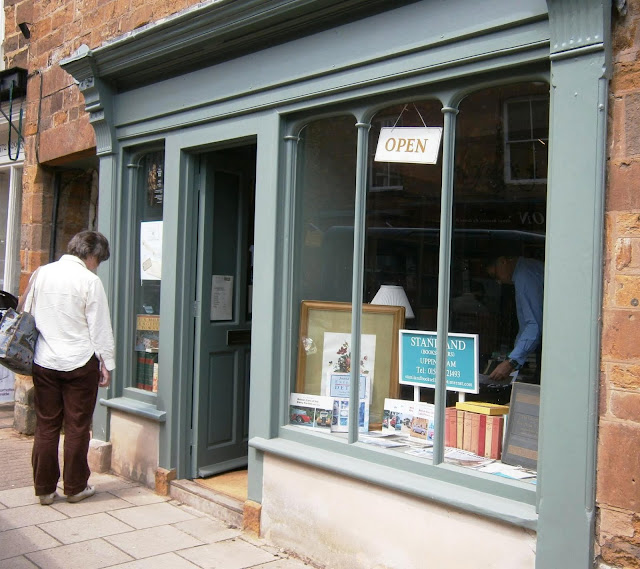
I looked for Staniland Books in High Street East, where it had moved from Stamford in 2011 or thereabouts, only to find the shop empty. The photo below was taken when it was still very much open.
On to High Street West and what used to be Forest Books, a shop that used to go back and back forever. It was the people in the print shop who told me where the other shop in Orange Street used to be.
They also told me of another shop in Uppingham that used to sell second-hand books and records that I can't place, so this post is clearly not a comprehensive list.
And, a few doors down, I wasn't surprised to find that The Rutland Bookshop wasn't trading. Over the years, a fair percentage of my collections of T.H. White and Richard Jefferies came from trips up the narrow staircases to its upper floors.
But let's end on a hopeful note: this sign was in the shop's window.
Perchance it is not dead but sleepeth.
Wednesday, July 19, 2023
Film of York in the 1970s
Gentle footage of the city as it was when I started at the university there in 1978.
I remember in particular two long-vanished bookshops: Godfrey's in Stonegate, which you could get lost in, and Pickering's in The Shambles, with its invaluable tray of pamphlets on obscure chess openings.