Sunday, August 06, 2023

Kathe Green: Primrose Hill

There's an irony to Kathe Green's musical career. Everyone knows her voice, but her first album - Run the Length of Your Wildness - is notoriously hard to find.

You know her voice because her father Johnny Green composed and conducted the score for the film of Lionel Bart's Oliver! It turned out that Mark Lester, their Oliver Twist, couldn't sing a note and had to be dubbed. Kathe, already in her mid-twenties, showed her father she could produce a convincing voice for him and got the job.

And if you do come across a copy of her rare first album, the critics agree it's not that good a listen.

Here's Richie Unterburger on All Music:

Strangely scattershot, if fitfully entertaining LP, Run the Length of Your Wildness can't quite make up its mind whether to be pop-folk, Swinging London pop/rock, or middle of the road pop. 
In that respect, as well as in its Baroque orchestral arrangements (which verge on the fruity at times), it's reminiscent of another late-'60s record, Dana Gillespie's Foolish Seasons - not surprising, as Wayne Bickerton produced both albums. 
You can throw in some similarities to a few other British female vocalists of the time straddling the lines between pop and folk, like Marianne Faithfull and (much more distantly) Judith Durham of the Seekers ...
Green did write or co-write much of the material on Run the Length of Your Wildness, and some of it's above average for this orchestrated British pop-folk-rock genre, particularly 'Primrose Hill' and the slightly Donovan-ish 'Promise of Something New.''
Overall, however, it's a little too mushy, and recommended only to serious fans of this particular niche genre.

But it couldn't be more of its era. The title comes from a poem by Green's friend Richard Harris, and the album sleeve has notes by Peter Sellers, Rex Harrison and Simon Dee.

It's so Sixties, there's a song named for a fashionable part of London. So here's Primrose Hill.

And for proof a boy can sing Where is Love?, try Keith Hamshere from the original London production of Oliver!. He even manages to sound angry about things towards the end.

Saturday, August 05, 2023

Joe Pasquale impaled in freak moose antler incident in Skegness


There are rumours tonight that bookies are already paying out on Headline of the Year, but this effort has at least won BBC News our Headline of the Day Award.

Now read about the death of Harold Davidson, the Vicar of Stiffkey.

Arts Fresco is back on Sunday 10 September


Arts Fresco, the biggest free arts festival in the Midlands, returns to Market Harborough on Sunday 10 September.

You can read about some of the acts who'll be appearing over on the Arts Fresco website.

This is my favourite public event of the year in Harborough. It's suffered a difficult few years because of the Covid pandemic, and last year had to find a new date at short notice because of the death of the Queen. But all looks set for 10 September.

Lib Dems set their sights on retaking Charles Kennedy's seat


Writing in the Herald, Kathleen Nutt says the Liberal Democrats is seeking to take back Charles Kennedy's old seat of Ross, Skye and Lochaber.

Kennedy lost the seat to the SNP's Ian Blackford in 2015 after a bitter local campaign. Blackford has recently announced he will be standing down as an MP at the next election.

Lib Dem ambitions are boosted by the strength of the candidate they have in place, the prominent entrepreneur and local councillor Angus MacDonald:

The businessman opened Fort William’s first cinema in 15 as a gift to his home town and also runs a bookstore while his son, Archie MacDonald jointly runs The Highland Soap Company, which opened a multi-million base in 2020.

Cllr MacDonald was named Scottish and UK Entrepreneur of the year in 2017 and founded The Caledonian Challenge endurance walk, which has raised £13million for local charities. He is also a published author.

And there is plenty for the Lib Dems to campaign on. The SNP's centralising tendencies - Scotland now has a single national police force, for instance - look less benign when viewed from the Highlands than when viewed in Edinburgh:

Scottish Lib Dem leader Alex Cole-Hamilton will be campaigning in Fort William today with Highland councillor Angus MacDonald.

Ahead of the visit to the town Mr Cole-Hamilton accused the SNP of overseeing "a complete dearth of infrastructure spend" and making do with an ageing ferry fleet.

"For years, the SNP have removed autonomy from Highland communities, cut council budgets and singularly failed to stand up for rural issues," Mr Cole-Hamilton said.

"Ian Blackford and the SNP have overseen a complete dearth of infrastructure spend and the north and west Highlands have had to make do with an ageing, creaking ferry fleet while new vessels fall ever further behind schedule and budget. ...

""Angus will protect jobs, create opportunities and secure a better deal for people right across the region.

"He is already campaigning tirelessly on the issues that matter, such as replacing the Belford Hospital, rejuvenating local high streets and improving the A82.

"The residents of Ross, Skye and Lochaber deserve so much better than a centralising SNP and years of nationalist neglect."

After all, it was the Tories who promised to 'Stop the Boats' and not the SNP.

The lost bookshops of Uppingham


I visited Uppingham - Rutland's second city - on Thursday. When I came to file away the photos I had taken, I was surprised to find I was last in the town in December 2016.

Because Uppingham used to be a town of second-hand bookshops, with the result that I went there regularly. On Thursday I found none of them still trading.

The photograph above shows Don Paddy's, a wine bar and coffee house on the Market Place. But I can remember when the first floor of the building was occupied by a bookshop. And if you doubt me, a little exploration of the area will yield this frieze of books, that marks what used to be the rear entrance to the shop.


Goldmark's is still there in Orange Street, but no longer sells books from its extensive premises. These days it concentrates on selling 20th-century British art and is well worth a visit if that's your taste. Mike Goldmark, its owner. has also been a publisher and brought out Iain Sinclair's early novels.

There used to be another bookshop in Orange Street and, after taking local advice, I can say it was in this modern building. I remember fishing a Roger Fulford paperback on Queen Victoria's Wicked Uncles out of the bargain box here once.

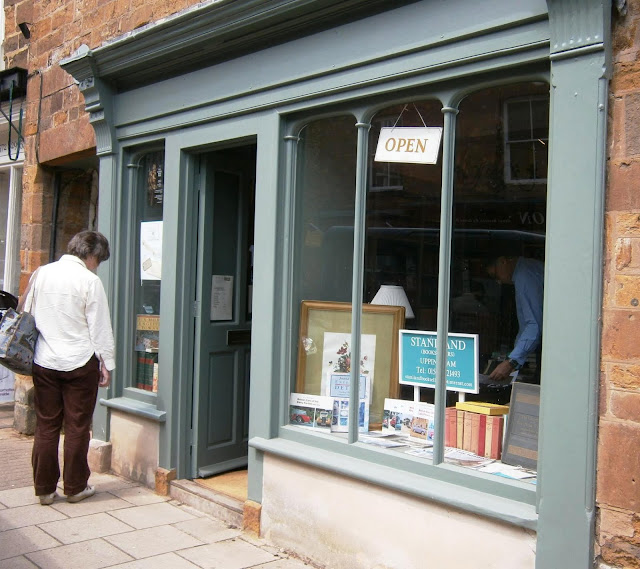
I looked for Staniland Books in High Street East, where it had moved from Stamford in 2011 or thereabouts, only to find the shop empty. The photo below was taken when it was still very much open.

On to High Street West and what used to be Forest Books, a shop that used to go back and back forever. It was the people in the print shop who told me where the other shop in Orange Street used to be.

They also told me of another shop in Uppingham that used to sell second-hand books and records that I can't place, so this post is clearly not a comprehensive list.


And, a few doors down, I wasn't surprised to find that The Rutland Bookshop wasn't trading. Over the years, a fair percentage of my collections of T.H. White and Richard Jefferies came from trips up the narrow staircases to its upper floors.

But let's end on a hopeful note: this sign was in the shop's window.

Perchance it is not dead but sleepeth.

Friday, August 04, 2023

How the Lib Dems' South West London heartland once changed the face of British music

Embed from Getty Images

Richmond, Twickenham and Kingston aren't just a cradle of Liberal Democrat ambitions.They also played an important part in the British popular music of the 1960s.

You can here the story in Raving Upon Thames, the latest edition of The Strange Brew podcast:

Discover how Richmond upon Thames changed the face of rock music. Richmond’s Crawdaddy Club launched the careers of the Rolling Stones and the Yardbirds while at Eel Pie Island, Rod Stewart, David Bowie, Jeff Beck and Jimmy Page found inspiration.

From 1956 to 1971, the riverside suburbs of Richmond, Twickenham, and Kingston were the breeding ground for a music scene that rocked the era. Join us as Andrew Humphreys describes a lost chapter in the story of the Swinging Sixties.

Thursday, August 03, 2023

The Devil went down to Shropshire

Writing in the new Fortean Times, Francis Young notes that the Devil of English folklore

is a considerably less threatening figure than the Devil of theology and often becomes the dupe of saints in folk-hagiographies. While the Devil of folklore is a foil for saints and serves to explain landscape features and prehistoric monuments.

There aren't many saints in Shropshire these days, but Owd Scratch (as the Devil is known in the county) remained a presence there until recently. 

Amy Boucher has collected some tales of his interventions, including one from her own grandfather, who was convinced he had met him one Sunday in Ironbridge when bunking off church to play cards.

Fear of the Devil is said to have killed a boy as recently as 1915, but the for the most part his interventions seem random and rather trivial for him to spend his time on.

When it comes to explaining Shropshire landscape features, it's the outcrop called the Devil's Chair on the ridge of the Stiperstones that gets most attention. Amy Boucher has discussed these legends too, in a Shropshire Star article that includes a 1958 photograph that captured some members of Malcolm Saville's Lone Pine Club.

Talking of the Lone Piners reminds me that in Seven White Gates the Morton twins claimed to have met Owd Scratch in his chair:

"Well - comin' up the mountain, Dickie and me swore a deadly oath that we'd dance in that old Devil's Chair, and we would have done that only his curse must have come upon us..."

"Just as we were scrambling and fighting our way up inch by inch..."

"An' the vultures were screamin' around our heads..."

"An' just as we came to the last and worst bit. then the old Devil said, 'No, you don't, Dickie and Mary..."

"'Just get out o' my throne,' he said."

"And then, before we could do anything else, and I could leap up there and dance like we said we would in our oath, there was an awful crash and blue lightning..."

"Goin' bang, crackle, BANG all around us..."

"Gosh! It was awful, but we were brave, and then the rain came and more lightnings came out of the throne."

It's hard to decide who must have been more frightened: the Devil or the twins.

And if you listen to Amy Boucher's audio drama The Best of Men (part 1 and part 2) you may find that Owd Scratch has not finished with Shropshire yet.

Lib Dems to target more seats at the general election


Anna Gross writes in the Financial Times:

The Liberal Democrat party is stepping up campaigning in more than a dozen seats predominantly in the south of England following recent by-election wins, as it starts to broaden its ambitions ahead of the general election expected next year.

Dave McCobb, the director of field campaigns, presented a paper to members on Tuesday night that identified areas where support for the Lib Dems was growing, giving the party a good chance of pushing out the Conservatives at the next election.

Most of these constituencies are in the party’s former heartland in the south-west of England, including Taunton Deane and West Dorset, as well in Surrey in the south-east and the seat of Stratford-on-Avon in the West Midlands.

As someone who was at the meeting has told the FT, some of these seats were not thought to be winnable even a few months ago. Certainly, the three that Gross mentions here have not been much discussed in the media.

The worry, as ever, is that we will become too ambitious, spread our resources too thinly and suffer a series of narrow defeats. But this optimism seems better founded than that which fuelled the our 2019 campaign, which was based on wishful thinking and some unlikely opinion poll findings.

Wednesday, August 02, 2023

The Joy of Six 1150

"One of the leaders of the German branch of the QAnon movement - a conspiracy founded on the belief that Donald Trump was doing battle with a cabal of Satanic paedophiles led by Hillary Clinton and George Soros, among others - was at first best known as the author of vegan cookbooks." James Ball maps the path that leads from concern for your health to conspiracy theories and then fascism.

Pen Hemingway on the horrors of the prison hulks: "By the turn of the 20th century, it was thought the hulks were a ridiculous concept; degrading, repellent, best sunk in the past. Who'd have thought they'd make a comeback."

"The UK's division of government powers and functions between the centre and local government has for decades been recognised as a major source of our inefficiency.  Germany, where the massive powers  reserved to the Lander have long been one of the reasons for its economic pre-eminence, is seen as the example to follow.  France, despite its Napoleonic inheritance, has followed suit and devolved considerable  powers to its regional governments and town councils." Power in Britain is too centralised, argues Peter Wrigley.

Mindfulness in schools doesn’t improve mental health and the best way to find effective interventions for young people is to work with them, says Willem Kuyken.

Peter Greenaway is interviewed about his career as a film director: "Yes, I had an agent after the success of The Cook, the Thief, His Wife & Her Lover. There were people knocking on my door all the time. And looking back, do you remember a film called Who Framed Roger Rabbit? I was the first director asked to actually film that. Would you believe that?"

Amy Boucher takes us to Shropshire to tell the story of the phantom monk of Linley Hall.

Rumours of government support for British chess

Ellen Milligan reports on Bloomberg:

The British premier this month plans to announce proposals to build interest in the game by expanding instruction in schools and installing 100 chess tables in public parks, people familiar with the matter said. The announcement is due at a ceremony featuring an over-sized set on 10 Downing Street’s lawn, they added.

Sunak will also earmark £500,000 ($640,000) of funding for the English Chess Federation, they said. The grant to help send teams to international tournaments would be the first time the UK government has financially backed its national squads. 

Number 10 declined to comment, but the great British chess advocate Malcolm Pein has tweeted a link to the article, saying:

Thanks to @10DowningStreet and @DCMS for the support and once again to all who have been working on this. International chess, chess in schools and park chess to get government support for the first time. 

So this looks like seriously good news for British chess, which has failed to win funding in the past because Whitehall declines to regard it as a sport, which is what many other countries do.

Despite this, as Ellen Milligan says, we were once a formidable chess power. In the 1980s England's men were second only to the Soviet Union, but are now ranked 13th in the world. I once wrote a post here looking at the reasons for this decline.

The Bloomberg report places this move in the context of Rishi Sunak's wish to improve numeracy, and the idea that playing chess has wider educational and educational benefits was popular a some years ago.

As I wrote on the Guardian website at the time, Armenia even made the game part of the school curriculum for all six year olds. But since, notably by the Education Endowment Foundation, has generally failed to find much evidence of these supposed wider benefits.

So let's cherish chess for what it gives us in itself, not as a means to something else.

Tuesday, August 01, 2023

Walking the dramatic landscape of the River Medway

Last month we saw John Rogers walking the coast from Folkestone to Dover. This time he's in Kent again:

This walk takes us along the River Medway in Kent following the Saxon Shore Way with Professor Kate Spencer from Gillingham to Rainham. 

Starting at Strand Leisure Park we pass Horrid Hill, Bloors Wharf, Eastcourt Woods and Otterham Creek. 

Kate is an expert of estuarine environments and we learn about the specific ecosystem of the Medway estuary and its industrial past. 

John has a Patreon account to support his videos and blogs at The Lost Byway.

GUEST POST Why is the UK failing so badly at infrastructure?

Our obsolete political system and a lack of knowledge and experience in the civil service have made Britain an also-ran in infrastructure investment, argues James Oates.

On the face of it, we are in something of a golden era for investment British infrastructure. The Elizabeth Line (Crossrail) in London, was just opened on 21 May 2023, and at the same time the full-scale construction of the HS2 high speed rail line between London and Birmingham is now underway, with a projected completion date of between 2029 and 2033. The Thames Tideway super sewer is also now on course to be completed by 2025. 

Over the course of the last decade, 400 miles of UK Motorway have been turned into 'smart motorways'. A programme of junction improvements across the country is another significant investment in the national road network. 

Yet, the slightest comparison shows that the UK is in deep trouble. The Infrastructure and Projects Authority, which reviews major projects on behalf of the government now believes that at least one in ten of current major infrastructure projects cannot now be achieved, including HS2.

Much of what is being built is drastically behind schedule. Crossrail was first proposed in 1941, and in the time the UK has built two through lines in London, namely Crossrail and Thameslink, France has built five, all significantly longer. 

As for High-speed rail lines, France has built over 2800 km of such lines, while HS1 is 109km and even if completed, HS2 will only be 225km in length. Much of the British railway infrastructure runs along the equivalent of cobbled streets, which explains our low standing in the Global Economy ranking of the quality of nations' railway infrastructure - and we do little better in their ranking of roads.

More to the point, the French have been able to build these projects for far cheaper as well as far quicker than the UK. The construction of the LGV from Paris to Bordeaux, 302km of new built lines, which was completed in 2017, had a total project cost of €9bn (£7.7bn at current exchange). 

The scheduled project cost of HS2 is already over budget at £44 billion, and this is only for Phase 1, London to Birmingham and Phase 2a, Birmingham to Crewe. There is no current budget to complete phase 2b of the project to Manchester, and the Eastern alignment to Sheffield may be abandoned altogether. 

How come the UK is going to spend well over ten times the amount that France spent on the LGV Sud Ouest and end up with a project that delivers little or even nothing?

Many suggest that there is a question of geography: that South East England is extremely crowded and that land costs are much higher than is France. This is true, but only a small part of the story: the NAO estimates that the cost of purchases for phase one of the project (including c.£900m of compulsory purchases) was a total of around €3bn. 

So, given that the purchases have now largely been completed, the costs are high, but not insane. Nor are the specific geological problems for construction much different in France versus Southern England, so how come the build costs are so massively higher in the UK versus France?

One suggestion as to why UK costs are so high is that contractors are not kept under constant control by the build customer. That each large infrastructure project requires individual delivery authorities, and that there is a churn between these authorities and the contractors. 

This is certainly anecdotally true, but the costs are reviewed by central ministries and ultimately by the National Audit Office. In theory then, any questions of bid irregularities should be at least kept under control, if not eliminated entirely.

In practice, however, things may not be properly reviewed at all. The benchmark for contractors is that bid prices reflect the prevailing market conditions and this generally means therefore that the lowest bids are accepted. The risk of the open bidding process being subverted by insider knowledge is clear, and equally, though hard to prove, it appears to be widespread.

The problem for infrastructure investment, as with so much in the UK government system is that the central civil service no longer has a body of experience and knowledge that allows it to evaluate design and build issues from a position of control.  Delivery authorities are not beholden to the civil service, given that the longer-term career interests for those who serve with them are more likely to be aligned with the private sector, once the project is complete. 

The costs of engaging consultants to provide the necessary expertise is extremely high, and again, interests may not be fully aligned.  In any event the issues with both the delivery authorities and the consultants are too short term to work efficiently for the longer-term issues that large scale infrastructure is likely to involve.

Some would argue that the whole process should be nationalised, and that the IPA takes executive powers or a new body could be created. My own view is that, while such planning could certainly benefit from a more coherent policy approach, the issue is to create a skill set and culture within the UK civil service that can adequately supervise the delivery authorities, and that if there is a clear career path for those involved in the delivery authorities, it should be within the public sector as much as the private.

The UK, for environmental, social, and economic reasons needs to modernise its infrastructure. The combination of the obsolete political system and underinvested, poorly structured and badly motivated civil service is making Britain the also-ran in global infrastructure investment and undermining our whole future. 

We talk a lot about policy. We do not talk enough about administration and delivery, and while this is true in much of the British public sector, it is now critical in the way we build our infrastructure in the coming few years. Civil service training and incentives will be at the heart of the coming debate.

Are we ready?

James Oates blogs at Cicero's Songs and you can follow him on Twitter.

Monday, July 31, 2023

Jim Parker, John Betjeman and A Shropshire Lad

The composer Jim Parker has died - you can read his obituary in the Guardian.

He was a hugely successful composer of music for television, but I remember him for two of quirkier projects. The first, Captain Beaky and his Band, was briefly a cult in the early Eighties and explains why the Gloucestershire fast bowler David Lawrence, after first being nicknamed Syd Lawrence after the bandleader, came to be known as Hissing Syd Lawrence.

More substantially, Parker composed the music to which John Betjeman read his poems on four LPs, beginning with Banaba Blush, between 1974 and 1981. As Jon Wilde wrote in 2013, it was not cool to like these at the time, but they have turned out to have a cult following:

In music circles, Betjeman has his disciples. Morrissey referenced Betjeman's 1937 poem Slough on Everyday Is Like Sunday and chose Child Ill for his 2004 NME compilation Songs to Save Your Life. Nick Cave, Suggs and British Sea Power have all cited Betjeman as an inspiration, whereas dance producer Andrew Weatherall has covered his music. Jarvis Cocker is known to play selections from Banana Blush on his BBC 6 Music show.

This setting of A Shropshire Lad can be found on Banana Blush and I can remember it getting some radio plays in the Seventies.

I was once minded to choose it as a Sunday music video, but allowed myself to become annoyed by Betheman's idea of a Shropshire accent. So I ended up choosing the recording of A Shropshire Lad by John Kirkpatrick, which uses Parker's tune and the correct accent for the part of the county the poet namechecks.

But here is Betjeman himself, reading his poem to that tune.

Court of appeal rules that wild camping is allowed on Dartmoor

Good news from the Guardian:

Wild camping is once again allowed on Dartmoor after the national park won a successful appeal against a ruling in a case brought by a wealthy landowner.

Camping had been assumed to be allowed under the Dartmoor Commons Act since 1985, until a judge ruled otherwise in January. It was the only place in England such an activity was allowed without requiring permission from a landowner.

The case hinged on whether wild camping counted as open-air recreation, leading to a long debate in the court of appeal.

That question gave rise to some top judging by Sir Geoffrey Vos:

He said a walker who lay down for a rest without pitching a tent would be present for the purpose of open-air recreation. It was the same if that walker fell asleep. It made no difference if the walker rested or slept on a plastic sheet to prevent the damp, or in a sleeping bag to protect from the cold, or under a tarpaulin or in an open tent or in a closed tent to protect from the rain. The fact that a tent was closed rather than open could not convert the wild camping from being an open-air recreation to not being one.

Richard Foord, the Liberal Democrat MP for Tiverton and Honiton, was a strong supporter of this appeal by the Dartmoor National Park Authority and the Open Spaces Society.

Still no reopening date for the Bridgnorth Cliff Railway


Bridgnorth's rare inland funicular railway, which has been closed since just before Christmas when problems were found with a wall beside the line, seems no nearer reopening. 

A report in the Shropshire Star earlier this month said:

While one section of the wall has now been repaired, work is yet to start on an second section that needs to be fixed before the attraction can open safely.

Bridgnorth Town Council are awaiting the signature from the operator of the railway to authorise the works.

Owner of the Railway Malvern Tipping said the delay is due to his insurer's solicitor needing the time to review the documents.

He said: "The wall diverts away from the Cliff Railway at an angle and is nowhere near the Cliff Railway property. Yet, it is the issue of signing off paperwork with respect to that section which has caused weeks of delay.

Malvern Tipping also told the Star:

"The legal process is a slow one, which means that we need to allow it to run at its own pace. However, this case becomes ever more frustrating for us, because the longer this case goes on, the more the Cliff Railway will be depleted of reserves, which in turn places the viability of its future under greater stress.

"We are anxious that the works to the Town Council’s retaining wall are now completed expeditiously so that we shall be able to re-open and our staff may then resume their places."

It's worth pointing out again that this railway isn't just a tourist attraction: it also an important amenity for local residents.

And Malvern Tipping had some good news:

"The top station ticket office has been undergoing a complete refurbishment. The ticket booth has been painted green, whereas it was previously brown, but in keeping with its art nouveau heritage.

"I am so pleased that the Cliff Railway’s manager, Karl, has replaced the old strip lighting with something much more suitable for the period.

"He has replaced it with copper piping and electric bulbs which look as though they had come straight out of the late Victorian era.

"They very much resemble what one sees in the carriages at the railway museum at the Mid-Suffolk Light Railway close to where I live. I am sure that this upgrade will appeal to local passengers and tourists alike."

Sunday, July 30, 2023

The Joy of Six 1149

"As a liberal I believe that we should all have equal access to decent facilities which we can use if we choose to. You should be able to walk to the pub or the school of the mosque within easy reach providing roughly the same standards of service whether for need or pleasure. The whole point of neighbourhoods is about enabling and not enforcing." Richard Kemp says we must destroy the '15-minute city' myths.

Josh Self decodes the Nigel Farage playbook: "He rails against 'the elite', ever-evoked but rarely defined by the privately-educated former stockbroker who spent 25 years working as an MEP. And he displays real skill in galvanising and directing sections of the British public at his unfortunate foes."

Anna Funder discovers that George Orwell's first wife Eileen has been written out of his life, not least by Orwell himself.

"Birmingham’s Trocadero was once the meeting place of the city’s Surrealists: Conroy Maddox, Emmy Bridgwater, brothers John and Robert Melville, Oscar Mellor and Desmond Morris. Between 1935 and the 1950s, these artists brought the strangest of all modern art movements to the Second City." Ruth Millington traces Birmingham's sites of Surrealism.

Joni Mitchell's surprise appearance at the 2022 Newport Folk Festival, 53 years after she first played there, marks another twist in her chameleonic career, says Annie Zaleski.

Jane Chelliah has been to see Barbie.

The Tymes: Ms Grace

I tweeted this week:

The 1975 is an odd name to choose for your band. The charts were rubbish that year - full of novelty records. Glam was dead and punk was still slouching towards Soho to be born.

There were those who defended some of the year's number ones, and others who rightly pointed out what a great year it was for LPs. But I was a poor boy from the back streets of Market Harborough and had to rely on Radio One and Radio Luxemburg for my music.

Still, I thought I would look at the charts for 1975 and choose a single from the charts to post today. And this is what I came up with.

The Tymes were a black American vocal group who enjoyed success on both sides of the Atlantic. Ms Grace, which reached number one in January 1975.

They had been founded as long ago as 1956 and first charted in the UK in 1963. But then a lot of the Black vocal groups of the Sixties and Seventies look rather mature to modern eyes. 

Maybe that's why their music leant towards the sad and the wise, though Ms Grace is joyous.

Back to my tweet on 1975. The best reply was from @bigboyted:
Or as that not so well known NME journo Gramsci put it 😉

"The old world is dying, and the new world struggles to be born: now is the time of monsters."

Saturday, July 29, 2023

Stuart Broad announces his retirement from test cricket

At close of play at The Oval today, Stuart Broad announced his retirement from test cricket. He's not out overnight and has one more innings to bowl in, but his test figures currently stand at 3656 runs and 602 wickets.

You can see his finest hour above. He always was a bowler who, if he took one wicket, was likely to get two or three more in short order.

At one time he looked likely to develop into a genuine test all rounder, but he rather lost his confidence after being struck in the face. As bowler or batsman, he was always entertaining.

He was first mentioned on this blog in 2007, when he was still playing for Leicestershire. I described him then as Stuart "Should have been picked for the Ashes" Broad, referring to the 2006/7 tour of Australia.

Fortunately, he was picked for the Ashes after that. Remarkably, the last home test against Australia that he didn't play in was the final test of 2005, when Kevin Pietersen's innings secured a draw and the Ashes. He is one of the immortals.

Bobby Henrey, his parents and wartime London


The Soho Bites podcast bills itself as 'a show about movies set in Soho, the beating heart of bohemian, cosmopolitan London". But its latest episode is about a film that isn't set in Soho but had its genesis there: Carol Reed's The Fallen Idol.

I've written before about this film, which contains one of the great child performances. The actor, Bobby Henrey, now a retired accountant and hospital chaplain, spoke about the experience of making the film in a video I posted on here a few years ago.

But the podcast talks first about his life before the film, and touches on some fascinating social history. As a child in London he lived in a flat in Mayfair, not because his parents were rich but because they were short of money. The rich had fled central London because of the Blitz, so the rents for such properties had collapsed. 

And he talks about the books his parents published on London life under the shared pseudonym 'Mrs Robert Henrey'. It was seeing Bobby's photo on the jacket of his parents' A Village in Piccadilly that led the people making The Fallen Idol to offer him an audition.

Roger Greaves, Soho Bites tells us, is writing a study of the Mrs Robert Henrey books. By the sound of them, they contain a lot of interesting social history. I did once quote one of them about London just after the war:

There is, perhaps, no better example than Chesham Mews of the way the well-to-do, unable any longer to keep establishments worthy of their station, have descended upon the accommodation which their forebears allotted to the groom and to the coachman. 

The clerks and typists of the Ministry of Education filled the noble rooms of the former aristocratic mansions in the Square, while the aristocrats slept in hay-lofts over their cars for which, in another month, they would no longer be given any basic allowance of petrol.

And for this podcast, Bobby Henrey - except he has always been Robert Henrey as an adult - was interviewed on his eighty-fourth birthday about something he did when he was eight. Child stardom is a strange phenomenon.

Friday, July 28, 2023

Bank closes the account of Gina Miller's political party

Embed from Getty Images

From BBC News:

Anti-Brexit campaigner Gina Miller was told a bank account for her political party would close without explanation.

Monzo initially refused to tell Ms Miller why her "True and Fair" party account would be closed in September.

After the BBC contacted the bank about the case, it said it did not allow political party accounts and had made a mistake in allowing it to be opened.

To which I can only reply: I told you so. How the people who've spent the last fortnight telling us that banks must be allowed to act precisely as they choose will react to this, I don't know.

Debanking is a huge problem for those affected - as the first article in my latest Joy of Six shows - and I can see it becoming a political weapon if the government does not act.

You young people won't remember it, but when we lived among the ruins of the Liberal Democrats' performance in the 2015 general election, there were those who wanted Gina Miller to be our next leader, even though she wasn't an MP (or a Lib Dem, come to that).

There's nothing as odd as the recent past.

Thursday, July 27, 2023

Working narrow boats on the Black Country canals in 1965

The Sixties were the decade when commercial traffic more or less died out on England's canals. And this precious footage of the Birmingham Canal Navigations in 1965 reveals that the boats and the infrastructure were both in a pretty shabby state by then.

There are more films on this blog's Canals label.

The Joy of Six 1148

Amy Taylor reminds us that banks have been denying people accounts for years: "For my client, there was no accusation of fraud, no prosecution, and no knowledge of any fraud, just a registered possibility of risk, which left her without banking facilities at an extremely vulnerable point in her life. No amount of pleading or explaining her situation worked. The banks turned her away."

Sarah Dyke the 35th woman elected to Westminster under the Liberal or Liberal Democrat banner. Stephen Williams lists them all, and adds the women who have been elected to national parliaments and the European Parliament.

Danny Finkelstein on the rise of RFK Jr: "His presidential campaign is highly unlikely to be successful, and he won’t be the Democratic nominee, but he is doing better than many thought he would, because conspiracy theorists can be found on the left as well as the right. And everywhere they are found, they are a danger to Jews."
 
"For reasons that have never been clear to me, my mother’s money ran out after one year and, at age 4½, I set off on my own. I headed south, sometimes living in the streets, sometimes joining gangs of other homeless children, sometimes living in orphanages, and most of the time being hungry. My recollections of those four years are vivid but not continuous, rather like a series of snapshots. Some of them are brutal beyond description, others more palatable." Mario Capecchi, a Nobel Prize winner in the physiology of medicine, recalls his extraordinary wartime childhood.

Ian Mansfield shows that Belsize Park was home to many important figures in the Modernist movement in British art.

"Jonson’s statement concerning Shakespeare’s alleged ignorance of Greek and Latin might be the single most misunderstood and misinterpreted line of English poetry ever written: it means the opposite of what most people think it means." Tom Moran argues that William Shakespeare knew Classsical languages far better than we imagine. 

Wednesday, July 26, 2023

When a young David Bowie played a venue opposite the derelict Leicester Belgrave Road station


One of my favourite Twitter threads is one from The Chisit on gigs at unlikely venues in and around Leicester.

It reveals, for instance, that Joni Mitchell and Paul Simon both played Ye Old White Swan, a vanished pub that used to occupy a corner of the Market Place.

But it is the thought of David Bowie playing an obscure venue in Leicester as early as 1966 that really intrigues me, though not just for musical reasons.

The venue was The Latin Quarter in Belgrave Road and The Bowie Bible says Dave Bowie and the Buzz played there on Friday 12 August 1966. 

A few weeks ago I went to photograph it, and you can see my photo above.

Bowie played with The Buzz in 1966 and 1967. His first band, The Lower Third, had split with him because of a dispute with the management over pay. During their time together, The Buzz played on Bowie's fourth single You're Holding Me Down, which is a record that has not found its way on to YouTube.

The opening of The Latin Quarter was announced in a feature that took up the best part of a page of the Leicester Daily Mercury on Friday 27 May 1966, which announced:

New Teenage Night Spot

Opening Tomorrow

The Latest in Coffee Clubs and Restaurants 

A special all night live music session opens the Latin Quarter on Saturday night with local groups playing from 8 pm through till 6 am Entrance is in Belgrave Road by the lights junction with Abbey Park Road The tunnel of wicker hurdles through which grow ferns and down the stairs under the baleful watch of Pagan masks 

Not only is this to be a restaurant by day but will provide the ultimate in the city as a dusk-’til-dawn coffee club complete with most up-to-date Rock-ola Grand Prix Juke Box with stereophonic sound Meals will be served on occasional tables and diners on Design Centre chairs of a brilliant 'flame' colour.

The feature also promised:

Continuous Music by Local Groups

Every evening at eight ... that is the motto of the Latin Quarter for your entertainment entertainment that we know you will like all the best in the local groups provided by PS Promotions.

And to be fair to PS Promotions, among the bands announced for the venue's first week are The Farinas, who were soon to become Family, Leicester best band of the era.

The Latin Quarter was clearly meant to be a big deal - the feature has notices from its suppliers wishing well. I was intrigued to see that all the internal design work was by Derrick Knightley Associates of Leicester, because Derrick Knightley was an Independent member of Harborough District Council when I was a councillor.

All of which makes it rather sad that I can find no reference to The Latin Quarter after 1966. Among the non-Leicester bands who did play it that year were Bluesology, whose young keyboard player was Reg Dwight. He was to make a stage name from those of two other musicians who were members of the band: Elton Dean and Long John Baldry.


What interested me as much as The Latin Quarter is what was on the other side of Belgrave Road.
It doesn't look much today, but in 1966 this store and car park were the site of Leicester Belgrave Road station, the Great Northern Railway's old terminus in the city.

It had closed to passengers - by then it was mainly used for holiday trains to the Lincolnshire coast - in 1962, but the last railway buildings on the site were not demolished until 1985. The photo before shows the station many decades before that

So I like to think that David Bowie popped out for a fag and discovered the old station as a haunt of pigeons with its masonry stained green by leaking gutters and plants forcing their way from every crack and cranny they could find.

If I had a time machine, I might well set it for the evening of 12 August 1966.

Investigation into how warehouse worker became trapped under hundreds of blocks of cheese is drawing to a close


Once again, the Shropshire Star wins our Headline of the Day Award.

I'm pleased to say the trapped worker walked away unscathed. So I can end with a joke...

"I had a terrible weekend. I went to a wedding, and we were all having our photos taken afterwards when a lorry drove past the church. A huge cheese fell of it, rolled into the churchyard and crushed the photographer.

"We all tried to warn him."

Tuesday, July 25, 2023

John Russell's maiden speech in the Lords

Embed from Getty Images

John Russell after making his maiden speech yesterday (Are you sure about this? Ed.)


As Mark Valladares says on Lib Dem Voice, until yesterday, it was a long time since there had been a maiden speech by a Liberal Democrat peer.

That changed thanks to John Russell, the younger son of Conrad Russell, who now holds the title Earl Russell and recently won one of those odd by-elections for hereditary peers they hold in the upper house.

Here are a few highlights from his speech:

"Thank you for the kind words I have received about my father, Conrad. I know he is still remembered, particularly for his unique historical and constitutional knowledge. If I might share with your Lordships: one of his proudest moments was when, during one very late-night sitting, he out-quoted the Bishops one by one with the Bible."

"I am passionate about the environment. My commitment and care come from my personal experience of adventure, long-distance walking and a love of wild places. Climate change is happening now. It is real and it is truly frightening. No longer the stuff of dystopian films, it is our present reality."

"The questions of what to do and how we fight for our common survival must be addressed and solutions found and implemented with utmost urgency. We have to adapt our ways of life, our cities, our transport systems, simply for our society to continue to function and survive. We must have hope and inspire confidence that change is possible."

"Big companies and businesses must adapt: they will be part of the solutions we need for a functioning society. The biggest polluters must be held accountable. We must give nature and the ecosystem an economic value and assign it worth. We need a new economics and a global green economy." 

You can read the whole speech on They Work for You.

Claire Young chosen to fight Thornbury and Yate for the Lib Dems


Claire Young, the Liberal Democrat leader of South Gloucestershire Council, has been chosen to fight Thornbury and Yate for the party at the next general election, reports the Gazette. 

Thornbury and Yate covers much the same area as the old Northavon constituency, which Steve Webb held for the party between 1997 and 2010.

Claire, a Cambridge mathematics graduate who has worked in the software industry, told the Gazette:

“I am delighted to have the opportunity to stand at the next election and win this seat for the Liberal Democrats.

"I know local people are really fed up with this government’s mishandling of the economy and the NHS and want a change.

"Only the Liberal Democrats can beat the Conservatives here. 

"Living locally and running the council I know just what is needed in the area - it’s time for an MP who speaks up and delivers.”

Lord Bonkers' Diary: Sarah Dyke is battling the forces of darkness

Marcus Trescothick retired in 2019 after a remarkable 25-year career with Somerset and England. But when I first mentioned the Well-Behaved Orphans' summer holiday in the pages of Liberator, he was a 14-year-old playing alongside his father for the Keynsham club in Bristol. In those days the WBOs went to a different Cornish resort: Trebilcock Bay.

A prize (in a very real sense) for the first Liberal England reader to tell me where that name came from.

Anyway, this entry brings us to the end of another week with Lord Bonkers. I see the old boy was right about Somerton and Frome.

Monday

Soon it will be high summer and time to take the Well-Behaved Orphans on their annual holiday at Trescothick Bay in Cornwall, but before I see to that happy duty I have another to fulfil: a whistle-stop tour of current by-elections.  First Selby, where a contest has been called following the resignation of one Nigel Adams – I know no more about him than you do. Then it will be off to Uxbridge, where I am told the locals are still celebrating the departure of Boris Johnson, before I call in at Somerton and Frome. Here our own Sarah Dyke is battling the forces of darkness. With a little strategic advice and practical help from you diarist, I fully expect her to triumph.

Finally, I shall hang my hat in Mid Bedfordshire, where a by-election has long been promised but has yet to materialise because the aforementioned Dorries refuses to make good her solemn oath to resign. If she does finally cop for the Chiltern Hundreds, then whichever Conservative is selected will face the unhappy task of defending their party’s widely disliked, at least in Bedfordshire, ‘Do Your Number Twos in the Great Ouse’ campaign.

Lord Bonkers was Liberal MP for Rutland South West, 1906-10.

Earlier this week...

Monday, July 24, 2023

Book Review... Ma'am Darling: 99 Glimpses of Princess Margaret by Craig Brown

Playing herself at the Borsetshire Fashion Show on The Archers in 1984, she sounded curiously flat and uninvolved, almost as though she couldn’t get to grips with her own character. After the first run-through, the producer, William Smethurst said: “That’s very good, Ma’am, but do you think you could sound as if you were enjoying yourself a little more?”

“Well, I wouldn’t be, would I?” replied the princess.

Craig Brown noticed Princess Margaret's ubiquity when researching an earlier book of his. Open the biography of any public figure from the second half of the 20th century and she will be there in the index. Usually you will be directed to an anecdote about her where she appears haughty or rude.

Brown has turned these brief appearances into a study of Margaret. The tale is familiar: the failure to marry Group Captain Peter Townsend, the marriage to Lord Snowdon, the years of fun and scandal on Mustique, the decline in her health from too much tobacco  and alcohol, the death a few weeks before that of her mother.

Yet I learnt plenty that was new from Ma'am Darling. Margaret's wish to marry the war hero Townsend alarmed the royal family and court because he was divorced from his first wife. She was persuaded to abandon the idea and him by pressure that went all the way up to threatening to cut her off without a penny. Today's public would be more concerned that Townsend was 16 years older than Margaret, who had been only 13 when they met. After parting from Margaret, he went on to wed an even younger woman.

The happiest time in Margaret's life seems to have been the early years of her marriage to Lord Snowdon, when they were London's most fashionable couple - this was a few years before it began to Swing - and moved in glittering social and artistic circles, But their relationship soon soured, and Snowdon treated her with calculated cruelty.

Later she sought solace in the millionaire's paradise of Mustique with the amusing (Roddy Llewelyn) and the criminal (John Bindon). Then her health began to decline and she was seen about no more. She died in 2002, aged 71.

It was not a happy life, and reading about it strengthened my belief that a strong argument against having a monarchy is the impossible lives members of the Royal Family are forced to live.

Ma'am Darling has no index - I took the story about Margaret's appearance on The Archers, which is in the book, from a Guardian article - but I think I'm right in saying that the book omits the one wholly creditable story I have heard about Margaret.

This time I am quoting BBC News on Joan Littlewood's play Oh! What a Lovely War:

Littlewood gave the show a new political bite, as befitted a nation growing tired of deference. The family of Field Marshal Douglas Haig wanted to stop the show reaching the West End, claiming the portrayal of him was a crude caricature.

But [Victor] Spinetti recalls a useful royal visit when the play was still in Stratford. "One evening Princess Margaret came with Lord Cobbold, who as Lord Chamberlain was also the theatre censor.

"Afterwards Princess Margaret came backstage and said 'Well Miss Littlewood those things should have been said many years ago - don't you agree, Lord Cobbold?' He gave a thin smile and said 'Oh yes ma'am'. And Joan knew that was our permission to go into the West End."

Lord Bonkers' Diary: Lynched during the lunch interval

I am pleased to see such a clear condemnation of what happened at Lord's. As to the widely publicised reason for the closure of the Bonkers Hall Safari Park, Lord Bonkers has suggested on more than one occasion that "those nuns were the authors of their own misfortune".

Sunday

To St Asquith’s for Divine Service, with the happy consequence that I am not at Lord’s to witness the appalling scenes in the Long Room. Reports are still coming in, but it seems the Australians’ physiotherapist and reserve wicket keeper were lynched during the lunch interval. By all means let us play our cricket hard, but this was Going A Bit Far. 

Lord’s should not be allowed to host another test until the MCC has proved it can control its members. If an alternative ground has to be found, then we need look no further than my own here at the Hall. I will even undertake to have the grounds thoroughly searched for big cats – ever since the sudden closure of my safari park there has been a tendency for boundary fielders to disappear when the bowling is from the Pavilion End.

Lord Bonkers was Liberal MP for Rutland South West, 1906-10.

Earlier this week...

Sunday, July 23, 2023

The Joy of Six 1147

"This mess was, of course, both predictable and predicted. That’s why I’ve been struck, visiting the UK this summer, by the curious political taboo against discussing how badly Brexit has gone, even among many who voted against it." Michelle Goldberg has found that no one in the UK wants to talk about the disaster of Brexit.

Neil Schofield-Hughes warns Wales to be beware of Keir Starmer's attack on devolution in London over ULEZ.

Mark Lilla says we need a post-identity liberalism: "By the time ... [students] reach college many assume that diversity discourse exhausts political discourse, and have shockingly little to say about such perennial questions as class, war, the economy and the common good."

I have long been more interested in Karl Popper theory of knowledge than his philosophy of science.  Steven K. Graham looks at its implications for the education of younger children.

Andy Boddington is pleased that Ludlow is not too posh for Rag’n’Bone man: "A few complaints from people that live a mile from the castle. The topography of Ludlow means that sound travels to unexpected places. Expected places too. There were good crowds on Whitcliffe Common which could perhaps remarket itself as the Ludlow Amphitheatre."

This weekend's weather in Manchester has been no laughing matter, though John Arlott used to claim it's the only city where they have lifeboat drill on the buses. The Mill looks into the fairness of its reputation for rain.

Black Box Recorder: The English Motorway System

Consisting of Sarah Nixey, Luke Haines (of The Auteurs), and John Moore (formerly of The Jesus and Mary Chain), Black Box Recorder were an indie band who flourished around the turn of the century. The English Motorway System is a track from their 2000 album The Facts of Life. 

Jude Rogers tells us what's going on here:

Another Ballardian beauty from the band, taking Kraftwerk’s love of the autobahn and capturing its peculiar hypnotic qualities as we find them on home turf. 

A song about a couple about to break up, it also perhaps the band’s most tender and least blackly comic track, ignited by atmospheric ahhs and their most lovely chorus yet. "It’s going to be there forever", Nixey says, mythologising the tarmac, "it’s never going away".

But I dream of motorways lying derelict with thistles forcing their way up though the concrete. Meanwhile, enthusiasts give up their weekends to keep short stretches the way they used to be.

Lord Bonkers' Diary: Sporting on its shore in animal skins

Back in 2004, before Tony Blair had won his third election, I blogged:

Conrad Russell died last week, an irreplaceable loss to the Liberal Democrats and to Liberalism in general. There were worthy obituaries in the Daily Telegraph and the Guardian. I remember his saying once, rather overgenerously, that I did for the party what Matthew Parris does for the country. 

I also remember his asking me, as his wife had always wondered, why Lord Bonkers talked about Earl Russell and his Big Band. I explained that as there were band leaders called Count Basie and Duke Ellington... When I was studying philosophy as an undergraduate, I never dreamed that I would have this conversation with Bertrand Russell's son.

And if you read the whole post you will find that there really was an Earl Russell, Big Band, or at least an Earl Russell Orchestra.

Saturday

How splendid to have a Russell on the Liberal Democrat benches in the Lords again! Earl Russell won the by-election among hereditary peers, casually giving a member of the Lloyd George clan one up the snoot in the process. 

My only worry is that he has mentioned more than once his dream of getting his father’s big band back together and asked if I know what became of them. 

It happens that I gave them sanctuary on an island in Rutland Water after Conrad’s death. From time to time I see them sporting on its shore in animal skins and playing upon rude instruments, and I know Meadowcroft rows out for the occasional jam session, but few others know of their presence. 

Will they thank me if I shatter their idyll? Can I continue to change the subject when my newest colleague broaches the matter?

Lord Bonkers was Liberal MP for Rutland South West, 1906-10.

Earlier this week...

Saturday, July 22, 2023

Want to win public support for green policies? Learn to present them more clearly

Embed from Getty Images

I was still playing chess in the county league in the 1990s. Many of the matches took place in school classrooms in the evenings, and if I was on top in my game, I would copy my hero Garry Kasparov and prowl the room while I waited for my opponent's next move.*

This gave me the chance to read the children's work that had been pinned up on the walls. It was often about the environment, and it usually revealed that the issues of greenhouse gases that cause global warming and chemicals that damage the ozone layer were tangled together in the children's minds.

As their teachers thought this work worthy of being honoured, I assumed that the issues were entangled in their minds too.**

I thought of those days when I read this in a report on the Guardian website this morning:

Tom Burke, the co-founder of the green thinktank E3G, predicted that those within Labour who are antagonistic to green measures will seize this moment. He said: "There will be pressure inside Labour – some people will take fright from this.” Some trade unions have deep reservations about the transition to a low-carbon economy, and some in the party are fearful over Tory attacks on climate policies.

But Burke warned that Starmer should not listen to these concerns. He said: "They should be very careful in generalising from this to climate policy more generally. What Starmer should do is not attack his own side, but communicate far more effectively what the consequences will be of climate policy failure. That’s what’s missing from this debate."

Because ULEZ isn't about climate change: it's about reducing air pollution London and so reducing its serious effect on health - children's respiratory health in particular.

If Labour*** had presented ULEZ to voters as a health measure it might well have won more support, because threats to your children's health are urgent. But most voters probably assumed the measure was something to do with climate change, which seems a more distant threat.****

So campaigners need to do what those children and their teachers didn't do: untangle these issues so they are better understood by the public.

* In his Chess for Tigers, Simon Webb advises you to keep an eye on an opponent who is having a long think while you prowl. If they start shifting in their seat as if they are about to move, you should, he says, go back to the board and make a show of thinking hard about the position. This will make them think even longer about their move and increase the chances they will lose the game on time. I tried this several times and it works.

** In case you see this as political indoctrination, the idea that children should be interested in nature and care about it was central to 20th-century children's literature. And no one would call Enid Blyton woke.

*** Yes, I know it's a policy of the Conservative government.

**** The psychologist David Smail used to talk about 'proximal' and 'distal' threats. I think this is useful jargon.