From the 1971 BBC adaptation of Tom Brown's Schooldays - Richard Morant as Flashman, Anthony Murphy as Tom Brown.
Thursday, November 19, 2020

The first Boris at 10 Downing Street

The 'Dear Bill' letters were a regular feature in Private Eye throughout Margaret Thatcher's years as prime minister.
Purporting to be the private correspondence of her husband Denis, they gave an inside view of life at 10 Downing Street.
The Bill of the letters was generally taken to be William Deedes, the editor of the Daily Telegraph and former Conservative minister.
If Denis wanted to know what was going on he would seek out the mysterious Boris. He was generally to be found in the cupboard under the stairs talking to Moscow on the radio.
Over a snifter of his mother's plum brandy, Boris would fill him in on the events of the day.
Now we have another Boris at number 10 and today the son of a KGB officer took up the peerage that this Boris has awarded him.
Lord Bonkers' Diary: Tinkering with a cafetiere

Thursday
I surprised my closest inner circle with a trip to a private island where we could pretend things were normal just for a brief moment in time. The island, of course, was one of an archipelago in Rutland Water that I happen to own, but now I back at the Hall and working on my latest invention.
Do you remember the 'Teasmade'? This was a contraption sold with the promise that if you set it up by your bedside it would wake you at the appointed hour next morning with a piping hot cup of tea. Well I tried one once but found it in every way less efficient than a valet.
Nevertheless, it has given me an idea and I spend the day in my workshop tinkering with a cafetiere and the engine from an old steam-driven Shuttleworth press. The result is that I now have a working prototype of my new Morning Coffee Maker.
Lord Bonkers was Liberal MP for Rutland South West, 1906-10.
Wednesday, November 18, 2020
What's really going on in the Liberal Democrats?

If you want to know, download the new Liberator free of charge from the magazine's website.
Alongside the usual selection of articles, you will find the indispensable Radical Bulletin section.
Stories this time include:
- A row over the policy motion on a federal UK passed at conference
- The future of conference after the success of our September virtual event
- What's going on in Witney?
And tomorrow we begin another visit to Bonkers Hall.
A psychiatrist on the manufacture of ADHD
The website Mad In America is serialising the British psychiatrist Sami Timimi’s book 'Insane medicine: How the mental health industry creates damaging treatment traps and how you can escape them'.
So far the first three chapters have appeared. Part 1 of chapter 3 deals with what Timimi calls the 'manufacture' of ADHD (attention-deficit/hyperactivity disorder):
After 1957, the number of medical articles about children with the “symptoms” of ADHD, escalated exponentially in the United States, and later in other countries. In the previous half century, medical literature, particularly that influenced by psychoanalytic ideas, was more concerned with withdrawn, shy, “neurotic” children. The late fifties, then, marked a turning point as interest transferred more to children who exhibited delinquent, violent, and other antisocial behaviours.What was behind this shift? According to Matthew Smith, it may have been related to fear, following the Soviet launching of the Sputnik satellites in the autumn of 1957, that the US was falling behind the USSR in the race for scientific, technological, and military superiority. There was concern that if changes were not made to the American school system to redress the situation, they might lose the Cold War altogether. This caused a change in classroom structure, teaching methods, and expectations with regard pupil performance.I am not entirely convinced by this, and think that such events intersected with other changes taking place in the culture of the time, including (but not limited to) the growth of and fear of adolescent culture, changes in family structure and community rootedness, growing size of an aspirational middle class, and greater concern about children both as perpetrators and victims.The more important point here is recognising that ADHD emerges and gets popularised because there are cultural, not scientific, reasons for it becoming a sellable brand.
Market Harborough locomotive shed photographed in 1959

I blogged the other day about how the water for Market Harborough locomotive shed came from the canal.
That post had photos of the sluice at the top of Logan Street where it was drawn off and the pipe that carried it across the Welland.
I've now foundone of where it came out.
It was taken on 30 October 1959 and shows a locomotive beside the shed's water column.
The caption on Geograph runs:
'Vulcan' - the final 'Austerity' 2-8-0 - at Market Harborough. View eastwards, north of Market Harborough station: ex-Midland Main line, London St Pancras to the North, junction with the ex-LNW Rugby - Peterborough line. No 90732 'Vulcan' was built in 5/45 as No. 79312, shipped to France after VE-Day and was stored at Calais, but it worked on the SNCF until shipped back to England in 1947, to be loaned to the LNER at March in 11/47; it stayed on the ER after Nationalisation (as No. 90732) and was withdrawn in 9/62.
Tuesday, November 17, 2020
The United Kingdom must break up for England's sake

In 2019, Boris Johnson became prime minister of the United Kingdom of Great Britain and Northern Ireland. In 2020, he shrank into being prime minister of England. For the second time in less than seven years, the union is in trouble.
But this time the problem needs a new question. Forget: "Should Scotland be independent?" The Scots will take care of that. Ask instead: "Who in the rest of Britain needs this union with Scotland? And why?"
Neal Ascherson has another thoughtful piece in the London Review of Books - and to put it mildly, the prime minister has done nothing in the past two days to suggest his introduction is wrong.
The conclusion he comes to is a novel one: the United Kingdom must come to an end, not just for Scotland's sake, but also for England's:
In Scotland’s 2014 referendum campaign, one apparently humble word became the deadliest weapon. The word was "normal". Again and again, at pro-independence gatherings, I heard people say: "I just want my kids to grow up in a normal wee nation, like other countries." By this they meant a country which took its own decisions for better or worse, which could feel that its future was in its own hands. But they also meant that the UK was "abnormal". ...
At the core of the abnormality was England’s difficulty in accepting its Englishness. Not all Britishness is a deceit ... but in politics the moth-eaten remnants of imperial Britishness form a blindfold against the 21st-century world.
Britain is an imaginary realm, floating in a category above mere nation states; England is a European country like its neighbours.
Britain is exceptional and must express itself in superlatives ("world-beating", ‘"global leader", "most efficient on the planet"); England is a medium-sized country with first-rate scientists and rotten management.
Britain dreams of becoming a heavily armed, swaggering pirate power, defying international rules; England is a minor, sceptical nation with a taste for satire and democracy.
Commons justice committee calls for review of age of criminal responsibility in England and Wales
The Commons Justice Committee has called on the government to review the age of criminal responsibility in England and Wales.
In its report Children and Young People in Custody (Part 1): Entry into the youth justice system, published last week, the committee says:
The age of criminal responsibility in England and Wales is a contentious issue with substantial arguments in favour both of the status quo age of 10 and an increase in that age. We are not persuaded that it should be immediately increased, but given the arguments in favour of raising it and the fact that the age in England and Wales is lower than in broadly comparable countries, we consider there is a case for reviewing the age of criminal responsibility.
We recommend that the Ministry review the age of criminal responsibility, considering the data available from Scotland and from broadly comparable European and other jurisdictions in which the age is higher than 10 at which it stands in England and Wales.
We recommend that the Ministry report on the implications of raising the age in England and Wales to 12 and to 14, including the likely effect on reducing the number of children in custody and alternative methods of disposing of children beneath those ages who have committed serious offences.
We recommend that if it concludes that 10 should remain the age of criminal responsibility, the Ministry set out the evidence and reasoning to justify an approach the Minister of State recognises as one that differs from the average.
As the Guardian says, the committee also draws attention to the fact that a disproportionate number of children in custody are from a minority ethnic background.
Our low age of criminal responsibility, and in particular the practice of trying children facing serious charges in adult courts, was dramatised in the BBC2 play Responsible Child, shown just before Christmas last year.
Both Responsible Child and its young lead Billy Barratt have been shortlisted for International Emmys. In the video above one of its producers, Karen Wilson, talks about the making of the play.
Monday, November 16, 2020
Along the Thames from Purfleet to Grays
Purfleet, famous as the site of Carfax Abbey in Bram Stoker’s Dracula. Standing on that windswept shore beneath the twisted steampunk towers of the Proctor and Gamble factory, I imagined the unfortunate Jonathan Harker battered by the same damp Thames Estuary gales before his ill fated trip to Transylvannia. Carfax Abbey may have been Bram Stoker’s creation but the P&G Factory is equally worthy of a work of dystopian fiction.
John Rogers is our guide for a walk through an extraordinary landscape. He has a Patreon account to support his videos.
Six of the Best 976

"With little support and no counselling, the survivors nonetheless took up the threads of their lives and wove a new existence. News of Sutcliffe’s capture and his conviction came as an overwhelming relief, but the damage done to the women’s reputations as a result of institutional sexism brought agonies of their own." Carol Ann Lee looks at what happened to the women who survive attacks by Peter Sutcliffe.
David Hencke looks at the Independent Inquiry on Child Sexual Abuse's report on the Roman Catholic Church: "It suggests that while the Church may have put in structures to deal with the issue there was no real compassionate commitment from the top of the Church to act."
The 2020 US election has turned a divided nation into a place of protests, violence and fury, says Ian Birrell.
"She is almost unrecognisable in the lead role, swapping her usual sexually alluring look for plain prison clothes and unwashed hair. Her performance is a tour de force, the highlight of her fascinating acting career." Anna Cale reviews a Blu-ray release of the 1956 film Yield to the Night - Diana Dors's finest hour.
Was Louie, Louie the dirtiest song of the Sixties? Anwen Crawford investigates.
Man claims he moved to rural Rutland because electricity makes him ill

Our Headline of the Day Award goes to the Leicester Mercury.
I hope the gentleman in question did not found himself living next to one of Lord Bonkers industrial plants.
Sunday, November 15, 2020
The demolition of Northampton Castle in the 1870s
The ruins of Northampton Castle were cleared in the 19th century to make room for Northampton Castle railway station, which is still open today and just called Northampton.
So I blogged a couple of years ago, and to prove it here is a photo of that clearance taking place.
Don't be too harsh on the Victorians: for better or worse, many of the views we hold today will seem very odd to people 150 years from now.
Ed Davey virtually going to Ludlow

The Liberal Democrat Leader Ed Davey will be addressing the AGM of the Ludlow local party on Friday.
Ruth Houghton, the Lib Dem councillor for Bishop’s Castle, told the Shropshire Star
"This is the first time that the Liberal Democrat Leader has addressed the Ludlow Lib Dem AGM and we are delighted to welcome him, albeit virtually, to south Shropshire.
"Liberal Democrats from Shrewsbury and north Shropshire constituencies will also join the meeting as Shropshire is a key target for the Liberal Democrats in the forthcoming local elections in May 2021."
The Lib Dems have made some impressive by-election gains in the county in recent years.
They form the official opposition on Shropshire Council, and group leader Roger Evans recently told Sunshine Radio they would be fighting every seat next May with the intention of taking control of the authority.
Unit 4 + 2: Concrete and Clay
The late Barry Summers, who taught me history at Welland Park College and was later a fellow Liberal member of Harborough District Council, was a photographer in the 1960s, specialising in the pop scene.
One of his favourite stories was that after hearing Concrete and Clay he immediately arranged to photograph Unit 4 + 2 because he was certain it would be a hit and that shots of the obscure band would be in demand. Sure enough, the record reached number one in the UK singles chart in April 1965.
This video shows the band miming on a construction site that was in the process of becoming the Barbican Centre. This quarter of London was bombed to destruction in the second world war - it was somewhere on the resulting bombsites that Jon Whiteley found a gun and accidentally shot a friend in the 1956 film The Weapon.
Russ Ballard tells the story of Concrete and Clay on an edition of The Strange Brew podcast. Unit 4 were essentially a folk band, so Ballard was called in as lead guitarist and Bob Henrit as drummer to beef them up for their assault on the charts. Which means that Ballard must be next to the lead singer in this video.
Later he and Henrit were members of Argent - Hold Your Head Up and God Gave Rock and Roll to You, which have both featured here, were written by Ballard.
I think Barry Summers had it right. Concrete and Clay is a great record, thanks in part to Ballard's inventive guitar work.
Saturday, November 14, 2020
The water supply for Market Harborough locomotive shed came from the canal

There used to be a locomotive shed at Market Harborough. It stood to the north of the station and west of the tracks. Opened by the LNWR in 1864, it was closed by British Rail in 1965.
I remember it being demolished in 1977, when I was 17 and old enough to regret such losses.
But what, I here you ask, does this have to do with the photo above?
That photo shows a pipe that crosses the Welland beside the Farndon Road bridge. This is the site of Bloodyman’s Ford, where Charles I was almost captured as he fled from his defeat at Naseby in 1645.
And the pipe used to carry water from the canal at the top of Logan Street. That's Logan as in this blog's hero J.W, Logan MP.
You can see what remains of the sluice where the water was drawn off in the photo below. Before the nearest house was built, this site was much more open to the road below.
From the Farndon Road bridge the pipe headed for the embankment of the line to Rugby and followed that to Market Harborough station and locomotive depot
It used to be possible to see where it arrived at the station. The remains of substantial iron pipework could be seen above the station approach in the abutment of the vanished bridge that had carried the lines to Rugby and Northampton.
I have searched my photos but cannot find a shot of it, which suggests that those remains disappeared more than 10 years ago.
Either that, or I have not taken enough photographs of Market Harborough station.
Reader's voice: To be honest, I think you've already taken too many.
Thank you for that. Anyway, I have long known about this pipe and had the story confirmed by other people in town, but I can't find anything online about it.

Christine Jardine calls for free postage on independent shops' online orders

Ms Jardine wants the UK Government to cover postage for online orders from independent shops to make them more favourable destinations for present buying.
She said: "So many gift shops and retailers across Edinburgh, and elsewhere, have been hit hard by the Covid-19 restrictions and now their major market of the year could also be undermined by the competition from huge retailers who can cater for the fact that many people have to shield or are uncomfortable going into shops.
"The Chancellor has already acted once to support the hospitality industry and now we hear that there may be a second winter Eat Out to Help Out scheme, so why are we not hearing that he is going to do the same for retailers?"
Christine has won support from the national chairman of the Federation for Small Businesses for this "creative" idea.
The Scotsman quotes him as saying:
"This is going to be the most important festive season our economy has ever seen and could be make-or-break for some of our small businesses."
It's interesting that online commerce, which sounds as though it should be the nearest thing to the 'perfect competition' of the economics textbooks, has in practice led to thumping monopolies. Sooner or later government is going to have to act on this.
And being seen to support small, local businesses is good politics for the Lib Dems.
Friday, November 13, 2020
Colwall: The least used station in Herefordshire
There are only four railway stations left in Herefordshire. The least used of them is Colwall, even though you can still catch direct trains from it to Birmingham New Street and Paddington.
Geoff Whitewick and Paul Marshall are our guides and they find time for a bit of industrial archaeology, looking for the original railway tunnel at Colwall, which was replaced by a new bore in 1926.
Six of the Best 975

"We don’t allow companies to make a profit out of children by running schools, so why do we allow it in the 24-hour care of vulnerable children? One justification would be if allowing modest profit-making resulted in better quality and more reasonably priced care than the state could provide. Yet there is evidence that privately run care is of poorer quality and more expensive." Sonia Sodha shows that children’s homes have become centres of profit-making and abuse.
Peter Mitchell has seen through the campaign against the National Trust: "The treatment the National Trust has received for daring to understand its mission as to help us understand history, rather than supply us with fantasy, is a warning to all historians. This, ultimately, is what the trust’s critics are incensed by: that its properties are endowed with real historical meaning rather than comforting myth."
Tim Crook tells the story of Rudolph Dunbar, the pioneering musician, campaigning black journalist and war correspondent.
"As a kid to whom the world had always been kind, I had no doubt he would do it. I couldn’t wait for it to happen. Now, I marvel at the unlikeliness of it all: of life bending itself into the shape of happy-ever-after fiction – and how rarely that happens." Jon Hotten was there when Geoff Boycott scored his 100th century in the 1977 Ashes test at Headingley.
Johnny Restall offers a personal selection of portrayals of Lucifer and his minions in British horror cinema.
Thursday, November 12, 2020
Shropshire Party PPC joins the Lib Dems

News of an unusual political defection today: Robert Jones, who fought North Shropshire constituency for the Shropshire Party at the last general election, has joined the Liberal Democrats.
He will fight Shropshire Council's Ruyton and Baschurch ward in next May's local election.
The North Shropshire Lib Dems site quotes him:
"I want to stand up for, and represent my local community, to help hold the Tory council to account, and to work towards improving the lives of residents and communities across Shropshire.
"I feel particularly strongly about devolving power, empowering local communities and getting their voice heard. Standing for the Liberal Democrats is the best way to achieve that.
"I can’t wait to get to work, win this election and then deliver for the residents of Ruyton & Baschurch division and for Shropshire."
Man charged in Russian sausage tycoon sauna crossbow killing

At least, headline about it won our award on consecutive days.
There was Russia's 'Sausage King' Murdered With Crossbow In Sauna.
And then Russian 'Sausage King' investigators find man handcuffed to bed.
The latest news comes from the Russian Legal Information Agency:
Investigators have charged Alexander Mavridi, a defendant in a case over murdering Myasnaya Imperia and Ozeretskiye Kolbasy companies owner Vladimir Marugov, with extortion and illegal deprivation of freedom, the Investigative Committee’s press service reports.
Charges have been also brought against Mavridi’s alleged accomplice Konstantin Barsky.
Claudia Webbe faces March trial on harassment charge

The Guardian reports:
The court heard it related to numerous unwanted telephone calls and threats on at least two occasions.
The Metropolitan police said the accusation was made on 25 April this year and relates to an alleged offence in London.
It goes on to say that Webbe has accused police in Islington, where she remains a councillor, of conducting a flawed inquiry that has resulted in this case.
The report also says the request of Webbe's counsel that she be allowed to sit in the well of the court for the hearing, rather than in the dock, was declined by the chief magistrate.
Exploring Royal Deeside in 1959

This is a nice find. In a film made in 1959 for the Scottish Educational Film Association, two children follow the River Dee upstream from Aberdeen Harbour to somewhere close to its source in the Cairngorms.
Click on the still above to view it on the British Film Institute site.
The blurb there says:
Visit Aberdeen harbour, crammed with fishing boats, then row up the river Dee to see the fishermen, with crates of salmon and wriggling eels. After Cults station, stop at Peterculter for the Culter paper mill, then at Banchory for A & G Paterson’s saw mill. Steam on to Ballater for a bus to Balmoral Castle and a Highland Games for some right royal revelry.
And after that, visit the Linn of Dee, watch some mountaineers and see are young protagonists Maria and Michael do some scrambling themselves.
The absence of adult supervision is striking and we see other children helping out on a farm. The past is a foreign country.
As we visit Royal Deeside, I suppose I had better mention again that my forebears worked on the Balmoral Estate.
I am particularly proud of Alexander 'Sandy' Campbell, my great great grandmother's brother, who is said to have refused to shave his beard off for Queen Victoria and who may be the subject of a silver statuette on display in the ballroom at Balmoral.
Wednesday, November 11, 2020
Malcolm Turnbull skewers climate change scepticism
Great stuff from the former Australian prime minister as he takes on The Australian’s editor-at-large, Paul Kelly. The Australian is a newspaper owned by Rupert Murdoch.
Turnbull sums up the tactics of the right on climate change perfectly:
The company you work for and its friends in politics, like Trump and others, have turned this issue of physics into an issue of values or identity. ... Saying that you believe or disbelieve in global warming is like saying you believe or disbelieve in gravity.
You've turned something that should be a question of engineering and economics into undiluted ideology and idiocy, and we are paying the price in delayed action to address global warming.
And he is a distant relation of Angela Lansbury too.
Kamala Harris in action
I came across this video of the new US Vice President Kamala Harris in action on Twitter last night. She is mightily impressive.
There is a good short piece on her for the Guardian by Arwa Mahdawi:
Aged 13, she mobilised the neighbourhood children to protest against rules that stopped them playing on the lawn in front of their apartment building. The protest was a success.
Tuesday, November 10, 2020
A short video about Mary Wollstonecraft
Mary Wollstonecraft is in the news today because of Maggi Hambling's new memorial to her, which it is fair to say has received a mixed response.
I don't want to pass judgment on it too quickly. I like Hambling's memorial to Benjamin Britten on the beach at Aldeburgh, but possibly as much for the way she commissioned a small local engineering firm to make it as anything else.
So here is a good short video about Wollstonecraft. It ends at Old St Pancras Church, which is one of my favourite London places.
Six of the Best 974

Who killed soft Brexit? Jill Rutter and Anand Menon suggest a solution along the lines of Murder on the Orient Express.
Kathrin Glösel on a Finnish scheme under which homeless people receive a small apartment and counselling without any preconditions. Four out of five make their way back into a stable life and it all costs less than accepting homelessness.
"There used to be parties in the apartments on the top floors of New York City’s branch libraries. On other nights, when the libraries were closed, the kids who lived there might sit reading alone among the books or roll around on the wooden library carts—if they weren’t dusting the shelves or shovelling coal. Their hopscotch courts were on the roof. A cat might sneak down the stairs to investigate the library patrons." Sarah Laskow tells the story of the flats in New York's Carnegie libraries.
How did a working-class Scottish actor became a suave English icon? Geoffrey Macnab looks at Sean Connery’s early career in film and television.
Bob Fischer has been reading children's books from the Sixties, Seventies and Eighties.
These three-legged Armadillo robots are shouting at people in Leicester's Aylestone Meadows

The Leicester Mercury wins our Headline of the Day Award.
The judges also liked the opening sentence of the report below:
They have three legs, infra-red motion sensors, a camera and, according to some, a booming voice just like the late Rev Ian Paisley.
Monday, November 09, 2020
A walk along the railway from Farnsfield to Southwell
This is a well-made video of a walk along the abandoned railway between Farnsfield and Southwell in Nottinghamshire.
I once visited Farnsfield to photograph the grave of an obscure writer and I have known and loved Southwell and its cathedral for most of my life.
You can see my own photos of Southwell station and the huge mill beside it on this blog.
I caught the bus from Southwell to Farnsfield, but it looks an attractive walk with some relics of the railway left to enjoy.
And I do agree it would make a great heritage railway, ideally running as far as Rolleston to connect with Nottingham to Lincoln trains.
Meanwhile, they question of how to pronounce 'Southwell' remains unanswered.
Warning of Christmas Stilton shortage
Neal's Yard Dairy has written about the problems that 2020 has caused the makers of blue cheeses - Joe Schneider, Jo Clarke and Stilton maker Billy Kevan of Leicestershire's Colston Bassett Dairy in particular:
The cut-off for making the Stilton-style blue cheeses produced by Joe, Billy and the Clarkes was roughly the middle of September. “Anything you make after that struggles to be ripe in time for Christmas,” says Joe.
Yet back in July, when these producers would normally start their Christmas cheese production, predicting what December might hold was akin to gazing into a crystal ball. “It’s a chain of decisions you make based on what things look like at the time, and how you’re feeling,” says Joe. ...
In July, Billy and Joe were cautious – “high class restaurants weren’t open yet, delis had reduced hours, people’s shopping habits had changed,” says Billy – but come August and all of that eating out to help out, rising sales suggested things might be alright after all.
So, they put their collective feet on the gas. “Towards the end of August, I started to make cheese seven days a week, for three weeks,” says Joe, “which took us up to the end of September. We’ll pierce those cheeses a week early, so I hope they’ll be ready – but there’s no guarantee.” It is, says David, the blessing and the curse of farmhouse cheese. “You can’t just press a button to make more – and that’s part of what makes it special.
If there is enough Stilton at Christmas it will be at the expense of other blue cheeses, as dairies have cut back production of them in the hope of producing enough of their biggest seller.
And if the cheesemakers do make it through Christmas successfully, a new danger threatens:
The other concern looming over both Joe and Billy, who send many of their cheeses to Europe, is Brexit. Come January, when those cheeses which weren’t quite ripe enough in December are ready to be sold, they have no idea what the situation will be with Europe – “or with America!” exclaims Billy. “Our tariffs on cheese sales there might change as a result of the election.
The Stilton country can be a political powder keg, as Lord Bonkers recently recalled when discussing the Great Stilton Strike of 1919:
when the miners came out demanding better pay and Lloyd George sent the troops in. They were billeted in Cropwell Bishop, and I recall telling LG at the time that this was Going A Bit Far, but by then he only had ears for his new Conservative friends
I hope it doesn't come to that in 2021.
Campaigners concerned at plans for Leicestershire's hospitals

After taking issue with a Leicester Mercury report about it, the group explains on its website:
A spokesperson for the Clinical Commissioning Group in Leicester, Leicestershire and Rutland responds to this by saying that “Nowadays, modern patient care is not just about having beds in hospitals; our focus is on providing care closer to where people live.”
But community care is in complete crisis due to a decade of austerity and there is no explanation in the Trust’s plans as to how this alternative will be funded. In fact, on page 6 of the public consultation document, the Trust explicitly states that “This consultation does NOT include community hospitals, GP practices, mental health and other services provided in the community or in people’s homes.”
We are opposed to the dishonesty about the closure of Leicester General Hospital, the loss of public land and its impact on communities in Leicester East and in Leicestershire.
These changes to hospital provision in the county were reported as though they are part of meeting Boris Johnson's pledge to build 40 new hospitals in England by 2030.
It would be entirely typical of this prime minister and this government if the announcement turns out to mean we are actually losing a hospital.
Certainly, Save Our NHS Leicestershire thinks we are:
The CCG spokesperson states: “The General Hospital would not close, but would be retained as a community health campus including some non-acute beds.”
However, the only University Hospital of Leicester services remaining on the site will be the Diabetes Centre, an imaging hub (CT scans etc) for GP referrals, possibly an administrative block, and possibly (subject to consultation and for a trial period) a midwife-led unit.
Do these four services (compared to the 87 currently at the site) make up a hospital? We think not.
Sunday, November 08, 2020
Listen to the podcast Nick Clegg recorded with Joe Biden in 2018
Before he went to work for Facebook, Nick Clegg had a go at being a media personality. One effort in this direction was his podcast Anger Management.
And on 12 July 2018 he interviewed former US Vice President Joe Biden.
But westward, look, the land is bright

For the present, at least, it seems as though its not just Donald Trump who has been defeated and diminished, but whole worldwide far-right populist movement.
Besides this powerful symbolism, the American people will now enjoy better government and the wider world will benefit from the US rejoining the Western mainstream. Biden has already announced that the US will rejoin the Paris climate agreement, for instance..
And we in Britain may be brought to our senses.
The idea that a trade agreement with the US could take the place of our membership of the single market was always a fantasy. Unlike Trump, Biden is likely to tell us that.
He will also make it clear that there will be no agreement of any sort if Britain refuses to fulfil its obligations under the Good Friday Agreement.
Sometimes you need a candid friend and Britain is in that position now. We must hope that Biden will prove such a friend.
Fraud at the Polls: Citizen Kane foretold the fall of Donald Trump
More than one person tweeted this clip yesterday, but I thought I would immortalise it here.
This 'social media' is all very well, but you can't beat old-fashioned blogging.
Simon and Garfunkel: America
I've long been a little ashamed that the first album I bought with my own money was Band on the Run by Wings.
But I have no such feelings about the second, which was Simon and Garfunkel's Greatest Hits.
And as we have all been thinking about America these past few days, this seems a good time to choose one of Paul Simon's greatest songs.
It has appeared here before, but I've decided that, as this blog has been running so long, repetition is a service to most readers.
Saturday, November 07, 2020
John Betjeman visits St Mary the Virgin, Wellingborough

St Mary the Virgin, a 20th-century church near Wellingborough railway station, is famous for the interior by its architect Sir Ninian Comper. I have tried to visit it a couple of times but found it locked.
John Betjeman had more luck when he made this for Shell in 1960, but if ever a film cried out for colour stock...
Click on the still above to watch it on the British Film Institute site.
Six of the Best 973

"The story ends with no satisfactory conclusion. But we have to ask what might have been done to help Graham and the other victims and to bring Smyth to some form of justice. The key person who seems missing in action is of course Justin Welby." Stephen Parsons on the case of John Smyth QC (Mary Whitehouse's favourite lawyer) who used the Church of England to facilitate his sadistic abuse.
"The type of 'placemaking' achieved by global property finance forces out local communities through rising rents and property prices, and airbrushes local culture from existence." Anna Minton argues that 'regeneration' schemes too often result in an unfair fight between local people and global finance.
Marcela Kunova looks at the dilemmas journalists face when asked to delete a story.
British towns and cities that were heavily bombed in the second world war are now likely to have high levels of child deprivation says Sean Coughlan, reporting new research.
Terry Gilliam reveals the secrets of his animations for Monty Python in a 1974 video.
West Clare hotelier loses out in US Presidential election

Our Headline of the Day proves that there is always a local angle.
Congratulations to The Clare Echo and thanks to the reader who nominated it.
If you read the story you will see it refers to the Trump International Golf Links and Hotel Ireland at Doonbeg.
The return of the Belper Moo

The other day I blogged about one Derbyshire town's way of coping with the stresses of the first Covid lockdown: the Belper Moo.
Now lockdown's back, the Moo is too.
BBC News has interviewed its organiser Jasper Ward:
"Once the weather really turns there is every chance that some people behind closed doors won't interact with another person that day or step out the house, so if nothing else, it gives them a reason to open a window and let off some steam or connect with a neighbour for a few seconds."
He adds:
"You can't see people but last night a man who lives opposite came out. I recognised his moo through the darkness."
Friday, November 06, 2020
Bishop's Castle in 1957

Click on the still above for some lovely footage of my favourite Shropshire town.
That link will take you to the British Film Institute site, where the blurb will warn you:
Rock 'n' roll arrived in Bishop's Castle in Shropshire giving a lift to the traditional town carnival. Jiving 'hep-cats' dance on one float and the Suez Skiffle Scuttlers are on hand for a satirical swipe at the political crisis that gripped the nation towards the end of 1956 - although their fez and Arab robe get-ups are likely to provoke a different response from modern viewers.
But I think we can cope with that.
Besides the carnival floats, there are some nice shots of the steeply sloping high street being resurfaced.
Nature Recovery Network for England launched
The Nature Recovery Network delivery partnership, led by Natural England, was launched today.
It brings together representatives from more than 600 organisations to drive forward the restoration of protected sites and landscapes and to help provide at least 500,000 hectares of new wildlife-rich habitat across England.
Read more about it in this Department for Environment, Food and Rural Affairs policy paper.
Thursday, November 05, 2020
City Road: Islington’s abandoned Tube station
Another interesting video from Jago Hazzard, who I believe was a minor character in Poldark.
And Colour My Days has some photos of City Road Basin on the Regent's Canal.
"The most accomplished liar in public life": Rory Stewart on Boris Johnson
Rory Stewart does not so much review Tom Bower's biography of Boris Johnson for the TLS as brush the book aside to get at its subject himself.

After paying sincere and generous tribute to qualities in Johnson that may have eluded outside observers, he strikes:
Johnson is after all the most accomplished liar in public life - perhaps the best liar ever to serve as prime minister. Some of this may have been a natural talent – but a lifetime of practice and study has allowed him to uncover new possibilities which go well beyond all the classifications of dishonesty attempted by classical theorists like St Augustine.
He has mastered the use of error, omission, exaggeration, diminution, equivocation and flat denial. He has perfected casuistry, circumlocution, false equivalence and false analogy. He is equally adept at the ironic jest, the fib and the grand lie; the weasel word and the half-truth; the hyperbolic lie, the obvious lie, and the bullshit lie – which may inadvertently be true.
As Stewart goes on to say, many politicians have had been adept liars, but they have used this ability in pursuit of what they see as the greater good.
The unique thing about Johnson is that he appears to have no political beliefs at all. Stewart describes his experience of working for him at the foreign office:
He demanded, for example, to know why we were not doing more for "charismatic megafauna", but when I came back with a £9 million programme to work with the German development agency on elephant protection in Zambia, he simply laughed and said “Germans? Nein. Nein …".
He said, "Rory: Libya. Libya is a bite-sized British problem. Let’s sort out Libya", but when I proposed a budget, and some ideas on how we might work with the UN and the Italians in the West of Libya, he switched off immediately.
"Cultural heritage", he told me, "is literally the only thing I care about in the world", but again I could not get him to support a fund on cultural heritage.
He adds that even when Johnson does take action the results seem not to be what he intended. As mayor of London,
having campaigned against skyscrapers, for example, and in favour of emulating the architecture of Periclean Athens, he left a legacy of some of the most ill-considered, inhuman towers in London (Nine Elms in Vauxhall being a dramatic example).
So why does he do it? Why is he in politics at all? For the shits and giggles? For the glory? To get level with his fellow Bullingdon boy David Cameron?
No one know, but having brought nothing of values into it, Johnson may be discovering in politics the truth about show business once expressed by Chris Evans.
When you get to the top, you find there's nothing there.
Man denies drug dealing after crack and heroin found between his buttocks
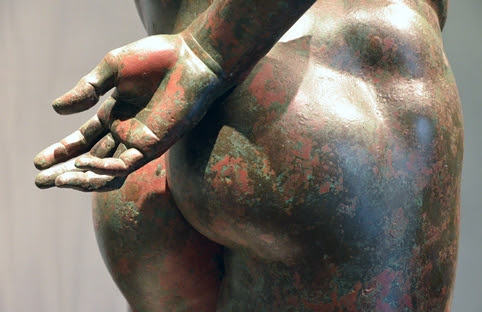
Thank you to the reader who nominated it.
Photo by Carole Raddato.
Wednesday, November 04, 2020
John Rogers discusses This Other London with Arthur Smith
I often post videos of John Rogers' walks here, but he has also written a book: This Other London: Adventures in the Overlooked City.
Here, in two interviews, he talks to Arthur Smith about it, as well as the research he does for Russell Brand.
John Sessions: A lost comic genius
When the improvisational comedy panel show Whose Line Is It Anyway? was first screened on Channel 4 in 1988 it was compulsory viewing. People would make a point of staying in to watch it.
And the most talented performer on the show, above Paul Merton or Josie Lawrence or Stephen Fry, was John Sessions.
His ability to mimic almost anyone, extraordinary range of knowledge and love of cinema history led to some remarkable performances.
Sessions died on Monday. Writing in the Guardian, Stephen Moss expresses what many who remember his appearances in the 1980s must feel:
What an enigma John Sessions was, and what a peculiar career. Not unsuccessful by any means - he was a fixture on the emerging comedy scene in the 1980s and kept popping up in screen parts, some good, some atrocious, over the next 30 years. But there was always a sense of what might have been: of what this glorious freewheeling talent could have achieved if he hadn’t been dogged by self-doubt or if the cards had fallen differently.
Later in his article Moss describes Sessions as suffering from Peter Cook syndrome:
the imagination is so great, the possibilities so enticing, that they cannot easily be fitted into a conventional commercial box.
Except that Sessions had one thing over Cook: he could act. In his films, Cook always seems a little disconnected from what is going on around him. Sometimes directors made good use of this - it is one of the things that makes him so enigmatic in The Rise and Rise of Michael Rimmer - but it did limit him as an actor.
I remember discussing Cook with Adrian Slade, who had auditioned him for the Cambridge Footlights. He said Cook was the funniest man he had ever met and that you would spend all evening with him laughing and then not be able to remember a word he had said the next day.
Adrian also said, however, that being a revue performer - putting on a hat and a funny voice for a two-minute sketch - is not the same as being an actor. And he agreed that sometimes with Peter Cook it showed.
But John Sessions could act: he was RADA trained. Moss quotes him as saying:
"When I left Rada, my plan was to try and do two careers at once - to be a comedian and an actor. For some years, I managed to juggle the two, but I never felt I joined either club. I still feel like a rookie. I feel inadequate when I’m working with great actors like Michael Gambon. It’s like talking to God."
Moss concludes:
If only Sessions had realised that in comedy terms, he was God.
Wishing that a performer had enjoyed a more stellar career can be selfish, in that it is expresses disappointment that you did not get to see more wonderful things from them. But it also contains a love and concern for that performer, and I think Moss is right about John Sessions.
Russian 'Sausage King' investigators find man handcuffed to bed

This time the winner is the Guardian.
Tuesday, November 03, 2020
Six of the Best 972

"In Nebraska I walked the main street of a former town district where the street and the curbs and the lines for angle parking were still there, but the rest of the place was just foundations and neatly tended grass. In western Kansas I drove through a boarded-up town with a sign along the highway asking passersby to pray for the town." Ian Frazier calls on the Democrats to reconnect with rural America.
Political decision-making is failing our urban green spaces, argue Nicola Dempsey and Julian Dobson.
Corinne Silva and Val Williams are studying the collaboration between the local history pioneer W.G. Hoskins and the photographer F.L. Attenborough (father of Richard and David): "Attenborough ... depicted the remoteness of the Leicestershire Hills and the edge of Rutland, the expanses of heathland, fragmented buildings, and the ridges and furrows of medieval farming."
A sensitive young rebel before James Dean and a 'Method' man before Marlon Brando, Montgomery Clift has a complicated legacy. But why isn't he remembered like those burning out young and beautiful? Brogan Morris investigates.
Manfred Mann remembers the kindness of Burt Bacharach.
Former Lib Dem MEP says farmers feel abandoned by the Tories

The latest edition of East Midlands Bylines has an article by Phil Bennion, a farmer and former Liberal Democrat MEP.
Commenting on a Farmers Weekly poll last week that found 98 per cent of respondents took the view that the government does not have farmers’ best interests at heart, he says:
Considering that the overwhelming majority of farmers usually vote Tory, this is a resounding condemnation of government policy. The combination of government positions on the Agriculture Bill and the International Trade Bill have brought farmers to the conclusion that they have been betrayed by the government.
Although many farmers have been shocked by the situation, I predicted this outcome last year, saying that Brexit could lead to a triple-whammy for farmers. Firstly, they faced losing Common Agricultural Policy ... payments already proposed in Gove’s draft Agriculture Bill. Secondly, they could lose access to their main export market in the event of a bare bones or no deal. And thirdly they could be exposed to imports from low cost producers with access to methods that are illegal here in the UK.
Thus far all three scenarios are on track to become reality. This would render farming uneconomic in the UK, with the exception of a few niche sectors.
Faced with such comments, left-liberal Twitter loves to point out that farmers mostly vote Conservative so it serves them right. As if habitual Tories becoming disenchanted with their party and voting for someone else instead isn't exactly the outcome we want.
Or they will say that the farmers all voted Leave, so it serves them right.
The support for Leave amongst farmers is often exaggerated. Surveys conducted by Farmers Weekly in the Decembers of 2016 and 2017 found that 53 per cent of them had voted Leave.
Given that farmers are more likely to be men and older than the population in general, this is not the figure their critics would expect.
For more on this see my post Did we want to defeat Brexit or just to feel superior?

Monday, November 02, 2020
Coping with lockdown: The Belper Moo
This is how the Derbyshire town of Belper relieved the stress of lockdown in the spring.
The townsfolk would moo from their doors and windows at 6.30 every evening.
It seemed to help.
Does Magna Carta mean nothing to you?
Magna Carta has been trending on Twitter today because some people have decided that it gives them the right to ignore the new Covid-19 lockdown.
It doesn't.
As the leading lights of legal Twitter never tire of telling us, Magna Carta was repudiated by King John the year after he signed it and very little of it is to be found in English law today. Besides, even in 1215 its provisions applied only to a tiny minority of the population.
But as this interesting video from Greg Jenner of Horrible Histories tells us, there is more to it than that.
Medieval kings after John all acknowledged Magna Carta, it was cited in the prosecution of Charles I and had a strong influence on the drafting of the US Constitution.
The idea that Magna Carta gives all English or British citizens rights that the government cannot take away may be a myth, but it seems to me a healthy one.
We Liberals tend to write off history as being intrinsically Conservative and feel we must look to the future, but we have not always been like that.
Classical Athens was a great inspiration to many 19th-century Liberals, while others took inspiration from England's Saxon history.
Today the latter is hardly mentioned and I came across an interesting theory on why this has come about in a rather unlikely way - through watching Dr David Starkey on Richard and Judy's afternoon programme:
Starkey said the idea that 1066 is the most important date in British history is a recent one. In fact it dates from 1914 - the year when all things French became good and all things German bad. German Shepherd Dogs turned into Alsatians and the House of Saxe-Coburg-Gotha turned into the House of Windsor.
Until then we had been very aware of our Saxon heritage and believed that the roots of our democracy lay in that era. After 1914 the Norman Conquest became almost a Year Zero and the Saxon kings were relegated to become a faintly embarrassing pre-history.
And the Norman kings are not inspiring figures for any Liberal.
As Boris Johnson's government is reminding us, it is Liberals who worry about arbitrary government power and Conservatives who rather enjoy wielding it. So it's helpful to us for there to be a national myth that holds this is not the way we do things.
If we just tell people they are wrong about Magna Carta without understanding its appeal we risk adopting the unattractive lecturing tone that is worryingly characteristic of so much anti-Conservative social media.
History is too important to the Tories and Magna Carta matters. Don't let her death have been in vain.
There’s Drama in the Queer Penguin Community

Thanks to a nomination from a Liberal Democrat insider, the American publication The Cut wins our Headline of the Day Award.
Photo by Plume at Morguefile.com
Sunday, November 01, 2020
Lord Bonkers 30 years ago: Welcome to Blackpool

Perhaps the old boy and I were still smarting from the Liberal Party's decision to merge with the SDP at a special conference in Blackpool two years before - we both voted against. You can find more evidence of my animus against the town in the Wikipedia entry for the Norbreck Castle Hotel.
Saturday
There are some phrases that strike terror into one's very soul. Worst of them all - worse even than "See me in my study after Prayers, Bonkers" or "The next commentator will be Christopher Martin-Jenkins - is "Welcome to Blackpool".
My low opinion of this dismal caravanserai is more than confirmed when I discover a seagull expiring on the balcony of my hotel room - the air of the town (largely an admixture of plutonium dust and sewage) having proved too much for it.
I grasp the first heavy object that comes to hand and put the unfortunate creature out of its misery with a single blow. I am left feeling sorry for the bird but pleased to have at last found a use for a Gideons' Bible.
Lord Bonkers was Liberal MP for Rutland South West, 1906-10.
Free school meals protest reaches Market Harborough

I was wandering the back streets of Market Harborough this afternoon when I came across this lone protest outside the Conservative Party's office.
Well done to whoever was responsible. 'Neil' is Neil O'Brien, the Tory MP for Harborough.
Remember, the Tory leader of Leicestershire has exploded the myth that the government gave councils money to fund free school meals over the Christmas holidays.
Should you wish to add a plate of your own, you will find the office in Nelson Street.
Later. The Harborough Mail reports that there was a protest on free school meals in the town centre, 30 people taking part. Among them was Phil Knowles, leader of Liberal Democrat group on the local council, and representatives of the Labour and Green Parties.


Former Tory MP for Harborough condemns attacks on lawyers by Boris Johnson and Priti Patel

Which goes to show that Lord Garnier is a proper philosophical Conservatve and Boris Johnson and Priti Patel are just chancers.The unlawful prorogation of Parliament in September 2019, long trailed in the media by his acolytes before he took office and executed shortly afterwards, (personal interest alert: acting for Sir John Major in the case, I must be one of the few in this land who have called the Prime Minister "the defendant"), is an example of Mr Johnson’s carelessness about the law and what it means.
Photo by David Whelan at Morguefile.com
Wah!: Seven Minutes to Midnight
Peter Wylie played with Ian McCulloch and Julian Cope in minor Liverpool bands before he formed his own. Wah! changed names regularly - it's possible this single should be credited to Wah! Heat.
Seven Minutes to Midnight was released in 1980 and is very much of its period - which is a good thing as far as I'm concerned. At times it sounds like a more melodic version of The Jam.
Its title refers to the Bulletin of the Atomic Scientists' Doomsday Clock, which had just been set forward by two minutes,
Subscribe to:
Posts (Atom)