Saturday, July 16, 2016

Boris Johnson begins to realise that he has gone too far

A couple of days after the referendum Boris Johnson wrote a column for the Sunday Telegraph saying we could all still have nice things despite the result:
I cannot stress too much that Britain is part of Europe, and always will be. There will still be intense and intensifying European cooperation and partnership in a huge number of fields: the arts, the sciences, the universities, and on improving the environment. EU citizens living in this country will have their rights fully protected, and the same goes for British citizens living in the EU. 
British people will still be able to go and work in the EU; to live; to travel; to study; to buy homes and to settle down.
The result was that Johnson's new-found supporters were outraged and his lieutenant and strategist Michael Gove deserted him. As a result, he dropped out of the Conservative leadership contest.

On Friday he made a speech at the French Embassy in London and called for "a political, cultural, psychological, and economic union" with France. He was booed by some members of his audience.

Tonight comes news that a dinner for European Union foreign ministers has been cancelled. This, suggests The Sun, is in part because Johnson's European counterparts have no particular wish to break bread with him.

All this must hurt Johnson. He is no Little Englander: he was born in New York to a father who made his living by working in international organisations. Some sources claim he is still a US citizen.

But, by gambling he could court the Leavers, whose views he must surely despise, lose the referendum and gain in the long run, he has spoilt all this for himself and for the nation.

I am reminded of a passage in Auberon Waugh's* first novel The Foxglove Saga. I did read it years ago, but this extract comes from William Cook's anthology of the younger Waugh's writings Kiss Me Chudleigh. Cook suggests it may be a picture of Auberon himself as a boy:
Stoat began to realise that he had gone too far. It had happened several times in his career before, when, without warning, his entire world had seemed to collapse about his ears, leaving him just a shade more lonely, and spiteful, and not a jot wiser than before. 
When his first Nanny, called Freda, to whom he was passionately attached, had suddenly been teased too much about her boyfriends, and had turned and thrashed him savagely, and had given her notice the same evening; when his spaniel puppy, Rollo, had been pushed once too often into the goldfish pond, and had caught a cold and died, and his father had sworn that he would never have another dog; when, at his first prep school, a game of Cops and Robbers had got out of hand, and a boy had nearly lost a finger, and Stoat had been asked to leave.
Like Stoat, Boris Johnson has begun to realise that he had gone too far.


* A word on Auberon Waugh. When I am seeking inspiration for my own comic writing, it is to him and his courage and absurdity that I turn.

Kiss Me Chudleigh is a good representation of his work, except that there is too much of Waugh's fulminations against the working class. Granted his politics are not my politics, but when he wrote like this (and he did frequently) he was not so much hammering at the same theme as hammering away at the same note. And it was not that funny to begin with.

In praise of eyesores: The Bull's Head, Tur Langton:


I seem to have reached the stage where I am revisiting local villages that I have already photographed for this blog. Today it was the turn of Tur Langton.

When I was there in 2010 the Bull's Head, though empty, still stood. You can see it in the photograph above.

It had closed around the turn of the century - a reminded that it is not so long since a village of any size could support two pubs.

Now it has gone, replaced by a chaste terrace with, I believe, some larger houses behind. The terrace is in the photo below.

But at least someone from the Markta site got inside the derelict pub before it was demolished,

The Bull's Head turns out to have an interesting history.

If you know your Michael Wood's Story of England, you will recall the Gartree, an oak tree situated to the north of the Roman Gartree Road and west of the ancient ridgeway running north to south, between Shangton and Illston-on-the-Hill.

Gartree is also one of the hundreds of Leicestershire. And, records This Was Leicestershire, it was at the tree that the hundred court met between at least 1458 and 1750.

After that, it relocated to the Bull's Head, the nearest convenient inn to the ancient meeting place.

Anyway, what I have learnt in my travels is that ever you see a building described as an 'eyesore' you should go and photograph it. It will have an interesting story and one day some well-meaning person will pull it down.


Cleobury Mortimer, Highley and the Isle of Man in the late 1930s


More Shropshire goodness from the BFI's Britain on Film collection.

Click on the image above to view this film by Freddy Morrison of Cleobury Mortimer.

It combines shots of village life and people, including Cleobury's wonky spire, with footage of trips to Highley and the Isle of Man.

Look for coal miners and what was then a new road bridge in the former, and the TT races and horse-drawn trams in the latter.

Enjoy to the telephone number Cleobury Mortimer 6.

Friday, July 15, 2016

Lib Dems choose Michael Mullaney to fight Bosworth again


Amid the carnage of 7 May 2015, Michael Mullaney's holding on to second place for the Liberal Democrats in the Leicestershire constituency of Bosworth counted as a considerable achievement.

Tonight he was again selected by Bosworth Lib Dems as their candidate.

If this parliament runs until 2020, the next election will be fought on new boundaries. But there are those who believe an early general election looks the logical choice for Theresa May.

Escaped wallaby causes mayhem on rail network says train operator

BT will be pleased to have won my Headline of the Day Award.

The judges enjoyed the note of scepticism.

Thursday, July 14, 2016

Saddington canal tunnel


Opened in 1797, Saddington tunnel is on the Leicester line of the Grand Union Canal.

It is reputed to be haunted by Anna, a headless female ghost.

As at Husbands Bosworth, you can still follow the path that the horses that drew the narrow boats used to take over the hill.


An early general election looks the logical choice for Theresa May


A major Whitehall reorganisation.

Accomplished plotters like George Osborne and Michael Gove sent to the backbenches.

Potential disasters like Boris Johnson and Liam Fox brought in.

Others  - Andrea Leadsom, Priti Patel - given cabinet positions they will hate.

You cannot accuse Theresa May of lacking ambition, with Brexit on the books and a likely economic downturn on the way, it all sounds too much for a prime minister with a majority of only 12.

The logic of that, I suppose, is that we should expect a general election in the autumn or the spring of next year.

Without it, Theresa May may find she has overestimated the strength of her position.

Two Shropshire village schools to close


The Shropshire Star reports that Hope Church of England Primary School and St Mary’s Church of England Primary School in Westbury are set to close. Under the plans, pupils will be transferred to an amalgamated site at Worthen Church of England Primary School.

Heather Kidd, the excellent Liberal Democrat councillor for the area, sees no alternative because young families cannot afford to move to the area.

But it is hard not to gasp as the casuistry of the Conservative cabinet member for education on Shropshire Council:
“It is very important to understand that this is not a decision to close the schools, but a decision to consult on the amalgamation of the three schools, requiring the closure of two of the sites and enlarging the provision on the third site to accommodate the displaced pupils."
As I asked when the school at nearby Stiperstones was threatened:
Aren't Tories meant to have romantic feelings about things like village schools?
The photographs here show the school at Hope.

Wednesday, July 13, 2016

Boris Johnson and the collapse of British power


So Boris Johnson is the new foreign secretary.

Our relations with other countries are now in the hands of a man who, only a couple of weeks ago, destroyed his own chances of becoming the Conservatives' leader with one undiplomatic newspaper column.

And he has previous.

In 2004 Johnson was ordered by his leader Michael Howard to go to Liverpool and apologise to the people of the city after he marked the murder of Ken Bigley by running an article in the Spectator that said of them:
"They see themselves whenever possible as victims, and resent their victim status; yet at the same time they wallow in it."
In 2006 he had to apologise to the people of Papua New Guinea after likening to his colleagues in the Tory party:
"For 10 years we in the Tory Party have become used to Papua New Guinea-style orgies of cannibalism and chief-killing."
In 2007 he described Portsmouth as
"a place that is arguably too full of drugs, obesity, underachievement and Labour MPs."
And in 2008 he apologised for a column he had written in 2002 that referred to black people as "piccaninnies" and talked about their "watermelon smiles". During that same mayoral campaign he was also embarrassed by some of the racist columns by Taki that he had published in the Spectator.

The appointment of Boris Johnson is a confirmation that Britain is no longer a world power.

What international relations are left to us will be handled by David Davis, who is a grown up, as we attempt to withdraw from the European Union.

Johnson will merely go around the world exuding what he imagines to be upper-class charm. He will go down well with the sort of people who enjoy Richard Curtis films.

When the foreign secretary gig falls through - and I would not put money on its lasting too long - he will probably turn to playing the English butler in a situation comedy on American television.

Tuesday, July 12, 2016

The Bishop's Castle elephant found on film


As a regular visitor to Bishop's Castle I have from time to time come across the story that there used to be an elephant stabled at the town's Castle Hotel.

I have never quite believed it, but thanks to Flicks in the Sticks' Bigger Picture Archive Project, you can see the creature in the clip above.

The Shropshire Star quotes Elizabeth-Anne Williams from the Project:
"An interview recorded with George Evans in 2011 and archived at Bishops Castle Heritage Resource Centre reveals that when the Second World War broke out, a travelling circus had been performing in Bishops Castle with three or four elephants in their troupe. 
"The elephants required a lot of hay for feeding and when they packed up they weren’t able to take one elephant." 
George said the elephant was kept in the Castle Hotel stables, in the present car park, and he also remembered the elephant being taken for a walk past the Boys' School in Station Street where he and others gave it a swede which it 'squashed with its foot to eat it'.
The Bigger Picture Archive Project also turned up the footage of Amy Johnson at the gliding station on the Long Mynd that I posted recently.

Six of the Best 611

Peter Black says: "The opposition party leaders need to calm down. A snap General Election is not necessary and they are being rather silly to call for one." And he's right.

"No serious person believes that Jeremy Corbyn can win a General Election; yet the old men at the top of British trade union movement continue to back a useless leader because he plays a nostalgic tune that they and a dwindling number of their comrades recognise." James Bloodworth argues that Labour is becoming a historical re-enactment society.

Rewild our trashed hills, demands Mark Avery.

Kate Connolly on the English schoolboys who perished in the Black Forest in 1936 and became the centre of a Nazi publicity coup. Do read the comments too.

"His sister glanced away, as if trying one last time to arrange all the pieces. Then she said, 'I don’t think we’ll ever know for sure what really happened. Unlike in detective stories, we have to live without answers.'" David Grann examines the mysterious death of a Sherlock Holmes scholar.

Paul Gallagher remembers the glory days of Pan Books.

Monday, July 11, 2016

Vanessa Redgrave on Blow-Up - 50 years on


Thanks to Mike's Movie Projector for finding this video.

How Reg Varney ruined the British economy


The comedian Reg Varney was born 100 years ago today.

Normally one would celebrate such an anniversary, but I cannot forget an old post on Stumbling and Mumbling.

This demonstrated conclusively that Varney (who died in 2008) was single-handedly responsible for Britain's woes.

If you doubt me, read this:
His portrayal of Stan Butler did much to perpetuate the image of the 1970s worker as a bone-idle work-dodger; we forget today just how enormously popular On the Buses was. And this in turn might subconsciously have contributed to the popularity of Thatcherism. How many of those who, when asked by Tories in 1979 whether the working class had become too big for its boots, conjured up a picture of Stan Butler and so voted for Thatcher?
And this:
Reg Varney was the first man in the world to use a cash point machine. In doing so, he might have kicked off two effects. One is a tolerance of inflation. One of the drawbacks of inflation is that it forces us to economize on holding cash, as inflation erodes its value. We therefore make more trips to the bank, incurring what economists call shoe-leather costs - costs which are more significant than you might think ... However, the invention of the ATM helped make it much easier to get cash out of the bank. This fall in shoe leather costs for technological reasons offset part of the normal cost of inflation, which helped make people less intolerant of it. 
Is it really a coincidence that inflation began to rise as the cash point machine, as popularized by Mr Varney, became more widely used? I think not.
And this:
Before Mr Varney used the cash point, impulse buying of good or sessions down the pub were constrained by the fact that cash was hard to obtain. After that fateful day, however, the constraint came down. 
If you think of consumers as rational far-sighted maximizers the effect on spending should have been minimal. But if people lack self-control, the spread of the ATM would have raised spending. 
Maybe, then, Mr Varney is partly to blame for the low savings ratio.
Is it any wonder that some people did not care for him?

Leicestershire Tory MP forecasts 20 defections if Theresa May becomes leader


Let's be honest: the East Midlands regional section is not always the most interesting part of Sunday Politics.

But it was certainly worth watching yesterday.

Andrew Bridgen, the Conservative MP for North West Leicestershire, was defending Andrea Leadsom and her bid to lead the party.

When the interviewer Marie Ashby put him to him that, according to the Sunday Times, some East Midlands Tory MPs were threatening to leave the party if Leadsom won the contest Bridgen replied:
"If Theresa May ends up leading the party I think you'll have as many people falling off the other side of the party."
You can see the exchange from 42:36 if you watch it on iPlayer.

Remember that the Sunday Times claimed as many as 20 Tory MPs were prepared to leave the party if Leadsom won.

Sunday, July 10, 2016

Andrea Leadsom decides to apologise and play the victim

Remember this and Andrea Leadsom's other tweets on the theme?

All that has changed.

Helped by a comically one-sided article in the Telegraph by my former classmate Allison Pearson, Leadsom has decided to apologise and play the victim.:
When I ask if she would like to apologise to Mrs May, she says: "I've already said to Theresa how very sorry I am for any hurt I have caused and how that article said completely the opposite of what I said and believe." 
She refuses to say how the message was conveyed to the Home Secretary, but she admits she has felt “under attack, under enormous pressure. It has been shattering.”
Given that we have all read and heard what Leadsom said, you have to wonder how the apology was received.

And if a week in the public gaze has been "shattering," you have to wonder whether Leadsom is remotely suitable for the role of prime minister.

Reading between the lines, it sounds as though Leadsom originally stood to make herself better known, assuming that Boris Johnson would emerge as the Leave candidate.

Suddenly, Johnson and Gove took one another out and she found herself one of the final two candidates.
Featured on Liberal Democrat Voice
For her sake and the sake of the country, Leadsom should now stand down from the contest.

Young voters did turn out in large numbers for the referendum


In the immediate of the referendum there were news stories suggesting a very low turnout among younger voters.

Now research has appeared that questions that conclusion.

Toby Helm writes in the Observer:
The turnout among young people aged 18 to 24 in the EU referendum was almost double the level that has been widely reported since polling day, according to evidence compiled at the London School of Economics. 
The new findings – based on detailed polling conducted since the referendum by Opinium, and analysed by Michael Bruter, professor of political science and European politics at the LSE, and his colleague, Dr Sarah Harrison – suggests the turnout was 64% among this age group.
He goes on to quote from a report by Bruter and Harrison:
"The question of whether young people voted or not is politically important for two critical reasons. 
"First, because there continues to be a significant proportion of younger voters who say that they are unhappy with the result of the referendum and want to be heard, and one of the key arguments that has been made in answer to them is that they should have bothered to vote if they cared that much. 
"And, second, because the government chose not to give the right to vote to 16- and 17-year-olds in the referendum. It is fair to ask whether allowing them to vote could have changed the result of the referendum or not."

Camper Van Beethoven: Take the Skinheads Bowling


Why was Take the Skinheads Bowlilng a hit?

Don't ask David Lowery who founded Camper Van Beethoven and wrote the song:
I never thought that Take the Skinheads Bowling would become a Hit. If someone had traveled from the future and told me we would have a hit on our first album I would not have picked this song as being the hit. Not in a million years. I would have more likely picked Where the Hell is Bill. 
Why? We regarded Take The Skinheads Bowling as just a weird non-sensical song. The lyrics were purposely structured so that it would be devoid of meaning. Each subsequent line would undermine any sort of meaning established by the last line. It was the early 80′s and all our peers were writing songs that were full of meaning. It was our way of rebelling. 
BTW this is the most important fact about this song. We wanted the words to lack any coherent meaning. There is no story or deeper insight that I can give you about this song.
David Immerglück from Camper Van Beethoven went on to be the guitartist with Counting Crows.

Saturday, July 09, 2016

Leicestershire landscape


The road from Saddington to Smeeton Westerby.

Andrea Leadsom campaign manager's childlessness jibe against Sarah Teather


Tim Loughton is Andrea Leadsom's campaign manager.

In September 2013 the Telegraph quoted a speech of his to Conservative activists:
"The person who was actually in charge of family policy amongst the ministerial team at the DfE was Sarah Teather. Which was a bit difficult because she didn't really believe in family. 
"She certainly didn't produce one of her own. So it became a bit of a family-free zone. I think that was a huge disappointment."
Loughton later told the BBC that he would apologise to Teather.

Jo Swinson had it right in her quote in the Telegraph story:
"Using someone’s lack of children as an insult is shameful, crass and, frankly, disgusting. It reflects far more on him than on Sarah."
All in all, a remarkable coincidence.

Friday, July 08, 2016

Six of the Best 610

Stephen Tall cannot but take Brexit personally: "When he’s older I’ll have to explain to my son why we voted to leave the EU ... For a lot of ... people — I don’t know how many, none of us does — it was simply that they didn’t want more immigrants, people like his mother, in this country."

The Liberal Democrats have their highest membership for a decade. Left Foot Forward talks to some new recruits.

"David Cameron’s decision to promise a referendum on British membership of the EU will be remembered as the greatest blunder ever made by a British prime minister." Michael Portillo shows no mercy.

Layo argues that "The self-righteousness of the metropolitan left combined with the cultism of the far-left has created a toxic cocktail of absolutism and puritanism within the Labour Party."

Londonist visits the Jackfield Tile Museum in the Ironbridge Gorge, Shropshire, as you should too.

Learn the history of the Terry's Chocolate Orange on Culture 24.

Nobody knows anything about British politics any more

"Nobody knows anything." That's what the screenwriter William Goldman said.

He went on to explain:
Not one person in the entire motion picture field knows for a certainty what's going to work. Every time out it's a guess and, if you're lucky, an educated one.
And it's certainly true of British politics now too.

Take what I wrote on Sunday:
There will be no coronation for the new Conservative leader. Two names will be put to the party's leadership. Those names will be Theresa May and Andrea Leadsom. 
May will win the ballot, but it will be no walkover - say 56 to 44 per cent.
Aww. How sweet! I love the exact percentage figures.

Everything I have seen since I wrote that had led me to believe that the Conservative members will choose Andrea Leadsom.

There are a lot of fruitcakes among them and they want a fruitcake to lead them.

It's not just me. The current Private Eye has two columns of quotes from pundits telling us that Remain would win the referendum or that Boris Johnson would be our new prime minister.

And who could forget our own Nick Tyrone? At the start of May her drew on his own experience of the Yes campaign in the AV referendum:
Twenty days out from the AV referendum vote, the polls had Yes and No neck in neck, a knife’s edge finish supposedly clearly ahead. But saner heads knew, even on the Yes campaign at that exact moment, what was coming. I recall clearly when that poll was discussed in the Yes to AV campaign HQ: the younger, inexperienced members of staff figured we were in with a real chance; the older, more experienced members knew it was all over. I remember one of them saying to me – “It’ll be about 65-35 No, for sure”. Remarkably spot on in retrospect. 
Most of the wiser heads on Yes to AV didn’t need the polls to tell them we were headed for a hiding anyhow. When every cogent voice in Westminster says something is a bad idea, while every lunatic comes out of the woodwork to support your cause, in a 50-50 plebiscite it is only going to go one way. And sure enough, it did. 
So if I’m sure we’ll be seeing a repeat of history in short order, when will the polls actually turn? We’re only seven a half weeks out, so probably not for a bit. They’ll probably go definitely Remain’s way about two weeks to ten days out, so sometime between June 9th and June 13th.
If the fact that nobody knows anything about British politics any more has an upside it is that we will hear less of people promising to run naked down Whitehall if their predictions turn out to be wrong. Call it danhodgesism.

And there is a serious point to all this. In April I wrote:
That party membership is such a minority taste now suggests that the 19th-century model of political parties we still embrace is hopelessly outdated. 
Yet no politician has the vision or overweening ambition to wrench it apart and allowing something more attuned to our needs today to take its place.
Party membership is growing again, so I was wrong about that. But maybe the tectonic plates really are moving.

Already, Remain and Leave across the UK, and Yes and No in Scotland, seem more vital and more coherent identities than the old party labels.

But I am probably wrong - and I am not sure about that "overweening".

Thursday, July 07, 2016

Disused railway stations in Manchester


Includes a nice photo of Manchester Central before it became, er, Manchester Central.

Private Eye story on moves to oust Tim Farron

A story from the new Private Eye:
As the other two parties went into meltdown, senior Lib Dems took to the phones to sound out members on whether the time was ripe to ditch Tim Farron and replace him with, er, Nick Clegg.
The organ goes on:
In last July's leadership contest, Clegg allies came out firmly for former minister Norman Lamb, the standard-bearer for the party's libertarian right. When Lamb lost by a wide margin, one former Clegg special adviser told colleagues the Cleggies should wait 18 months for Farron to fail, then depose him and "Bring  back Nick".
I hope there is nothing in this. Certainly, a senior Liberal Democrat and a former special adviser are two different animals.

It may be that the belligerent youths who surrounded Clegg in government have never come across someone who did not go to private school and Oxbridge. No wonder they are struggling to cope.

Yet, as I found during the leadership election, that different background is part of Tim's appeal.

What would be welcome, as I blogged just after the election, would be Nick Clegg taking on the Europe and foreign affairs for the Liberal Democrats,

His party needs him and his country does too.

GUEST POST The peculiar contradictions of Scotland’s Named Person scheme

Simon Calvert from NO2NP on the controversial scheme that will give every Scottish child a state guardian

We don’t hear about it much in England, but north of the border, in the corridors of Holyrood, politicians are under pressure over plans to implement a controversial Named Person scheme.

Health visitors, teachers, children’s groups, social workers, Police Scotland and parents have all expressed serious reservations about the scheme. Yet the Scottish government is ploughing on regardless.

What is it? 

From August, every child in Scotland will be appointed a Named Person. These are state guardians who will be tasked with looking after a child’s "wellbeing" – that is, their "happiness".

The scheme will be put in place regardless of whether or not children or parents want it, and regardless of whether there is any need for state intervention.

Over 34,000 Scots have signed a petition against the scheme and Named Persons became one of the biggest issues of the recent Scottish Parliament election, with some suggesting it cost the SNP their majority.

Why is it a problem?

One of the biggest reasons so many people are saying 'No' to Named Persons is the Scottish Government’s astonishing lack of clarity. Nearly every time ministers attempt to explain themselves, they end up sowing even more confusion.

Here are 10 contradictions from the Scottish government:

Opting out 

The first minister Nicola Sturgeon says that Named Persons are "not compulsory". Yet the Government’s own QC said that allowing an opt-out would "defeat the purpose of the scheme".

In fact the phrase "opt out" appears absolutely nowhere in the legislation. If the scheme was voluntary, it would be fine. Parents who want help would know where to go to get it. But the Named Person law is universal.

Compulsion

Government guidance says Named Persons have "no new legal powers to compel parents… to accept advice, support or help". In reality of course, if mums and dads refuse to engage with the scheme, they will inevitably find themselves under scrutiny.

Alan Small, one of the main cheerleaders of the policy, suggested parents won’t be able to hang up the phone on Named Persons. Separate Government guidance even lists "parental resistance" as a “risk indicator”.

Snooping around 

We are told the policy is not, as many people feel, a 'snoopers' charter'. So why do the information-sharing provisions in the Act say nothing about telling parents what is being shared and why? If information is "likely to be relevant" to the Named Person and "ought to be provided" then it "must" be shared.

Government guidance to health visitors actively discourages them from seeking consent, saying sharing of information with or by a child’s Named Person "ill be a duty even where there is a duty of confidentiality". It even says "consent to share relevant and proportionate information in this context will not be required and if sought and refused could potentially damage the HV/parental relationship".

Kayley Hutton only discovered that her Named Person had compiled a 120-page dossier on her and her daughter Kaiya when she made a Subject Access Request under the Data Protection Act.

Monitoring duty 

We are also told that a Named Person "isn’t there to monitor family life". Yet official guidance for health visitors is explicit that a health visitor has "responsibility for overall monitoring of the child’s wellbeing and outcomes as their GIRFEC Named Person".

Known to the family

The whole premise of the scheme is the idea that families will have a "single point of contact" (hence "a named person"). Deputy First Minister John Swinney seeks to reassure anxious parents by promising that the Named Person "will be someone already known to a family – usually a health visitor or teacher".

But given the number of children involved, and the reality of staff turnover, it is impossible to assign every child a teacher or health visitor whom they already know, who can be "There for you" consistently.

Scotland’s biggest teachers' union had to explain to the Government that their members could not fulfil the Named Person duties at evenings, weekends and during school holidays. Moray Council, which is already piloting the scheme, recently relied on just eight council workers to cover for 80 Named Persons during school holidays. So when the child’s actual Named Person is not available, the role will be fulfilled by someone who is not named and not known to the family at all.

Nice and simple 

The new law and supporting documents supposedly provide "a clear set of steps for practitioners". Yet guidance on implementing the scheme is vast and opaque. It doesn’t help that it is littered with strange graphics.

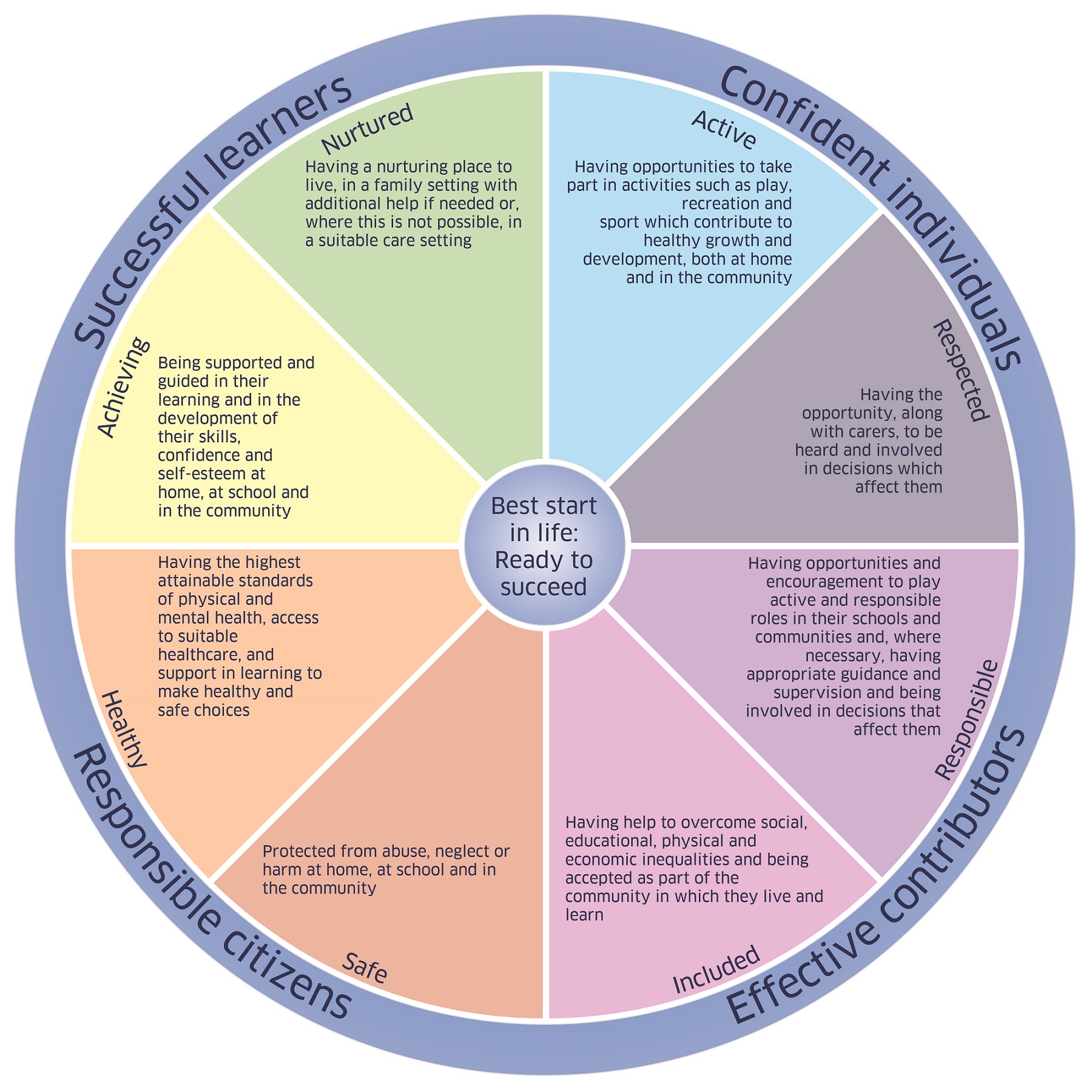
  • A so-called ‘National Practice Model’ has been drawn up using a series of diagrams called the 'Wellbeing Wheel,' the 'My World Triangle' and the 'Resilience Matrix'.
  • The 'Wellbeing Wheel' is to be used to examine eight 'key' aspects of every child’s life, known as the ‘SHANARRI’ indicators: Safe, Healthy, Achieving, Nurtured, Active, Respected, Responsible, and Included.
  • In total, teachers and health visitors will need a working knowledge of 221 risk indicators and 308 wellbeing indicators. 
Protect the vulnerable 

Former children's minister Aileen Campbell was responsible for the Named Person policy. Defending it, she observed "that it is not always possible ... to predict in advance which children might become vulnerable".

Yet the new law says nothing about targeting help at those who are vulnerable. Rather, every one of Scotland’s one million children will have a Named Person to "promote" their "wellbeing". This is a vague concept that’s likely to be far removed from vulnerability.

Finding truly vulnerable children is like finding a needle in a haystack. The scheme simply makes the haystack bigger.

Information sharing 

Ms Campbell also claimed that "the law already allows information sharing to prevent or tackle a risk to wellbeing".

This simply isn’t true. The current law allows those in possession of personal information to breach their duty of confidentiality and share information (e.g. with police and social workers) when there is "risk of significant harm" to a child. But the Information Commissioner’s Office quite clearly explains that the Named Person law is "lowering that trigger down to wellbeing".

As children’s charity Clan Childlaw says, the wellbeing threshold "involves a highly subjective judgment on the part of the Named Person and others as to whether to share information. It allows for the sharing of confidential information at that lower threshold even if the child does not consent. There is a serious risk that the overriding of confidentiality when there is no child protection concern will lead to children being reluctant to engage with confidential services".

Child protection 

No one doubts the good intentions of those who promote Named Persons, but there is a terrible and dangerous confusion over the entire purpose of the policy.

Government ministers cite previous infant deaths and claim Named Persons will prevent future deaths. The First Minister, Nicola Sturgeon, told The Times in April "if it saves the life of one child, I think it’s worth it".

But practitioners like Bill Alexander, whose pilot scheme in Highland is held out by the Government as the model for Named Persons, say that is not what the scheme is about. Alistair Gaw, President of Social Work Scotland, a defender of the scheme, said "It is not about child protection."

Old news 

Supporters of Named Persons also insist the scheme "isn’t new". But how can it take eight pages of statute to create something which isn’t new?

Advice to local authorities issued by an implementation partnership group says: “Compliance with the legislation can only be achieved through significant transformational change supported by systems, practice and culture change.” Remember too that health visitors and teachers have already expressed serious reservations.

It’s all just very confusing

The Scottish Government has been trying to wriggle its way out of the endless contradictions as it ties itself in knots. People just don't buy the spin.

NO2NP is the campaign against state-appointed Named Persons for every under 18 year-old in Scotland. It is backed by a broad range of people including politicians, journalists, academics, religious groups, educationalists and parents.

Wednesday, July 06, 2016

Six of the Best 609

"The Article 50 process, and the system of rules that it is embedded in, is designed to make life very difficult. The UK was involved in designing the system, just as much as any other country. Indeed, the process means that no one would trigger it unless they were willing to risk paying a extraordinary economic price." Alex's Archives on the folly of Brexit.

"Those who believe in the open politics and the open society will still need to carry the unconvinced, but in the end the closed society can not deliver the prosperity that the open can." Cicero's Songs speculates on the shape of Britain in the years after Brexit.

Eunice Goes looks at Ed Miliband's failed attempt to revive Labour.

Cahal Moran, Zach Ward-Perkins, and Joe Earle criticise 'econocracy' - a society in which political goals are defined in terms of their effect on the economy; and the economy itself is believed to be a distinct system with its own logic that requires experts to manage it.

Why are there so few Conservatives in academia? An anonymous contributor to Quora has some ideas (in America at least).

Alastair McKay traces the unexpected connection between Winston Churchill and the Glastonbury Festival.

Charles Kennedy speaking against the invasion of Iraq


The publication of the Chilcot report today has caused many people to remember Charles Kennedy's courage in opposing the invasion of Iraq.

The two videos above will show you the speech he made in the Commons on 18 March 2003.

Note the fury coming from the Conservative benches.

The Tories' had been driven mad by Tony Blair's unconditional embrace of the United States. They liked to see themselves as the great advocates of the Atlantic alliance. Suddenly they felt like like a young boy who had lost the friendship of a glamorous older boy.

I tried to convey something of Blair's approach to the US in a column I wrote for Liberal Democrat News the following year.

Future historians will probably have better things to do than discuss the internal politics of the Liberal Democrats, but the truth does matter.

I mean no disrespect to Charles Kennedy's memory when I recall that he was rather bounced into opposing the invasion of Iraq by his own party.

This post by James Graham tells you what went on before this debate and the famous march through London.

Now questions are raised about edits to Andrea Leadsom's Wikipedia entry

The grandstand at Towcester racecourse ©  Oliver Hunter

Yesterday evening I blogged about the questions being raised over Andrea Leadsom's claims about her career.

Now the Guardian is claiming that suspicious edits have been made to her Wikipedia profile:
Andrea Leadsom faces questions over her Wikipedia entry after it emerged that embarrassing media stories had been removed from the page. The changes appear to have been made from Towcester, where the Conservative leadership contender’s constituency office is located. 
In 2015, references to media reports about the Leadsom family’s use of trusts to own a buy-to-let company and details of financial donations from Leadsom’s brother-in-law, Peter de Putron, were deleted from Leadsom’s profile on the website. 
The changes were made by an unregistered user, with an IP address in Towcester, which is in Leadsom’s constituency of South Northamptonshire. Penny Mordaunt defends Leadsom Tory leadership bid. 
The deletion was accompanied by a note stating: “The allegations by Private Eye, the Guardian and the Independent are false and designed to be politically damaging. No laws have been broken and Her Majesty’s Revenue and Customs can confirm that Mrs Leadsom’s tax status is perfectly legal.”
Reader's voice: I am surprised you are bothering to blog about this.

Liberal England replies: I wasn't going to, but I have this comment to hand...

Lord Bonkers writes exclusively for Liberal England:
"Towcester is a fascinating place. You never know who will pop up next."

Tuesday, July 05, 2016

Watch Michael Gove in his brief career as a yoof broadcaster


This is a trailer for a 1993 show called A Stab in the Dark that Michael Gove hosted alongside David Baddiel and Tracey Macleod.

I have the feeling that Chris Morris watched it closely.

Tracey Macleod remembered it for the Guardian today:
It was pretty clear from the first week that the show was a turkey, with any humour that may have appeared in our monologues stifled at birth by a shooting style that exposed the presenters as three sarcastic students shouting in an underground car park.
And she remembered Michael Gove in particular:
David and I did share the occasional canteen sandwich with our mysterious colleague, but we might as well have been lunching with a unicorn, so different was he from us or anyone else we knew. Apart from his politeness, and his apparent acid reflux problem, he didn’t really register as an actual person. 
It came as a surprise when a big group of his friends turned up to cheer him on from the studio audience, loudly applauding at the end of his sections and staying silent at the end of ours. At the time, I remember being amazed that he had friends at all, and that they looked relatively normal. But in retrospect maybe it was an early attempt at a putsch.

Was Andrea Leadsom really a City high-flyer?


When leadership candidates appear from almost nowhere, it is often an idea to cast a sceptical eye over their CVs.

Iain Duncan Smith, for instance, originally claimed that he had attended the University of Perugia in Italy. A Newsnight investigation revealed that this was a considerable exaggeration.

Now some people are questioning the picture that Andrea Leadsom has allowed to be painted of herself. Was she really a City high-flyer before she turned to politics?

Robert Stephens politely suggests she was not:
Her job at Barclays/BZW 1993-1997 was a largely administrative one, “Financial Institutions Director” meaning the maintenance of contractual relationships with other banks. 
Her job as Managing Director of De Putron Fund Management,1997-1999 seems to have involved setting up the onshore shell of her brother-in-law’s offshore investment company. 
But her job at Perpetual/Invesco Perpetual, 1999-2009, is particularly worthy of closer inspection. I was a fellow employee throughout her time there. Last week, at my prompting, she corrected her CV with Wikipedia and Who’s Who, changing her title from the obviously incorrect Chief Investment Officer to the titles of Senior Investment Officer and Head of Corporate Governance. 
Her actual job was to work (sometimes part-time) on "special projects", mostly for the Chief Investment Officer. These included for example negotiating pay terms for senior fund managers. Towards the end of her time, she advised on a couple of governance issues. 
As I understand it she had no-one reporting to her in either role, so the words Senior and Head are, one might say, superfluous.

St Mary's and the streets of Far Cotton, Northampton


Far Cotton is an area of terraced housing just to the south of the river in Northampton. As at least one street name reflects, it was built for workers employed by the LNWR.

A tight grid of streets presided over by the inevitable late-Victorian church, it reminded me a little of Oxford's Jericho.

Far Cotton has also managed to hold on to at least some of its shops, though many seem to be niche business with no necessary connection to that part of town. I was taken with the wool shop though: it could have come straight out of 1962.


Angela Eagle's chess career

I am not convinced Angela Eagle is the answer to Labour's problems, but I do remember her and her sister as junior chess champions in the 1970s.

In last Saturday's Guardian Leonard Barden recalled those days:
Angela Eagle, who is set to challenge Jeremy Corbyn for the Labour leadership, was the 1976 British girls under-18 co-champion and an England junior international. She also represented Oxford in the annual varsity match. 
The Wallasey MP still takes a keen interest in the game and in 2011 was photographed with Garry Kasparov and Nigel Short at a Chess in Schools meeting hosted in Westminster. 
Eagle would be easily the strongest chess player ever to lead Labour, and if one day she becomes prime minister she would rival Andrew Bonar Law as the best player to hold that office.

Monday, July 04, 2016

Paddy Ashdown and Nick Clegg to speak at Kew literary festival

© David Hawgood
Two former Liberal Democrat leaders are taking part in the 2016 Write on Kew literary festival in September.

The organisers say:
Nick Clegg offers a frank and honest account of his spectacular rise in the 2010 general election, through his tumultuous years as Deputy Prime Minister, to a brutal defeat in 2015 in order to tell the inside story of this change and reflect on what it means for our future. 
Paddy Ashdown - Join the renowned politician and former marine and intelligence officer to hear the true story of a lethal spy triangle in Bordeaux between 1942 and 1944 and of France’s greatest betrayal by aristocratic and right-wing Resistance leader Andre Grand-Clement. It’s a story of special operations, treachery, bed-hopping and executions in the city labelled ‘la plus collaboratrice’ in the whole of France.
You can find full details on the Write on Kew website.

Sunday, July 03, 2016

The darker side of Thorpe Langton

Last Saturday I went out to Thorpe Langton seeking balm for the soul and came back with some reassuring photographs.

But every village has its darker side...


The coming civil war in the Conservative Party


No one but a fool would try to forecast political events in Britain at the moment, so I am willing to give it a go.

There will be no coronation for the new Conservative leader. Two names will be put to the party's leadership. Those names will be Theresa May and Andrea Leadsom.

May will win the ballot, but it will be no walkover - say 56 to 44 per cent.

That will not be the end to the Tories' troubles but the start of them.

Because they have no clear vision of what Brexit will be like, the Leavers are bound to be disappointed.

Britain's bosses will not suddenly grasp opportunities to trade with the world and bring in a new era of prosperity. If they were minded to do that, there was nothing about British membership of the European Union that stopped them.

Errand boys are unlikely to start whistling in the street again either.

And if the Leavers are disappointed they will conclude their referendum has been betrayed and look for scapegoats.

Chief among them will be the leader of their party. Theresa May, they will rage, was a Remainer. How can they ever trust her?

Arron Banks, the sugar daddy of Ukip, claimed on Twitter this morning that the Leave.eu campaign he funded is followed by more than 20 per cent of the Tory membership.

Certainly, from the limited sample of Conservative activists I follow on Twitter, I get the impression that the party's grassroots are closer to Nigel Farage than they are to Cameron or May.

It was notable this morning that Leadsom refused to rule out having Farage on her Brexit negotiating team. She know what her potential supporters want.

So what I see is Theresa May as leader of a party where a large proportion of the membership increasingly regard her as a traitor and owe semi-allegiance to a grouping that overlaps with the party.

For a model of how this works, have a look at the Labour Party and Momentum.
Featured on Liberal Democrat Voice
In the words of Leonard Cohen: "I have seen the future, brother, and it is murder."

A professional critique of the Remain campaign

Campaign, the trade magazine for the advertising industry, has been talking to some of the agencies who were asked to contribute to the Remain campaign in the recent referendum.

Its conclusion from the exercise is that
a clear picture emerges of an ineffectual, unfocused and strategically barren process led by a disjointed committee of cross-party middleweights.
One agency told the magazine:
"We were simply called upon to provide creative window-dressing, not political strategy. And because Stronger In had no political strategy, we had nothing to say. Of course we struggled to get our message across, because the real art is working out the message in the first place and we weren’t allowed to help with that." 
For example: "They knew voter turnout among young people would be a problem but they didn’t ask us to help solve that problem, so we were left drawing posters." 
And: "They had no creative nerve. Whenever we tried to take the gloves off, we were told to calm things down." So agencies were crippled from contributing at any meaningful level.
When Remain leadership appointed itself in July last year this blog asked: "Is this the best the pro-European forces in Britain can do?"

Leonard Cohen: The Future


A song to suit these troubled times. It is the title track from Leonard Cohen's 1992 album The Future.

Saturday, July 02, 2016

A wooden knight in front of All Saints, Northampton


I photographed this wooden sculpture in front of All Saints, Northampton, this afternoon. It is one of half a dozen that stood in various locations around the town last year.

This one commemorates the Battle of Northampton, one of the major battles of the Wars of the Roses, which took place in 1460.

The battlefield, which lies close to various development sites in the south of the town, seems constantly threatened these days.

Friday, July 01, 2016

Six of the Best 608

How can Britain find a way out of its current crisis? Carl Gardner knows.

David Hencke says Michael Gove cannot be trusted with your money.

"The historic idea of what the Labour Party in fact is revolves around the synthesis between its elements being strong and working as one unit. By insisting that the PLP is voiceless, Corbyn has destroyed this – possibly temporarily, possibly forever." Nick Tyrone argues that Jeremy Corbyn's refusal to stand down challenges the basis of his party.

Maria Pretzler says Boris Johnson should have remembered the Ostracism of Hyperbolus.

"The women’s game has, until now, avoided the significance-bloat that blights most elite professional sport : the hype, the hysteria, the Twitter-storms, the vicariously enjoyed psychodramas, the angst." Backwatersman is our man in the stand at Grace Road.

Terence Towles Canote celebrates Olivia de Havilland on her 100th birthday.

Geoffrey Hill and Mercian Hymns

I

King of the perennial holly-groves, the riven sandstone: overlord of the M5: architect of
   the historic rampart and ditch, the citadel at Tamworth, the summer hermitage in Holy
   Cross: guardian of the Welsh Bridge and the Iron Bridge: contractor to the desirable
   new estates: saltmaster: moneychanger: commissioner for oaths: martyrologist: the
   friend of Charlemagne.

‘I liked that,’ said Offa, ‘sing it again.’


Another day, another hero gone. The poet Geoffrey Hill has died.

Mercian Hymns brought together his West Midlands boyhood, legends of King Offa and the present day in 30 short prose poems. The first of them is above.

Much of Hill's work beyond this is obscure and complex, but it repays an effort to understand it.

And I like Hill's claim, to be found in his Telegraph obituary, that he had learnt as much from Frankie Howerd as he had from John Donne or Gerard Manley Hopkins.

Welcome to the new Liberal Democrat bloggers

Two blogs were added to the LibDemBlogs aggregator in June. Thanks as ever to Ryan Cullen for sending me this information.

John Anderson has just joined the Liberal Democrats after previously resisting joining any party. Here he takes a random walk through the rubble of Brexit:
The single biggest value-added employers in the country -  the investment banks - are deserting the ship like rats. One could make an argument that Brexit is simply giving them an excuse to pull the trigger on drastic restructurings. 
Maybe, maybe not. But the reality is those jobs which pay well above the national average will no longer be on offer unless you want to move to New York, Frankfurt or Singapore.
...in pursuit of nuance... is written by Lucy Salek, who has just joined the Lib Dems too. (She is already a member of the Women's Equality Party.) Here she writes on her experience of attending the World Humanitarian Summit:
It was only when I began work for Islamic Relief on understanding how Islam provides a basis for humanitarian action, development, focusing particularly Islamic understandings on conflict and peace, that I began to experience first-hand the separation (and occasional hostility) to the role of religion and faith communities in the humanitarian world. Over the past three years, I am glad to say I have seen this changing.
If you have a blog you would like to appear here next month, please add it to LibDemBlogs.