Saturday, June 11, 2016

"It's Illegal to Use a Legal Name"


These strange posters have been appearing across the country. I photographed this one outside Oakham station when I was in the town a couple of weeks ago for the reopening of the castle.

Jon Kelly tries to get to the bottom of the mystery on the BBC News site, but reaches no firm conclusion. You will also a thread about it on Above Top Secret.

There are lots of people out there with strange views, but not many of them have the money to pay for a national billboard campaign.

Friday, June 10, 2016

The lost fair and turf maze at Boughton Green


Across the road from the kissing gate that admits you to the churchyard of the ruined church of St John outside the village of Boughton is a triangle of land enclosed by three roads.

This land is the old village green of Boughton and the original village stood around it.

The Victoria County History for Northamptonshire describes it:
Boughton Green was long associated with a fair, held annually, at least since it was granted to Henry Green in 1350, on the vigil, day, and morrow of St. John the Baptist; it used to be famed for brooms and wooden-ware, and the last day was given up to wrestling and other forms of sport, but during the last years of its existence it consisted merely of a large horse and cattle-fair and lost its social character. It was abolished during the War (1914–18); the horses formerly sold at Boughton are now sent to the cattle-market at Northampton; and the green has since been enclosed.
The fair, once famous across England, is not all the green lost during the First World War.

Sacred Texts gives us the text of Mazes and Labyrinths, by W.H. Matthews from 1922. Matthews wrote:
At Boughton Green, in Northamptonshire, about half a mile from the village of Boughton and near the ruined church of St. John the Baptist, was, until recently, a turf maze of like design but having the innermost convolutions of purely spiral form (Fig. 61). It was 37 ft. in diameter and was called the "Shepherd Ring" or "Shepherd's Race." The "treading" of it was formerly a great feature of the three days' fair in June, an event dating from a charter by Edward III. in 1353. 
In a "Guide-book to Northampton" by G. N. Wetton, published in 1849, the maze is spoken of as being in a neglected condition. In a later book, however, a novel named "The Washingtons," written by the Rev. J. N. Simpkinson in 1860, occurs the following passage: "He had just been treading the 'Shepherd's Labyrinth,' a complicated spiral maze traced there upon the turf; and was boasting of his skill, how dexterously and truly he could pursue its windings without a single false step, and how with a little more practice he would wager to go through it blindfold."
Another novel, "The Last of the Climbing Boys," by George Elson, contains a reference to it, in which it is spoken of as being "An attraction which was the origin of the fair"—a statement which it would be interesting to verify if possible. 
Unfortunately, this famous relic was destroyed by some of our soldiers in training during the Great War; trenches were driven right across it, and practically all traces of it are now obliterated.
The plan of the maze on Sacred Texts is rather small, so I have borrowed the larger one here from pages published by Michael Behrend. It comes from an article by a 19th century antiquarian.

If you want to see a similar maze today, go to Wing in Rutland.

So that ends my visit to Boughton. A ruined church, follies and much else - not bad for an area I had always assumed to be Northampton suburbia.

Leicestershire sets aside £2m for the Greville Janner abuse inquiry

From the Leicester Mercury:
Leicestershire County Council has set aside £2 million to cover the cost of assisting the inquiry into Greville Janner's alleged sexual abuse of boys in its care. 
The authority ran the children's homes in the city and county, where the former Labour politician allegedly met, groomed and sexually assaulted boys. 
It believes the £2 million will cover the cost of legal representation and digging out documents and other relevant material from its past. 
It said the cash would also would cover the cost of supporting the welfare of alleged abuse victims. 
The council will give an account of its actions to the Independent Inquiry into Child Sexual Abuse, (IICSA) later this year.
The inquiry may cast more light on the actions of the county council in the case of Frank Beck, with whose offences the allegations against Janner are intertwined.

An orangutan finds a magic trick hilarious


I have never found stage magic that entertaining, but this young orangutan thinks it's hilarious.

This is a remarkable little video. Not only is the animal able to form rational expectations about the permanence of objects, when reality fails to bear them out it finds it funny.

h/t Animal Cognition on Twitter

Thursday, June 09, 2016

The ford on Spectacle Lane, Boughton


The Spectacle stands, not unreasonably, on Spectacle Lane. Follow it and you come to this unexpected and pleasing ford.

Scroll down this page on the Northants Weather site for a picture of the little river in spate.

The unexpected benefits of the sugar tax

Liberal Democrat Voice published an article the other day saying the Liberal Democrats should not have supported the sugar tax on soft drinks.

Written by Jack Watson, it was based on a briefing from the Taxpayers' Alliance. Its chief arguments were that the tax would hit the poor (note the tension between "everyday" and "occasionally":
The TPA also suggested the sugar tax would “push up the cost of everyday products for hard-pressed families”. Many low-income households consume soft drinks occasionally as part of a balanced diet. Is it fair to put the cost of tackling obesity on those households?
And that:
As liberals we believe in the freedom to choose independent of government coercion.
One instinctively nods in agreement with the latter statement, but the truth is that Britain has had consumer protection legislation since the mid 19th century and we liberals have consistently promoted and supported it.

There was a useful report on the likely effects of a sugar tax published last year by the Behavioural Insights Team. It suggests that the effects will be wider and more varied that Jack Watson allows.

Among those effects are:
We often think about behavioural change in terms of how we influence individual behaviour. But there is growing recognition that the some of the biggest health benefits can be achieved through product reformulation by producers. For example, the gradual reductions of salt in processed foods, which have drastically cut salt consumption without consumers having to change their purchasing decisions. 
Because it is already possible to replace sugar with low-calorie sweeteners, producers are likely to respond by reformulating their existing products. And we think that this will be where we are likely to see the biggest health impacts.
And:
The effect of price changes will likely be stronger if retailers make these changes more salient at the point of purchase. Research has shown that consumers underreact to taxes that are not salient. In one study by Raj Chetty in the US, posting tax-inclusive prices reduced demand by 8%, even though the same price was paid whether the tax was highlighted or not. In other words, if cans of cola are clearly marked as being higher in price because of the levy, this may lead to a greater effect on behaviour.
And:
The final, and in some ways most elusive and interesting, effect of the sugar tax will be the signalling effects that the levy creates – namely that highly sugared drinks can be bad for your health, and that there are alternatives available. If this wider attitudinal change starts to change purchasing behaviours, we will be on the path towards reducing obesity in the UK.
Or it may simply be that the sugar tax is an effective and popular way of raising revenue.

The New York Times reports that Philadelphia is poised to become the first large American city to pass such a tax:
Mayor Jim Kenney’s original proposal was to tax sugary drinks at 3 cents an ounce, a rate that would have doubled the price of many sodas. Aware of the political challenges, he tried a novel strategy to promote his tax. 
Instead of selling it as a nanny state measure meant to make the city healthier, he presented it as a big untapped source of revenue that could be used to pay for popular initiatives, including expanded prekindergarten, and renovations of city libraries and recreation centers.
The arguments for and likely effects of a sugar tax are more varied and interesting than the Taxpayers' Alliance allows.

Six of the Best 604

Alistair Carmichael writes on the Commons debate on the Investigatory Powers Bill: "The Bill is rotten to its core and I wish we could have blocked it as we did in Coalition when faced with the Communications Data Bill. Dealing with Tories in government was difficult. Dealing with Tories in government and Labour in opposition is impossible."

The Sports Direct scandal is the result of successive governments desperate for jobs, says Conrad Landin.

"If I ever see you in the street, I hope you get shot." Dawn Foster on her experience of moderating comments on the Guardian website.

Steve Parnell looks back at the work of the angry and passionate Ian Nairn, the outspoken critic of England’s 'subtopian' demise.

The Birmingham Conservation Trust takes us to Moseley, where 1945 prefab houses can still be found.

"I think these were the first books where I really had a sense of place from them, whereas Blyton’s descriptions don’t tend to be of anywhere specific and nicely pleasantly general, Saville’s descriptions of location were precise and taken from real life. It made me want to visit Shropshire and since I was 16 or 17 I have done, frequently. Its become one of the places I love to be most in the world." A contributor to World of Blyton recalls discovering the charms of Malcolm Saville.

Tuesday, June 07, 2016

The Boughton Park follies and Jeyes Fluid


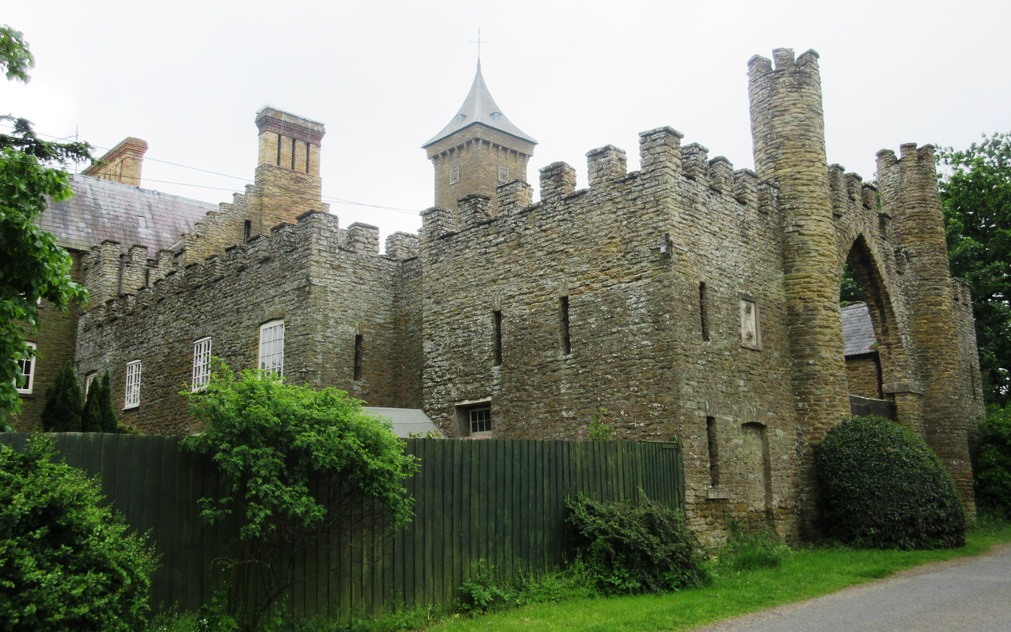
In the 18th century the Boughton Park estate was owned by the Earls of Strafford. William Wentworth, 2nd Earl of Strafford, built six follies there.

The photograph above shows The Spectacle, a castellated archway built to be seen on the horizon from Boughton Hall.

Near it stands a large house in similarly romantic style. this is not one of Wentworth's follies but Holly Lodge, which was built for the Jeyes family (as in Jeyes Fluid) in the following century.

Another of the Boughton Park follies is the Hawking Tower, which I have been looking for on the main road between Market Harborough and Northampton for decades without knowing what it was.

And The Obelisk, which was built by Wentworth as a memorial to his friend William Cavendish, the fourth Duke of Devonshire, loomed up in the distance as I walked around Boughton on Saturday.

One day I will go back and photograph it close up, though I have the feeling that it is one of those buildings that will move around the landscape if you try too hard to pin it down.

There is more about the Boughton Park follies on Painted Pixels and in an old newspaper article about Simon Scott, who has written a book about them.


Scrutiny process "ripped up" on Leicestershire's fire authority


Mike Charlesworth, the leader of the Liberal Democrat group on Leicestershire's fire authority, has written a letter of complaint about the way the authority is being run to its monitoring officer.

The complaint, reports the Leicester Mercury, follows the departure of the county's chief fire officer after just over a year in the job with an £84,000 pay off.

This move was not discussed with the Lib Dem group, which holds the balance of power with the authority. It would probably have remained secret if the Mercury had not revealed it.

There is a widespread perception that the fire authority has been carved up between Sir Peter Soulsby, the Labour mayor of Leicester, and Nick Rushton, the Conservative leader of the county council.

As Mike Charlesworth told the Mercury:
Rushton and Soulsby are running what ought to be a democratic body as a two man show. 
"We appreciate there will be employment issues involved with Richard Chandler leaving, but as a courtesy at the very least we should have been told about this so we could raise any concerns. 
"There are so many questions about this that need answering. 
"We don't know what settlement package has been agreed with the chief fire officer, whether it is justified. 
"They've just ripped up the scrutiny process. 
"They are making major decisions effecting public services as if it was some private club."
The paper also quotes Rushton's reply, which does not seem overconcerned with democratic oversight of the authority's decisions..

Meanwhile the people of Leicestershire wait avidly for news of the police investigation into the hacking of Nick Rushton's Twitter account.

Monday, June 06, 2016

George Whyte-Melville, the author of "Market Harborough"


Despite the presence of the ruined St John a little way out of the village, Boughton has a medieval church. St John the Baptist probably began life as a chapel for Boughton Hall.

Next to it is the village pub, The Whyte Melville.

It is named for the 19th-century Scottish novelist and poet George Whyte-Melville, whom I have run into a couple of times before.

He wrote many novels of the hunting field. One of them, published in 1861, was titled Market Harborough.

And around 1990 I occasionally played chess for Northampton Working Men's Club. They took part in the national club knock out championship, which was something the Market Harborough team did not aspire to.

The building where we played in Northampton was often referred to as "Whyte-Melville" because George had founded it.

Like so many such clubs, it has now closed. The premises are occupied by a pub called The Fox and Quill (which was previously the Goose on Two Streets).

Six of the Best 603

RIA Novosti archive
"If Brexit wins, it will be because a majority of British voters have simply lost confidence in the way they are governed and the people they are governed by. That loss of confidence is part bloody-mindedness, part frivolity, part panic, part bad temper, part prejudice. But it is occurring – if it is – in a nation that has always prided itself, perhaps too complacently, on having very different qualities: good sense, practicality, balanced judgment, and a sure instinct for not lurching to the right or left." Martin Kettle analyses why we have been brought to the verge of Brexit.

Bernard Aris says the Leave campaign has not thought about the implications for Ireland - north and south.

Mikhail Gorbachev still has lots to say finds Neil MacFarquhar.

The good news is that expensive libel cases are in decline, says David Hencke. The bad news is that the rich are using the 'right to be forgotten' to effectively silence their critics instead.

Daniel Ralston tells the story of the fake Zombies - the strangest con in rock history.

York Stories visits the threatened buildings of Ordnance Lane.

Viktor Korchnoi was a beacon to Soviet dissidents


In April I wrote that:
Like all sports, chess has a way of mirroring the conflicts in wider society. 
The Fischer vs Spassky match of 1972 was a wonderful metaphor for the Cold War, even if the gentlemanly, quietly dissident Boris Spassky was never a cypher for the Soviet Union. 
In the 1980s the volatile Garry Kasparov was a perfect symbol of glasnost and perestroika against the model Soviet citizen Anatoly Karpov.
In between those two rivalries came the one between Karpov and Viktor Korchnoi, which was a battle between the model Soviet citizen and a dissident.

Korchnoi died today at the age of 85. Leonard Barden's obituary of him in the Guardian explains his significance in and beyond the game:
Viktor Korchnoi ... was a chess grandmaster who defected from the Soviet Union, then twice challenged the USSR’s Anatoly Karpov for the world title. Their first contest, in 1978 in the Philippines, was the most bizarre in championship history, bitterly fought on and off the board. 
Soviet media referred to Korchnoi as “the opponent” or “the challenger” rather than by name. Karpov refused the traditional pre-game handshake, Korchnoi wore mirror glasses. Karpov’s team included a hypnotist seated in the front rows staring at Korchnoi, who enlisted two members of a meditative sect on bail for murder. Needing six games to win, Karpov led 5-2 before Korchnoi fought back to 5-5, only to lose the decisive game. 
Korchnoi was already 45 years old when he defected, an age when most chess players are well past their best. For him it was a liberating experience, and when his results equalled or surpassed what he had achieved as a Soviet citizen, it stimulated an exodus not just of grandmasters but also of other intellectuals.
Korchnoi's agreed  epitaph already seems to be that he was the strongest player never to win the world title.

Sunday, June 05, 2016

Michael Winner on the Stiperstones


Another film from the BFI's Britain on Film site. As ever, click on the image above to view it there.

This is a 1961 travelogue taking in haunted sites across Britain. What interests us most is the opening, where David Jacobs (in a suit) is seen with a young lady on top of the Stiperstones, before Edric and his wild hunt put in an appearance up there.

The superstition I know is not that it will rain if you sit in the Devil's Chair. Rather it is that if those rocks are shrouded in cloud then the old boy is sitting there himself.

Edric and his followers also put in an appearance in Malcolm Saville's Seven White Gates:
Suddenly Jenny gave a stifled little scream and pointed up the track which led to to the mines. Shadowy in the thickening mist, the two girls seemed to see a figure on horseback waving ghostly arms but no sound of hooves came to their straining ears. Then, far away on the hilltop, it seemed to Peter than tiny, gnome-like figures flitted in uncanny procession. 
Jenny turned and wailed into Peter's shoulder. 
"Peter. It's true. It's them. They're riding again. What shall we do. Peter? We must hide our eyes. We mustn't even see them. Don't Look. Peter."

Martin Carthy and Dave Swarbrick: Byker Hill


Dave Swarbrick died this week, a full 17 years after the Telegraph published his obituary. But what the paper said then remains true:
Dave Swarbrick, the violinist and singer ... was one of the most influential folk musicians of the 1970s and 1980s, especially with the group Fairport Convention. A small, dynamic, charismatic figure, "Swarb"—cigarette perched precariously on his bottom lip, unruly hair flapping over his face, pint of beer ever at hand—could electrify an audience with a single frenzied sweep of his bow. He never failed to produce a dramatic effect, whether on fiddle or mandolin, whether playing in tiny folk clubs or at huge open air festivals
Here he is with his regular collaborator Martin Carthy - the pair have featured here before.

Saturday, June 04, 2016

The ruins of St John, Boughton: the most haunted site in Northamptonshire


Boughton is a chocolate-boxy village just north of Northampton where for decades the wealthy of that town have chosen to live. Today it is threatened by its remorseless expansion.

But less than a mile to the east everything changes. This is the original site of Boughton and there you will find the ruins of the church of St John.

The Victoria County History described it thus in 1937:
The ruins of the old church of ST. JOHN stand to the north-east of Boughton Green on a site which falls from west to east. The building consisted of chancel, north chapel, nave, and west tower with spire and was of 14th-century date, but the remains have long been neglected and are undergoing a gradual process of disintegration by the agency of weather and the unchecked growth of ivy. The site is thickly overgrown and at the west end is a confused mass of rubble, broken gravestones, brambles, and nettles. Where the walls stand to any height their architectural features are generally hidden by ivy. Bridges, early in the 18th century, described the building as then 'in ruins, without a roof, the walls in several parts levelled with the ground', (but the tower and spire stood till about 1785.
But things were worse in the 16th century:
the rabbits invaded the churchyard itself, making the place so dangerous that the inhabitants were afraid to go to mass for fear of breaking their necks. It was said that the bones dug up by the conies would fill a scuttle and 'that a man can go skantly in a corner of yt but he shall fynde it full of dead mennes bones, a thing most pytyous to be seen'. One of the parishioners stated that a 'great number of conyes have so underminded the church yarde of Bouckton that it wold abhorre any Crystiane manys harte in the world to see it'.
Today the ruins are picturesque, but the steeply sloping churchyard makes it difficult to explore and there are disconcertingly recent burials.

There is also a spring issuing from beneath the east wall of the ruined chancel, making one think that this must be an ancient site whose sacredness predates Christianity.


It also has the reputation of being the most haunted site in Northamptonshire.

The Ghost Book says:
Around two hundred years ago, a young couple had been married only a few hours when the groom dropped dead. Grief stricken and unable to live without her love, the young lady ended her own life next to her husband's grave.
And it continues:
Following on from the tale of the doomed newly weds, the most famous ghost is said to be that of a beautiful red haired woman. She entices male passers by, and asks for a kiss. Be warned, for the legend follows that if you receive a kiss from this young woman, you will come to your death exactly a month after. 
This is said to be the fate of William Parker. He was passing by the churchyard on Christmas Eve in 1875 when he met a beautiful red haired girl. She invited him to sit with her for a while. After saying farewell, the young woman vanished and sure enough, William died exactly one month later, to the day. 
Again, on Christmas Eve, a moaning spirit makes his presence known. It is believed to be the spirit of Captain Slash, but why would he haunt the churchyard? Perhaps he is in search of the other members of his gang, ready to patrol the highways once more. 
The spirits of children have been reportedly seen amongst the grave stones. There is evidence that several children are buried on the site. 
A figure of a woman in white robes, and a headless man have also been seen.
I did catch sight of something in the corner a couple of times, but when I turned my head it had gone.

There was no sign of the beautiful redhead, Captain Slash or the ghost children, but I did take a lot of photographs.

And in my experience such things are more likely to appear if you print those photos in black and white.


The greatness of Muhammad Ali and the decline of boxing


In his pomp Muhammad Ali was just about the most recognisable man on the planet. Supreme as an athlete, he risked everything that had earned him to stand up for his people and for what he believed to be right.

One reason for his extraordinary fame was that he was a great athlete in a sport that enjoyed a popularity it hard to imagine today.

Heavyweight boxing was the blue riband event. In the years of rationing after the second world war British men like Bruce Woodcock, who were really no more than middleweights, had to take on American heavyweights so we had someone to compete in it.

When I was a small boy the great heavyweight bouts were global events of extraordinary significance. I have a clear memory of listening to them on the radio late in the evening.

So much so, that when I was in New York I went to look round the foyer of Madison Square Garden, where so many of those great fights were held, just so I could say I had been there. (Admittedly, the recent Clapton and Winwood concert there may have had something to do with it too.)

Time moves on and sports lose popularity. In the first year of this blog's life I wrote:
Thirty years ago the British heavyweight boxing champion was just about the biggest name in sport - think of Henry Cooper. Can you name the current holder of the title without using Google? I can't.
That would have to read 42 years ago today. There are several credible British heavyweights around today, but I have not idea if any of them is British champion.

I fell out of love with boxing when Michael Watson suffered brain damage in a bout with Chris Eubank. That had been an era when there were great British middleweights - Watson, Eubank, Nigel Benn - and their clashes made for wonderful fights.

It was magnificent when Eubank got off the canvass and from God knows where found a punch to knock Watson out and win the fight. But the damage it caused convinced me that professional boxing was insupportable.

I did watch Eubank's son Chris Eubank Jr fight Nigel Blackwell. The younger Eubank is clearly a very talented fighter, but I found the proceedings sickening.

Not just because Blackwell ended up in a coma and almost died, but also because of the dishonesty of the commentators.

It was clear almost at once that Eubank could unload combinations on Blackwell's head at will and that Blackwell lacked the weapons to stop him. Yet the commentators talked up the idea of Blackwell fighting back right up until the point that the fight was stopped.

The nearest equivalent to Muhammad Ali today in talent and personality is Usain Bolt. It is hard to see how a boxer could ever achieve that sort of fame again.

Until things change (and they will), you have to put your money on the next sporting figure to matter beyond sport in the way Ali did being a footballer.

Friday, June 03, 2016

Haltwhistle to Alston in 1976


This branch is a branch that survived the closures of the Beeching years but succumbed in the following decade. The film here was shot in 1976, its final year of operation.

Today part of the trackbed is used by the South Tyndale Railway, but if the whole branch had survived only a few more years it might still be open today.

Thanks to Tim Hall on Twitter.

Drunk vicar: ‘I’m from the Vatican, you're f**ked’

A new winner of our Headline of the Day Award: well done Court News UK.

Thanks to Joe Oliver on Twitter.

Thursday, June 02, 2016

Vince Cable outside the Angel, Market Harborough

Photo © Andrew Carpenter
Vince Cable was in Leicestershire today campaigning in the European referendum. He spoke in meetings in Leicester, Oadby and Market Harborough.

He is seen here outside the Angel, Market Harborough, with East Midlands EU referendum coordinator Cllr Phil Knowles and Harborough Liberal Democrats' parliamentary spokesperson Zuffar Haq.

"Jeremy Corbyn: The Outsider" is a sad film


We are so used to this behind-the-scenes view of politics being used in satire that it is hard to view this film from VICE News without looking for opportunities to laugh.

What it confirms is that the operation around Jeremy Corbyn is shambolic and that his decades on the far left have given him a weird view of the world.

In those circles the enemy is not so much the Tories as moderate Labour people and the press. Note that it is the Guardian and the BBC, where those two tendencies tend to come together, that particularly annoy Corbyn.

So in the end this film is not funny but sad. Sad because it makes you fear that, though they are incompetent and split down the middle, the Conservatives may well walk the next election.