Wednesday, September 19, 2012

Nick Clegg says sorry over tuition fees pledge


Nick Clegg has recorded this video - you can read a full transcript of his words on the party's website.

It was released to journalists this evening (as well as being made freely available on Youtube) and will be shown as the Liberal Democrats' conference broadcast on Monday.

My reading of the video is that Nick is apologising, not for the party's policy at the last election, but for the pledge that he and (so Wikipedia suggests) every successful Liberal Democrat candidate signed before the last election:
“I pledge to vote against any increase in fees in the next parliament and to pressure the government to introduce a fairer alternative.”
I also take him as apologising, not for breaking this pledge, but for making it.

I think Nick is right to make this apology, because he should never have signed the pledge in the first place. As I argued at the height of the fees row in December 2010:
Whatever your view on the tuition fees issue, there are good reasons why candidates should not get involved with such pledges. 
Because they are often signed out of fear. A campaign group asks candidates from all parties to sign a pledge and they sign it, often regardless of the importance of the issue or the coherence of the group's ideas, because they are afraid of bad publicity. No one wants to see a headline like "Lib Dem candidate refuses to support fluffy kittens" (or it may be sad orphans or puppies with large trusting eyes). 
Nor is it helpful for candidates to commit themselves to the fine details of policy in this way. I can see that a candidate might think that, say, improving educational opportunities for children from poor families is not negotiable, but I can see no good reason to wed yourself to a particular mechanism of achieving it. Good government does not consist in implementing your manifesto regardless of changing circumstances.
But then I am unusual among Liberal Democrats in that I never saw our policy on tuition fees as particularly admirable. I have a great deal of sympathy for the case recently made in a guest post on this blog by 'Dr Anonymous' - that too many of what he calls the DMC (dull middle class) go to university.

The rapid expansion in higher education over the past 20 years has made it inevitable that the state will be less generous to students than it used to be. If that expansion had seen far more youngsters from poor homes benefiting then I would feel more inclined to see financing students as a priority. But as things stand, giving more funding to students does not seem a priority nor even a particularly radical policy.

The hope now is that the tuition fees will not now dominate the public's view of the Liberal Democrats. In particular, voters do seem to have grasped that it is us who they have to thank for the substantial income tax cut enjoyed by lower earners. The hope is that we can build on this at Conference and beyond.

Incidentally, this is rather impressive on the part of those voters, given that the press coverage of the Budget centred on pasties.

One other point...

The email from Nick Clegg to Liberal Democrat members was headed "No easy way to say this...". I thought for a moment he was leaving me.

Tuesday, September 18, 2012

Delapre Abbey, Northampton


Today I visited Delapre Abbey in Northampton and it turned out to be real gem - a Medieval nunnery converted into a great house in the 16th and 17th centuries, with the addition of a fashionable library around 1820.

You can't go round the house, but the admirable Friends of Delapre Abbey sell teas in the old stables and the lovely walled garden. Bonkers Hall must be very like this.

The Abbey was threatened with demolition in the 1950s and (after serving as the county record office for some years) with redevelopment of its park a few years ago. So it needs friends.

The new Liberator is out

Read all about it on Liberal Democrat Voice.

Alex Thomson doorsteps Kelvin MacKenzie

Lord Bonkers' Diary: Giving up the captaincy

Giving up the captaincy

In Westminster, I come across our own Nick Clegg. I ask him if he has seen Andrew Strauss’s resignation as captain of the England cricket team. I emphasise how Strauss had won everyone’s respect because of his dignified bearing and the happy timing of his decision.

Warming to my theme, I say: “You don’t want to be like Michael Vaughan. He stayed at his post for too long and then burst into tears. Look at Colin Cowdrey: they had to drag him bodily from the Long Room and he tried to hold on to the furniture as he went past it. And poor Andrew Stoddart shot himself.”

Clegg is polite, but when we part I remain unconvinced that he has taken my point.

Lord Bonkers was Liberal MP for Rutland South-West 1906-10

Earlier this week in Lord Bonkers' Diary

Monday, September 17, 2012

Meet the Kray Twins


Or as Monty Python put it:

Presenter: ... Last Tuesday a reign of terror was ended when the notorious Piranha brothers, Doug and Dinsdale, after one of the most extraordinary trials in British legal history, were sentenced to 400 years imprisonment for crimes of violence. We examined the rise to power of the Piranhas, the methods they used to subjugate rival gangs and their subsequent tracking down and capture by the brilliant Superintendent Harry 'Snapper' Organs of Q Division. Doug and Dinsdale Piranha were born, on probation, in a small house in Kipling Road, Southwark, the eldest sons in a family of sixteen. Their father Arthur Piranha, a scrap metal dealer and TV quizmaster, was well known to the police, and a devout Catholic. In 1928 he had married Kitty Malone, an up-and-coming East End boxer. Doug was born in February 1929 and Dinsdale two weeks later; and again a week after that. Someone who remembers them well was their next door neighbour, Mrs April Simnel.

Mrs Simmel: Oh yes Kipling Road was a typical East End Street, people were in and out of each other's houses with each other's property all day. They were a cheery lot.

Interviewer: Was it a terribly violent area?

Mrs Simmel: Oh no......yes. Cheerful and violent. I remember Doug was keen on boxing, but when he learned to walk he took up putting the boot in the groin. He was very interested in that. His mother had a terrible job getting him to come in for tea. Putting his little boot in he'd be, bless him. All the kids were like that then, they didn't have their heads stuffed with all this Cartesian dualism.

Hold the front page: A sensible Tory MP

Having taken what is historically the Liberals' last bastion, Glyn Davies (the Conservative MP for Montgomery) must have something going for him.

Ah, you will say, all he had to do was stand there while Lembit Opik imploded. But that might be to underestimate him.

Because Davies has just written a blog post that shows a rare degree of good sense about the Coalition:
Sometimes my Conservative colleagues cause me despair. Never more than when they attack our coalition partners, the Lib Dems. I wonder what planet they're on whenever I hear references to "The tail wagging the dog". Some even advocate bringing down the coalition. Ill-considered nonsense in my opinion. Triumph of hope over reason. Its actually time for re-declarations of love, not filing for divorce. 
Lets look at some of the facts. 
1) The Conservatives did not win the last General Election. There was certainly a case for 'going it alone' at the time, and instigating another election in a year or so which would hopefully deliver victory - but we didn't. We took a clear direction and decided that the economic and financial challenges were such that a coalition was the better option. Nothing has changed. 
2) Its was the Lib Dems who had to make the biggest concessions - admittedly because their manifesto was hopelessly undeliverable. They signed up to higher student fees - despite promising the opposite. They signed up to a VAT increase despite making such a big deal of opposing this. 
3)They signed up to nuclear power despite being supposedly anti-nuclear. And the consequence of this is that their opinion poll support has bombed. They took the massive risk of growing up from being woolly hatted idealists into hard headed realists. It was courageous. 
3)* Without the Lib Dems, the current Government wouldn't last long. OK, so fixed term parliaments are enshrined in law, but I do not believe we could limp on until 2015. I want to see Nick Clegg remain DPM, and the Coalition last the full five year term. I suggest some of my colleagues think how they'd feel with Ed Miliband as PM and Vince Cable/Tim Farron as DPM. Time they got real and stayed real.
One of the sad things about the recent reshuffle is that it made it impossible to hold a favourable opinion of David Cameron.

Once you could believe he had grasped that the death of liberal Conservatism was his party great weakness and that he had co-opted the Liberal Democrats to fill the void. No longer. Either he has failed to recognise that truth or he lacks the courage to act upon it.

So I have a new Conservative hero. Glyn Davies for Tory leader!

* OK, so Maths isn't his strongest subject.

Headline of the Day

A hometown decision? The winner is the Harborough Mail:

Kevin is the new ‘face of potatoes’ for the region

Six of the Best 277

"Our starting point, the reason I became a Liberal Democrat, and the reason many people joined the Liberal Democrats, is because they want people to be free and empowered and are suspicious of the state taking on excessive authority." Mark Pack welcomes Jeremy Brown's first interview as a Home Office minister. (That's Jeremy speaking, not Mark - though I am sure Mark agrees with him.)

Neil Monnery takes apart a particularly silly argument against the reform of school examinations.

"Saudi Arabia these days is all too reminiscent of the dying decade of the Soviet Union, during which one decrepit leader succeeded another, from Leonid Brezhnev to Yuri Andropov to Konstantin Chernenko, before a younger and more open-minded Mikhail Gorbachev arrived too late to save a stagnant society and economy." Karen Elliott House looks at the future of the kingdom in the Washington Post.

This Was Leicestershire visits the Richard III dig in Leicester.

By contrast, "Nottingham has never been quite sure of its identity. Bloody Robin Hood has a lot to answer for, or at least Basil Rathbone and Alan Rickman camping it up as the Sheriff of Nottingham." Or so Jones the Planner says.

LDN Photo Journal snaps the Crystal Palace dinosaurs, which will be familiar to those who share my affection for the film "Our Mother's House".

Lord Bonkers' Diary: David Boyle's wonderful opening ceremony

The September issue of Liberator has just arrived on my doormat with a satisfying thump, which means it is time to spend some more time with Rutland's most popular fictional peer.

Incidentally, we used to hand out this issue from the magazine's stall at Conference, but the level of security at the event now makes that impossible.

O tempora! O mores!


David Boyle's wonderful opening ceremony

Wasn’t the Olympic opening ceremony fun? Such events are not usually my cup of tea (I seem to recall that the ceremony for the 1936 Berlin Games was devised by Albert Speer, who decided to repeat the ‘cathedral of light’ effect that had gone down so well at the Nuremberg rallies), but when I heard that the one for London 2012 was in the hands of that excellent Liberal David Boyle, I knew we were in for a treat. Some, I know, found the evening’s events such a cornucopia that they were at a loss to know quite what was going on; it happens that I am familiar with Boyle’s oeuvre and can therefore enlighten them.

The evening began with rustic scenes of sheep farming and cricketers in top hats – I flatter myself that this passage was inspired by Boyle’s many visits to the Hall. Then the Industrial Revolution took place (my dear: the noise, the people!) and the stadium was filled with dark satanic mills.

Just as we were all getting downhearted, the most wonderful thing happened: the mill hands realised that there was more to life than forging nuts or widgets or whatever it was they were making and began to set up their own co-operatives, open organic teashops and inaugurate local currencies. They were having so much fun that the Army had to be called in to clear them from the grass in case they were still there when the qualifying rounds of the women’s discus were due to begin.

Incidentally, if you see Boyle, can you mention that I am still looking for a bar in London that accepts these blessed ‘Rutland Dollars’ he invented.

Lord Bonkers was Liberal MP for Rutland South-West 1906-10

Banned in London

The Manifesto Club has launched a Google map, titled Banned in London, which reveals the 435 special zones that now cover half the area of the British capital.

Writing on Spiked, Josie Appleton says:
In these areas, people can be fined or prosecuted for activities that would otherwise be perfectly legal - including leafleting, protesting, dog walking, gathering in groups, or drinking. Similar zones have been enacted by local authorities across the UK. In London and most other UK urban areas, there are four different kinds of zone: no-dog zones; no-leafleting zones; alcohol-confiscation zones; and dispersal zones. London also has the distinction of a fifth zone – a restricted protest zone, in the vicinity of the Houses of Parliament.
And she goes on to explain:
Worryingly, these banned zones are being enforced not only by police, but also by a growing force of unaccountable officials. There are now hundreds of council officials with powers to fine people for unlicensed leafleting or walking dogs in the wrong area. Several London councils also contract private security companies to patrol the streets and issue fines.

Sunday, September 16, 2012

Does Cameron's lurch to the right give Nick Clegg an opportunity?

I was depressed by the changes David Cameron made in his reshuffle, particularly the way they marked the death of any support for localism or green politics in Tory circles.

However, writing in tomorrow's Guardian, John Kampfner argues that those changes have presented Nick Clegg with a welcome opportunity:
What has been found to work is when, publicly but politely, one leader says: "We advocated A, they advocated B, but we agreed to settle on C." All surveys in Europe suggest that the public respects an open airing and settling of differences. 
Yet the Lib Dem leader consistently dismisses this notion. Instead he has fluctuated from the mistaken love-in on the lawn and the kamikaze mission over tuition fees, to visceral anger over Cameron's undermining of the AV campaign and House of Lords reform. 
This month's reshuffle presents Clegg with an unlikely opportunity. He can now have no doubt about Cameron's intentions. The Conservative rump of the cabinet is as red meat as it could be – authoritarian and sceptical about climate change. Some of Clegg's team were taken aback by the changes. They shouldn't have been. 
With the coalition entering the second half of its projected five-year lifespan, the Lib Dem leader needs each and every day to tell the public what his party is seeking to do, what it will put up with, and what it won't. This can be done without petulance – at least on the Lib Dem side. If Tory backbenchers, in denial over their failure to win in 2010, wish to force an early election or go into minority administration, let them.

Liberal Democrat Conference: A reminder

Despite the vote at Conference last year, you will again have to be approved by the police before you can attend this year's event.

Once again, I call upon late Gordon Jackson to demonstrate the wrong way of presenting your papers.

Kate Bush: The Kick Inside


Having had for some years a cupboard full of LPs and nothing to play them on, I decided to act. I had either to take them down to the charity shops or buy something to play them on. I chose the latter course and am now the owner of a cute little portable record player.

Most of my collection consists of secondhand classical LPs (always wonderful value for money), many of them bought from Yarborough House in Bishop's Castle. But I also have the LPs I bought as a teenager and there is something wonderful about being able to play them today.

Songs of the Wood by Jethro Tull turns out to have been played to death - it jumps all over the place - but The Kick Inside by Kate Bush still sounds good.

In fact it sounds better than it did, because the needle on our old family portable used to pick up Kate Bush's voice in adjacent grooves and the title track sounds strange to me without that odd pre-echo.

In a 1978 interview (that was when Kate Bush still gave interviews) she explained the genesis of the song:
"That's inspired by an old traditional song called 'Lucy Wan.' It's about a young girl and her brother who fall desperately in love. It's an incredibly taboo thing. She becomes pregnant by her brother and it's completely against all morals. She doesn't want him to be hurt, she doesn't want her family to be ashamed or disgusted, so she kills herself. The song is a suicide note. She says to her brother, 'Don't worry. I'm doing it for you'."
"The Kick Inside" was also recorded by Julie Covington, but I cannot find that version on YouTube.

Saturday, September 15, 2012

The search for Richard lll press conference, 12 September


This is the press conference held by the University of Leicester in the city's Guildhall on Wednesday at the which the discovery at Greyfriars was announced.

My sources tell me that the Leicester's mayor, Sir Peter Soulsby, was originally a sceptic about the project. But he looks like a cat who has got the cream here.

Grumpygate rocks Telford & Wrekin Council

From the Shropshire Star:
Tory group leader Andrew Eade stormed across the council chamber to confront Labour rival Clive Elliott and told him: “We can sort this out outside.” 
Councillor Elliott, a member of the Labour Cabinet on Telford and Wrekin Council, had said: “What does he do for his Special Responsibility Allowance? 
“Even the seven dwarves went out to work. I can see some of them here: Sneezy, Sleepy, Dozy, Happy, Doc and Bashful. 
“What I don’t see is any leadership from Grumpy.”
Councillor Eade said to mayor Kevin Guy, chair of the meeting: “Either you shut him up or I will” before getting up to stand next to Councillor Elliott. 
He said: “Do you want to come and talk about it outside? Come on. We can sort this out outside.”
Thanks to a tweet from Harry Cole for the happy coinage 'grumpygate'.

Friday, September 14, 2012

More open days at the Richard III dig site in Leicester

Such has been the interest in Leicester's Richard III dig that three further open days at the Greyfriars site have been announced:
  • Saturday 15 and  Sunday 16 September: 11.00am – 4.00pm
  • Wednesday 19 September: 5.00pm – 7.00pm
  • Saturday 22 and Sunday 23 September: 11.00am – 4.00pm
There is also a Richard III exhibition at the nearby Guildhall and guided walks around the Leicester sites associated with Richard.

More on the city council website.

GUEST POST The difficulty of getting started in farming

Joshua Metcalfe suggests some ways of making things easier for the next generation of farmers

People in developing countries depend heavily on agriculture for their livelihoods, yet are increasingly challenged in their ability to produce sufficient food for their families and for markets. As the world’s population continues to grow, expected to reach nine billion by 2050, nearly 1 billion people remain undernourished and by 2050 farmers will need to double crop and meat production to meet demand.

More volatile and extreme weather, pests and disease only exacerbate the problem. Investment is needed to attract fresh blood, and increase access – access to natural resources, knowledge and information, technologies, research and extension services - to name just a few.

Although it is still an important industry, farming seems to have fallen out with the younger generations in Britain. In an attempt to move the population forward past governments and the entertainment industry have sown the seeds of professional career pride. We are born to fill a pair of smart office shoes, born to sit behind a desk and type away for 50 years until we are finally granted permission to retire. This is not a life I’d choose, which drives me to find an alternative: farming.

The agricultural industry is one of the most difficult to venture into. The very nature of the sector deters most due to the long hours required, the physical labour and the endless depths of knowledge needed.

But the sector needs new blood. With the average age of farmers being well over 60, 20 years down the line their boots will have to be filled. Our farms must keep up with the growing demand of our domestic population as well as that from further afield in Europe. What astonishes me is that nobody seems interested in following in their footsteps. The process of which could be made much easier by calculated government intervention.

Funding is the biggest issue. Enormous initial set up costs can look very ugly on one’s bank statement. Plus, even when the business is established, there is no guarantee of money coming in as any number of problems can factor in and can easily destroy livelihoods.

Interest free overdrafts could be provided to larger sums than usual for first generation farmers, offering them a strong financial wind-block for the times when hatches must be battened down. Banks can go further in assisting by offering low interest long term business loans to prospecting farmers, and if not the banks then the Government. Education comes under the umbrella of funding. The vast majority of courses at agricultural college have no government funding available, and at £10,000 a year in some cases, it leaves the hopeful farmer stuck between a rock and a very hard place.

Access to land is another tall hurdle presented to the budding farmer. The current nature of business and practice within the sector dictates that well-established and successful farms become greedy and lease or buy more and more land each year amassing truly enormous estates. Farmers need to understand that snatching opportunity away from starters will prove to be detrimental to the industry they passionately and proudly work in. Local councils must stop selling their tenant farms; they must be reserved for new starters.

One statistic that exemplifies this great land grab comes from the dairy sector: In 1992 there were 22,000 dairy farms active; today that number has dropped to 6000. This huge reduction is indicative of a trend that only recently has bucked; that trend being near industrialisation of the sector, estranging it from its organic roots in the local community.

Encouragement is essential. This will require government intervention and further regulation by bodies such as the NFU. Codes of practice in business need to be introduced and adhered to by the established farms. Funding must be made available to budding farmers. Assistance must be offered but it is also imperative that it is not made easy.

The lifestyle of a farmer is one of the most demanding and acquiring the means to instigate your venture into the industry must be equally as demanding; but it must be made available. The British agricultural industry is the most advanced of its kind in the world and it must have a future. With good forward thinking, intervention and assistance it can long continue to be as productive and profitable as it has always been.

Joshua Metcalfe blogs at I Want to be a Farmer. You can also follow him on Twitter.

Those missing monarchs in full

They were digging up the road outside my office in Leicester today. Perhaps, emboldened by the apparent discovery of Richard III in  the city, they were looking for another king?

To help them, the BBC Leicester pages have posted a guide to the English kings whose bodies have gone missing.

They are:
  • Alfred the Great (he may be somewhere under Winchester)
  • Harold II (who was shot in they eye at the Battle of Hastings - what happened next is unclear)
  • Henry I (it might be worth searching under Reading)
  • Stephen (last seen in Faversham in Kent)
  • Edward V (he may be buried in Westminster Abbey, but may well not. Richard III adds: They always drag that up, don't they?)
  • Oliver Cromwell (shurely shome mishtake?)
  • James II (and VII of Scotland - he died in exile in Paris, and his tomb was sacked in the French Revolution)
The article also suggests that Charles I was mislaid for a good while:
Workmen rediscovered the vault by accident in 1813 and found a velvet draped coffin with the missing monarch's name on it. To satisfy their curiosity, a group of notables opened the casket and, sure enough, found a body with a detached head and a pointy beard.

Headline of the Day

Could the Daily Mail be emerging as a rival to the Shropshire Star?

Saddam lookalike attacked by gang who tried to kidnap him and force him to impersonate the dictator in porn film 

I suspect that Saddamporn is something of a niche market.

Thursday, September 13, 2012

Gareth Epps on The Westminster Hour

Gareth Epps, my Liberator colleague, was interviewed by Carolyn Quinn on last Sunday's The Westminster Hour. You can hear the interview on the BBC website.

More from Gareth Epps on his blog.

Stop mental health discrimination: Back the Bill


Tomorrow morning at 9.30 the second reading of Gavin Barwell's Mental Health (Discrimination) Bill in the Commons. This video explains why MPs should support it.

Wednesday, September 12, 2012

Six of the Best 276

"The failure of leadership was compounded by the way in which the authorities reacted to the disaster. As the report makes clear, the attempts to evade responsibility, the prevarication of certain officers and officials, and the conduct of some parts of the media turned a tragedy into a scandal and prolonged the agony of the families who lost loved ones." Matt Gallagher writes on today's report from the inquiry into the Hillsborough disaster."

Jonathan Fryer attended Nick Clegg's equal marriage celebration.

"Malls offer a false sense of community, kicking you out when the shops close at 5pm. The high street on the other hand is a place for all." On NewStart, Gilbert Rochecouste talks to Clare Goff about ways of revitalising Australia's towns.

"The brilliant, infuriating, persistent, renegade psychiatrist Thomas Szasz has died." Mind Hacks pays tribute to the author of The Myth of Mental Illness.

Heresy Corner on Channel 4's decision to pull a second screening of Tom Holland's documentary  In The Shadow of the Sword.

Victoria Walden reviews Michael Rosen's biography of Roald Dahl for the TES.

"Have you washed your hands, Tompkins?" CCTV in schools

Big Brother Watch received a lot of publicity this morning for its report Class of 1984: The extent of CCTV in secondary schools and academies.

That link will take you to the full report, and there is also an article about it on the Big Brother Watch website:
This report highlights an issue that has not been subject to any real public debate and we hope by highlighting the scale of the situation a proper debate can now take place about not only how to regulate CCTV, but also why surveillance continues to increase unchecked when there is still no academic research that suggests it is having a positive impact. 
We make three key recommendations in the report, which are: 
- The Home Office code of practice for CCTV cameras should apply to all publicly funded bodies 
- The Surveillance Camera Commissioner must have the power to enforce the code of practice and penalties for breaching the code must be available 
- The Government should commission an independent review of CCTV use in schools to explore the evidential basis upon which cameras have been installed. This should include ensuring any school using CCTV has appropriate policies in place so teachers and parents are fully aware of why surveillance is being used, when footage can be viewed and by who. 
The surveillance experiment of the past twenty years has failed to reduce crime or improve public safety. As schoolchildren across the country are now expected to accept surveillance for the formative years of their education, it is time for a different approach.

Have they found Richard III under a Leicester car park?


Extraordinarily, the answer may well be yes. Not only that, if I have understood the excavations correctly, they found him in the first trench they opened.

The video above explains how the dig has been conducted, and here is the opening statement that Richard Taylor, the University of Leicester's director of corporate affairs, made at this morning's press conference at Leicester Guildhall:
“The University of Leicester applied to the Ministry of Justice under the 1857 Burials Act for permission to exhume human remains found at the Grey Friars site in Leicester. 
“The work was conducted by Dr Turi King from the University’s Department of Genetics and Dr Jo Appleby and Mathew Morris of our School of Archaeology and Ancient History. 
“We have exhumed one fully articulated skeleton and one set of disarticulated human remains. The disarticulated set of human remains was found in what is believed to be the Presbytery of the lost Church of the Grey Friars. These remains are female, and thus certainly not Richard III. 
“The articulated skeleton was found in what is believed to be the Choir of the church. 
“The articulated skeleton found in the Choir is of significant interest to us. Dr Jo Appleby has carried out a preliminary examination of the remains. There are five reasons for our interest:
1. The remains appear to be of an adult male. 
2. The Choir is the area reported in the historical record as the burial place of King Richard III. John Rous, reports that Richard ”at last was buried in the choir of the Friars Minor at Leicester”. 
3. The skeleton, on initial examination, appears to have suffered significant peri-mortem trauma to the skull which appears consistent with (although not certainly caused by) an injury received in battle. A bladed implement appears to have cleaved part of the rear of the skull. 
4. A barbed iron arrowhead was found between vertebrae of the skeleton’s upper back. 
5. The skeleton found in the Choir area has spinal abnormalities. We believe the individual would have had severe scoliosis – which is a form of spinal curvature. This would have made his right shoulder appear visibly higher than the left shoulder. This is consistent with contemporary accounts of Richard’s appearance. The skeleton does not have kyphosis – a different form of spinal curvature. The skeleton was not a hunchback and did not have a 'withered arm'. 
“Both sets of remains are now at an undisclosed location where further analysis is being undertaken. 
“I need to be very frank. The University has always been clear that any remains would need to be subjected to rigorous laboratory analysis before we confirm the outcome of the search for Richard III. 
“We are not saying today that we have found King Richard III. What we are saying is that the Search for Richard III has entered a new phase. Our focus is shifting from the archaeological excavation to laboratory analysis. This skeleton certainly has characteristics that warrant extensive further detailed examination. 
“Clearly we are all very excited by these latest discoveries. We have said finding Richard was a long-shot. However it is a testament to the skill of the archaeological team led by Richard Buckley that such extensive progress has been made. 
“We have all been witness to a powerful and historic story unfolding before our eyes. It is proper that the University now subjects the findings to rigorous analysis so that the strong circumstantial evidence that has presented itself can be properly understood. 
“This is potentially a historic moment for the University and City of Leicester.”
The project is being filmed by Channel 4 (local rumour has it that the BBC turned the idea down) for a documentary that will be shown later this year.

Things have moved on since June, when I came across the legend that Richard was buried under Greyfriars in Leicester.

Badgers: Stop the Cull

Tuesday, September 11, 2012

Why Roger Helmer had to leave the Harborough Innovation Centre

Amid a heap of bluster, the UKIP Roger Helmer MEP admits in the Leicester Mercury that he has indeed been obliged to move his office out of the Harborough Innovation Centre because he had no right to be there in the first place:
"I have to admit I'm not a start-up tech company and a senior person from Oxford Innovations, which manages the centre, came to see me, apologised, but said I would have to leave."
Helmer's attempt to blame my old colleague Simon Galton neglects the fact that Harborough District Council is run by the Conservatives.

The Mercury found that, characteristically:
Coun Michael Rook, the Tory leader of the council, was unavailable for comment.
Still, well done to him for enforcing the rules.

Leah McGrath Goodman interviewed about Jersey on The Keiser Report


Back in July I blogged about the American journalist Leah McGrath Goodman, who had apparently been banned from the United Kingdom for seeking to investigate the treatment of children in public care on Jersey.

Here she is interviewed about her experience on The Keiser Report. The item begins at around 12:35, though the whole programme is interesting. The financial and political set up on Jersey is made to sound extremely odd.

Leah McGrath Goodman has written more about Jersey on her own website today.

Those new Lib Dem PPSs in full

News reaches me from Westminster about the appointment new Liberal Democrat parliamentary private secretaries.

Duncan Hames, MP for Chippenham, has been appointed as PPS to Lib Dem Leader and Deputy Prime Minister, Nick Clegg.

Lorely Burt, MP for Solihull, has been appointed as PPS to Chief Secretary to the Treasury, Danny Alexander.

Stephen Gilbert, MP for St Austell and Newquay, has been appointed as PPS to Energy and Climate Change Secretary, Ed Davey.

Tessa Munt, MP for Wells,  has been appointed as PPS to Business Secretary, Vince Cable.

Simon Wright, MP for Norwich South,  has been appointed as PPS to Education Minister, David Laws.

They've all done very well.

Later. It has been pointed out to me that Tessa Munt has held this post for some months. Someone had better tell Lib Dem HQ, who kindly sent me this list.

Into the Mouth of Hell exhibition, Wallsend

In 1816, as part of the celebrations of the final defeat of Napoleon, a state visit to the Britain was arranged for Tsar Alexander of Russia. He was accompanied by his 20-year-old younger brother the Grand Duke Nicholas - the future Nicholas I.

According to North-East History Tour, Nicholas expressed a wish to visit a coal mine:
Arriving at Wallsend on 16th December 1816, he was given a prolonged tour of the colliery site, before being invited to change out of his glittering finery and into a deputy-overman’s outfit, prior to being escorted to the gaping hole that was the pit-head. 
The chosen mode of descent for The Grand Duke was considered the safest of its day. This involved the riding of a large iron hook at the end of a long rope, by which he was told to cling to firmly, whilst keeping himself clear of the black and dripping walls with a short stick during his long, slow drop. 
At the time, Wallsend Colliery was one of the most profitable in the land and produced the very finest quality coal. The visit was meant to impress and enlighten, but ended up delivering a little too much in the way of information. For when Nicholas was brought to the very edge of the pit and looked down into the abyss, he stepped back hurriedly, holding up his hands in horror, exclaiming in French, “Ah! My God! It is the mouth of hell! None but a madman would venture into it!”
While I was at Segedunum museum, which stands next to the site of the old Wallsend colliery, there was an exhibition that took its name from this incident. "Into the Mouth of Hell" marked four major mining disasters that took place on Tyneside between 1812 and 1862. In particular, it commemorated the 150th anniversary of the Hartley Colliery Disaster, in which 220 men and boys died.

The fullest description of this incident and the community in which it took place is to be found on the Northumberland and Durham Family History Society site:
No man knew the people of these single-storey rows better than the colliery viewer, Joseph Humble. The viewer's duties were those of a manager who would be responsible for the day-to-day running of the pit, hiring workers, and so on. It was fitting that he had been chosen as census enumerator for much of the area in 1861: he would have known many of the families personally and would have their confidence in recording their details. Incidentally we have been able to find a good number of the miners' families in the 1861 census, but by no means all. Many would have moved into the area at the annual spring hiring in May, and in particular there was a big influx of new families from Scotland up at Quarry Row. 
Joseph Humble played a vital role during the anxious days following the closing of the shaft. He it was that kept communications going between the rescuers, led by the renowned 'sinker', William Coulson, and the anxious families at the pithead. He it was that was asked to go down once the way was open and see for himself the huddled rows of bodies with sons cradled for protection in their fathers' arms. 
His words poignantly expressed the grief sensed by all around him: "Oh, my men, my canny men, they would have done ought for me and there they are all lying dead and cold".
The exhibition has now closed, but at South Shields Art Gallery you may be able to see John Robson's 1930 painting "The Hartley Men", which makes the disaster look like an outing from a progressive school of the period gone horribly wrong.

Monday, September 10, 2012

The February 1974 general election campaign


Jeremy Thorpe, Edward Heath, Harold Wilson, a butcher from Kingstanding, Margaret Thatcher, Cyril Smith, Hester Smallbone, David Steel, Enoch Powell...

And proof it was true even 38 years ago that, whoever you vote for, David bloody Dimbleby gets in.

Nick Clegg conceded too much to the opponents of Lords' reform

In the course of a characteristically sparky performance in the Commons last week, making a statement on House of Lords reform and answering questions, Nick Clegg uttered said something that worried me:
For now, the immediate decision for the Government is how we fill the gap in the legislative timetable. We will bring forward measures to promote growth—the Government’s priority and my priority—and the Prime Minister and I will shortly be announcing details of that package.
This seemed to constitute a tacit acceptance that it was foolish to pursue reform of the House of Lords at a time when the economy is in such a poor state.

The truth, of course, is that all governments are doing many different things at any one time. It is perfectly possible to reform the Lords while giving the economy all the time it needs.

But it worried me for a deeper reason. Hasn't the Liberal and Liberal Democrat case always been that our economic malaise is closely connected with our flawed constitution and politics? I was sure that if I searched this blog I would find a senior Lib Dem making just the case.

Well, I searched it and did found just that. What I did not expect was that the person making the case would be Nick Clegg himself.

Here is the start of a House Points column I wrote for Lib Dem News in January 2009:
Is concern about accountability and democracy a luxury at a time of economic crisis? That was the question Nick Clegg asked the audience at Portcullis House, Westminster, on Tuesday night. 
He was speaking at an event marking 20 years of the campaign group Charter 88. Now part of Unlock Democracy, Charter 88 was set up to campaign for constitutional and electoral reform. A book – Unlocking Democracy: 20 Years of Charter 88 – has also been produced for the anniversary. 
Nick’s answer was clear: “An economic crisis is a political crisis as well.” He argued that this government’s mismanagement of the economy is directly related to our unreformed constitution. A winner-takes-all electoral system encourages a cycle of boom and bust and makes it too easy for the policy agenda to be captured by vested interests such as the City. 
A more pluralist system would have forced the government to listen to a wider range of voices. Better still, it would have forced it to listen to Vince Cable.
I don't know if that last point was in the speech or was dropped in by me, but Nick was right in 2009 and his argument holds just as true today.

Featured on Liberal Democrat Voice

Andrew Mitchell's Schooldays

Black Dog in the Mail on Sunday provides an insight into the character of Andrew Mitchell, the new Conservative chief, er, whip:
New Chief Whip Andrew Mitchell spent much of last week trying to live down his Rugby schooldays nickname of 'Thrasher'. 
It won't be easy. Fellow ex-pupils say that by the time Mitchell became head of house at Rugby in the Seventies, all the boarding houses had abolished beatings - except one, Tudor, where self-proclaimed disciplinarian Mitchell was in the all-powerful position. 
'The cool set had a spliff in one hand and a Hendrix LP in the other,' said a contemporary. 'Andrew had a big stick in one and a Tory manifesto in the other.'

Karl Popper on Head to Head

Head to Head is a BBC Radio 4 series in which Edward Stourton revisit broadcast debates from the archives, exploring ideas, the great minds behind them and echoes of the arguments today.

This morning's programme - which will be available on BBC iPlayer for the next week - dealt with an encounter between the philosopher Sir Karl Popper and the neurophysiologist Sir John Eccles.

It was not exactly a debate, as the two were in agreement, but it examined Popper's idea of falsifiability as a criterion for what is or is not science.

As a young man Popper had been greatly impressed by the way that Newton's theories, which seemed the most secure example of scientific knowledge, were shown to be inadequate by the work of Einstein. He contrasted this with the work of Freud, which seemed impossible to refute. From this he concluded that Newton's work was science and Freud's was not.

For a fuller discussion of Popper, which pays attention to his political philosophy, try this edition of In Our Time for 2007.

One good thing about this edition of Head to Head is that Stourton is respectful of both Popper and Eccles. So he does not laugh down his nose at them, as he has a habit of doing in the series.

When he does it, he sounds exactly like Martin Jarvis makes Hubert Lane sound in his readings of the Just William books.

Sunday, September 09, 2012

Free: Wishing Well


This record reminds of the time when I first made a point of listening to the singles chart on a Sunday evening. It was a hit in 1972, so I was probably 12. It also marks the end of an interesting era - a sort of interregnum between the glories of the 1960s and the rise of glam rock - when quite heavy bands made it into the charts.

Free, best remembered for Alright Now, though My Brother Jake is a good record too, were a notably youthful band, still in their teens when they came together in the late 1960s. Two of them went on to form Bad Company, while the guitarist Paul Kossoff died from drug-related heart problems at the age 25.

His father was the actor David Kossoff, who was a sort of Rabbi Blue of his era. Following links on Wikipedia, you learn that David Kossoff was the brother of the veteran Radio 2 DJ Alan Keith, and that Keith's daughter Linda inspired Keith Richards to write "Ruby Tuesday".

Grant Shapps' problems with the internet

As I possess that rare thing among Liberal Democrats - a soft spot for Baroness Warsi - I have been amused by three Guardian stories today about her successor Grant Shapps:
And they have reminded me of an incident that took place in 2007 during the Ealing Southall by-election. As Mark Pack revealed on Liberal Democrat Voice, the following comment was posted on a Liberal Democrat campaign video:
Okay, realistically we’re not going to win though. Especially since the Tories have just received 5 defecting Councillors from Labour. Don’t quite know how they’ve done it, but the Tories have stolen a march on us this time.
It was certainly meant to look like a comment from a Lib Dem activist, but it was posted from Grant Shapps' Youtube account.

Shapps, then a shadow housing minister and the man in charge of the Tory campaign in the by-election, denied the accusation. He gave his explanation of the incident to Iain Dale, the writer of the leading Conservative blog in those days, saying that his account had been hijacked.

The comments on that post suggest that not everyone was convinced.

Saturday, September 08, 2012

Richard III dig open day at Greyfriars, Leicester


Today I was one of more than 1500 people to visit the dig at Greyfriars in Leicester. The organisers weren't taking any chances: I counted security staff from the city council and at least two private firms. These middle-aged archaeology fans are obviously a notoriously rough crowd.

We were taken around the site in groups by an archaeologist, and I learnt much in the process. We Time Team viewers are used to the geophysics people producing miraculously clear plans of the building the diggers are seeking. The reality in urban archaeology is that the techniques reveals services like pipes, cables and gas mains, and that all the trenches have to be dug in the gaps between these.

The dig has now found the monastery and Robert Herrick's garden mentioned in my post from June. It has obviously been wonderfully fortunate in two ways.

First, the site has never been built on. There are no Victorian cellars here - indeed, it seems to have remained a garden until it became a municipal car park in the 1930s or 1940s. Second, the first trench came down precisely on the edge of the monastery's cloisters.

You can read the latest bulletin on the University of Leicester website. And the good news is that the dig, which was due to end this weekend, will continue next week.

Friday, September 07, 2012

The murder of Sir Jack Drummond and his family in 1952

A 2002 Guardian article by Jon Henley begins:
Fifty years ago next weekend a Hillman saloon pulled off the N96 near the village of Lurs, about 75 miles from Aix. It was a stifling Provençal afternoon and the car's occupants, the distinguished British scientist Sir Jack Drummond, his wife Ann, and their 10-year-old daughter Elizabeth, decided to camp out for the night by the banks of the river Durance. 
Within hours they became the centre of one of France's most troubling criminal puzzles, variously shot and clubbed to death. The tragic demise of the Drummonds is a murder mystery that has fired the public imagination for half a century. 
It was not just the victims' renown and the consequent fuss across the Channel: Sir Jack, a 61-year-old former professor of biochemistry at London University, had been knighted for his exceptional work in nutrition during the second world war and was a senior researcher at the Boots laboratory in Nottingham. 
Nor was it the unlikely and altogether too handy perpetrator fingered by the police and convicted 18 months later: Gaston Dominici, a 75-year-old peasant farmer whose smallholding was the nearest property to the scene of the crime, was a pillar of the local community. 
No, it was the many key questions that remained unanswered. What was Dominici's motive? Where did the murder weapon, a battered US army Rock-Ola carbine, come from? What of the unidentified men seen on the road? And was Sir Jack, as Fleet Street soon began claiming, rather more than just an eminent scientist?
This case has obvious similarities with the murders of Saad al-Hilli and his family in France earlier this week. (I had a journalist on the phone today hoping to be put in touch with the psychologist who has been interviewing the little girl found in the car. Don't you just love the tabloid press?)

The murder of the Drummonds was the subject of a BBC East Midlands documentary last year - you will find a video of it at the bottom of that page.

The blogger would like to thank his Mum for telling him about this case.

GUEST POST House of Lords reform in a 1950s whodunnit


Charles Beaumont looks An English Murder by Cyril Hare
"England, alone of all civilized countries, retains in its constitution an hereditary legislative chamber." - An English Murder, Cyril Hare (1951)
The Tory media screeched that the idea of an elected legislature would lead to “blood on the floor and the walls and the ceiling” and Boris Johnson, who owes his job to the largest direct election in British politics declared “[i]t is crucial to the success of the Upper House […] above all that it is at one remove from the electorate”. The average liberal got a forcible reminder of conservatism’s tight grip on the gullet of British politics.

At times like this, it’s important to be reminded that liberals are not crazy, dangerous or unpatriotic. And I can think of no better way to do this than by wallowing in the shameless nostalgia of a favourite novel, An English Murder, by Cyril Hare. First published in 1951 but still in print, this tells the story of a Christmas house party at Warbeck Hall, the crumbling family seat of impoverished aristocrats. It’s a classic whodunnit: an unpleasant bully is murdered on Christmas Eve and as the house is cut off by snow those present must solve the mystery. All of the main characters have a motive for the killing and the wonderful Dr Wencelaus Bottwink, historian late of Prague University, who is at the hall researching the Warbeck archives, has the role of detective thrust upon him.

So far, so ordinary, conservative even. However, as the plot unfolds it becomes clear that the motive hinges on knowledge of an obscure aspect of English law.  The novel ends with a dig at the hereditary legislature, demonstrating that it was outdated in 1951 and (in this case) had in fact led to blood on the floor.

An English Murder is a gentle parody of the classic country-house mystery.  Its author, Cyril Hare, did not have an obviously radical background: he was an Oxford-educated judge from a well-off Surrey family who enjoyed field sports. Although his works demonstrate a generous and progressive mindset, An English Murder is not a campaigning tract. I can find no evidence that at the time it caused Daily Mail outrage or foaming at the mouth from the 1950s equivalent of Boris Johnson. As such I find it an important reminder that we liberals aren’t crazy or bloodthirsty and even 60 years ago people found it bizarre that the activities of your ancestors might entitle you to legislate for others.

'Charles Beaumont' is a pseudonym as the author holds a politically restricted position.

Thursday, September 06, 2012

Six of the Best 275

On the ALDES - Association of Liberal Democrat Engineers and Scientists - site Ed Long interviews Ed Davey, the Lib Dem State for Energy and Climate Change.

Will relaxing the planning rules on extensions boost the economy? Paul Walter on Liberal Burblings answers his own question: "Unequivocally, No. Having had detailed experience of the process for several years while on the Town Council, extensions normally get waved through unless they are seriously out of keeping with the street scene, or represent gargantuan over-development."

Edinburgh Eye claims that Grant Shapps, the new chairman of the Conservative Party, is a "spam spiv".

Nick Cohen, writing for Standpoint, does not welcome the prospect of a new series of The Thick of It: "Politicians are always spineless, untrustworthy and mendacious. Such is the broadcasters' creed. I am just about old enough to remember when British television had more than one act in the repertoire. Like the makers of Borgen or The West Wing in our time, the writers of The Challengers, The Nearly Man, Bill Brand and other dramas from the 1970s showed politicians trying in however flawed a manner to put their ideas into practice."

Neil on Cook'd and Bomb'd Comedy Chat accuses prominent comedians of using their online fans for co-ordinated, safety-in-numbers bullying.

The lavender is being harvested on a roundabout in Hackney, reports Spitalfields Life.

Doctor Who's grandson captains Warwickshire to county title

Today Warwickshire beat Worcestershire by an innings to win cricket's county championship with a match to spare.

Warwickshire are captained by Jim Troughton who (I can reveal in my Trivial Fact of the Day) is the grandson of Patrick Troughton, the second Doctor Who.

Mark Billingham and Martyn Waites coming to Leicester

The leading crime novelists Mark Billingham and Martyn Waites are speaking at Leicester Central Library in Bishop Street on Monday 24 September (6.30-8.00 p.m.)

Details of how to get tickets (£2 library members, £3 others) are on the Leicester City Council website.

Wednesday, September 05, 2012

The King's School, Tynemouth, to enter state sector


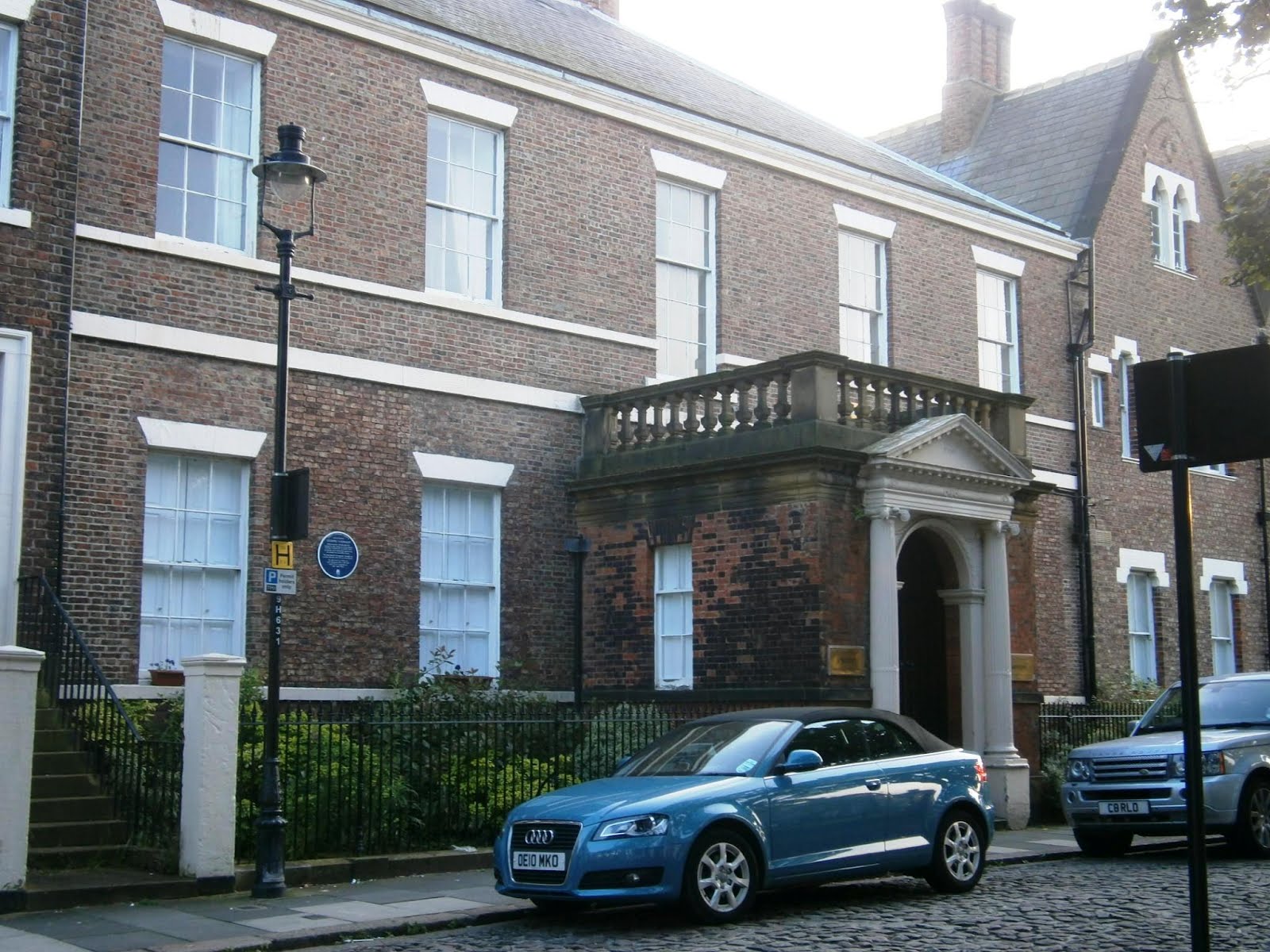
This house now forms part of The King's School, Tynemouth - former pupils include Stan Laurel and Toby Flood. The blue plaque on its wall records that Garibaldi stayed here in 1854 "while visiting Tynemouth to brief local political and industrial leaders on his plans for a unified Italy".

The King's School is in the news this week. As The Journal reports:
One of the North East’s leading private schools will become free to parents next year after the Government approved plans for it to convert to academy status. 
The King’s School in Tynemouth will merge with nearby Priory Primary School to become an all-age, state-funded independent academy. 
The new school, called Kings Priory, is due to open in September 2013 and will be sponsored and operated by the Woodard Academies Trust.
As I blogged last year, such moves - bringing good schools into the state sector - are to be welcomed, but the left is always deeply suspicious of them.

Sure enough, the area's Labour MP is quoted on the Evening Chronicle website expressing concerns about the move.

David Cameron: "No ifs, no buts, no third runway"

One of Justine Greenings leaflets from the last election (h/t William Green of The Journal).

Lib Dems' Corby by-election HQ open


Jill Hope's by-election headquarters have opened at 2a Ryder Court, Saxon Way East, Corby, Northamptonshire NN18 9NX

The HQ will be open every day between 10am and 8pm, seven days a week.


View Larger Map

A knighthood for Nick Harvey

As a consolation prize for being sacked as a defence minister yesterday, Nick Harvey (Lib Dem MP for North Devon) is to receive a knighthood. The honour is listed towards the bottom of this page on PoliticsHome.

Among the others retiring minsters to be awarded knighthoods is my own MP, the Conservative Edward Garnier.

Vince Cable's grandson speaks at Westminster

The Evening Standard reports:
A London schoolboy will eclipse the teenage William Hague’s famous Tory Party conference speech tonight when he presents a campaigning film he has made about animal welfare to MPs at the Commons at the age of nine. 
Ayrton Cable - grandson of Business Secretary Vince - said he was “not nervous” about appearing before the invited audience of politicians and lobbyists.
Farmers Guardian (which manages to report an event that hasn't happened yet in the past tense) quotes Ayrton further:
“With method of production labelling people can choose either to buy meat and cheese from animals which are kept in a kinder system, even though this may cost a bit more,” he said. “Or they could choose intensively farmed food, which may be cheaper, but which has been made using animals who suffered.”
Ayrton is to be congratulated on identifying the key issue in animal welfare (though he looks older than nine in the Standard's photograph). By contrast, the RSPCA has generally preferred to campaign on things like hunting and the regulations on keeping pets.

Featured on Liberal Democrat Voice

Segedunum Roman fort at Wallsend


This is the futuristic viewing tower from which you can look out across the remains of the Roman fort of Segedunum at Wallsend and the replica bath house that has recently been constructed there. The fort marked the easternmost point of Hadrian's Wall.

The site was lost under terraced housing until the 1970s and has been excavated more recently than that. The Segedunum museum and its tower opened in 2000.

There is a remarkable photograph in the guidebook I bought there. A group of children are playing in the street (judging by their clothes it was taken around 1970), and at the end of that street the bow of an enormous ship towers over them.

It could have been taken right on top of the remains of the fort, because Wallsend is beside the Tyne and that terraced housing was built to house the workers in the neighbouring shipyards. The museum, without its tower, began life as the canteen for Swan Hunter.

While we were in the Roman baths my mother became locked in the lavatory and had to rescued by a passing archaeologist. Alan Bennett would spin an incident like that into comedy gold.

Tuesday, September 04, 2012

The Thick of It: A glimpse of the new series


It will be interesting to see how the new series works out. Not just because the Liberal Democrats are involved, but also because Peter Mannion (played by the mighty Roger Allam) has always been the nearest thing to a sympathetic character that The Thick of It has.

On feeling a little sorry for my Tory MP

The Harboroiugh Mail has the press release issued by Edward Garnier after he was sacked as Solicitor General:
“Of course it is disappointing to lose one’s job in Government but losing out in politics is not unheard of and often has nothing to do with merit or messing things up. 
“The Prime Minister told me that I had done an excellent job as Solicitor General but he needed to change the faces round the table. My replacement, [North East Hertfordshire MP] Oliver Heald, will enjoy the work as I have – it is a huge honour to work in Government and even more as a senior barrister in the Commons to be a law officer. 
“I will miss it but have plenty to be getting on with out of Government.”
I have always been puzzled by Garnier's lack of preferment, given that he appears personable and competent - two qualities rare among MPs of all parties.

While the Tories were in opposition he even suffered the indignity of being dropped in favour of Bill Cash. He certainly deserved better than that.

If I may end by being the first to start a new by-election rumour, there have always been stories that Garnier had ambitions to be a judge. If he concludes that his ministerial career is over, perhaps he will devote his efforts to his legal career instead?

Keep HSBC in Kibworth blog launched

Sarah Condon, the woman behind the campaign, now has a blog called Keep HSBC in Kibworth.

She wrote yesterday:
Really busy day all day outside HSBC in Kibworth today. I was there from 10am until 3.30pm. There was a constant stream of customers all day and queues for much of the time…I took in excess of 250 signatures!

Richard III dig open day on Saturday

From the University of Leicester website:
In response to the huge amount of local and national interest in the ongoing work, the Greyfriars Project will be open to the public this Saturday, 8 September 2012, giving you the chance to view the remarkable progress which has been made and some of the items unearthed. 
The University of Leicester, working in partnership with the Richard III Society and Leicester City Council, will open the site to the public on Saturday between 11.00am and 2.00pm. Access will be from Greyfriars Street itself. 
Admission is free and no advance booking is needed. However, there may be queues as we are expecting significant interest and there is a limit to the number of people who can actually get into the site at any one time.
As that website points out, this opportunity coincides with 2012's Heritage Open Days. This will see a number of buildings in Leicester being specially opened to the public.

Later. Some further open days have been announced.

Monday, September 03, 2012

Six of the Best 274

Calling for Nick Clegg to go? Not me, Guv, says Lib Dem MP Adrian Sanders.

On Liberty Now points out that Liberal Democrats are good at saying "No", but it is time for the public learnt what it is they say "Yes" to.

"Can someone please tell me, with links to evidence, how the NHS is being 'abolished' or 'destroyed'?" asks Mark Thompson. "I have seen many people claim this, often Labour activists but I have never seen proof of it, or even a convincing prima facie case."

"Political campaigns have always lied and stretched the truth, but when caught in a lie, would typically defend themselves (claim it was actually true), retract, or at the very least stop repeating the lie. Either way, the presumption was that truth-telling had some moral force; one ought to tell the truth, even if that commandment was often honored in the breach. What’s creepy about the Romney crew is that they don’t do any of those things. They don’t deny, they don’t stop, they just don’t care at all. What they’ve realized is that, given today’s hyper-polarization and fragmented media, there’s no practical risk to lying. It doesn’t hurt them, in terms of getting votes, so why shouldn’t they do it?" Writing on Grist, David Roberts notes the arrival of post-truth politics.

"Strauss leaves the team ironically in the same state of turmoil it was in when he accepted the captaincy," writes Leg Side Filth. That sounds a little harsh - it would make Andrew Strauss the David Steel of English cricket.

Spitalfields Life examines the centuries of graffiti at the Tower of London.

Cookery Corner: Chocolate moose

Write a guest post for Liberal England

A reminder that I welcome guest posts on Liberal England. So far 29 (count 'em) have appeared.

I am chiefly interested in political posts, but as you can see from the list below, this blog has a wide range of interests.

If you would like to write a guest post yourself, please send me an email so we can discuss your idea.

  • In praise of slow government - Simon Beard
  • Children and the surveillance state: Will the Coalition keep its word? - Terri Dowty
  • Standards matter in higher education, not just participation rates - Anonymous
  • A Woking class hero is something to be - Lisa Harding
  • The campaign for a Robin Hood Tax - Ian Sullivan
  • The limits of the Big Society - Martin Veart
  • Can hyperlocal news sites be the future of journalism? - Niall Sullivan
  • How Edward Stourton misunderstood The Orange Book - Simon Titley
  • Why I caged my son: The Love Outdoor Play campaign - Daniel Raven-Ellison
  • Against the Comment is Free view of politics - Jonathan King
  • A beginner's guide to anarchism - Ruth Kinna
  • The other side of suicide - Elinor O'Neill
  • AV, politicians and the wasted vote - Chris Slowe
  • Creative Perambulations: Marking the boundaries of Sherwood Forest - Dave Wood
  • Towards a Liberal Democrat ideology - Simon Beard
  • The community shops movement - Mike Perry
  • Why the Liberal Democrats should support co-operatives - Peter Arnold
  • Grandparents or adoption: Who would you choose? - Peter Hulme
  • Arts Fresco, Market Harborough, 9-11 September 2011 - Hazel Cook
  • Richard Jefferies and Coate: A centenary celebration - Rebecca Welshman
  • "A modest county": Pevsner in Leicestershire - Susie Harries
  • Anthony Burgess in Leicester - Phil Beesley
  • Why you should visit The Bog - Paul Davis
  • Blogging for happiness - Ellen Arnison
  • An economic liberal case for a consumer-driven economy - Matt Burrows
  • John Locke and Wrington - Lisa Harding
  • Spelling out the reason to vote Liberal Democrat - Andrew Brown
  • Tommie Smith - The man behind the image - Matt Roebuck
  • Don’t make the dull middle class go to university - Dr Anonymous
  • Sunday, September 02, 2012

    Laing Art Gallery, Newcastle


    I like provincial art galleries. They generally have a good cafe and unexpected treasures among their collection.

    The Laing Art Gallery in Newcastle is no exception, with paintings by John Martin, Gaugin and Holman Hunt and a Grayson Perry pot.

    Roger Helmer leaves the Harborough Innovation Centre

    When East Midlands MEP Roger Helmer left the Conservatives and joined UKIP he obviously needed a new office in the constituency. So he set himself up at the new Harborough Innovation Centre, which was built with public money.

    This caused controversy at the time, with some asking how he fitted centre's role of being "a hub for businesses to launch, innovate and grow".

    Now a reader has alerted me to a report in the Leicester Mercury revealing that Helmer is one of four tenants who have recently left the centre. But quite why he has left, the paper does not say.

    After the Stiperstones fire

    In July there was a serious gorse fire on the Stiperstones in Shropshire.

    Pontesbury Parish brings us up to date with the latest developments:
    Summer fires can be very damaging to the heathland wildlife, unlike the controlled burning which is carried out in the winter months. Luckily in this instance the underlying peat was wet enough, due to the wet summer, and the fire didn’t go into the peat. If the peat had caught fire, as is often the case in the summer, hot spots may have occurred which would have been very difficult to put out, and the fire could have burnt for much longer. 
    Our thanks go to the Shropshire Fire Service for their excellent response, calling on 70 fire-fighters from around the region and also to the Stiperstones Inn which kept them refreshed during what was a very hot day. It is hard enough climbing up the slope of Mytton Dingle in normal clothes, but I can’t imagine doing it in fireman kit. 
    The main effects of the fire will have been a hot burn of the gorse and heather, which will take longer to recover than a cooler winter burn, however due to the damp ground the damage is not as bad as it might have been. The south facing slopes of these dingles on the west side of the hill are dominated by bell heather which has the most vivid colour of the three heathers found on the hill. The bell heather prefers the drier poor soils, the ling or common heather makes up the bulk of the site and the cross leaved heather prefers the wetter areas around springs and wet hollows. 
    The rocky outcrops seem to have been spared, which is good news as these often hold some of the most interesting plants and lichens. One of these is a blue-flowering plant called sheep’s-bit, although it does have various names including blue bonnets and blue buttons due to its tightly packed head of blue florets.

    The Stranglers: Walk On By


    Last Sunday I described Tony Hatch and Jackie Trent's "Where Are You Now, My Love?" as a "suburban take on Bacharach and David", though using "suburban" has a pejorative term was lazy, given how much I like suburbs.

    Last night came news that Hal David has died, so here is a Bacharach and David song as a tribute to him.

    "Walk On By" was first, and most famously, recorded by Dione Warwick - you can see here miming to it here, apparently in an abandoned office furniture showroom. But here are The Stranglers with their own take on the song,

    Saturday, September 01, 2012

    Tories' Corby candidate Christine Emmett thinks her party's leadership does not know what it is doing

    Congratulations to Rutland blogger Martin Brookes for finding this insight into the thinking of the newly selected Conservative candidate in the Corby by-election. It dates from last year.


    Come to think of it, someone with contempt for David Cameron would fit in very well on the Tory backbenches. But she is unlikely to make it to the Commons, at least from Corby.

    Christine Emmett chosen as Conservative candidate for Corby

    Christine Emmett has been chosen as the Conservative candidate in the Corby by-election, reports the BBC.

    She is a Conservative councillor from Rutland, representing Ketton ward, and lives in a former windmill. More about Christine Emmett on her website.

    Her campaign has got off to a shaky start. The constituency's full name is Corby and East Northants, but some bright spark at Conservative HQ, as Cranmer shows, thought she had been chosen to fight Corby and North East Hants.