Friday, September 29, 2006

Peter and Jane again

Last year I mentioned the Ladybird Keywords reading scheme in a couple of postings (here and here, to be exact - I think it must have been an example of this blog's eclecticism.) As Statcounter tells me those postings are still read, I thought I would mention it again.

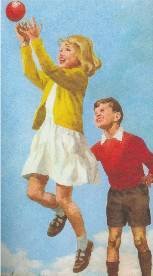
There is an article on a Ladybird collectors' site about the illustrations in the Peter and Jane books. As it points out, the books came out in 1964 and only six years later the publishers decided that the illustrations needed to be updated.

The writer asks:
I wonder if the original target audience were aware of the nostalgic, retrospective feel to them when they first came out? Perhaps there was an awareness even then that these idyllic domestic tableaux were unreal and presented a world that had never existed. (Yes, I was part of that early audience, but at the age of 5, I don't think my powers of analysis were up to the job). Or is it that those years, between the mid-sixties and early seventies saw exceptionally dramatic social change for families. Is this dramatic period of change encapsulated by the 2 versions of the books?

Because if you flip through the pages of a 1970s revised edition, it will still feel pretty modern today - which the first version absolutely does not - although produced nearly 35 years ago. No mobile phones, designer trainers or computer games - but the children have scruffy hair, wear jeans and T-shirt and don't tidy up after themselves.
I think there were huge social changes round about the mid-sixties and that the two versions of these books appeared either side of that watershed. Certainly, if you see photographs of university sports teams or railway excursions from the early sixties then everyone is dressed like the young Ming Campbell in sports jacket and tie. A few years later they all have anoraks, T-shirts and jeans.

It would be easy to paint this move from the early 1960s to the early 1970s as a straightforward liberation for children, but things were more complicated than that:

The first thing you notice is that Jane gets to wear jeans and is seen playing with roller-skates where once she played with dolls. The scenes portrayed look less ordered and serene. Play time is messier and the children appear to bicker more.

However, if, like me, you are happy to spend a few evenings browsing through the two different versions, you'll find that the biggest changes in the first few books are all to do with sweet consumption. Whereas the Peter and Jane of the 1960s would visit the sweet shop, the 1970s Peter and Jane go to buy apples instead.

This change was considered so important that even Murray's text (so carefully worded and so rarely tampered with) was adapted in the revised books. adapted to reflect the apple over the jelly-baby.

If I recall my own childhood correctly, this disapproval of sweets had nothing to do with obesity but arose from the high rate of tooth decay. Whatever the era, there is always something for parents to worry about.

CCTV nation

I bought the New Statesman on the way home from work this evening. It is rather a good issue, with not too much of it written by comedians.

In particular, I recommend the lead article by Brendan O'Neill. It looks at the spread of closed-circuit television and what that tells us about our society.

He writes:
Throughout the country are an estimated five million CCTV cameras; that's one for every 12 citizens. We have more than 20 per cent of the world's CCTV cameras, which, considering that Britain occupies a tiny 0.2 per cent of the world's inhab itable land mass, is quite an achievement. The average Londoner going about his or her business may be monitored by 300 CCTV cameras a day. Roughly 1,800 cameras watch over London's railway stations and another 6,000 permanently peer at commuters on the Underground and London buses. In other major city centres, including Manchester and Edinburgh, residents can expect to be sighted on between roughly 50 and 100 cameras a day.


Besides the official cameras - such as those operated by Westminster City Council from the Trocadero basement - ever-growing numbers of private companies, banks, building societies, schools, community halls, leisure centres and private residences are using CCTV.

And the cameras are getting cleverer all the time. As well as filming and recording our every move (Westminster, for example, stores all footage for 31 days), some cameras now come with automatic number-plate recognition, facial recognition and even suspicious behaviour recognition. In 2003, "smart" software called Intelligence Pedestrian Surveillance was introduced. This analyses clusters and movements of pixels in CCTV footage in search of "behavioural oddities".

British scientists, backed by the Ministry of Defence and a £500,000 government grant, are developing cameras with "gait recognition". These will recognise whether people are walking suspiciously or strangely, and alert a human operator. Think of it as the Ministry of Unfunny Walks
And:
Under the tyrannical gaze of today's CCTV, none of us is really free. Instead, we live in a permanent state of parole, where we must walk, talk and act in a certain way, or risk having our collars felt by a cop or council official alerted by the spies behind the cameras. It is time we took some action against these peeping Toms of officialdom, and told them to switch off their spycams.

Ian Macwhirter on John Reid

The Herald and Sunday Herald journalist writes on Comment is Free:
If Labour installs him as its leader, the party will complete its transition to an authoritarian party of the populist right. It will mean riots at home; new wars abroad. There will be imprisonment without trial, a massive increase in police powers, curbs on immigration.

This must not happen. If Reid becomes leader, I will be voting for David Cameron.

Thursday, September 28, 2006

Bremner, Bird and Fortune on the skids

Last night I took part in an improvised comedy workshop in Leicester. It was great fun and reminded me of the television show Whose Line is it Anyway? from the 1980s.

When it started it was exciting and new - the sort of show you stayed in to see. After a while you stopped doing that, but you certainly watched it if it was on. Then it drifted out of your consciousness until, if you happened to catch it, you were amazed that it was still on.

A lot of shows go through this sort of cycle. Have I Got News for You? is on the way down, though it was given new life after Angus Deayton was sacked. Now Bremner, Bird and Fortune is on the skids. I watched the last series out of duty, not because it was funny. I did not bother with the start of the new series last Saturday.

Brighton blogging article in place

I have now posted my article on bloggers at the Brighton Conference. The print version will appear in tomorrow's Liberal Democrat News.

It was originally going to be 600 words, but such was the cornucopia of exciting copy this week that I was cut down to 400. So apologies to all the people I did not have room to quote.

Lord Bonkers' new diary

His lordship's contribution to Liberator 313. Many readers will have collected their copy from our stall at Brighton. It will be with other subscribers shortly.

You can find an archive of earlier diaries on the old boy's website.

Monday
Finding myself staying overnight in the Principality, I go to Welshpool International Airport to catch the morning flight back to Rutland. My curiosity is aroused when I see the name "Air Lembit" on the side of the Government Surplus Sopwith Camel and, sure enough, I find a familiar figure at the controls when I board. As we weave in and out of the Stiperstones, narrowly avoid the Long Mynd and give Brown Clee a wide birth (despite my suggestion of a sharpener at the Boyne Arms), the MP for Montgomery describes his plans for his airline. The in-flight catering is limited – poor Öpik has trouble keeping a steady course whilst buttering the bread for the sandwiches – and neither is there a moving picture to enjoy. (My pilot offers to play his mouth organ, but I tell him that will not be necessary.) It happens that we pass over the Bonkers Hall Estate on the approach to Oakham, so I save him the trouble of landing by parachuting out. When I alight, Meadowcroft takes me for a German paratrooper and pursues me with his pitchfork; the misunderstanding is soon sorted out.

Tuesday
The recommendation of a friend ("You knew Trueman, didn’t you? There’s a film about him that you really should see") sends me to the cinema, but I am sorely disappointed. For some unaccountable reason the actor playing the great fast bowler – one "Philip Seymour Hoffman", if you please – has chosen to give him an absurd, high-pitched, lisping American accent. Now, I am the first to agree that Fred could be a bit of a joker (particularly at the Scarborough Festival), but I never knew him to speak like that. Not since Meryl Streep starred in Silverwood have I been so disappointed by the portrayal of a Yorkshire and England opening bowler.

Wednesday
People sometimes ask me whether, from my long experience of public life, campaigning ever changes the Government’s mind. Does the dreary round of petitions, letters to one’s MP and press releases actually achieve anything? I always reply that there can be no guarantee that it will, but one does meet the most interesting people in the process. A case in point is my attempt to help the inhabitants of Pluto over the summer. When first they heard that their world was no longer to be a planet within the meaning of the Act they were naturally concerned – not least because this would mean that they would cease to qualify for generous grants from the European Union. So the Plutonians (or Plutocrats or whatever the fellows call themselves) contacted me for advice, and I told them to write to all the newspapers and arranged a meeting with the minister: I still treasure the memory of them sitting in Central Lobby, waving their tentacles and laughing at the quaint dress of the Commons staff. As everyone now knows, their campaign failed, but at least I was able to introduce them to Lembit Öpik before they went home.

Thursday
Inspired by my friends from Pluto, I spend the evening in my observatory. The telescope is not powerful enough for me to see their distant home but, as I believe I have remarked before, on a clear night tonight you can see Uranus. There are those who say that observing the heavens puts our Earthly troubles in perspective, but I beg to differ. One sees billions of stars, many of which will have their attendant planets; some of those planets will have life, and if that life has been around long enough it will have invented Liberalism and be engaged in democratic battles with its enemies. Thus, when I observe the night sky I see an infinite number of closely fought by-elections – it is enough to overwhelm even our own Lord Rennard.

Friday
I notice from the Manchester Guardian that when Fidel Castro fell ill his brother Raul stepped in as President of Cuba. Mention of these two reminds me of my own days in Hollywood when I attempted to promote the Castro Brothers as comedians, somewhat along the lines of the Marx Brothers. (We did achieve some success with their first picture – A Night in Havana – but generally it was Rather Hard Work.) Whilst there were similarities between Fidel Castro and Groucho Marx – the facial hair, the taste for fine cigars – there were also differences, which became all too apparent as Fidel’s career developed. In particular, whilst Groucho specialised in witty retorts, Fidel’s talents lay more in the direction of seven-hour denunciations of American imperialism and the iniquities of the capitalist system; these were a challenge to incorporate into a madcap comedy and as a result the Castro Brothers soon faded. Ironically, the biggest success amongst them was not really a Castro at all: "Harpo Castro" was in reality a doctor by the name of Guevara, yet the poster of him with his harp and ridiculous wig of blonde curls can be found on students’ bedroom walls to this day.

Saturday
It is hard not to sympathise with the New Party’s MPs: Blair has clearly gone barking mad – his public protestations of love for a chimpanzee, all those foreign wars, his plans to send children to the Jack Straw Memorial Reform School, Dungeness, before they are born – but their constitution makes it impossible to get rid of him. We Liberal Democrats recently had leadership problems of our own, but Kennedy’s fondness for drink never put the country in peril. Yes, he might fall asleep in meetings, sing raucous Highland ballads or try to kiss Alan Beith, but life was still more restful than under his predecessor, Paddy Ashplant, and – dash it all – I am rather fond of old Beith myself. A word of advice to the New Party: if you do succeed in tipping Blair out of the window, don’t replace him with that dour Brown fellow. Try someone younger and fresher like Tony Benn’s charming daughter Hilary or one of the Millipede brothers.

Sunday
A hectic weekend has seen one of my meadows quite turned upside down by the Time Team of moving television fame. It all went Terribly Well: they found a Roman villa, an Anglo-Saxon cemetery, the grave of a junior minister in Baldwin’s Government (that took some explaining, I can tell you) and, best of all, the keys to my Bentley which I dropped when walking my setters there last summer. Between ourselves, gentle reader, I was rather hoping they would turn up.

Lord Bonkers was Liberal MP for Rutland South-West 1906-10.
Wednesday, September 27, 2006

Simon Hughes re-elected

The Cowley Street press release says:
Simon Hughes MP has today been re-elected unopposed as President of the Liberal Democrats. Nominations closed at noon today and Simon Hughes was the only candidate nominated. He will therefore serve for a further two years until the end of 2008.
Suz Blog is delighted (if a little confused):

Been waiting on tenterhooks since the close of nominations to know if Simon Hughes has been re-elected as the party President.

Didn't want to jump the gun until I received the news through official sources but now it's confirmed. He's been elected unopposed for a further two year term.

Personally I very pleased - didn't believe the rumours about a possible challenger for one minute.

Liberal Legend is less impressed:
Yup, I've just had official word from Cowley Street. Simon has been re-elected unopposed. Ho hum..... Consigned to two years of impotent dissidence now.

Hitler paintings for sale


At least you can see what it's meant to be.

Lib-Labbery lives

Anne Perkins writes on the Guardian's Comment is free superblog:

Out in the wilds, beyond the impregnable conference fortress, in a meeting room in one of Manchester's interchangeable business hotels, a small sect gathered last night to discuss the prospects for a realignment of Liberal Democrats and Labour, a new progressive consensus.

It is a tribute to the determination of Neal Lawson, chair of the Compass, and Neil Sherlock, of the new thinktank CentreForum, that the effort to find common ground which began in the mid 1990s has continued through electoral landslides and official neglect into an era where the best prospect of Lib Dem gains in the next election will be to take seats from Labour in its old core territories in the cities and towns of the north.

This seems to me largely a waste of time. We know by now that if Labour has a majority they do not need us. If there is a hung parliament and they do need us, then they will come running.

No doubt it is a good thing that people from different parties talk to one another now and then. But there is more work to be done to give the Lib Dems some intellectual backbone. Shouldn't Centre for Um be concentrating on that?

Tuesday, September 26, 2006

Sarah Teather goes to school

It has been nearly 20 years since I sat in a comprehensive school as a student...

writes Sarah Teather on the Guardian's mortarboard blog today.

That is true. But as an earlier profile, also from the Guardian, makes clear, it is slightly less long since she sat in the independent Leicester Grammar School as a student.

As the product of a Leicestershire comprehensive myself, I take an interest in such things.

It strikes me that Sarah's background - experience of state schools, private schools and home schooling - is perfect for a shadow education secretary. I do hope she will not feel obliged to play it down.

Bloggers at Brighton

This article appears in tomorrow's Liberal Democrat News. The printed version does not include all the hyperlinks, of course...

Bloggers at Brighton

Brighton 2006 was the Conference of the bloggers. Increasing numbers of Liberal Democrats are writing blogs - or weblogs, to give them their full name. Some use these simple websites to keep in touch with constituents or fight local campaigns: others are frustrated newspaper columnists. But together they make up a movement that is changing British politics. No longer do you have to be a Westminster insider to hear the latest ideas and scandal or to have your say. Blogging is open to everyone.

The party recognised this by offering an award to the blogger who "has done the most to promote liberalism in the last year". It was given to Stephen Tall from Oxford at a reception held on the Sunday of Conference. Stephen became something of a media celebrity for the rest of the week, and many other bloggers were quoted or asked to give their views too.

There were so many bloggers at Brighton or watching proceedings on television that their writings gave a far fuller and more colourful picture of events than the mainstream press could provide. Take Ming Campbell's first speech as Lib Dem leader. Paul Walter was euphoric: "It was ... a barnstormer. It reminded me of the best of Paddy's speeches - brilliant!" Anders Hanson was more measured: "The word I would use is solid ... It could perhaps have been delivered more strongly, but then the majority of people will only hear clips on the news."

The reviews for Nick Clegg's speech were uniformly positive. Lynne Featherstone (one of several blogging MPs) thought it was "an excellent speech which really went for the shallowness of Labour's rhetoric on crime, their obsession with new legislation ... and their hideous illiberal approach to dealing with the new threats we face." Tristan, who blogs at Liberal (not so) Alone, said: "He's said some of the very things which led me to the Lib Dems ... Some good jokes. Something for everyone."

It was not all so serious. During the week Lib Dem blogs also offered an account of the bloggers' social at the excellent Evening Star pub near Brighton station, a guide to secondhand bookshops in East Sussex and all the gossip.

Conference gossip

You won't catch me passing tittle-tattle on.

Try Liberal Action instead.

Monday, September 25, 2006

Michael Brown gets two years

The BBC reports:

A millionaire businessman whose company gave the Lib Dems more than £2m has been jailed for two years after being branded "dishonest" by a judge.

Michael Brown, 40, had admitted committing perjury and making a false declaration to obtain a passport.

Let us remember Lord Bonkers' wise words (from Friday):
If anyone had it in mind to send him a cake with a file in it, I think that would be a nice gesture.

Theo Butt-Philip

It is time to welcome Theo to the exciting world of Lib Dem blogging. You can find him at “As I look out over this magnificent vista…”

And thanks to Theo for introducing us to the Revd Kingsley Laws.

Lord Bonkers sings

There was a new Liberator songbook on sale at Brighton, with a foreword from Lord Bonkers:
I can never visit Brighton without being reminded of Sir Richard Attenborough’s Pinkie.

Yes, this spacious Sussex resort is famous for its connections with the Arts. I well recall the days when Herbert Wilcox and Anna Neagle would take tea on the Brighton Belle, while even today one may expect to come across luminaries as Dame Dora Bryan whilst walking along the Front. So it is entirely appropriate that we Liberal Democrats should meet here to practise the art of song.

(I have been asked to point out, in case this edition of the songbook is on sale at subsequent events, that it is equally appropriate that we should meet in Bournemouth, Whitley Bay or Hunstanton.)

I know from my correspondence that only one thing rankles with the purchasers of these songbooks: the discovery that one has left last year’s copy at home, with the resultant necessity to purchase a new one. I am pleased to announce that a solution to this dreary problem has now been found.

By special arrangement with Air Lembit – “Welshpool’s Most Go-ahead New Airline” – we can arrange for your last year’s songbook to be collected from home and flown to the Conference venue by fast War Surplus Sopwith Camel. Charges begin from a very reasonable five thousand guineas (exclusive of my own brokerage fee).

So I trust those amusing young people at Liberator magazine will hear no more complaints about the need to buy a new songbook. Begone dull care – let us sing!
You can find last year's foreword here.

Sunday, September 24, 2006

TV Film of the Week: A Matter of Life and Death


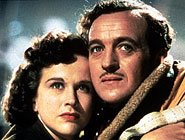
An honourable mention to This Boy's Life (BBC1, Tuesday 11.05pm), but it has to be the Powell and Pressburger fantasy A Matter of Life and Death (Channel 4, Thursday 1.35pm).

Released in 1946, this fantasy stars David Niven as an airman who bales out of his plane without a parachute but fails to die because of a bureaucratic mix up in heaven. He then has to argue for his life before a celestial court.

Like all the best Powell and Pressburger films it is witty and full of ideas. It is particularly pleasing that earth is in colour and heaven is in black and white.

The film also has their characteristic sexiness and hint of something slightly perverted - in this case the doctor, played by Roger Livesey, who observes the village through his camera obscura.

Two elements root A Matter of Life and Death firmly in the last years of World War II. The first is the examination of Anglo-American tensions. The second is David Niven's words: "Politics - Conservative by nature, Labour by experience."

You can find out far more about this film on the Powell and Pressburger site.

Finally, a reminder that American prudery did not begin with reaction to Janet Jackson's breast. When A Matter of Life and Death was released in America as Stairway to Heaven, the little naked goatherd who appears near the beginning was edited out.

Tim Worstall's Britblog Roundup

Click and point it, matey. Indeedy-ho.

Saturday, September 23, 2006

What is the President of the Lib Dems for?

Simon Hughes is quoted in the Scotsman as telling the BBC:

"I guess it was a seven or eight out of ten speech, in terms of speech, but it did the necessary for the party."
This seems a fair verdict to me. But should we be pleased by his candour or outraged at his disloyalty?

Does the President exist to tell the party's leadership uncomfortable truths on behalf of the wider membership? Or is he meant to be the public face of the party, telling everyone how well it is doing. And if it is the latter role, why do we need a President as well as a Leader?

I only ask because I want to know.

Friday, September 22, 2006

My new laptop

This is the first posting written on my new laptop. I went out and bought it today as my PC expired just before Conference.

So far it hasn't burst into flames once!

Calder at Conference

A rather self-indulgent column from today's Liberal Democrat News.

Books galore

Books of Liberal Democrat essays are like buses: you wait for ages for one to come along and then three turn up at once. Actually, Brighton buses aren’t quite like that. In my experience three buses turn up as you approach the stop and leave before you can catch any of them. You then wait 20 minutes for another one to show.

Yet the buses have their compensations. Brighton may not have trams, which are one of the few good things about Blackpool – come to think of it, they are the only good thing about Blackpool – but at least its buses have names. This week I have ridden on Lord Cohen, C. B. Cochrane and William Friese Greene.

I suppose Lord Cohen is named after the founder of Tesco, and Cochrane was a theatrical impresario. The most interesting name is Friese Greene. A Brighton man, he was the father of the Claude Friese Greene whose films from the 1920s formed the basis of a BBC TV series earlier this year.

William himself was a pioneer of photography. In 1951, to mark the festival of Britain, a film called The Magic Box was produced. Its burden was that William Friese Greene had been the first man to photograph the moving image but been cruelly denied his place in history. The film starred just about every well-known British actor of the period – there is even a story that one of the Kray twins appeared as an extra.

In fact the idea behind the film was nonsense. William Friese Greene certainly did not invent cinematography, but at least he is remembered on a Brighton bus.

Reader’s voice: You were talking about books of Liberal Democrat essays.

Thank you. This year, after something of a lull, three such books have appeared. The Association of Liberal Democrat Councillors has produced an updated version of the 1980 classic The Theory and Practice of Community Politics. Several MPs have contributed to Britain After Blair – or This Isn’t the Orange Book 2, Dear me no, as it is more widely known. Finally Liberator magazine has brought out Liberalism: Something to Shout About.

I think this sudden proliferation of books is a thoroughly good thing. One of the striking thing about the fringe at recent Lib Dem Conferences has been that most of the fringe meetings promoting challenging new ideas have been organised by outside pressure groups. There has been far fewer such meetings originating from party groups. They seem to concentrate on training people how to fight elections or run councils. This is important work, but we need to be a thinking party too.

The other thing to report from the fringe is the arms race in catering. There are so many meetings now that you need free food and a popular speaker to have any chance of a decent turn out.

If you can’t provide Nick Clegg and a fish and chip supper, you may as well book a broom cupboard.